Manar Maged: The Egyptian Girl Born with Two Heads – A Medical Miracle That Shocked the World
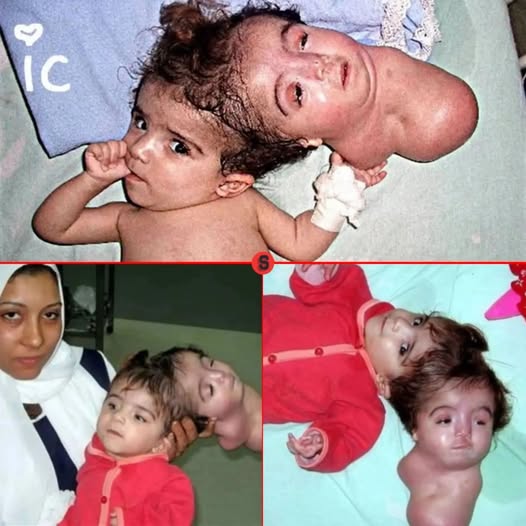
Manar Maged: The Egyptian Girl Born with Two Heads – A Medical Miracle That Shocked the World
In the annals of modern medicine, few cases have captured global attention with the same intensity as the extraordinary life and death of Manar Maged. Born in Egypt in 2004, Manar entered the world already carrying the weight of the unimaginable: she was born with a rare congenital condition known as craniopagus parasiticus (also called parasitic twin syndrome). In this extraordinary phenomenon, a second, underdeveloped head developed as a parasitic twin attached to the skull of the main twin — but without any functional body of its own. Manar was essentially a single-body child living with a fully formed, mobile second head that moved independently, creating a haunting and unforgettable image from the moment of her birth.
Her case became a global sensation almost immediately. Doctors and medical teams around the world watched in awe as the second head began to move on its own, blink, and even cry. The condition was so rare and shocking that it dominated headlines and medical discussions for years.
At just eight months old, Manar underwent one of the most complex and risky pediatric brain surgeries ever attempted: a 13-hour-plus operation to separate the parasitic head from her skull. The goal was to give her a chance at a normal, independent life. Although the initial results were cautiously viewed as a medical triumph — the second head was removed and Manar began to show early signs of development — the surgery was far from perfect. Over time, she suffered a series of severe complications, most notably a devastating brain infection that ultimately claimed her life in 2006 at the age of two.
Manar Maged’s short life and tragic end became a powerful reminder of both the incredible advances and the heartbreaking limitations of pediatric surgery in the face of conditions that defy conventional understanding. Her story continues to be studied by medical professionals and taught in universities around the world as a case study in the boundaries of human resilience and the ethics of experimental surgery.
Today, Manar Maged remains one of the most haunting and remembered cases in modern medicine — a silent witness to the power of the human body and the fragility of life itself.
Sources
- Medical case reports published by Egyptian hospitals and international journals (2004–2006)
- News coverage in The New York Times, BBC, and The Guardian (2005–2006)
- American Journal of Medical Genetics and pediatric surgery reviews referencing the case as a landmark example of craniopagus parasiticus