First Breath, Then a Team: Juliette and Treacher Collins Syndrome
Juliette arrived with a face that had not finished the work of the first and second pharyngeal arches. Treacher Collins syndrome—mandibulofacial dysostosis—is a rare genetic condition, roughly one in fifty thousand births, most often caused by a change in TCOF1 and sometimes in POLR1C or POLR1D. Bones of the cheeks, jaws and outer ears undergrow. The eyes slant. The lower jaw can be so small that the tongue falls back and the airway collapses. About a third of children also have a cleft palate; some have a cleft lip as well. Hearing is often conductive because the middle ear is malformed even when the inner ear is intact. Intelligence is typically typical. Life span, if the airway is secured, approaches that of other children.
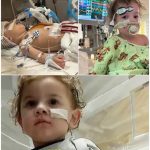
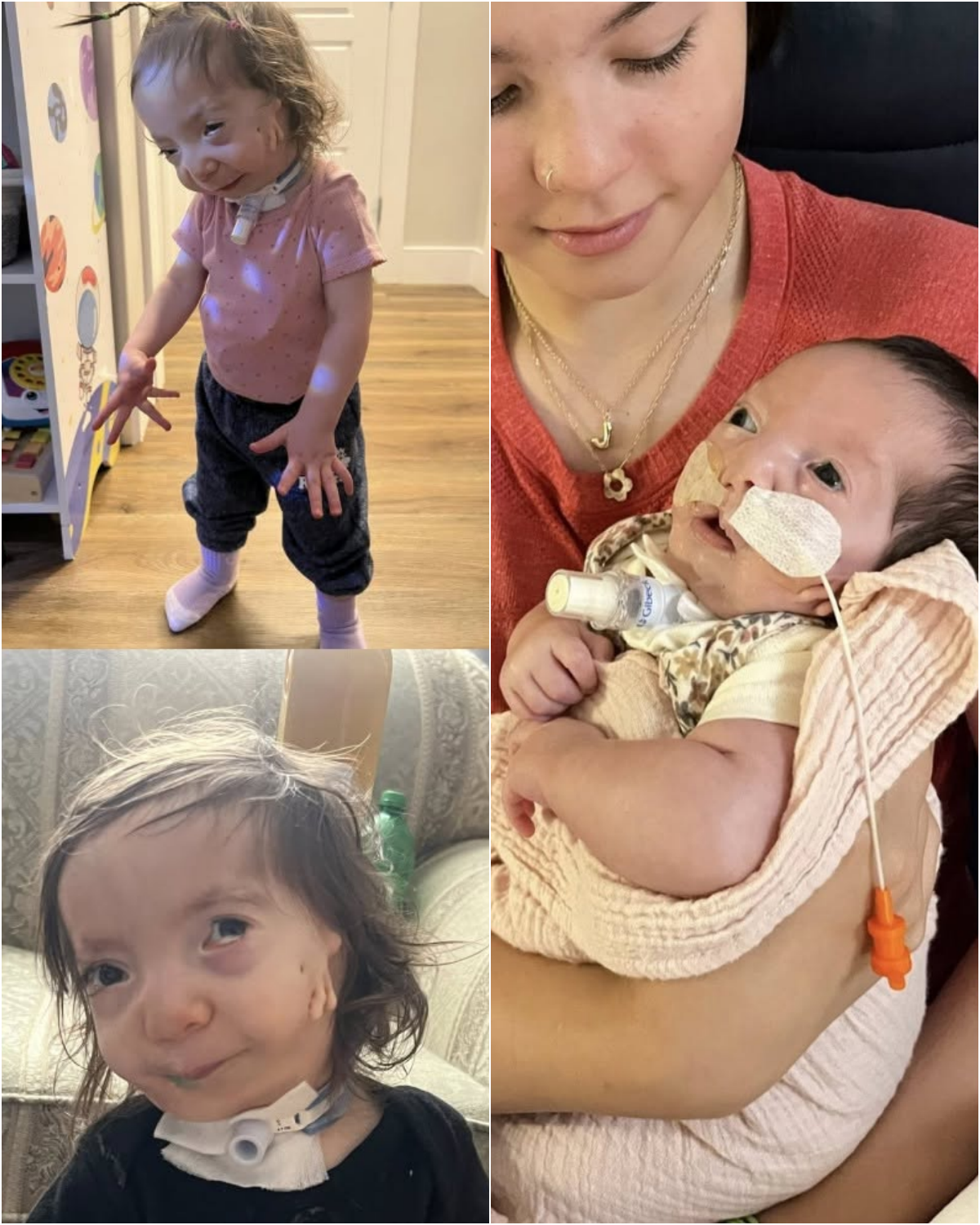
Her parents had not imagined this. She was born with a severely underdeveloped mandible, a bilateral cleft of lip and palate, and external ears that barely formed. Doctors also considered Pierre Robin sequence: the small jaw pushing the tongue backward, blocking breath and often leaving a U-shaped cleft. In Treacher Collins the same geometry is part of a wider craniofacial pattern, so the label can overlap. The first problem was air. Severe cases need intubation at delivery or a tracheostomy in the neck within days. Feeding follows: a nasogastric tube, then often a gastrostomy, because sucking and protecting the airway at the same time is impossible. The photographs show both eras at once—a newborn against a mother’s chest with a tube taped to the cheek, and a toddler standing in socks with a trach collar, hair clips like antennae, already walking through a living room.
Treatment is a childhood, not an afternoon. Craniofacial teams stage jaw distraction or later osteotomies, lip and palate repair when the airway will tolerate it, ear reconstruction or bone-anchored hearing devices, speech therapy, sleep studies, eye protection if lids do not close. Mandibular distraction works less reliably in Treacher Collins than in isolated Robin sequence; some children keep a trach for years. None of that is a verdict on the child. It is a calendar of operations and clinic visits around a girl who smiles, stands and wears a shirt that says SOOK.
Her mother’s necklace bears a J. The condition is named for a London surgeon who described it in 1900. Juliette’s name is simpler. The work ahead is long. The fact that she is already on her feet is the first answer to the question her first breath asked.
Sources: Family description accompanying the photographs; GeneReviews and NORD overviews of Treacher Collins syndrome; ACPA resources on TCS and Pierre Robin sequence; Medscape review of mandibulofacial dysostosis (airway, tracheostomy, cleft timing).