Born Joined at the Head. Separated After 11 Hours. Home After 485 Days.
Born Joined at the Head. Separated After 11 Hours. Home After 485 Days.
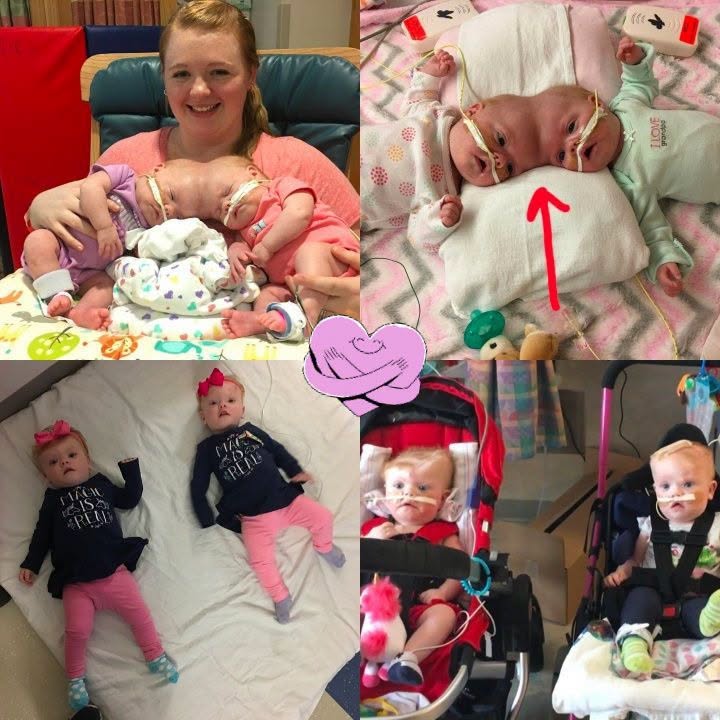
When Erin and Abby Delaney were born in July 2016, their parents faced one of the most extraordinary medical challenges imaginable. The identical twin girls were craniopagus twins — joined at the skull. Their journey would lead to one of the most complex and carefully planned separation procedures ever performed at Children’s Hospital of Philadelphia.
The twins were not born in Pennsylvania, as some social media posts have suggested. Their family lived in North Carolina. The girls were delivered at CHOP in Philadelphia after doctors identified the condition during pregnancy. An ultrasound at about 11 weeks showed that the babies were joined at the tops of their heads. Further imaging revealed that the connection involved complex blood vessels and structures around their brains.
Erin and Abby were delivered by cesarean section on 24 July 2016, at approximately 30 weeks. Each weighed just 2 pounds and 1 ounce. Because they were premature and remained physically connected, their early months were spent under intensive medical care at CHOP.
Doctors began preparing for separation almost immediately. The team included neurosurgeons, plastic and reconstructive surgeons, anesthesiologists, radiologists, intensive-care specialists, nurses and therapists. The challenge was not simply to separate the girls physically, but to ensure that each child would have adequate blood flow and protection for her brain afterward.
The twins shared part of a major venous structure known as the superior sagittal sinus, which drains blood from the brain. Separating this structure safely was considered one of the greatest risks of the operation.
Rather than immediately attempting the final separation, the surgeons developed a staged strategy designed to make the eventual operation safer.
The team used computer-aided modeling and a three-dimensional printed model to study the girls’ unusual anatomy. At around three months of age, surgeons performed an initial procedure to separate portions of the fused skulls. A custom-designed distraction device then gradually moved the twins apart, creating additional space for the eventual surgery.
The process was carefully controlled over several weeks. Later, tissue expanders were placed beneath the skin around their heads. These devices gradually stretched the skin, providing additional tissue that could be used to cover the areas left after separation.
The approach was particularly important because the doctors wanted to separate the girls while they were still very young. Their surgical team believed that younger brains might have a greater capacity to recover from the trauma of such a procedure.
On 6 June 2017, when Erin and Abby were 10 months old, about 30 medical professionals came together for the final separation.
The operation lasted about 11 hours.
Surgeons carefully separated shared blood vessels, the protective membrane surrounding the brain, and other connected tissues. The most challenging stage involved the shared superior sagittal sinus. Advanced computer-assisted navigation helped surgeons understand anatomy that was difficult to see directly.
The girls were eventually separated and transferred to intensive care. Their recovery was closely monitored, and both required additional procedures and extensive rehabilitation.
The medical achievement was significant not only because the surgery succeeded, but because of the techniques developed specifically for their case. Surgeons later documented the use of three-dimensional modeling, custom distraction devices and computer-assisted surgical navigation.
Separation was only the beginning of another difficult stage.
After surgery, Erin and Abby spent months receiving intensive medical care, physical therapy, occupational therapy and developmental support. One of the girls was discharged from the hospital about four months after the operation, while the other remained hospitalized for approximately another month.
In total, the sisters spent 485 days at Children’s Hospital of Philadelphia before returning to North Carolina in November 2017.
Their recovery continued at home, with regular medical appointments and therapy. Doctors also anticipated additional reconstructive procedures as the girls grew, including treatment for areas of the skull that remained incomplete following the separation.
By 2019, Erin and Abby were described by their doctors and parents as making remarkable progress. At around two and a half years old, Erin was crawling and beginning to pull herself up, while Abby was sitting independently and moving around on her own. The girls were also beginning to interact with each other as individuals — a milestone their parents had once only hoped to see.
Their story attracted international attention because it represented an extraordinary combination of medical innovation, painstaking preparation and a family’s determination.
For their parents, Heather and Riley Delaney, the story was ultimately about much more than a groundbreaking operation. It was about watching two children grow into their own lives after beginning life physically connected to one another.
Erin and Abby’s journey shows how advances in pediatric surgery can create possibilities that once seemed almost unimaginable. Their successful separation also highlights the importance of multidisciplinary medicine, advanced imaging and careful long-term rehabilitation.
Most importantly, their story remains one of courage, family love and hope — a reminder that even the most daunting medical challenges can sometimes be met with extraordinary teamwork and perseverance.
Sources: Children’s Hospital of Philadelphia; Associated Press; CBS News. Story of Erin and Abby Delaney, born 24 July 2016; separated 6 June 2017.