Born Without Arms, Writing With Her Feet: Génesis of Diriamba
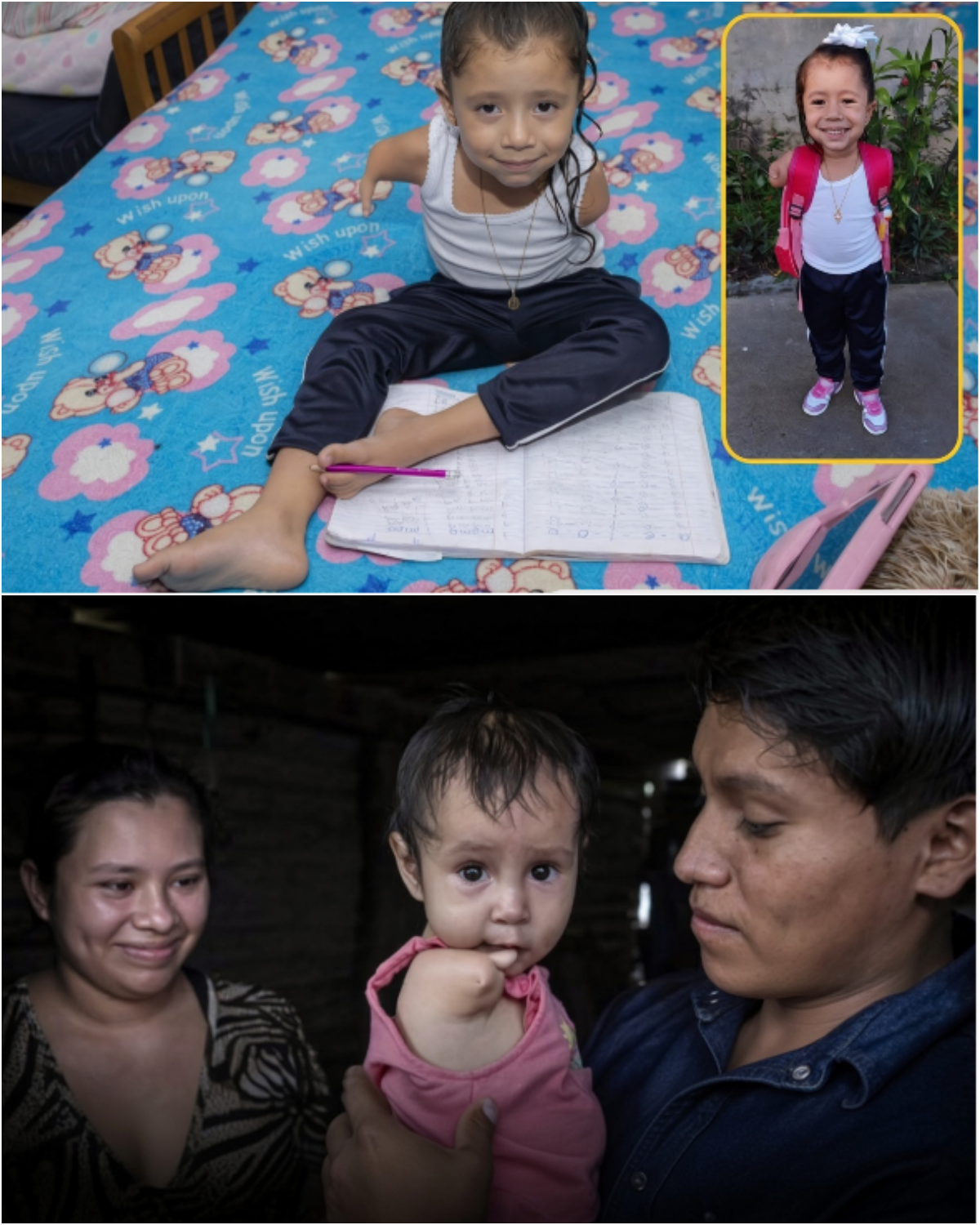
When Génesis Milagros Sánchez Villavicencio was born in Diriamba, Nicaragua, doctors told her parents she might have only an hour and a half to live. Ultrasound scans had shown missing limbs; some physicians advised ending the pregnancy. Her mother, Margarita Villavicencio, refused. The baby arrived with a rare congenital limb difference—reported locally as phocomelia or Roberts syndrome—leaving her without arms. She survived.
In the Bagazal neighborhood the family taught her to use her feet as hands. By age four Génesis was writing in notebooks, drawing, feeding herself, combing her hair, and dressing with her toes. She entered school, earned academic-excellence recognition, and marched in a patriotic parade wearing the ribbon. Nicaraguan television and social media circulated the images: a small girl seated on a patterned tablecloth, pencil gripped between her toes, filling pages of homework.
The social-media collage that accompanies her story also names a sister, Alexa, described as performing the same daily tasks—writing, dancing, grooming herself—with equal independence. Public news reports have focused primarily on Génesis; the two-sister framing appears in the widely shared caption rather than in the longest local articles.
Congenital absence of both arms is uncommon. Children who grow up without upper limbs often develop remarkable foot dexterity when families and schools treat independence as the default rather than an exception. Génesis’s case fits that pattern: early medical pessimism, parental refusal to give up, then ordinary childhood skills performed in an extraordinary way. Relatives have at times asked for help with a specialized stroller and, earlier, with the possibility of prostheses, but the core of the story is not equipment. It is a child who goes to class and does her work.
Her example has become a local emblem of resilience in Carazo. The photographs—infant in her parents’ arms, schoolgirl with a backpack, student writing with her feet—show the distance between a delivery-room prognosis of minutes and a first-grader who already knows how to sign her name.
Sources
- Canal 10 Nicaragua and 100 Noticias Nicaragua reports on Génesis Milagros Sánchez Villavicencio (Diriamba, academic excellence, use of feet)
- NC Noticias / Facebook local coverage of her birth and family’s early appeal (2022)
- Family and social-media account that presents Génesis and Alexa together