The Trunk That Was Brain: Asiya Manghrio and a Frontonasal Encephalocele
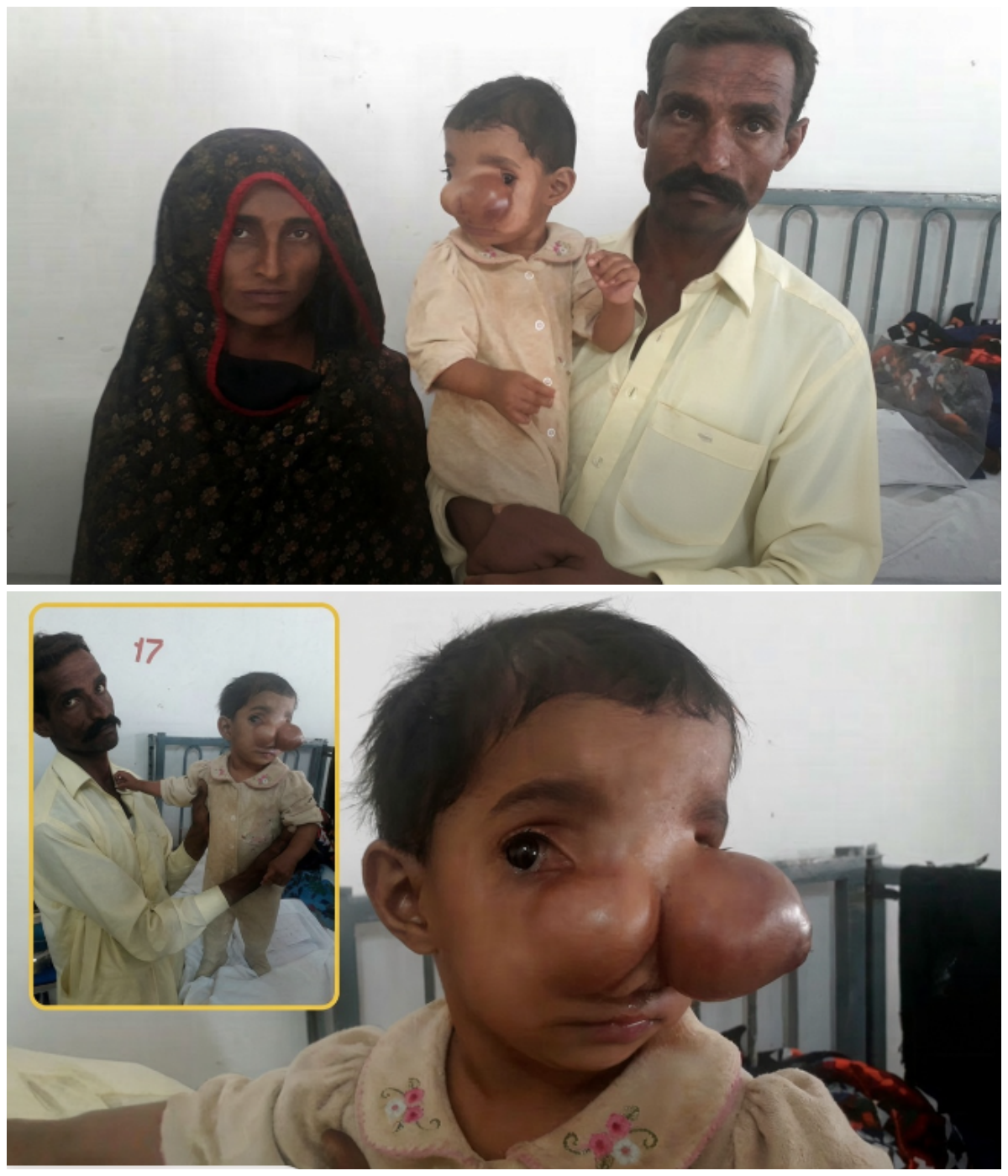
Asiya Manghrio was born by caesarean section in Sanghar, Sindh, Pakistan, with a swollen nose. Within months the swelling became a trunk larger than two tennis balls. Doctors named it frontonasal encephalocele: brain and meninges pushing through a gap in the skull into the face. The sac was heavy. She could not eat or sleep well and cried constantly. Some relatives called her a curse and a “defected baby.”
Her mother, Fatan Achar, then 23, sold a gold bangle. She and Asiya’s father, Achar Manghrio, a farm labourer, rode more than 160 miles by bus to Jinnah Postgraduate Medical Centre in Karachi. Neurosurgeon Dr Lal Rehman confirmed the diagnosis. Public lists were long; they were told to wait about two months. He warned that the mass could grow and threaten the airway.
In mid-January 2018, when Asiya was about 16 months old, the same team operated for roughly three hours: craniotomy, disconnection of the encephalocele stalk, dural graft, excision of the sac and extra tissue. Dr Rehman said the plan held. She moved from liquids to biscuits. Wire-service captions from that week show the family preparing to go home.
An encephalocele is a neural-tube defect. Frontonasal forms are uncommon even among encephaloceles. Surgery aims to return viable tissue to the skull, seal dura, and remove the empty sac—not to invent a new nose from nothing. Risk includes leak, infection, and injury to brain that has already herniated. Many children in low-resource settings wait, as Asiya did, because theatres are full.
The photographs that still circulate—the parents on a ward bed, the close-up of the pendulous mass—are from the weeks before that operation. The Spanish caption stops at the plea. The hospital record continues one step further: the mass came off.
Sources
- Daily Mail / The Mirror / IBTimes, December 2017: Sanghar, Jinnah Hospital wait, family statements
- Aflo / Caters follow-up, 17 January 2018: three-hour surgery by Dr Lal Rehman, Jinnah Postgraduate Medical Centre
- Clinical definition: frontonasal encephalocele as congenital skull defect with herniated cranial contents