When a Child’s Feet Will Not Stop Growing: Xiao Meng and the Limits of a Caption
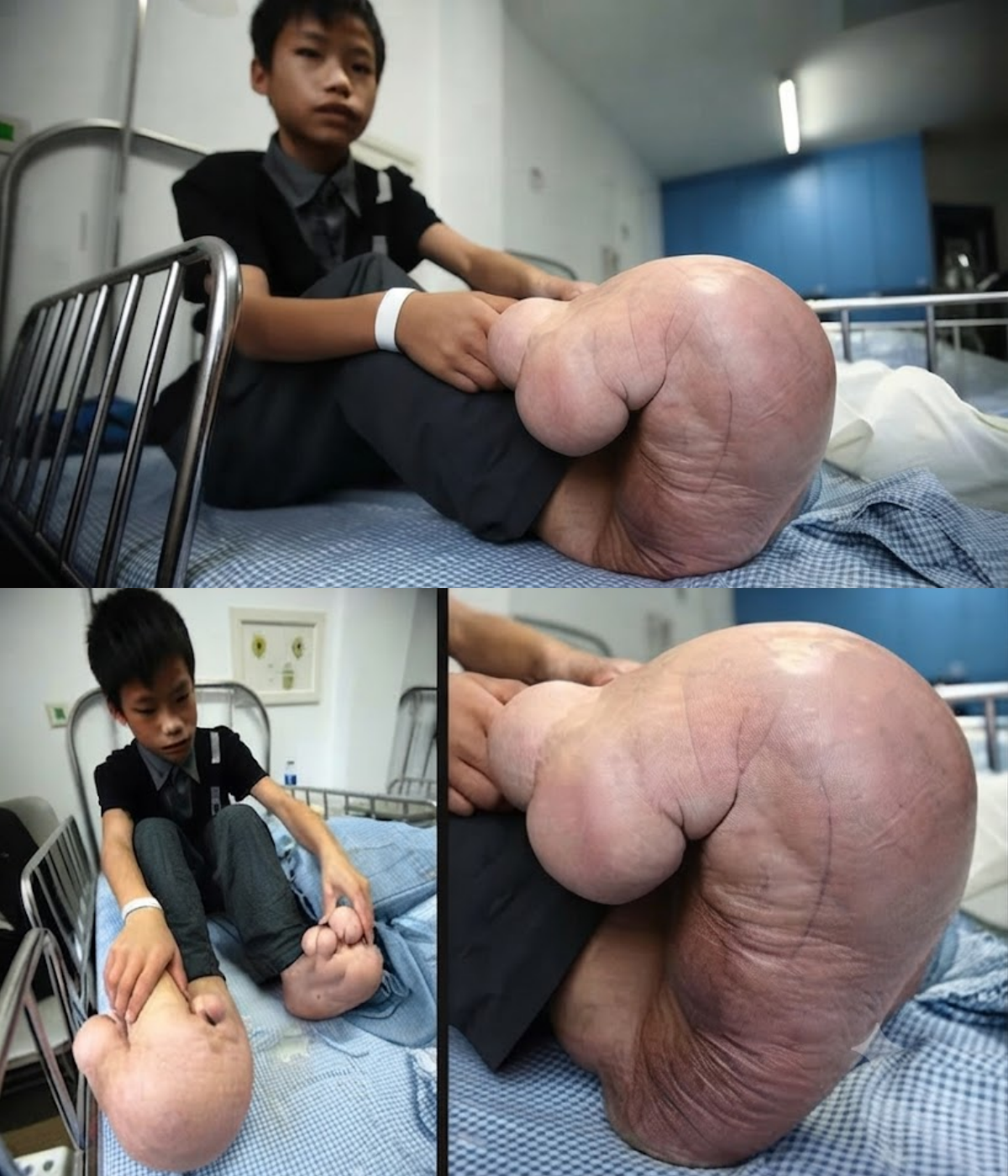
The photographs circulating with the Spanish overlay—a school-age boy on a hospital bed, feet swollen into folded, orange-sized masses—match the 2012 case of Xiao Meng (also reported as Meng Weixin), then 14, from Guangxi Zhuang Autonomous Region in southern China. He had lived with a congenital lesion of both feet since birth. Toes and soft tissue enlarged year after year until shoes were impossible. In winter he wrapped the feet in denim. He told reporters he wanted to wear shoes like his classmates and run. Teachers posted his pictures; Chinese media amplified them; Shanghai Children’s Hospital offered staged surgery at no charge. China Southern Airlines flew the family. The school raised living money.
English-language reports at the time used “congenital neurofibromatosis” and “lesion.” That is not the same disease as filarial elephantiasis, and it is not automatically the same as primary paediatric lymphedema. Neurofibromatosis can produce plexiform overgrowth that looks like elephantiasis. Primary lymphedema produces protein-rich swelling, thickened skin, fissures and recurrent cellulitis. Both ruin gait, both invite infection, both can twist ankles, knees and spine. A viral caption that labels every giant foot “congenital pedal elephantiasis / primary progressive lymphedema” collapses those distinctions. Without the original chart, the honest label for Meng is the one his surgeons used: a congenital overgrowth they planned to reduce in two stages—first excision of superfluous tissue, later functional reconstruction—hoping for roughly 70 percent of normal motion and custom shoes. Chief surgeon Ying Hao called the first operation successful. Long-term public follow-up is thin.
The Spanish paragraph is otherwise standard lymphedema teaching. Disproportionate distal volume blocks ordinary footwear, shifts the centre of gravity and cracks thin skin. Complex decongestive therapy—manual drainage, multilayer compression, skin care—is first-line wherever it exists. Microsurgery (lymphaticovenular anastomosis, vascularized lymph-node transfer) and reductive contouring are later options in centres that have them. Guangxi in 2011 did not. Shanghai did, once the internet made the child visible. That is the actual “international protocol”: not a United Nations task force, but a provincial hospital answering a teacher’s post.
Meng’s wish was small and specific. He did not ask to become a case study in supermicrosurgery. He asked to wear shoes. Whether the staged reductions delivered a durable, painless foot is less documented than the before pictures that still travel under new watermarks. The medicine worth repeating is narrower than the overlay: giant paediatric feet are not one disease; they are a group of overgrowth and drainage failures; untreated they isolate a child from school and sport; reduction and compression can help; naming the wrong parasite or the wrong vessel does not.
Sources
- China Daily, 20 November 2012
- New York Daily News / The Sun reports on Shanghai Children’s Hospital, November 2012
- Imaginechina / Alamy caption files from the same admission
- Standard clinical distinction: primary lymphedema vs neurofibromatous overgrowth vs filarial elephantiasis