A New Face, A New Beginning: Samira Benhar’s Remarkable Journey of Facial Reconstruction
- NguyenMien
- September 18, 2026
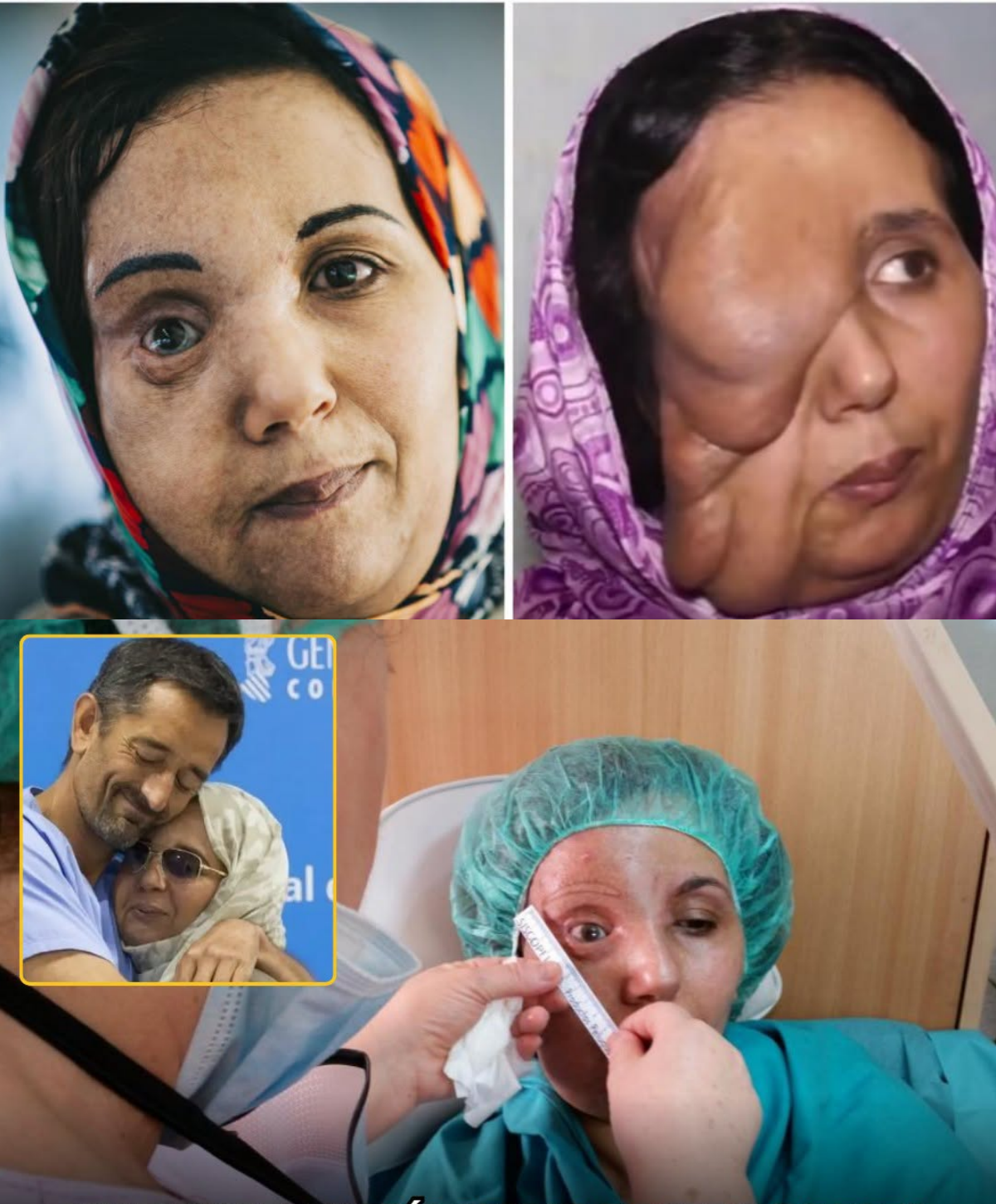
For years, Samira Benhar lived with a massive facial tumor that profoundly changed her appearance and affected almost every aspect of her life. Born in Casablanca, Morocco, Samira developed severe neurofibromatosis type 1, a genetic disorder associated with the growth of tumors along nerves. In her case, a large neurofibroma progressively spread across the right side of her face, eventually occupying roughly half of it and affecting one of her eyes.
According to reports published in 2016, Samira said that the condition had begun to affect her when she was a child, with a small growth appearing around the age of three. Over the years, the mass continued to grow. What began as a relatively small abnormality eventually became a severe facial deformity that made everyday life increasingly difficult.
A Life Marked by Social Isolation
The physical effects of the disease were accompanied by painful social consequences. Samira experienced rejection in her community and was also rejected by her husband. By the time she was in her late 30s, she had two children and had endured years of psychological and physical hardship related to her condition.
Her circumstances began to change after an unexpected encounter in a park in Casablanca. A woman noticed Samira and asked about her situation. That meeting eventually connected her with the ADRA Foundation, which had been involved in healthcare projects in Morocco. The organization, together with the Islamic Cultural Center of Valencia, helped arrange the necessary documentation and her journey to Spain for medical treatment.
In 2013, Samira met Spanish reconstructive surgeon Pedro Cavadas, who agreed to participate in her treatment without charging her for the surgery. Her case was subsequently treated at Hospital de Manises in Valencia.
Three Operations to Reconstruct Her Face
The reconstruction took place over approximately 13 months and involved three major procedures.
The first operation was performed in June 2015, when surgeons removed a substantial portion of the large neurofibroma occupying the right side of Samira’s face. Four months later, a second operation removed the remaining tumor tissue, particularly around the eye. A third procedure was carried out in April 2016 to complete treatment of the eye area, including placement of an ocular prosthesis.
The goal was not simply to remove the tumor. The medical team also had to restore facial contours and improve the appearance and function of the affected area after such extensive tissue removal.
By June 2016, after nearly a year of treatment, the difference was striking. Reports described a woman whose face had been dramatically transformed compared with the condition in which she had arrived in Spain.
“I Feel Reborn”
When Samira appeared publicly with Cavadas after completing her treatment, she struggled to contain her emotions. She expressed her gratitude to the people who had helped her and described herself as feeling “reborn.”
Her first reaction to seeing her reconstructed face in the mirror was also deeply emotional. Later reporting quoted Samira recalling that she cried with happiness when she first saw her new appearance.
For Samira, the transformation represented more than a physical change. After years of living with a condition that had subjected her to unwanted attention and social rejection, she could return to Morocco with a significantly reconstructed face and renewed confidence.
Her children, who were nine and twelve years old at the time, were waiting for her return home.
Samira’s case also illustrates the role that international medical cooperation can play in helping people with severe conditions access complex reconstructive treatment. Her journey to Spain involved the collaboration of the ADRA Foundation, the Islamic Cultural Center of Valencia, Hospital de Manises, and Pedro Cavadas and his medical team.
Years after the surgery, Samira’s story remains a powerful example of how reconstructive medicine can address not only the physical consequences of a serious disease, but also some of the profound social and emotional burdens that can accompany visible facial conditions.
For a woman who had spent much of her life trying to hide from the world, being able to look into a mirror and see a new version of herself became an important part of beginning again.
Sources: EL PAÍS; EFE; Cadena SER; Hospital de Manises; Fundación ADRA España; 20minutos; La Vanguardia; SINC; El Español.