Lakshmi Tatma: The Girl Born With Eight Limbs Who Took Her First Steps After a Landmark Surgery
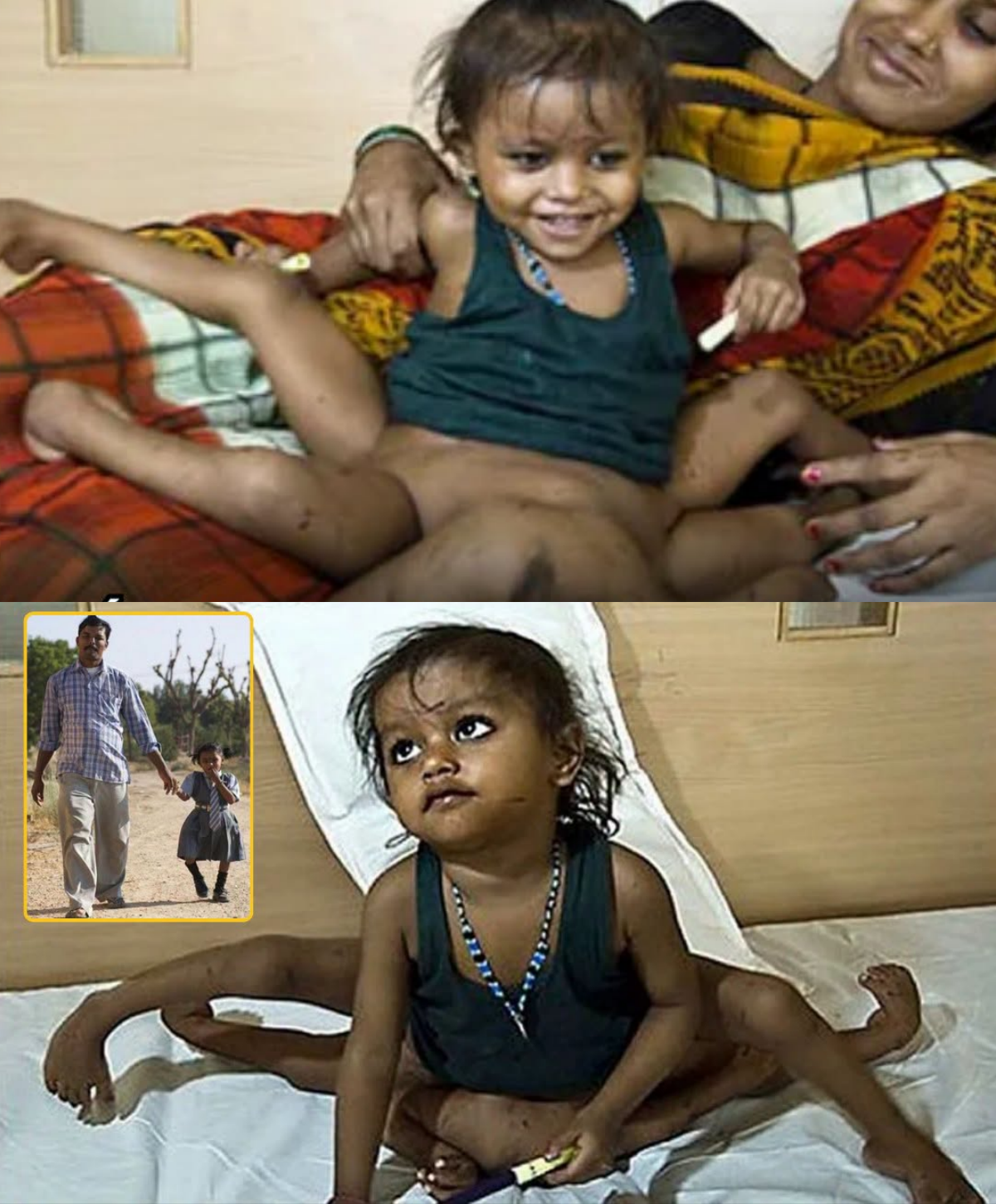
In 2005, in a remote village in Bihar, India, a baby girl named Lakshmi Tatma was born with four arms and four legs. Her extraordinary appearance attracted enormous attention in her community, where some villagers regarded her as an incarnation of the Hindu goddess Lakshmi. But behind the religious interpretations was an extremely complex congenital condition that posed serious risks to her future health and mobility.
Lakshmi was not simply a child with extra limbs. Doctors determined that she had been born as an ischiopagus parasitic twin—a rare form of conjoined twinning in which an incompletely developed twin is attached to the body of the more fully developed twin. In Lakshmi’s case, the two bodies were joined around the pelvis, while the parasitic twin had no developed head and had additional arms and legs. This created the appearance of a single child with eight limbs.
A Child Viewed As A Goddess
Lakshmi’s family came from a poor rural background in Bihar. Her unusual appearance quickly made her the focus of attention in the surrounding villages. Reports from the time described people traveling to see her and some treating her as a divine figure. Her father also named her Lakshmi, after the Hindu goddess associated with wealth and fortune, who is traditionally depicted with multiple arms.
However, doctors were concerned that her condition could seriously compromise her health. Lakshmi could not walk normally and was unable to move like other children. The anatomical connection involved much more than the visible limbs: the twins shared complex structures around the pelvis, spine, blood vessels and internal organs.
Medical specialists therefore faced a difficult question: whether such a complicated separation could be performed without causing catastrophic damage to Lakshmi’s functioning body.
A 27-Hour Surgical Marathon
In November 2007, Lakshmi was taken to Sparsh Hospital in Bangalore, where orthopedic surgeon Dr. Sharan Patil led a large multidisciplinary surgical team.
The operation began on November 6 and had initially been expected to take around 40 hours. Instead, the procedure was completed after approximately 27 hours, involving around 30 surgeons and specialists working on different aspects of the extraordinarily complicated anatomy.
The surgeons had to separate the fused structures while preserving the organs and blood supply necessary for Lakshmi’s survival. Among the challenges were the joined spine, complicated nerves, shared pelvic structures, blood vessels and internal organs. Doctors also had to reconstruct her pelvis after removing the additional limbs and tissues.
The surgery was considered extremely high-risk. Contemporary reports said doctors believed that without successful intervention, Lakshmi might not survive into adolescence.
After 27 hours, however, the separation was successfully completed.
Lakshmi survived the operation and was initially kept under intensive medical observation. Her surgical wounds were extensive, and she required further treatment and rehabilitation before she could begin learning to walk.
From Eight Limbs To Her First Steps
The surgery was only the beginning of Lakshmi’s recovery.
Three months later, in February 2008, reports documented an important milestone: Lakshmi had begun taking her first steps with the assistance of a walker. Doctors reported that she was able to move her legs and showed good muscle control, although she still had orthopedic problems including club feet.
A contemporaneous AFP report also documented her rehabilitation in Rajasthan, where she was practicing walking with a walker after the operation.
By July 2008, Lakshmi was reported to be walking, although her gait was still unsteady and she continued to require additional medical procedures and rehabilitation.
Later reports described further progress. By November 2008, Indian media reported that Lakshmi could stand, walk and run, although her recovery remained a continuing medical process.
A Long Recovery, Not A Single Miracle
Although photographs of Lakshmi after surgery can make the transformation appear immediate, her recovery was actually a long process.
The operation corrected the most serious anatomical problems, but doctors continued monitoring her pelvis, spine and feet. Follow-up reports indicated that additional orthopedic treatment was required, including treatment for clubfoot and monitoring for spinal curvature.
Lakshmi and her family subsequently lived in Rajasthan, where she could attend a school for children with disabilities while continuing her rehabilitation.
Her case became internationally known not simply because of her unusual birth, but because it demonstrated how a highly coordinated surgical team could address an exceptionally complicated form of parasitic twinning.
A Remarkable Chapter In Pediatric Surgery
Lakshmi Tatma’s story is often described as a medical miracle, but the documented events show a more detailed picture: a rare congenital condition, extensive anatomical challenges, a high-risk operation, intensive postoperative care and years of rehabilitation.
The successful 27-hour procedure separated Lakshmi from the incompletely developed twin attached to her pelvis and gave her the physical opportunity to develop abilities that had previously been impossible, including standing and walking.
Her story also illustrates the importance of looking beyond the extraordinary appearance of a medical condition. What some people in her village interpreted through a religious lens was, from the medical perspective, an exceptionally rare developmental abnormality requiring specialized surgery.
For Lakshmi, the most important milestone came not when the operation ended, but when she began taking her first uncertain steps afterward. From a child who could barely move independently, she gradually learned to stand and walk—turning a highly unusual medical case into a story of survival, rehabilitation and renewed mobility.
Sources