PART 2 — THE STRANGER AT THE DOOR
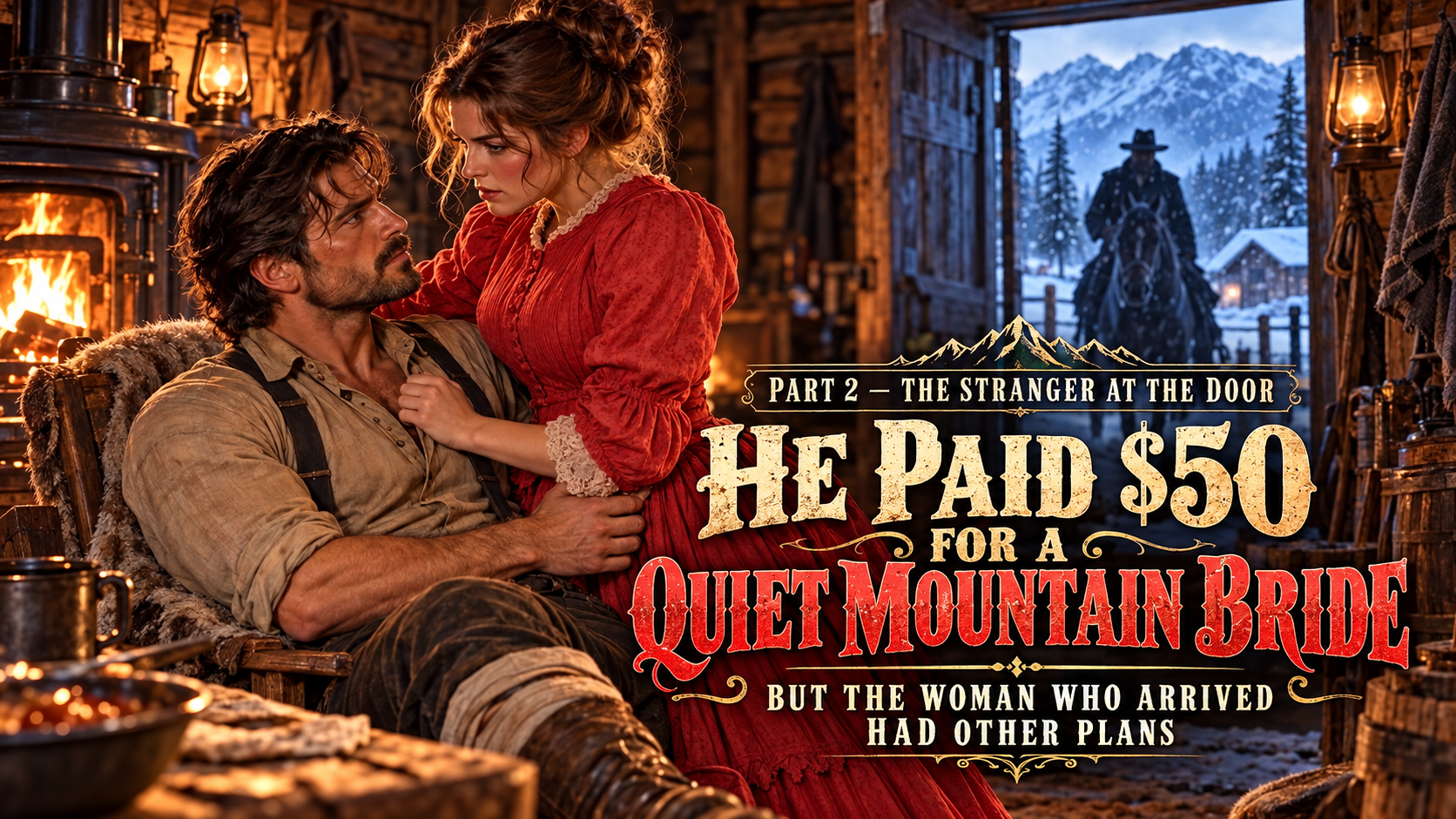
HE PAID $50 FOR A QUIET MOUNTAIN BRIDE—BUT THE WOMAN WHO ARRIVED HAD OTHER PLANS
THE FULL ENDING
The man standing outside Wyatt Blackwood’s cabin had traveled three hundred miles through a Colorado winter to find Cora Whitfield.
He carried a revolver beneath his black coat.
He had a silver watch in his pocket, a false name on his lips, and enough money to make almost any man in the territory look the other way.
But he had made one terrible mistake.
He believed the mountain man who had paid fifty dollars for a bride would surrender her just as easily for a hundred.
What he didn’t know was that Wyatt Blackwood had already spent one night listening to Cora breathe beside his fire.
And for a man who had spent eleven years believing nobody would notice if he died, that single night had changed everything.
The stranger knocked again.
“Blackwood! Open up! I’ve got business with you!”
Inside the cabin, Cora stood frozen beside her suitcase.
Her face had lost every trace of its usual confidence.
Wyatt noticed.
He also noticed the way her fingers tightened around the small wooden box.
“Get behind the stove,” he whispered.
“Wyatt—”
“Now.”
For once, Cora obeyed without argument.
Wyatt checked the Winchester, leaned it against the doorframe where he could reach it, and opened the door just wide enough to see outside.
A tall man stood on the porch.
He was perhaps forty-five, clean-shaven, with pale blue eyes and a black wool coat that looked far too expensive for the mountains.
His horse waited beneath the pines.
“Morning,” the stranger said pleasantly.
Wyatt said nothing.
The man smiled.
“Cold country you’ve got here.”
“Usually is in December.”
“I’m looking for a woman.”
“Plenty of women in Denver.”
The stranger’s smile tightened.
“This particular woman arrived yesterday. Brown hair. Hazel eyes. Traveling dress, red as a Christmas ribbon.”
Wyatt rested one hand against the doorframe.
“That so?”
“Her name is Cora Whitfield.”
“Never heard of her.”
The stranger studied him.
Then his eyes drifted toward the wagon tracks outside.
“Interesting. Someone told me you collected a bride from the settlement yesterday.”
“Someone talks too much.”
The man chuckled.
“Perhaps we should introduce ourselves. My name is Elias Mercer.”
Wyatt had never heard the name.
But something about the man’s polished boots bothered him.
There was fresh snow on the trail.
Anyone who had traveled six miles through the mountains should have been covered in mud and ice.
Mercer’s boots were nearly clean.
Which meant he had stopped somewhere nearby.
Or he hadn’t come alone.
“What do you want?” Wyatt asked.
Mercer reached into his coat.
Wyatt’s hand moved toward the rifle.
“Easy,” Mercer said. “Just a document.”
He produced a folded paper bearing an official-looking seal.
“I’m a private investigator. Mrs. Whitfield is wanted in connection with the disappearance of several valuable medical records belonging to her late husband’s estate.”
Wyatt didn’t move.
“Sounds like a matter for a sheriff.”
“It is. Unfortunately, the woman has already crossed two state lines using false information.”
“Then go find a sheriff.”
Mercer’s smile disappeared.
“Mr. Blackwood, I’m offering you an opportunity to avoid trouble.”
He reached into his pocket again.
This time, he produced a thick leather wallet.
“One hundred dollars.”
Wyatt looked at the money.
“What’s that for?”
“For your inconvenience.”
“What inconvenience?”
“The woman.”
Silence settled between them.
Mercer continued.
“I understand you paid fifty dollars for her passage and marriage arrangements. I’ll double your money. You tell me where she is, and we both walk away satisfied.”
Wyatt stared at him.
Then he slowly scratched his beard.
“One hundred dollars?”
“Cash.”
“For a woman?”
“For information.”
Wyatt leaned forward.
“Mr. Mercer, let me ask you something.”
“Certainly.”
“Do I look like a man who sells people?”
Mercer’s expression hardened.
“I think you look like a man who understands business.”
“Then you’ve got poor eyesight.”
Wyatt began closing the door.
Mercer caught it with his gloved hand.
“Blackwood, you don’t understand what you’re protecting.”
Wyatt’s voice dropped.
“Take your hand off my door.”
“That woman is dangerous.”
“Then you ought to be glad I’m keeping her.”
Mercer’s eyes narrowed.
For a moment, his polished manners vanished.
“You’ll regret this.”
Wyatt smiled without warmth.
“Get in line.”
He slammed the door.
Then he slid the iron bolt into place.
Behind the stove, Cora was trembling.
Wyatt turned toward her.
“Well?”
She swallowed.
“That wasn’t Elias Mercer.”
“I figured.”
“His name is Nathaniel Voss.”
Wyatt glanced toward the window.
“And what does Mr. Voss want?”
Cora looked down at the wooden box.
“Something my husband died trying to protect.”
Outside, a horse whinnied.
Then another answered from somewhere beyond the trees.
Wyatt’s expression changed.
He crossed to the window and carefully lifted the curtain.
Two horses.
Not one.
A second rider was waiting among the pines.
Wyatt lowered the curtain.
“Cora.”
“Yes?”
“Whatever you’ve got to tell me, you’d better tell it quickly.”
She nodded.
And for the first time since arriving in Colorado, Cora Whitfield stopped hiding behind clever remarks.
“My husband wasn’t just a doctor,” she began.
“He was a physician at St. Catherine’s Hospital in St. Louis. A good man. A gentle man. The sort who remembered every patient’s name and never turned away someone who couldn’t pay.”
Wyatt listened silently.
“Samuel believed medicine was a calling. He treated railroad workers, immigrants, children, and men injured in the factories. Sometimes he worked eighteen hours without stopping.”
Her voice softened.
“We were married for four years.”
Wyatt looked at her.
“You loved him.”
“Very much.”
He nodded once.
There was no jealousy in his expression.
Only understanding.
Cora continued.
“Two years ago, Samuel noticed something strange. Patients from a private industrial clinic were arriving at the hospital with similar illnesses. Many worked at the same chemical works outside the city.”
“What kind of illnesses?”
“Terrible coughs. Weakness. Unusual injuries. Some had been exposed to dangerous substances without being told what they were handling.”
Wyatt frowned.
“And?”
“Samuel began investigating. He discovered that the factory owners were falsifying medical reports to avoid paying compensation to injured workers.”
She opened the wooden box.
Inside lay a stack of letters, a small leather notebook, and a brass key.
“The men who owned that factory had friends in the city government. They paid inspectors. They influenced newspapers. They made complaints disappear.”
Wyatt picked up the notebook.
Its pages were filled with careful handwriting.
Dates.
Names.
Medical observations.
Payments.
Cora pointed to a particular entry.
“Samuel discovered that a man named Nathaniel Voss was responsible for making troublesome witnesses disappear from the records.”
Wyatt looked up.
“The fellow outside?”
“Yes.”
“What happened to your husband?”
Cora closed her eyes.
“One evening, Samuel told me he’d found proof that the company had deliberately concealed a dangerous accident. He was going to deliver the evidence to a federal investigator.”
She paused.
“He never reached the meeting.”
Wyatt said nothing.
“His carriage was found overturned near the river. The authorities called it an accident.”
“But you didn’t believe them.”
“No.”
“Why?”
Cora looked directly at him.
“Because Samuel was afraid of horses. He never drove his own carriage after dark.”
The fire crackled.
“And three days after his funeral,” she continued, “Nathaniel Voss came to our house.”
Wyatt’s jaw tightened.
“What did he want?”
“The notebook.”
“Did you give it to him?”
“No.”
“What did he do?”
Cora pulled back the lace cuff of her sleeve.
Around her wrist was a faint old scar.
Wyatt stared at it.
Cora quickly lowered her hand.
“He told me Samuel had made a terrible mistake. He said I could live comfortably if I surrendered the documents.”
“And when you refused?”
“He said accidents happen to widows, too.”
Wyatt’s expression went cold.
Cora took a shaky breath.
“I fled St. Louis that night. I stayed with relatives in Kansas, then worked under another name in Nebraska. But Voss kept finding me.”
“How?”
“I don’t know.”
Wyatt glanced toward the matrimonial agency letter on the table.
Then something occurred to him.
“Your marriage application.”
Cora nodded.
“I needed somewhere remote. Somewhere nobody would think to search. The agency promised confidentiality.”
“Apparently they didn’t keep it.”
“No.”
Wyatt looked at the notebook again.
“So you came here to hide.”
Cora’s eyes filled with tears.
“At first.”
He waited.
“I read your advertisement, Wyatt. I saw a man who needed help. Someone isolated. Someone who wanted a practical arrangement rather than a grand romance.”
She attempted a smile.
“I thought I could be useful.”
“You certainly made yourself useful with my kitchen.”
She laughed weakly.
Then her expression became serious.
“I should have told you the truth.”
“Yes.”
“I’m sorry.”
Wyatt studied her for a long moment.
Then he placed the notebook back inside the box.
“Did you intend to marry me?”
Cora looked startled.
“What?”
“Simple question.”
She hesitated.
“I didn’t know you.”
“Still don’t, mostly.”
“I intended to honor the agreement if you were a decent man.”
“And am I?”
Cora looked toward the clean kitchen.
The folded blanket beside the hearth.
The cup of coffee he’d left for her.
Then she looked at his injured leg.
“I think you’re a better man than you want anyone to know.”
Wyatt grunted.
“That’s an inconvenient opinion.”
For a moment, they almost smiled.
Then a sharp crack echoed through the valley.
Both turned.
A rifle shot.
Not aimed at the cabin.
A warning.
Wyatt crossed to the window.
A rider emerged from the trees, holding a rifle across his saddle.
Voss stood beside him.
The stranger shouted.
“Blackwood! Last chance!”
Wyatt reached for his Winchester.
Cora caught his arm.
“Don’t.”
He looked at her.
“They’ll kill you.”
“Maybe.”
“Wyatt!”
He turned fully toward her.
“Listen carefully. You came here believing you could hide. But these mountains don’t belong to men like Voss.”
His voice became very quiet.
“They belong to people who know how to survive them.”
He took a heavy coat from a peg.
“Put this on.”
“What are you doing?”
“Getting you out.”
“Where?”
“Somewhere they’ll never find you.”
Cora stared at him.
“And you?”
Wyatt checked the rifle.
“I’ll be right behind you.”
She looked at his injured leg.
“You’re lying.”
He didn’t answer.
Cora stepped closer.
“Wyatt Blackwood, if you think I’m going to let you sacrifice yourself after knowing you for one night, you’re even more foolish than your kitchen suggested.”
He frowned.
“This isn’t the time.”
“Then stop behaving like an idiot.”
“Cora—”
“No.”
She planted both hands on her hips.
“I have spent two years running from men who believed they could frighten me into silence. I am finished running blindly.”
Wyatt stared at her.
Then he slowly lowered the rifle.
“What do you suggest?”
Cora took a breath.
“We make a plan.”
And against every instinct he possessed, Wyatt listened.
***
The first part of their plan involved something Wyatt hadn’t expected.
His bride could shoot.
Not merely point a pistol.
Not close her eyes and hope.
She could shoot accurately.
Very accurately.
Wyatt discovered this when Cora opened her smaller suitcase and removed a compact revolver wrapped in linen.
He stared.
“Where did you get that?”
“My father.”
“What was he?”
“A schoolteacher.”
Wyatt raised an eyebrow.
“Interesting school.”
“He also served in the cavalry.”
“That explains more.”
Cora checked the revolver.
“Samuel insisted I learn to protect myself after the first threats.”
Wyatt watched her movements.
“How many times have you fired that thing?”
“Enough.”
“At people?”
She gave him a sharp look.
“No. At bottles, mostly.”
“Good. Let’s keep it that way.”
Outside, Voss shouted again.
“Blackwood! You have five minutes!”
Wyatt glanced at the clock.
Then he limped toward the back wall.
He pushed aside a wooden storage chest.
Beneath it was a narrow trapdoor.
Cora blinked.
“What’s that?”
“Root cellar.”
“Under the cabin?”
“Leads into an old drainage passage.”
“Where does it go?”
“About fifty yards downhill.”
Cora looked impressed.
“You built an escape tunnel?”
Wyatt shrugged.
“Built a place to store potatoes. The creek did the rest.”
She peered into the darkness.
“And you never thought to mention this?”
“We’ve been acquainted less than a day.”
“Fair point.”
Wyatt handed her a lantern.
“Follow the passage until you reach the fallen pine. There’s a narrow trail leading north. Keep climbing until you see a split boulder.”
“And then?”
“Wait.”
“No.”
He sighed.
“Cora.”
“I’m not leaving you.”
“You can’t stay here.”
“Then come with me.”
Wyatt glanced at his leg.
The injury had already begun aching from standing too long.
He could move.
But not quickly.
And certainly not through deep snow.
Cora understood.
She stepped closer.
“Tell me the truth. Can you make that climb?”
Wyatt looked away.
“Not fast enough.”
“Then we find another way.”
A second rifle shot struck the cabin wall.
Wood splintered near the window.
Cora flinched.
Wyatt pulled her down.
“That settles it.”
He grabbed the wooden box and pushed it into her hands.
“Take this. Get to the split boulder. There’s an old mining shelter beyond it. You’ll find food and blankets.”
“And you?”
“I’ll hold them here.”
Cora shook her head.
“No.”
“Cora—”
“Absolutely not.”
Wyatt caught her shoulders.
“Listen to me.”
She went still.
His expression was unlike anything she’d seen before.
Not angry.
Not stubborn.
Afraid.
Not for himself.
For her.
“I spent eleven years in this cabin,” he said. “Eleven winters. Eleven springs. Never once did I worry much about whether tomorrow came.”
Cora’s eyes filled.
“Wyatt…”
“Then yesterday, a woman in a red dress walked through my door and told me my dishcloth was a geological formation.”
Despite everything, she laughed.
His mouth twitched.
“And suddenly, tomorrow started looking different.”
A tear slipped down her cheek.
Wyatt gently brushed it away.
“I don’t know what this is yet,” he whispered. “But I know I don’t want it ending here.”
Cora placed her hand over his.
“Then don’t make it end.”
For a moment, neither moved.
Then Wyatt kissed her forehead.
“Go.”
This time, she obeyed.
But before climbing into the passage, Cora turned.
“Wyatt?”
“Yes?”
“If you die, I will be extremely angry with you.”
He almost smiled.
“Wouldn’t dream of disappointing you.”
Then she disappeared beneath the floor.
Wyatt closed the trapdoor.
Moved the chest back into place.
And turned toward the front door.
Outside, Voss was counting down.
“Three minutes, Blackwood!”
Wyatt sat in his chair.
Rested the Winchester across his knees.
And waited.
***
Nathaniel Voss had dealt with stubborn men before.
Factory workers.
Journalists.
Lawyers.
Doctors.
Men who believed truth and courage were enough to protect them.
Most eventually discovered otherwise.
Money worked.
Threats worked.
And when neither was sufficient, there were other methods.
But the mountain man inside the cabin was proving irritatingly difficult.
Voss turned toward his companion.
“Silas.”
The broad-shouldered rider beside him grunted.
“Yes?”
“Go around the back.”
Silas adjusted his rifle.
“What about Blackwood?”
“He’s injured. The fellow in town said he barely walks without limping.”
“Still has a rifle.”
“Then don’t give him time to use it.”
Silas dismounted.
Voss watched him disappear around the cabin.
Then he approached the porch.
“Blackwood!”
No answer.
“I know she’s inside!”
Still nothing.
Voss drew his revolver.
“You’re protecting a criminal!”
From inside came Wyatt’s voice.
“Funny. That’s what I was thinking about you.”
Voss stopped.
“Open the door.”
“Busy.”
“Doing what?”
“Considering your offer.”
Voss smiled.
“Now we’re being reasonable.”
“Got a question first.”
“What?”
“Does the hundred dollars include the horse?”
Voss blinked.
“What horse?”
“Yours. Looks healthy.”
“Blackwood, don’t test my patience.”
“Already did. Seems fragile.”
Voss’s smile vanished.
Then he heard a sudden crash from behind the cabin.
Silas shouted.
A moment later, a furious mule brayed.
Wyatt grinned.
He had almost forgotten about the old gray mule tied near the rear shed.
The animal hated strangers.
Especially strangers who approached from behind.
Silas had apparently learned that lesson.
The mule kicked the shed door open.
Wood cracked.
A man cursed.
Then came the sound of someone falling into the snow.
Wyatt allowed himself a quiet chuckle.
“Good girl, Matilda.”
Voss looked toward the noise.
That was when Wyatt fired.
Not at the man.
At the wooden railing beside his hand.
Splinters exploded.
Voss stumbled backward.
“Next one goes closer,” Wyatt called.
Voss scrambled behind the woodpile.
His face twisted with rage.
“You’ll pay for that!”
Wyatt leaned back in his chair.
“Put it on my account.”
For several minutes, neither moved.
Then the rear window shattered.
Wyatt spun.
Silas had recovered.
A rifle barrel appeared through the broken glass.
Wyatt threw himself sideways as a shot tore into the chair.
Pain exploded through his injured leg.
He hit the floor hard.
The Winchester slid beneath the table.
Silas climbed through the window.
Wyatt reached for his rifle.
Too late.
A boot slammed onto the barrel.
Silas aimed his weapon at Wyatt’s chest.
“Don’t move.”
Wyatt froze.
The rear door opened.
Voss entered, brushing snow from his coat.
He looked around the cabin.
The clean dishes.
The freshly swept floor.
The two plates beside the stove.
Then he smiled.
“Well, well.”
He approached Wyatt.
“Where’s the woman?”
Wyatt said nothing.
Voss crouched.
“I’ll ask once more.”
“Then you’ll be disappointed twice.”
Voss struck him across the face with the back of his hand.
Wyatt’s head turned.
Blood appeared at the corner of his mouth.
He slowly looked back.
“That all you’ve got?”
Voss hit him again.
Silas shifted uncomfortably.
“Boss, maybe we should just search.”
Voss stood.
“Fine.”
He pointed toward the bedroom.
“Find her.”
Silas moved away.
Voss noticed the large suitcase beside the door.
He opened it.
Books.
Clothing.
A small bundle of letters.
But no wooden box.
His expression changed.
“Where are the records?”
Wyatt spat blood onto the floor.
“Try the library.”
Voss turned sharply.
“You think this is amusing?”
“Starting to.”
Voss pressed the revolver against Wyatt’s shoulder.
“I could end your life right now.”
Wyatt looked at him.
“Then why haven’t you?”
For the first time, Voss hesitated.
Wyatt saw it.
And understood.
The man needed the documents.
Without them, killing Cora would solve nothing.
Somewhere, someone else knew what Samuel Whitfield had discovered.
Someone powerful enough to make Voss afraid of failure.
Wyatt leaned forward slightly.
“You’re not the one giving orders, are you?”
Voss’s eyes narrowed.
“What?”
“You’re somebody’s errand boy.”
Voss struck him again.
Wyatt laughed through the pain.
“There it is.”
Voss grabbed his collar.
“Where is she?”
Wyatt stared straight into his eyes.
“Farther away every minute you waste.”
Voss went pale with fury.
Then Silas shouted from the bedroom.
“Boss!”
“What?”
“There’s a trapdoor!”
Wyatt’s stomach dropped.
Voss turned slowly.
Then smiled.
“Well, Mr. Blackwood.”
He raised his revolver.
“Perhaps you should have bought a quieter bride.”
***
Cora had reached the end of the drainage passage when she heard the first shot.
She stopped.
Then came another.
Her heart pounded.
She wanted to turn back.
Every part of her wanted to climb into the cabin, stand beside Wyatt, and refuse to let him face those men alone.
But she knew that would be foolish.
Wyatt had bought her time.
She couldn’t waste it.
She crawled through the final stretch of the passage and emerged beneath a fallen pine.
Cold air struck her face.
Snow covered the mountainside.
She pulled the wooden box close to her chest and looked toward the split boulder.
Then she noticed something.
A narrow trail.
Fresh hoofprints.
Someone had ridden up the mountain before dawn.
And the tracks didn’t lead toward Wyatt’s cabin.
They led toward the old mining shelter.
Cora’s blood ran cold.
Voss had brought more than one companion.
She turned toward the cabin.
A distant shout carried through the trees.
Then silence.
Cora gripped her revolver.
For the first time in two years, she stopped thinking about where she could run.
Instead, she began thinking about where she could fight back.
Not with bullets.
With knowledge.
With evidence.
And with something Nathaniel Voss had underestimated from the beginning.
A woman who had spent four years working beside a physician had learned to observe details other people overlooked.
She studied the hoofprints.
One horse.
Heavy animal.
Iron shoes with a distinctive broken edge.
She remembered seeing the same marks outside the settlement’s livery stable.
The rider was local.
Which meant someone nearby was helping Voss.
Cora followed the tracks carefully.
After several minutes, she reached a clearing.
There stood the old mining shelter.
And beside it, tied to a tree, was a chestnut horse.
A man waited outside.
He wore a brown coat and a battered hat.
Cora recognized him immediately.
Thomas Bell.
The settlement’s deputy sheriff.
He had helped Wyatt load her suitcases onto the wagon the previous afternoon.
And he had smiled when he asked where they lived.
Cora stepped behind a pine.
Her stomach tightened.
Now she knew how Voss had found them.
The deputy was working for him.
Bell paced impatiently beside the horse.
He checked his pocket watch.
Then looked toward the cabin.
Cora slowly backed away.
A branch cracked beneath her boot.
Bell turned.
“Who’s there?”
She froze.
“Come out!”
Cora raised her revolver.
Bell saw it.
Then he smiled.
“Well, Mrs. Whitfield.”
He lifted both hands.
“Looks like you’ve taken a wrong turn.”
Cora kept the weapon steady.
“Move away from your horse.”
Bell chuckled.
“Easy now.”
“Move.”
He obeyed.
“You’re making a mistake.”
“I’ve made several lately. Trusting you was one of them.”
Bell’s smile faded.
“Voss just wants the documents.”
“And what happens after he gets them?”
Bell said nothing.
Cora nodded.
“That’s what I thought.”
She gestured toward the shelter.
“Inside.”
Bell hesitated.
“Cora, listen—”
“Mrs. Whitfield, Deputy.”
He stepped backward.
Then suddenly lunged.
Cora fired.
The shot struck the snow beside his boot.
Bell stumbled.
She raised the revolver again.
“The next one won’t be a warning.”
He froze.
For several seconds, the clearing was silent.
Then Bell slowly lifted his hands.
“All right.”
Cora approached carefully.
“Drop your gun belt.”
He unbuckled it.
The belt fell into the snow.
“Now get inside.”
Bell obeyed.
The mining shelter was little more than a stone room built against the hillside.
Old tools hung on the walls.
A broken table stood beneath a narrow window.
Cora ordered Bell to sit.
Then she used a length of rope from his saddle to secure his wrists to a heavy wooden support.
He struggled.
“You’re going to regret this.”
Cora tightened the knot.
“People keep telling me that.”
She stepped back.
Bell glared.
“What are you going to do?”
Cora looked at the horse outside.
Then toward the distant settlement.
“Something I should have done a long time ago.”
She opened the wooden box.
Removed Samuel’s notebook.
And began searching for a particular page.
Bell watched her.
“What is that?”
“Insurance.”
She found the entry.
Then smiled grimly.
“Samuel always said the truth becomes harder to bury when enough people know where to find it.”
Bell frowned.
“What does that mean?”
Cora looked at him.
“It means you’re going to tell me exactly who hired Nathaniel Voss.”
Bell laughed.
“Or what?”
She placed the notebook on the table.
“Or I’ll leave you tied here until the sheriff arrives.”
Bell’s smile faltered.
“The sheriff?”
“Yes.”
“He’s not coming.”
Cora studied him.
“Why not?”
Bell looked away.
And in that instant, she understood something even worse.
The corruption reached beyond one deputy.
Perhaps beyond the settlement.
Cora slowly closed the notebook.
“Who else is involved?”
Bell said nothing.
She leaned forward.
“Deputy, if you want any chance of explaining your part in this, now would be an excellent time to start.”
He stared at her.
Then whispered a name.
“Judge Arthur Pembroke.”
Cora went completely still.
She knew that name.
Samuel had written it in the notebook.
The judge had presided over the legal proceedings that declared her husband’s death accidental.
And now, hundreds of miles away, his influence had reached the Colorado mountains.
Bell swallowed.
“Pembroke owns part of the company. Voss works for him. The judge wants the notebook destroyed before the federal inquiry begins.”
Cora’s hands trembled.
“There’s a federal inquiry?”
Bell nodded reluctantly.
“Started last month.”
“Who is conducting it?”
“An investigator named Jonathan Hale.”
Cora stared at him.
Then she remembered a letter Samuel had hidden among his medical papers.
A letter addressed to a man named Hale.
She had never known whether it had been delivered.
Now she did.
Someone had continued Samuel’s work.
Someone was still searching for the truth.
And suddenly, the wooden box in her hands became more valuable than ever.
***
Back at the cabin, Wyatt was running out of time.
Voss had found the trapdoor.
Silas had discovered the passage.
And Wyatt’s injured leg was beginning to fail him.
The mountain man sat against the wall, his hands tied with rope.
Voss paced before him.
“Where does the passage lead?”
Wyatt shrugged.
“Outside.”
“Where outside?”
“The mountain.”
Voss stopped.
“You are an exceptionally irritating man.”
“Been told.”
Voss crouched.
“Listen carefully. I don’t particularly want to kill you.”
“That’s considerate.”
“But I will.”
Wyatt stared at him.
“Then stop talking.”
Voss stood abruptly.
He turned to Silas.
“Follow the passage.”
Silas hesitated.
“Boss, that tunnel’s narrow.”
“Then crawl.”
“What if he rigged something?”
Voss glared.
“Are you afraid of a hole in the ground?”
Silas looked toward Wyatt.
The mountain man smiled faintly.
“Depends what’s in it.”
Silas swallowed.
Voss cursed.
“Fine. I’ll find her myself.”
He grabbed his coat.
Then turned back.
“Silas, watch him.”
Voss disappeared through the front door.
For several minutes, silence settled over the cabin.
Silas stood near the stove.
Wyatt sat against the wall.
The fire crackled.
Then Wyatt spoke.
“You ever been trapped in a mountain blizzard?”
Silas frowned.
“What?”
“Blizzard. Ever been caught in one?”
“No.”
“Terrible thing.”
Silas said nothing.
“Wind gets so strong you can’t see your own hands. Snow fills your lungs. Fingers go numb. Men start walking in circles without knowing it.”
Silas shifted.
“What’s your point?”
“Storm’s coming.”
Silas glanced toward the window.
The sky had darkened.
Snow was falling harder.
Wyatt continued.
“By nightfall, every trail between here and town will disappear.”
Silas looked uneasy.
“Voss knows what he’s doing.”
“Does he?”
Silas didn’t answer.
Wyatt leaned back.
“That man ever pay you what he promised?”
Silas’s expression changed.
Wyatt noticed.
“Thought so.”
“Shut up.”
“You’re risking your neck for somebody who’d leave you in a ditch if it saved him five dollars.”
Silas tightened his grip on the rifle.
“I said shut up.”
Wyatt studied him.
Then he spoke quietly.
“There’s coffee on the stove.”
Silas blinked.
“What?”
“Coffee. Fresh pot. Woman made it this morning.”
Silas looked toward the stove.
Wyatt shrugged.
“Help yourself.”
Suspicion crossed the man’s face.
“Why?”
“Because we’re both stuck here. Might as well be warm.”
Silas hesitated.
Then approached the stove.
He poured himself a cup.
Took a sip.
And closed his eyes briefly.
“That’s good coffee.”
Wyatt nodded.
“She’s good at most things.”
Silas glanced toward him.
“Your wife?”
“Not yet.”
“Then why are you doing all this?”
Wyatt looked toward the empty bed.
The neatly folded blanket.
The little candle Cora had placed on the table.
Then he answered.
“Because she asked me to be a decent man.”
Silas stared at him.
Wyatt continued.
“And because nobody should have to spend their whole life running.”
For a moment, something uncertain crossed Silas’s face.
Then he looked away.
“Voss said she stole something.”
“She did.”
Silas turned sharply.
Wyatt nodded toward the door.
“She stole his employer’s chance to bury the truth.”
Silas frowned.
“What truth?”
Wyatt told him.
Not everything.
Only enough.
About the factory.
The sick workers.
The falsified records.
The dead doctor.
And the widow who had spent two years fleeing men who wanted to silence her.
Silas listened.
His coffee grew cold.
Finally, he asked a question.
“How many workers?”
Wyatt looked at him.
“What?”
“How many got sick?”
“Don’t know.”
Silas swallowed.
“My brother worked in a chemical plant outside St. Louis.”
Wyatt went still.
Silas stared into his cup.
“He came home coughing. Couldn’t work after that. Company said it wasn’t their fault.”
He rubbed his jaw.
“Died last spring.”
Neither man spoke.
Then Silas slowly looked toward the door.
“Voss never told me what the papers were about.”
Wyatt watched him.
“Would it have mattered?”
Silas’s expression tightened.
After a long silence, he answered.
“Maybe.”
Wyatt leaned forward.
“Then here’s your chance to find out.”
***
By late afternoon, the storm had begun in earnest.
Cora rode the deputy’s horse through falling snow, following the narrow trail toward the settlement.
She had left Bell secured inside the shelter with water, blankets, and enough firewood to last until help arrived.
Her plan was simple.
Reach town.
Find someone outside the deputy’s influence.
Send a telegram to federal investigator Jonathan Hale.
Then return with help.
But the mountains had other plans.
The wind strengthened.
Snow swept across the trail.
The horse struggled through deep drifts.
Cora pulled Wyatt’s heavy coat tighter around herself.
She had traveled barely two miles when she heard a voice.
“Cora!”
Her blood turned cold.
Nathaniel Voss.
He emerged from a stand of pines, riding a dark horse.
His black coat snapped in the wind.
“Stop!”
Cora urged her horse forward.
Voss followed.
The trail narrowed along a steep hillside.
Below lay a frozen creek.
Above rose a wall of jagged stone.
Cora leaned low over the saddle.
Branches whipped against her shoulders.
Voss shouted again.
“You’re making this worse!”
She didn’t answer.
The horse stumbled.
Recovered.
Then stumbled again.
Cora looked ahead.
A fallen tree blocked the trail.
She pulled the reins.
Too late.
The horse stopped abruptly.
Cora was thrown sideways into the snow.
Pain shot through her shoulder.
The wooden box flew from beneath her coat.
It struck a rock.
The lid broke open.
Letters scattered across the white ground.
Cora scrambled toward them.
Voss dismounted.
“Enough!”
She grabbed the notebook.
He seized her wrist.
Cora cried out.
“Let go!”
Voss twisted her arm.
“Where is the rest?”
She struggled.
“Get away from me!”
He pulled the notebook from her hand.
Then laughed.
“Two years.”
He stared at the leather cover.
“Two miserable years chasing you across half the country.”
Cora rose slowly.
Voss opened the notebook.
His smile widened.
“All this trouble over a dead man’s scribbling.”
Cora’s voice shook.
“Those pages contain the names of people your employers hurt.”
Voss shrugged.
“People get hurt every day.”
“Samuel died because of you.”
Voss looked up.
For a moment, something cruel flickered across his face.
“Your husband should have minded his own business.”
Cora stepped closer.
“He was trying to save lives.”
“He was trying to destroy powerful men.”
“And you helped them.”
Voss closed the notebook.
“Powerful men pay better.”
He reached for his revolver.
Cora’s eyes widened.
Then a voice came from the trees.
“That’s far enough.”
Voss froze.
Wyatt Blackwood stood beneath a snow-covered pine.
His Winchester was steady in his hands.
Beside him stood Silas.
The larger man held his rifle lowered but ready.
Cora stared.
“Wyatt?”
The mountain man looked at her.
“Didn’t I tell you to wait by the split boulder?”
She almost laughed.
“Didn’t I tell you not to die?”
“Fair argument.”
Voss turned toward Silas.
“What is this?”
Silas looked at him.
“Your employment arrangement has changed.”
Voss’s face twisted.
“You traitor!”
Silas shook his head.
“My brother worked at the company.”
Voss went pale.
For the first time, he looked genuinely frightened.
Wyatt took a slow step forward.
“Put the gun down.”
Voss tightened his grip.
“You can’t prove anything.”
Cora pointed toward the notebook.
“That’s where you’re wrong.”
Voss glanced at her.
Then at Wyatt.
Then toward the steep slope.
His eyes narrowed.
And suddenly, he moved.
He grabbed Cora.
Pulled her against him.
And pressed the revolver near her shoulder.
Wyatt froze.
“Drop the rifle!”
Cora struggled.
Voss tightened his hold.
“Now!”
Wyatt’s expression changed.
His injured leg trembled.
Snow collected on his shoulders.
Slowly, he lowered the Winchester.
“Easy.”
“Drop it!”
Wyatt placed the rifle in the snow.
Silas raised his hands.
Voss backed toward his horse.
“Both of you stay where you are.”
Cora could feel his hand shaking.
He was frightened.
And frightened men made dangerous decisions.
Wyatt watched him carefully.
“Voss.”
“Shut up!”
“Look behind you.”
Voss sneered.
“Nice try.”
Wyatt’s voice remained calm.
“You’re standing on the creek bank.”
Voss glanced downward.
Beneath the snow lay a shelf of ice.
The frozen creek curved around the hillside.
Recent snowfall had hidden the edge.
Wyatt knew that bank.
He had fallen there the previous winter.
It was where he’d broken his leg.
“Step forward,” Wyatt said.
Voss tightened his grip on Cora.
“Don’t tell me what to do!”
“Then listen to the ice.”
A low cracking sound rose beneath their boots.
Cora felt it.
A tremor.
A movement.
She looked down.
The snow shifted.
Voss tried to step backward.
The ice broke.
Cora screamed.
For one terrible instant, both disappeared from view.
Wyatt lunged forward.
Pain tore through his injured leg.
He fell to one knee.
Silas rushed past him.
Below, Cora clung to a root protruding from the creek bank.
Voss had fallen onto a lower shelf of ice.
His revolver was gone.
The notebook lay beside him.
Water rushed beneath the broken surface.
“Cora!” Wyatt shouted.
She looked up.
“I’m here!”
“Don’t move!”
“That was already my plan!”
Even then, she managed to sound irritated.
Wyatt almost smiled.
Then he saw the root beginning to tear loose.
His expression hardened.
“Silas! Rope!”
Silas ran toward the horses.
Wyatt crawled to the edge.
Cora’s fingers were slipping.
“Look at me!” he called.
She lifted her face.
Snow clung to her hair.
Her lips were turning blue.
“Wyatt, I can’t—”
“Yes, you can.”
“My hands—”
“Look at me, Cora!”
She did.
His voice softened.
“Remember what you told me last night?”
She struggled to breathe.
“What?”
“That you weren’t going anywhere.”
Tears filled her eyes.
“Wyatt…”
“Well, I’m holding you to it.”
Silas returned with the rope.
Wyatt looped it around a sturdy pine.
Then lowered the other end toward Cora.
“Catch!”
She reached.
Missed.
The root cracked.
Wyatt’s heart stopped.
“Cora!”
She grabbed the rope with one hand.
Then the other.
“Got it!”
Wyatt braced himself.
Silas seized the rope beside him.
Together, they pulled.
Inch by inch.
Foot by foot.
Cora rose toward the edge.
Wyatt’s injured leg burned.
His arms trembled.
But he refused to let go.
Finally, Silas caught Cora beneath the shoulders.
They dragged her onto solid ground.
She collapsed against Wyatt.
For several seconds, neither spoke.
Then Cora began crying.
Not quietly.
Not politely.
She buried her face against his chest and sobbed.
Wyatt wrapped both arms around her.
“You’re safe.”
She shook her head.
“You foolish, stubborn, impossible man.”
He pressed his cheek against her hair.
“Been told.”
She pulled back.
Her eyes were wet.
“You came back.”
Wyatt looked at her.
“Of course I did.”
“Your leg—”
“Still attached.”
“You could have died.”
He gently brushed snow from her cheek.
“Couldn’t let you finish cleaning the cabin without me.”
Cora laughed through her tears.
Then she kissed him.
It was brief.
Unexpected.
And enough to make Wyatt Blackwood forget every sensible thought he’d ever had.
When she pulled away, he stared at her.
Cora blushed.
“Don’t look so surprised.”
He blinked.
“Wasn’t expecting that.”
“Well, get used to surprises.”
Behind them, Silas cleared his throat.
“Not to interrupt, but we’ve still got a problem.”
They turned.
Nathaniel Voss remained trapped on the lower ice shelf.
He was shivering violently.
The notebook lay near his feet.
He looked up.
“Help me!”
Wyatt stared at him.
Voss swallowed.
“Please!”
For a long moment, nobody moved.
Then Cora spoke.
“We have to help him.”
Wyatt looked at her.
“After everything?”
She nodded.
“Samuel spent his life saving people. He wouldn’t want me to stand here and watch someone die.”
Wyatt studied her.
Then slowly nodded.
“All right.”
He turned toward Silas.
“Get the second rope.”
Voss looked stunned.
“You’ll help me?”
Wyatt’s expression remained hard.
“Don’t mistake mercy for forgiveness.”
Together, they pulled Voss from the creek bank.
Then Silas secured his wrists.
Cora retrieved the notebook.
Its leather cover was wet.
Several pages had torn.
But most of the writing remained intact.
She held it against her chest.
And for the first time in two years, she believed Samuel’s work might finally reach the people who needed to see it.
***
The journey back to the cabin was miserable.
Snow fell so heavily that the horses could barely see the trail.
Wyatt rode behind Cora, one arm around her waist to keep her steady.
Silas followed with Voss.
The former investigator had stopped making threats.
Perhaps the freezing water had frightened him.
Perhaps he finally understood that the men he served would not protect him forever.
Or perhaps he was simply waiting for another opportunity.
Wyatt didn’t care.
He had more immediate concerns.
Cora was shivering.
His leg was throbbing.
And the storm was growing worse.
They reached the cabin after dark.
The front door hung crooked.
The kitchen window was broken.
Snow had blown across the floor.
Cora stepped inside.
She looked at the mess.
Then slowly turned toward Wyatt.
“Mr. Blackwood.”
He closed his eyes.
“Oh, no.”
“Did you allow those men to destroy my clean kitchen?”
Silas stared at her.
Voss looked bewildered.
Wyatt slowly removed his hat.
“Cora, we were being attacked.”
She surveyed the broken window.
“That is not an excuse for leaving glass on the floor.”
For one long second, silence filled the room.
Then Wyatt laughed.
Not a chuckle.
Not a rusty little sound.
A full, deep laugh that seemed to shake something loose inside his chest.
Cora stared.
Then she began laughing too.
Silas looked between them.
Finally, he shook his head.
“You’re both mad.”
Wyatt wiped his eyes.
“Starting to think so.”
They secured Voss to a heavy chair.
Silas kept watch while Cora prepared hot water.
Wyatt sat beside the fire, trying unsuccessfully to hide how badly his leg hurt.
Cora noticed immediately.
She knelt before him.
“Boot off.”
He frowned.
“What?”
“Your boot.”
“Cora—”
“Now.”
Wyatt looked toward Silas.
“See what I deal with?”
Silas shrugged.
“Seems fair.”
Wyatt sighed.
Then obeyed.
His right leg was badly swollen.
Cora examined it carefully.
She had assisted Samuel with enough patients to recognize when someone needed proper medical attention.
“This isn’t something we can solve with warm cloths,” she said.
Wyatt looked away.
“Been living with it.”
“That doesn’t mean you should continue.”
She wrapped the leg gently.
“When the storm clears, we’re going to find a doctor.”
“Town’s twelve miles.”
“Then we’ll travel twelve miles.”
“Road’s rough.”
“I’ve noticed.”
“Costs money.”
Cora looked up.
“Wyatt Blackwood, if you offer one more excuse, I may personally carry you there.”
Silas laughed.
Wyatt glared at him.
“Don’t encourage her.”
Cora tightened the bandage just enough to make Wyatt wince.
“Behave.”
He muttered something beneath his breath.
She smiled.
Then, more softly, she said, “You saved my life.”
Wyatt looked at her.
“You saved mine first.”
“I cleaned your kitchen.”
“You made it feel like someone lived here.”
Cora’s expression changed.
For a moment, neither spoke.
Then Wyatt reached for her hand.
And this time, she let him hold it.
***
The blizzard lasted three days.
Three days of howling wind.
Three days of snow piling against the cabin walls.
Three days in which four people who had begun as strangers, enemies, and reluctant allies were forced to share the same small space.
Cora cooked.
Silas repaired the broken window.
Wyatt supervised from his chair, much to his irritation.
And Nathaniel Voss sat bound near the storage room, discovering that nobody was particularly interested in his opinions.
On the second evening, Cora opened Samuel’s notebook.
She spread the damp pages beside the fire.
Wyatt watched her.
“Can they be saved?”
“Most of them.”
She carefully separated two pages.
“Samuel used good ink.”
Wyatt nodded.
“Smart man.”
Cora smiled sadly.
“He was.”
She worked in silence for several minutes.
Then Wyatt asked something he’d been wondering since their first night.
“Why did you really answer my advertisement?”
Cora stopped.
“I told you.”
“Part of it.”
She looked at him.
Wyatt continued.
“You could have found work somewhere. Taken another name. Gone farther west.”
Cora stared into the fire.
Then she spoke.
“Because I was tired of being afraid.”
Wyatt listened.
“I spent two years sleeping in unfamiliar rooms. Every time someone knocked, I wondered whether it was Voss. Every stranger looked dangerous. Every new town felt temporary.”
Her voice trembled.
“Then I read your letter.”
Wyatt frowned.
“Wasn’t much of a letter.”
“No.”
She smiled faintly.
“It was terrible.”
He grunted.
“Appreciate that.”
“You listed your acreage, your supplies, your expectations, and the number of mules you owned.”
“Important information.”
“You described yourself as hardworking, practical, and not talkative.”
“Accurate.”
“And then, at the bottom, you wrote something.”
Wyatt looked confused.
“What?”
Cora reached into her suitcase.
She removed a folded piece of paper.
The original advertisement.
She handed it to him.
Wyatt unfolded it.
There, beneath his list of requirements, was a sentence he had almost forgotten writing.
“I have a good home, but it has been a lonely one. I hope to find someone who will not mind sharing it.”
Wyatt stared at the words.
Cora’s voice softened.
“That sentence made me answer.”
He looked up.
“Why?”
“Because it was the only honest thing in the entire advertisement.”
Wyatt lowered his eyes.
For years, he had believed admitting loneliness was a weakness.
Something a man should swallow.
Something to endure without complaint.
But Cora had crossed three hundred miles because he had admitted it once.
Just once.
And suddenly, the truth seemed less shameful.
“I was lonely,” he said quietly.
Cora moved closer.
“I know.”
He looked at her.
“Still am, sometimes.”
She took his hand.
“Then perhaps we can do something about that.”
Wyatt swallowed.
“Cora…”
She smiled.
“Yes?”
He looked toward the bed.
Then the fire.
Then back at her.
“I don’t know much about being a husband.”
“That’s all right.”
“Never been married.”
“I gathered.”
“Not much of a dancer.”
“Tragic, but survivable.”
“Can’t promise I’ll always say the right thing.”
Cora squeezed his hand.
“Wyatt, I don’t need a man who always says the right thing.”
He waited.
“I need a man who means what he says.”
The mountain man stared at her.
Then he slowly nodded.
“Think I can manage that.”
***
On the third morning, the storm finally broke.
Sunlight spilled across the mountains.
The snow glittered.
And the valley lay beneath a silence so complete that even the trees seemed to be resting.
Wyatt stood outside the cabin, leaning on a walking stick.
Cora joined him.
For several minutes, they watched the sunrise.
Then she spoke.
“It’s beautiful.”
Wyatt looked at the mountains.
This time, he didn’t shrug.
“Yes,” he said.
“It is.”
Cora smiled.
A distant bell rang from the settlement.
The sound traveled faintly through the cold air.
Wyatt turned toward her.
“Time to finish this.”
She nodded.
Together, they prepared for the journey into town.
Silas would accompany them.
Voss would be delivered to the sheriff.
And Samuel’s notebook would finally be placed in the hands of someone who could protect it.
But as they loaded the wagon, Cora noticed Wyatt studying the horizon.
“What’s wrong?”
He hesitated.
“Don’t know who we can trust.”
She looked toward the distant settlement.
“Neither do I.”
Wyatt nodded.
“Then we’ll be careful.”
Cora took his arm.
“We’ll be careful together.”
***
The settlement of Pine Hollow had never seen anything quite like the procession that arrived shortly after noon.
Wyatt Blackwood drove his mule wagon down the main street.
Beside him sat a woman in a red dress, wrapped in his oversized coat.
Behind them rode Silas.
And tied securely in the back of the wagon sat Nathaniel Voss, looking considerably less dignified than when he’d arrived.
People emerged from the general store.
The blacksmith stopped hammering.
Two children stared.
Someone shouted.
“Blackwood! What happened?”
Wyatt pulled the wagon to a stop.
“Had visitors.”
The blacksmith looked at Voss.
“Unfriendly ones?”
“Very.”
Cora climbed down.
Then she marched directly toward the sheriff’s office.
Wyatt watched her go.
Silas leaned toward him.
“She always walk like that?”
“Like what?”
“Like she’s about to take command of the entire territory.”
Wyatt smiled.
“Pretty much.”
Inside the sheriff’s office, Sheriff Daniel Mercer sat behind his desk.
He was a broad, gray-haired man with tired eyes and a reputation for fairness.
He looked up as Cora entered.
“Can I help you, ma’am?”
“Yes.”
She placed Samuel’s notebook on his desk.
“I need to report an attempted abduction, a conspiracy involving falsified medical records, and the corruption of one of your deputies.”
The sheriff blinked.
Then looked toward Wyatt.
“Blackwood?”
Wyatt removed his hat.
“Afternoon, Sheriff.”
Mercer sighed.
“I knew this was going to be a difficult day.”
Cora explained everything.
The factory.
Samuel’s investigation.
The threats.
The journey west.
Nathaniel Voss.
Deputy Bell.
And the judge whose name appeared repeatedly in the notebook.
Sheriff Mercer listened without interrupting.
When she finished, he leaned back.
“Mrs. Whitfield, these are serious allegations.”
“I understand.”
“Do you have evidence?”
Cora opened the notebook.
She showed him the entries.
The letters.
The names.
Then Silas stepped forward.
“My brother worked at that factory.”
The sheriff looked at him.
Silas swallowed.
“I was hired by Voss to help find her. I didn’t know what the records were about. But I heard him threaten her. And I heard him admit he was working for people who wanted those papers destroyed.”
The sheriff studied him.
“Are you willing to make a sworn statement?”
Silas hesitated.
Then nodded.
“Yes.”
Sheriff Mercer stood.
“Then we’re going to need more than one telegram.”
He called for the telegraph operator.
Within an hour, messages were traveling east.
One to Denver.
One to the United States marshal’s office.
And one addressed to federal investigator Jonathan Hale.
Cora stood beside the telegraph counter as the operator tapped out the message.
Her hands trembled.
Wyatt noticed.
He gently placed his hand over hers.
“Nearly done.”
She shook her head.
“No.”
He looked at her.
“This is only the beginning.”
Wyatt nodded.
“Then we’ll see it through.”
***
The federal investigator arrived four days later.
Jonathan Hale was a thin, serious man with spectacles and a leather briefcase.
He had spent nearly a year investigating the chemical works in Missouri.
When he saw Samuel Whitfield’s notebook, he removed his glasses.
For several seconds, he said nothing.
Then he looked at Cora.
“Mrs. Whitfield.”
“Yes?”
“Do you understand what you’ve brought us?”
She swallowed.
“I hope so.”
Hale placed one hand on the notebook.
“Your husband documented payments, false medical findings, and names we’ve been trying to connect for months.”
Cora’s eyes filled.
“Will it be enough?”
“Enough to strengthen the investigation considerably.”
She looked down.
“And Samuel?”
Hale’s expression softened.
“Your husband’s work may help protect people who never knew his name.”
Cora covered her mouth.
For two years, she had carried that notebook through fear, grief, and uncertainty.
She had hidden it beneath floorboards.
Sewn it into luggage.
Slept beside it.
Risked everything to protect it.
Now, finally, someone understood its importance.
Wyatt stood behind her.
He rested a hand against her back.
Cora turned and buried her face against his chest.
He held her quietly.
Hale waited.
Then he spoke again.
“Mrs. Whitfield, there is something else.”
She looked up.
“The inquiry has uncovered new information about your husband’s death.”
Cora went still.
“What information?”
Hale opened his briefcase.
He removed a document.
“Samuel Whitfield’s carriage had been inspected shortly before the accident. The examination revealed damage inconsistent with ordinary wear.”
Cora’s breath caught.
Hale continued carefully.
“We have reason to believe the carriage was deliberately tampered with.”
Wyatt’s jaw tightened.
Cora stared at the paper.
For two years, people had told her to accept the official explanation.
To stop asking questions.
To let her husband rest.
Now, the truth she had feared was being acknowledged.
“Who did it?” she whispered.
Hale shook his head.
“We cannot yet say who carried it out. But the investigation is ongoing.”
Cora closed her eyes.
A tear slipped down her cheek.
Then another.
Wyatt gently drew her closer.
She whispered something against his coat.
“What was that?” he asked.
Cora looked up.
“I said Samuel was right.”
Wyatt nodded.
“Sounds like he usually was.”
She laughed through her tears.
“He would have liked you.”
Wyatt looked startled.
“Me?”
“Very much.”
“Why?”
Cora smiled.
“Because he appreciated stubborn men with good hearts.”
Wyatt considered that.
Then grunted.
“Would’ve liked him too.”
***
The weeks that followed brought changes to Pine Hollow.
Deputy Thomas Bell was removed from duty and placed under investigation.
Nathaniel Voss was transferred into federal custody.
Silas gave his statement and agreed to cooperate with investigators.
The inquiry into the chemical works expanded.
Judge Arthur Pembroke faced formal scrutiny after financial records connected him to the company’s owners.
The investigation did not conclude overnight.
There were hearings.
Witnesses.
Documents to examine.
And questions that would take months to answer.
But the notebook survived.
And with it survived the truth Samuel Whitfield had risked his life to preserve.
For Cora, that was enough to begin healing.
Yet there was one matter that remained unresolved.
Her future.
And Wyatt’s.
***
On a cold January morning, Cora stood in the cabin kitchen kneading bread.
The room had changed dramatically since her arrival.
The pelts were stored properly.
The dishes were clean.
Fresh curtains hung beside the windows.
A little shelf held her books.
And on the mantel sat a framed photograph of Dr. Samuel Whitfield.
Wyatt had built the frame himself.
When Cora first saw it, she had cried.
Wyatt had pretended not to notice.
Now he sat beside the fire, working on a wooden chair.
His leg was improving slowly.
A physician in town had examined it and explained that the old injury required careful treatment, reduced strain, and time.
Wyatt disliked all three recommendations.
Cora enforced them anyway.
“You’re supposed to be resting,” she said without looking up.
“I am.”
“You’re building furniture.”
“Sitting down.”
“That is not the same thing.”
“Close enough.”
Cora sighed.
“Wyatt.”
He set down his tools.
“Yes, ma’am?”
She turned.
“Are you mocking me?”
“Wouldn’t dare.”
Her eyes narrowed.
Then she smiled.
He smiled back.
The cabin had become a place of small arguments and unexpected laughter.
But Wyatt had been unusually quiet that morning.
Cora noticed.
Of course she noticed.
She always noticed.
Finally, she wiped flour from her hands.
“What’s troubling you?”
“Nothing.”
“Wyatt.”
He sighed.
“Something.”
She folded her arms.
“Well?”
He reached into his pocket.
Then stopped.
Then put his hand back on his knee.
Cora stared.
“Are you ill?”
“No.”
“Is your leg hurting?”
“No more than usual.”
“Did Matilda escape again?”
“No.”
“Then what?”
Wyatt stood.
Slowly.
Carefully.
He walked toward her.
Cora watched him with growing concern.
“Wyatt?”
He cleared his throat.
“I’ve been thinking.”
“That sounds dangerous.”
“Probably is.”
He reached into his pocket again.
This time, he removed a small wooden box.
Cora went still.
Wyatt opened it.
Inside lay a simple gold ring.
Not large.
Not expensive.
But carefully polished.
Cora stared.
“Wyatt…”
He swallowed.
“I know we had an agreement.”
She said nothing.
“Fifty dollars. Marriage arrangements. Practical partnership. All that.”
Cora’s eyes filled.
Wyatt continued.
“But I don’t want to marry you because of an agreement.”
His voice became rough.
“I don’t want you staying because you feel obligated. Or because you’re frightened. Or because you’ve got nowhere else to go.”
He took a breath.
“I want you here because you want to be here.”
Cora covered her mouth.
Wyatt looked down at the ring.
“I’ve got forty acres. Two mules. A stubborn leg. A cabin that still needs work. And a terrible habit of saying the wrong thing.”
She laughed softly.
He looked up.
“But I can promise you a few things.”
She waited.
“I’ll never ask you to be quiet just because your words make me uncomfortable.”
A tear slipped down her cheek.
“I’ll never treat you like something I bought.”
Another tear.
“And if you ever need to leave, I won’t stand in your way.”
His voice trembled.
“But if you stay…”
He paused.
Then smiled faintly.
“I think we could make a pretty good life.”
Cora stared at him.
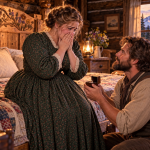
Wyatt slowly lowered himself onto one knee.
His injured knee.
Cora gasped.
“Wyatt! Your leg!”
He winced.
“Was hoping you’d overlook that.”
“Get up!”
“Not until you answer.”
“You’re impossible!”
“Been told.”
He held out the ring.
“Cora Whitfield, would you marry me?”
For one long moment, she couldn’t speak.
Then she dropped to her knees beside him.
Wyatt looked alarmed.
“What are you doing?”
“Joining you.”
“Floor’s cold.”
“So are you, half the time.”
He laughed.
Cora took his face between her hands.
“Wyatt Blackwood, I came to this mountain because I was running from my past.”
He listened.
“I thought I needed a place to hide.”
Her voice softened.
“But what I found was a man who gave me a place to belong.”
Wyatt’s eyes glistened.
She smiled through her tears.
“Yes.”
He stared.
“Yes?”
“Yes, you stubborn mountain bear. I’ll marry you.”
Wyatt let out a breath he seemed to have been holding for weeks.
Then he slipped the ring onto her finger.
It fit perfectly.
Cora looked at it.
Then at him.
“How did you know my size?”
Wyatt hesitated.
“Borrowed one of your gloves.”
She narrowed her eyes.
“You went through my things again?”
He grinned.
“Only for honorable purposes.”
She laughed.
Then kissed him.
And this time, Wyatt was ready.
***
They were married on February 14, 1885.
The little church in Pine Hollow had never looked more cheerful.
Snow covered the rooftops.
Pine branches decorated the doorway.
A small fire warmed the building.
And nearly everyone in town attended.
Not because Wyatt Blackwood was particularly sociable.
He wasn’t.
Not because Cora Whitfield had become famous.
She hadn’t.
But because the story of the stubborn mountain man and his outspoken bride had traveled through every household in the valley.
People had heard about the stranger in the black coat.
The chase through the snow.
The dangerous creek.
The federal investigation.
And the woman who had somehow convinced Wyatt Blackwood to wash his own dishes.
That last detail impressed the town more than anything else.
Wyatt stood beside the preacher in a clean dark suit.
His beard had been trimmed.
His boots were polished.
And he looked as nervous as a man facing a charging grizzly.
Silas stood beside him.
The former hired gun had remained in Colorado after cooperating with the investigation.
Wyatt had offered him work repairing fences and helping with the livestock.
Silas had accepted.
Now he leaned toward Wyatt.
“You look pale.”
Wyatt grunted.
“Fine.”
“Hands shaking.”
“Cold.”
“Church is warm.”
Wyatt glared.
Silas smiled.
“Just saying.”
Then the church doors opened.
And Wyatt forgot how to breathe.
Cora stood in the doorway.
She wore a simple cream-colored wedding dress, with lace at the collar and sleeves.
Her brown hair was pinned beneath a small veil.
In her hands she carried a bouquet of winter greenery and white flowers.
She was smiling.
Not the sharp, mischievous smile Wyatt had first seen beside his filthy kitchen table.
Something softer.
Something full of hope.
Wyatt stared.
Silas nudged him.
“Close your mouth.”
Wyatt did.
Then opened it again.
“She’s beautiful.”
Silas smiled.
“That she is.”
Cora walked down the aisle.
When she reached Wyatt, she noticed his expression.
“Mr. Blackwood.”
He swallowed.
“Miss Whitfield.”
“Are you planning to faint?”
“Considering it.”
She laughed.
“Try not to. I’d hate to carry you out before the ceremony.”
Wyatt smiled.
And the preacher cleared his throat.
The vows were simple.
The promises sincere.
When the preacher asked Wyatt whether he would love, honor, and cherish Cora, the mountain man answered so firmly that several people smiled.
“I will.”
When he asked Cora the same, she looked into Wyatt’s eyes.
“I will.”
Then came the final question.
“Do you, Wyatt Blackwood, take this woman to be your lawful wedded wife?”
Wyatt didn’t hesitate.
“With everything I’ve got.”
The preacher blinked.
Then smiled.
“I believe that qualifies.”
Laughter filled the church.
When the ceremony ended, Wyatt kissed his bride.
The congregation applauded.
And for the first time in eleven years, Wyatt Blackwood stood in a room full of people and felt that he belonged among them.
***
Spring arrived slowly in the Colorado mountains.
Snow melted along the creek.
Wildflowers appeared beneath the pines.
Birdsong returned to the valley.
And the Blackwood cabin became almost unrecognizable.
Cora planted a vegetable garden.
Wyatt built a proper storage shed.
They repaired the porch.
Added shelves.
And converted a small corner of the cabin into a reading area.
Cora filled it with books.
Wyatt complained that there were too many.
Then began reading them himself.
One evening, Cora found him absorbed in a novel.
She stood in the doorway.
“Mr. Blackwood.”
He looked up.
“What?”
“Reading?”
“Apparently.”
“For pleasure?”
“Don’t spread it around.”
She laughed.
He returned to his book.
Then, after a moment, he looked up again.
“Cora?”
“Yes?”
“This fellow in the story is an idiot.”
She smiled.
“Which fellow?”
“The one who keeps pretending he doesn’t love the woman.”
Cora crossed her arms.
“Sounds familiar.”
Wyatt looked at her.
Then slowly smiled.
“Suppose it does.”
She approached him.
He pulled her gently onto his lap.
And they sat together while the evening light faded over the mountains.
***
In June, a letter arrived from St. Louis.
Cora recognized Jonathan Hale’s handwriting immediately.
She opened it with trembling fingers.
Wyatt stood beside her.
“Good news?”
“I don’t know yet.”
She read.
Then read again.
Her eyes filled with tears.
Wyatt grew concerned.
“Cora?”
She looked up.
“The inquiry.”
He waited.
“They’ve confirmed the falsified records. Several company officials have been charged with fraud and conspiracy.”
Wyatt nodded slowly.
“And Pembroke?”
“Removed from his judicial position while separate proceedings continue.”
She swallowed.
“Voss has agreed to testify about the people who hired him.”
Wyatt placed a hand on her shoulder.
Cora continued reading.
Then stopped.
At the bottom of the letter was a final paragraph.
She read it aloud.
“Dr. Samuel Whitfield’s records have become an important part of the investigation. His careful work helped establish facts that would otherwise have remained concealed. Although the legal process is not yet complete, his contribution has been formally acknowledged.”
Cora lowered the letter.
For several seconds, she couldn’t speak.
Then she began crying.
Wyatt held her.
Not because the tears frightened him.
Not because he wanted to stop them.
But because he understood that some grief needed room to breathe.
When she finally looked up, he gently wiped her cheeks.
“He’d be proud of you.”
Cora shook her head.
“He was the brave one.”
Wyatt looked at her.
“Maybe.”
Then he smiled.
“But you’re the one who carried his work across half the country.”
She laughed through her tears.
“With a suitcase full of books.”
“And a revolver.”
“And a terrible temper.”
Wyatt nodded solemnly.
“Terrible.”
She swatted his arm.
He laughed.
Then kissed her forehead.
And together, they placed the letter beside Samuel’s photograph on the mantel.
Not as a reminder of fear.
But as a reminder that truth, once protected long enough, could finally find its way into the light.
***
By autumn, Wyatt’s leg had improved.
He still limped on cold mornings.
Still needed his walking stick on steep trails.
And still occasionally tried to do more than his physician recommended.
But he no longer hid the pain.
He told Cora when he needed help.
He rested when he had to.
And he discovered that accepting kindness did not make him less of a man.
One afternoon, Cora found him sitting on the porch.
He was watching the valley.
She approached with two cups of coffee.
“Something on your mind?”
Wyatt accepted a cup.
“Just thinking.”
“Again?”
“Dangerous habit.”
She sat beside him.
For a while, they watched the sun move across the mountains.
Then Wyatt spoke.
“Remember the first day you arrived?”
Cora laughed.
“How could I forget?”
“You called me a bear in trousers.”
“You were behaving like one.”
He nodded.
“Fair.”
She smiled.
“And you told me you’d paid fifty dollars for a quiet wife.”
Wyatt winced.
“Not my finest moment.”
“No.”
She leaned against his shoulder.
“But I think you got a reasonable bargain.”
Wyatt turned toward her.
“A bargain?”
“Certainly. You received a wife who cooks, cleans, reads, argues, and occasionally rescues you from your own foolishness.”
He considered this.
“Sounds expensive.”
She laughed.
“And what did I receive?”
Wyatt looked at her.
“A man with a bad leg and two stubborn mules.”
Cora shook her head.
“No.”
He waited.
She took his hand.
“I received a home.”
Wyatt’s expression softened.
“And a husband who listens when it matters.”
He smiled.
“Still working on that.”
“Yes, you are.”
She rested her head against him.
After a while, Wyatt spoke again.
“Cora?”
“Yes?”
“I need to confess something.”
She lifted her head.
“What?”
He looked embarrassed.
“That first night.”
She frowned.
“What about it?”
“When you told me to carry the pelts outside…”
“Yes?”
“I thought about putting you back on the wagon.”
Cora stared.
Then burst into laughter.
“You did not!”
“Did.”
“For how long?”
“About thirty seconds.”
She laughed harder.
“What changed your mind?”
Wyatt looked at her.
Then smiled.
“You started making biscuits.”
Cora slapped his shoulder.
“Wyatt Blackwood!”
He caught her hand and kissed it.
“Best decision I ever made.”
***
The following winter was colder than the one before.
Snow piled against the cabin walls.
The creek froze.
The wind howled through the valley.
But inside the Blackwood home, the fire burned warmly.
There were clean blankets.
Fresh bread.
Books on the shelves.
A sturdy table.
And two chairs beside the hearth.
Not one.
Two.
On Christmas Eve, Cora stood beside the window, watching snow fall through the darkness.
Wyatt approached from behind.
He wrapped his arms around her waist.
“Cold?”
“A little.”
He pulled her closer.
“Better?”
“Much.”
They stood in silence.
Then Cora turned.
“Wyatt?”
“Yes?”
“I have something to tell you.”
He looked concerned.
“What is it?”
She smiled nervously.
“I went to see the doctor in town last week.”
Wyatt stiffened.
“Are you sick?”
“No.”
“Something wrong?”
“No, Wyatt.”
She took his hand.
Placed it gently against her stomach.
And looked into his eyes.
For a moment, he didn’t understand.
Then his expression changed.
“Cora…”
She nodded.
“We’re going to have a baby.”
Wyatt went completely still.
The fire crackled.
Snow tapped against the window.
Somewhere outside, Matilda the mule brayed.
But Wyatt heard none of it.
He stared at his wife.
Then at her stomach.
Then back at her face.
“A baby?”
Cora laughed softly.
“That’s generally what the doctor called it.”
Wyatt swallowed.
“You’re certain?”
“Quite certain.”
He sat down abruptly.
Cora looked alarmed.
“Wyatt?”
He stared into the fire.
Then slowly covered his face with both hands.
For one terrible moment, Cora thought something was wrong.
She knelt before him.
“Wyatt?”
His shoulders trembled.
She touched his arm.
“Are you all right?”
He lowered his hands.
And Cora saw tears running down his cheeks.
Wyatt Blackwood.
The mountain man who had survived wolves, blizzards, hunger, and two days crawling through snow with a broken leg.
The man who rarely complained.
Rarely admitted fear.
Rarely allowed anyone to see him vulnerable.
Was crying.
Cora’s own eyes filled.
“Oh, Wyatt.”
He looked at her.
“A baby.”
She nodded.
“Our baby.”
He reached for her.
Pulled her gently into his arms.
And held her as though she were the most precious thing in the world.
For a long time, neither spoke.
Then Wyatt whispered something against her hair.
Cora pulled back.
“What did you say?”
His voice broke.
“I said I won’t be alone anymore.”
Cora’s heart ached.
She took his face between her hands.
“Wyatt Blackwood.”
He looked at her.
“You haven’t been alone since the day I walked through that door.”
He smiled through his tears.
“I know.”
She kissed him.
Then rested her forehead against his.
“And you never will be.”
***
Their daughter was born the following August.
They named her Hope Samuel Blackwood.
Hope, because she represented everything they had almost lost.
Samuel, because Cora wanted her child to grow up knowing the name of the good man whose courage had helped make their future possible.
Wyatt cried when he held her for the first time.
He tried to hide it.
Failed completely.
And didn’t particularly care.
Cora watched from the bed as he cradled the tiny bundle in his enormous hands.
He looked terrified.
“She’s very small.”
Cora smiled tiredly.
“Most babies are.”
“What if I drop her?”
“You won’t.”
“What if she cries?”
“She will.”
“What if she doesn’t like me?”
Cora laughed.
“Wyatt.”
He looked up.
“Yes?”
“She’s already holding your finger.”
He looked down.
The baby’s tiny hand had curled around one of his fingers.
Wyatt stopped breathing for a moment.
Then his face changed.
A smile spread slowly beneath his beard.
“Well, I’ll be.”
Cora watched him.
The man who had once believed nobody would notice if he disappeared into the snow was now holding a daughter who would grow up running toward him whenever he came home.
And the woman who had once traveled three hundred miles looking for somewhere to hide had found a place where she no longer needed to be afraid.
***
Years passed.
The cabin grew.
Wyatt added a second bedroom.
Then a larger kitchen.
Then a little porch where Cora liked to sit with her books.
Hope grew into a bright, curious child with her mother’s hazel eyes and her father’s stubborn determination.
She learned to read early.
She asked endless questions.
And by the age of five, she had developed the unfortunate habit of correcting her father’s grammar.
Wyatt blamed Cora.
Cora considered it a triumph.
Silas remained a trusted friend.
He eventually married a widow from Pine Hollow and settled on a small farm nearby.
Sheriff Mercer retired.
The settlement expanded.
And the old trail leading to the Blackwood cabin became a proper road.
But some things never changed.
Wyatt still disliked unnecessary conversation.
Cora still believed almost every problem could be improved by a clean kitchen and a serious discussion.
Matilda the mule remained impossible.
And every winter, when snow began falling over the mountains, Wyatt remembered the woman who had stepped down from a stagecoach wearing a red dress and carrying far too many books.
One December evening, many years after their wedding, Hope sat beside the fireplace while Cora prepared supper.
Wyatt occupied his usual chair.
His beard had turned silver.
His leg still ached when storms approached.
But his eyes were warm.
Hope looked up from her book.
“Papa?”
“Yes, sweetheart?”
“Is it true you paid fifty dollars for Mama?”
Wyatt froze.
Across the room, Cora stopped stirring the stew.
A dangerous smile appeared on her face.
“Oh, this should be interesting.”
Wyatt cleared his throat.
“Well…”
Hope leaned forward.
“Did you?”
He looked toward Cora.
She folded her arms.
“Go on, Mr. Blackwood.”
Wyatt sighed.
“Technically, I paid fifty dollars to a marriage agency.”
Hope frowned.
“Why?”
“Because I was looking for a wife.”
“Why didn’t you just ask Mama?”
Cora laughed.
Wyatt rubbed his beard.
“Hadn’t met her yet.”
Hope considered this.
Then asked the question that would become a family favorite.
“Was she worth fifty dollars?”
Wyatt slowly turned toward Cora.
She raised an eyebrow.
“Careful.”
He smiled.
Then looked back at his daughter.
“No, sweetheart.”
Cora blinked.
Hope looked confused.
“No?”
Wyatt shook his head.
“Not even close.”
Cora stared.
Wyatt continued.
“Your mother was worth more than every dollar I ever earned. More than this land. More than the cabin. More than everything I owned.”
Hope smiled.
“Then why did you only pay fifty?”
Wyatt laughed.
“Because I didn’t know how lucky I was.”
Cora’s eyes filled with tears.
Hope thought about that for a moment.
Then nodded solemnly.
“That makes sense.”
She returned to her book.
Wyatt looked toward his wife.
Cora stood beside the stove, smiling through tears.
He held out his hand.
She crossed the room.
Took it.
And leaned down to kiss him.
“You’re getting sentimental in your old age,” she whispered.
Wyatt smiled.
“Must be your influence.”
“Naturally.”
He squeezed her hand.
Then looked around the room.
At the books.
The fire.
The supper cooking.
Their daughter reading beside the hearth.
And the woman who had turned a lonely cabin into a home.
For a moment, he remembered the winter before she arrived.
The silence.
The cold.
The long nights.
The fear that one day he might simply disappear and nobody would come looking.
Then he looked at Cora.
And realized how completely his life had changed.
He had once asked for a quiet wife.
A woman who would cook his meals, tend the fire, and never disturb his solitude.
Instead, he had received a woman who challenged him.
Argued with him.
Protected him.
Made him laugh.
Taught him to ask for help.
And loved him enough to refuse to let him hide from life.
Wyatt Blackwood had paid fifty dollars hoping to survive another winter.
What he found was a reason to look forward to every winter that followed.
***
EPILOGUE — THE LETTER HE NEVER SENT
In the spring of 1905, Cora discovered an old envelope while sorting through a wooden chest.
The paper had yellowed.
The edges were worn.
Across the front, in Wyatt’s familiar handwriting, were the words:
“To the woman who may someday share my home.”
Cora frowned.
She opened it.
Inside was a letter.
It had never been mailed.
She began reading.
“Dear Madam,
I am not a man of many words, and I do not know how to write the sort of letter a woman might wish to receive.
I have a cabin in the mountains, forty acres of land, and enough work to occupy two people.
I am not wealthy.
I am not particularly handsome.
My right leg gives me trouble, and I have grown accustomed to being alone.
But I have begun to wonder whether a man can become too accustomed to loneliness.
Sometimes, when the fire burns low, I find myself wishing there were another voice in the room.
Someone to tell me about her day.
Someone to disagree with me.
Someone who might laugh when I say something foolish.
I do not need a servant.
I do not want someone who is afraid of me.
I suppose what I really want is a companion.
Someone who might choose to stay.
If such a woman exists, I hope she finds her way here.
Sincerely,
Wyatt Blackwood.”
Cora read the letter twice.
Then a third time.
By the time she finished, tears had blurred the final lines.
She found Wyatt outside, sitting on the porch beneath the afternoon sun.
His hair was silver now.
His face carried the lines of many winters.
But when he looked up and saw her, his eyes softened exactly as they had twenty years earlier.
“What’s wrong?”
Cora held up the letter.
“Why didn’t you send this?”
Wyatt stared at it.
Then smiled faintly.
“Forgot about that.”
“Wyatt.”
He looked away.
“Didn’t think anybody would answer.”
Cora sat beside him.
She took his hand.
“You should have sent it.”
He shrugged.
“Sent the other one instead.”
“The one asking for a quiet wife?”
“That one.”
Cora laughed through her tears.
“That was a terrible advertisement.”
“Worked, though.”
She looked at him.
Then leaned against his shoulder.
“Yes,” she whispered.
“It did.”
Wyatt wrapped an arm around her.
For a while, they sat quietly.
The mountains rose beyond the valley.
The creek shimmered in the sunlight.
Their daughter was laughing somewhere behind the cabin.
And the old house stood warm and welcoming beneath the pines.
Finally, Cora spoke.
“Wyatt?”
“Yes, sweetheart?”
“Did you ever regret marrying a woman who refused to obey?”
He turned toward her.
A familiar smile appeared beneath his silver beard.
“Every time you tell me to wash the dishes.”
She laughed.
Then he took her hand and kissed it.
“But not one other moment.”
Cora rested her head against his shoulder.
And Wyatt looked out over the mountains he had loved all his life.
He had survived storms that nearly killed him.
He had endured winters that seemed endless.
He had known loneliness so deep that silence itself became frightening.
But none of those things defined the life he would leave behind.
His life was defined by the woman who had walked into his cabin, picked up a filthy beaver pelt, and refused to accept that the world had to remain exactly as she found it.
She had changed his kitchen.
Then his habits.
Then his heart.
And finally, his entire future.
He had once believed that love meant finding someone who would fit quietly into the life he had already built.
Cora taught him something different.
Love meant making room.
For another voice.
Another dream.
Another person’s pain.
Another person’s courage.
And sometimes, for a woman in a red dress who arrived with two enormous suitcases and absolutely no intention of obeying a stubborn mountain man.
Wyatt smiled.
Then he whispered the words he had learned to say without fear.
“I love you, Cora.”
She lifted her head.
Her eyes were bright.
“I love you too, Wyatt.”
And beneath the Colorado mountains, in the home they had built together, the man who once paid fifty dollars for a quiet bride finally understood the greatest truth of his life.
He hadn’t bought a wife.
He had been given a chance to love someone.
And she had freely chosen to love him back.
THE END.