Part 2 – Full Ending: The Widow Who Saved Pine Ridge Ranch
Three hard knocks.
Metal against wood.
Cora stopped breathing for one terrible second.
The sound came again, faint beneath the screaming wind.
Clang. Clang. Clang.
“Harlan!”
She stumbled toward the cattle shed, dragging the iron poker through snow that reached her thighs. Her lungs burned. Ice had formed along her eyelashes, and the rope around her waist had tightened painfully beneath her coat.
Then she saw it.
The eastern side of the shed had collapsed.
Heavy roof beams lay twisted beneath a mountain of snow, and a broken section of fencing leaned against the remaining wall.
“Harlan!” she screamed.
A weak voice answered.
“Don’t come closer!”
Cora froze.
“Roof’s coming down,” Harlan shouted. “Get yourself back to the house!”
She almost laughed.
Even half buried in a blizzard, the stubborn old mountain man was still giving orders.
“Where are you?”
“Under the feed platform.”
She followed his voice around the broken wall.
What she found nearly stopped her heart.
Harlan was pinned beneath a fallen timber, his injured leg trapped under a beam thicker than Cora’s waist. Blood darkened the snow around his boot. Above him, the remaining roof sagged dangerously.
In his hand was an old horseshoe.
He had been striking it against a fence post, hoping someone might hear.
Cora dropped beside him.
“You foolish old man.”
Harlan managed a crooked smile.
“Been called worse.”
She examined the beam.
It would not move.
Not by hand.
Not with all the strength in her broad shoulders.
And the snow was still falling.
“Go home, Cora,” he whispered. “You got two children waiting.”
She looked him directly in the eyes.
“So do you.”
His expression changed.
For a moment, the wind seemed to disappear.
Then he looked away.
“Those children ain’t mine.”
Cora gripped his frozen hand.
“They’re yours if you choose to love them.”
A terrible cracking sound came from overhead.
The roof shifted.
Cora had seconds.
She shoved the iron poker beneath the fallen timber, wedged a flat stone under its handle, and threw her weight against the improvised lever.
Nothing.
She tried again.
The poker bent.
Harlan cried out as the beam shifted against his leg.
“Stop!” he shouted. “You’ll break yourself!”
Cora planted both boots in the snow.
Her shoulders trembled.
Her back screamed.
She thought of Arthur, buried beneath a mountain.
She thought of the mining company handing her three silver dollars.
She thought of the people who had looked at her large body and decided she was worth less than other women.
Then she remembered Harlan’s first words.
I need a cook.
Your kids need a home.
“No,” she whispered.
She pushed again.
This time, the timber moved.
Only two inches.
But two inches were enough.
“Harlan! Pull!”
The old man dragged his injured leg free with a cry that vanished into the storm.
Cora released the poker.
The timber slammed into the snow.
A heartbeat later, the remaining roof collapsed.
Cora threw herself over Harlan.
Wood splintered behind them.
Snow exploded across her back.
For several seconds, neither moved.
Then Harlan coughed.
“You alive?”
Cora lifted her head.
“Unfortunately for you.”
He gave a weak laugh.
And then he fainted.
Cora stared at the unconscious man.
The cabin was nearly a quarter mile away.
The storm had erased every landmark.
Harlan weighed almost two hundred pounds.
And she had no horse, no sled, and no one to help her.
For the first time since Arthur’s death, Cora felt something close to surrender.
She could save him from the beam.
But could she carry him through the mountain?
Then she remembered the rope around her waist.
And the broken cattle gate lying beneath the snow.
She pulled the gate free, turned it flat, and dragged it beside Harlan.
A sled.
Crude.
Heavy.
But possible.
It took nearly twenty minutes to roll him onto it and secure his body with the rope.
By then, her fingers had gone numb.
She could barely feel her feet.
Still, she tied the rope across her chest, leaned forward, and pulled.
The gate moved six inches.
Then another six.
Cora dragged Harlan through the whiteout one agonizing step at a time.
Twice she fell.
Once she sank into a hidden ditch and nearly lost the rope.
Every time, she climbed back up.
She did not know how long she struggled.
She only knew that somewhere behind the snow was a warm stove, an eight-year-old boy, and a little girl who believed her mother could fix anything.
Then she heard a bell.
A tiny, uneven ringing.
Cora raised her head.
Through the storm, a yellow light flickered.
The cabin.
And beside the door stood Will.
He was holding his father’s old brass dinner bell.
His little sister stood behind him, wrapped in a blanket.
“Ma!” Will screamed.
Cora tried to answer.
But her knees gave way.
She fell into the snow ten yards from the porch.
The last thing she heard was her son’s voice.
“Bessie! Get the blankets! Ma brought Grandpa home!”
Grandpa.
The word reached Harlan before consciousness fully returned.
And somewhere inside his frozen chest, something that had been dead for twenty years began to stir.
When Cora woke, the cabin smelled of smoke, wet wool, and boiling water.
She was lying beside the stove.
Her boots had been removed.
Warm blankets covered her body.
Will sat beside her, holding a cup with both hands.
“Ma?”
Cora tried to sit up.
“Harlan?”
Will pointed toward the bed.
“He’s breathing.”
Across the room, Harlan lay beneath three quilts.
His leg had been splinted with two pieces of kindling and wrapped in clean linen.
Cora stared at the work.
“Who did that?”
Will straightened proudly.
“You showed me how to wrap Bessie’s ankle when she fell last month.”
Cora looked at her son.
Then at the little girl sleeping against Harlan’s shoulder.
And she began to cry.
Not because she was frightened.
Not because she was tired.
But because, for the first time since Arthur died, she realized she was not carrying the whole world alone.
The storm lasted four days.
By the time the sky cleared, Pine Ridge Ranch had changed forever.
Harlan survived.
But his leg would never properly heal.
The doctor from Oak Haven arrived on horseback and examined him with a grim expression.
“No more climbing roofs,” he ordered. “No more lifting feed sacks. No more pretending you’re thirty.”
Harlan grunted.
“Could’ve told me that without charging two dollars.”
The doctor turned toward Cora.
“Mrs. Dotson, you saved his life.”
She shook her head.
“Will kept the fire going. Bessie brought the blankets.”
The doctor smiled.
“And you?”
Cora glanced at Harlan.
“I did what needed doing.”
But surviving the storm was only the beginning.
Three weeks later, a stranger arrived at the ranch.
He wore a black wool coat, polished boots, and a smile that never reached his eyes.
His name was Silas Vane.
He represented the Oak Haven Land and Cattle Company.
And he carried a folded document bearing Harlan’s signature.
“Mr. Croft,” Vane announced, “your outstanding debt has come due.”
Harlan’s face turned pale.
Cora noticed immediately.
“What debt?”
Vane opened the paper.
“Eight hundred dollars, including accumulated interest and penalties.”
The cabin fell silent.
Eight hundred dollars.
It might as well have been eight thousand.
Harlan slowly lowered himself into a chair.
“That’s impossible.”
Vane smiled.
“I’m afraid the agreement is quite clear.”
Cora stepped forward.
“Let me see it.”
The man hesitated.
“Madam, this is a business matter.”
“Then it ought to survive being read.”
She held out her hand.
Vane reluctantly surrendered the document.
Cora examined the writing.
She had spent years helping Arthur keep accounts for the mining company before he died.
She understood numbers.
She understood interest.
And she understood when a man was trying to bury another man beneath paper instead of stone.
“This original loan was four hundred dollars,” she said.
“Correct.”
“And Harlan paid one hundred and eighty last spring.”
“Toward the balance, yes.”
“Then why is the principal still listed as four hundred?”
Vane’s smile weakened.
“Administrative charges.”
Cora looked at the document again.
The figures had been altered.
A different ink had been used.
And one of the dates had been written over.
She looked up.
“You’ve been stealing from him.”
Harlan stared at her.
Vane’s expression hardened.
“Be careful, Mrs. Dotson.”
Cora folded the paper.
“I’m being very careful.”
The man took a step toward her.
“You have thirty days to settle the debt. Otherwise, the company takes possession of this property.”
He turned toward Harlan.
“And with your condition, I doubt you’ll be able to stop us.”
After he left, the cabin remained silent.
Finally, Harlan spoke.
“I should’ve told you.”
Cora looked at him.
“How long?”
“Three years.”
“Why?”
He stared at the floor.
“Bad cattle prices. Two winters without enough hay. Borrowed money to keep the herd alive.”
He swallowed.
“Thought I could work my way out.”
Cora sat opposite him.
“You were trying to save the ranch.”
He nodded.
“And now I’ve brought you and the children into a losing fight.”
Cora looked around the cabin.
At the clean floor.
The polished stove.
The curtains she had sewn from old flour sacks.
At Will’s boots drying beside the fire.
At Bessie’s drawings hanging above the table.
Then she turned back to Harlan.
“No,” she said quietly.
“You brought us home.”
That evening, after the children were asleep, Cora took out Arthur’s old account book.
She sharpened a pencil.
Lit another lamp.
And began calculating.
Harlan watched her from his chair.
“What are you doing?”
“Finding eight hundred dollars.”
He gave a humorless laugh.
“Good luck.”
Cora did not look up.
“Luck’s for people who don’t know how to work.”
For three nights, she studied every expense and every possible source of income.
Harlan owned sixty-three cattle.
Twenty-seven were ready for market by spring.
He had twenty acres of neglected pasture.
A smokehouse.
An old orchard.
And a stream that ran through the lower valley even in winter.
What he did not have was a plan.
Cora made one.
The next morning, she gathered everyone around the kitchen table.
“Will, you’re going to help me repair the chicken coop.”
Will frowned.
“We don’t have chickens.”
“We will.”
“Bessie, you’re going to help me sort the seed jars.”
The little girl clapped.
“Harlan, you’re going to sit down and tell me everything you know about that lower pasture.”
Harlan raised an eyebrow.
“And who’s running the ranch?”
Cora tied her apron.
“We are.”
By February, the first changes had begun.
Cora traded preserved apples for twelve laying hens.
She exchanged mending work for seed potatoes.
She sold fresh bread to passing timber crews.
Will repaired broken fence rails with Harlan’s guidance.
Bessie collected eggs, counted them carefully, and announced herself the ranch’s official bookkeeper.
But Cora’s boldest decision came when she discovered the abandoned smokehouse.
Its roof leaked.
Its chimney was blocked.
And its shelves had not been used in years.
She stood inside for a long time.
Then she smiled.
“Harlan,” she called, “how many ranches between here and Oak Haven have a proper smokehouse?”
He considered.
“Not many.”
“And how many men spend winter eating hard biscuits and spoiled meat?”
“Most of them.”
Cora turned.
“Then we’re going to feed them.”
Within six weeks, Pine Ridge Ranch was selling smoked beef, cured pork, bread, and jars of preserved vegetables to nearby mining and timber camps.
Cora negotiated every contract herself.
Some men laughed when they saw her.
A heavy widow in a faded apron, speaking business across a table of rough-handed ranchers.
But they stopped laughing when they tasted her food.
And they listened when she named her price.
One timber foreman ordered fifty pounds of smoked beef.
A mining camp ordered bread twice a week.
The Oak Haven general store agreed to stock her preserves.
For the first time in years, money began coming into Pine Ridge faster than it went out.
Harlan watched the transformation in disbelief.
One evening, he found Cora standing over the account book.
“How much?” he asked.
She looked up.
“Two hundred and seventeen dollars.”
He nearly dropped his coffee.
“In six weeks?”
“In six weeks.”
Harlan lowered himself into a chair.
Then he laughed.
A deep, astonished laugh that made Bessie come running from the bedroom.
“What’s funny, Grandpa?”
He wiped his eyes.
“Your mother’s making more money with a stove than I ever made with sixty head of cattle.”
Bessie nodded solemnly.
“That’s because Mama knows things.”
Harlan looked at Cora.
“Yes,” he whispered.
“She surely does.”
But Silas Vane was not finished.
In March, he returned with two men and a wagon.
This time, he carried a notice demanding immediate payment.
“The company has decided not to extend the deadline,” he announced.
Cora stepped onto the porch.
“You gave us thirty days.”
“Thirty days have passed.”
“You’re three days early.”
Vane’s smile vanished.
“Mrs. Dotson, I suggest you stay out of matters beyond your understanding.”
Cora walked down the steps.
She held Arthur’s account book in one hand.
And Harlan’s loan agreement in the other.
“I went to Oak Haven last week,” she said.
Vane stiffened.
“I spoke to the county clerk.”
Silence.
“I also spoke to the banker who recorded Harlan’s original loan.”
Vane’s eyes narrowed.
“And?”
Cora unfolded a certified copy of the original agreement.
“The lawful balance is two hundred and twenty dollars, not eight hundred.”
One of Vane’s men shifted uneasily.
Cora continued.
“The clerk found no recorded amendment authorizing those extra charges. And the banker confirmed that Harlan’s payments were never properly credited.”
Vane’s face darkened.
“You’re making a serious accusation.”
“No,” Cora said.
“I’m presenting serious evidence.”
She stepped closer.
“If you try to seize this ranch using that altered document, the county attorney will hear about it.”
For the first time, Silas Vane looked uncertain.
Then he smiled again.
“You still owe two hundred and twenty dollars.”
Cora reached into her apron pocket.
She pulled out a small leather purse.
And counted the money into his hand.
Every dollar.
Every coin.
The last twenty cents.
Vane stared.
Cora held out her other hand.
“The signed receipt, please.”
He hesitated.
“Now,” she said.
One of his men looked away to hide a smile.
Vane signed the receipt against the side of the wagon.
Cora inspected it carefully.
Then she stepped back.
“Pine Ridge Ranch is no longer your concern.”
The wagon rolled away.
Harlan stood on the porch, gripping his cane.
He had not spoken throughout the exchange.
Now he looked at Cora as though he were seeing her for the first time.
“You paid it?”
She nodded.
“All of it.”
He stared toward the disappearing wagon.
Then slowly removed his hat.
“Cora, I don’t know what to say.”
She folded the receipt.
“Then don’t say anything.”
But Harlan did something she never expected.
He began to cry.
The old mountain man who had survived blizzards, cattle drives, broken bones, and twenty lonely winters stood in the spring sunshine with tears running down his weathered cheeks.
“I thought I’d die watching them take this place,” he whispered.
Cora placed a hand on his arm.
“Not while I’m here.”
He looked at her.
And for the first time, he understood that she had not simply saved his ranch.
She had given him a reason to live long enough to see it flourish.
Spring arrived slowly in Pine Ridge.
The snow retreated from the valley.
Green grass pushed through the thawing earth.
The creek swelled with mountain water.
And the ranch began to bloom.
Cora planted potatoes, beans, squash, onions, and herbs.
Will helped Harlan repair the barn.
Bessie named every chicken and insisted that the largest hen, Matilda, was the true owner of the property.
By June, the smokehouse was operating six days a week.
Cora hired two widows from Oak Haven to help prepare food.
Both had been turned away from other work because they were considered too old, too poor, or too inconvenient.
Cora paid them fairly.
When one woman asked why she was being so generous, Cora answered simply.
“Because I know what it feels like when the world decides you’re worth nothing.”
Word spread.
Pine Ridge Ranch became known not only for its cattle but for its smoked meats, preserves, fresh bread, and honest business.
Travelers began stopping for meals.
Ranchers brought orders.
Timber crews came down from the mountains with empty sacks and returned with food.
And every evening, Harlan sat on the porch, watching the place he had nearly lost come back to life.
But the greatest change was not in the land.
It was in the children.
Will grew taller.
His cheeks filled out.
The newspaper disappeared from his boots, replaced by a sturdy pair Harlan bought him after the spring cattle sale.
Bessie stopped waking in the night crying for her father.
She still missed Arthur.
They all did.
But grief no longer occupied every corner of the house.
One warm evening, Harlan found Will repairing a broken harness beside the barn.
The boy worked carefully, his tongue pressed against his lip.
Harlan watched for a moment.
“Your father teach you that?”
Will shook his head.
“No, sir.”
“Who did?”
“You.”
Harlan swallowed.
The boy continued working.
Then he asked a question that nearly brought the old man to his knees.
“Grandpa, when I’m grown, can I help run Pine Ridge?”
Harlan stared at him.
“Why would you want to?”
Will looked surprised.
“Because it’s our ranch.”
Our ranch.
Harlan turned away before the boy could see his face.
For twenty years, he had believed he would die alone.
Now an eight-year-old child was planning a future that included him.
But happiness rarely arrived on the frontier without testing those who dared to trust it.
In August, disaster returned.
A lightning storm swept across Pine Ridge during the driest week of summer.
At midnight, a bolt struck the upper meadow.
Within minutes, flames raced through the grass toward the winter hay.
Will saw the orange glow first.
“Fire!”
The cabin erupted into motion.
Harlan grabbed his cane.
Cora seized two blankets and a bucket.
The hired hands ran toward the pasture.
But the wind was strong.
And the flames were moving faster than men could run.
If the hay burned, the cattle would starve that winter.
If the fire reached the barn, the entire ranch could be lost.
Harlan tried to mount his horse.
His injured leg buckled.
He fell against the fence.
Cora caught him.
“You stay here!”
“I can’t watch my ranch burn!”
“Then help me save it without getting yourself killed!”
She turned toward Will.
“Take Bessie to the creek. Stay with her.”
Then she shouted to the men.
“Cut the grass between the fire and the hay! Dig down to bare earth!”
The workers hesitated.
Cora pointed toward the lower pasture.
“Open the irrigation ditch!”
Years earlier, Harlan had dug a shallow channel from the creek to water the fields.
It had not been used in seasons.
But Cora remembered it.
And she remembered the wooden gate controlling the flow.
“Harlan!” she shouted. “Can that channel still carry water?”
He looked toward the ditch.
“Maybe!”
“Then open it!”
The old man limped toward the gate with one of the hired hands.
Cora and the others dug desperately, throwing soil over the advancing flames.
Smoke filled her lungs.
Heat scorched her face.
The fire came closer.
Twenty yards.
Fifteen.
Ten.
Then someone shouted from the creek.
“Water!”
A dark stream surged through the old irrigation channel.
It spilled into the dry grass and soaked the ground beside the hayfield.
Cora directed the workers to widen the channel.
The water spread.
The flames reached the wet earth.
Hissed.
Faltered.
And finally stopped.
By dawn, the upper meadow was black.
The ranch had lost several acres of grass.
But the barn stood.
The hay remained safe.
The cattle were alive.
And the house still stood beneath the first pale light of morning.
Cora sat on an overturned bucket, covered in soot.
Harlan approached slowly.
He looked across the blackened field.
Then at the woman who had saved his life, paid his debt, rebuilt his business, and now protected his land from fire.
“You know,” he said quietly, “I hired you to cook.”
Cora laughed tiredly.
“So you’ve mentioned.”
He lowered himself beside her.
“I reckon I got more than I bargained for.”
She looked at him.
“So did I.”
They sat together as the sun rose over Pine Ridge.
Neither spoke for a long time.
Then Harlan reached into his coat.
He removed a folded paper.
“I’ve been meaning to give you this.”
Cora opened it.
It was a deed.
A legal transfer of one-half ownership of Pine Ridge Ranch.
Her name stood beside his.
Cora Dotson.
She stared at the paper.
“Harlan…”
“I had it drawn up in town last month.”
She shook her head.
“I can’t accept this.”
“You can.”
“I came here because you needed a cook.”
“And I needed someone to remind me I was still alive.”
He took off his hat.
“You earned every board in that house, every acre of this land, and every breath of peace I’ve had since you arrived.”
Cora’s eyes filled.
“I never wanted your property.”
“I know.”
He smiled gently.
“That’s why I trust you with it.”
She looked down at the deed again.
For years, people had judged her by her size.
They had called her a burden.
A woman too large to be graceful.
Too poor to be important.
Too ordinary to deserve anything better.
Now an old mountain man was offering her something she had never expected.
Not charity.
Not pity.
Not a temporary roof.
A place that belonged to her.
She pressed the paper against her chest.
And wept.
Autumn returned to Pine Ridge with golden leaves and crisp mountain mornings.
The ranch had become a thriving business.
Cora’s smoked beef was sold in three towns.
Her preserves traveled with freight wagons as far as the next county.
The orchard had produced its first successful harvest in years.
The cattle were healthy.
The barns were repaired.
And the smokehouse had been expanded.
But one unfinished matter remained.
On a cold October morning, Cora rode into Oak Haven alone.
She carried a small purse.
Inside were three silver dollars.
The same three dollars the mining company had given her after Arthur died.
She had kept them separate from every other coin.
Not because she needed the money.
But because she had never forgotten what they represented.
At the edge of town stood the small cemetery where Arthur’s name had been carved into a modest stone.
His body had never been recovered from the collapsed tunnel.
The stone was all she had been able to give him.
Cora knelt beside it.
She brushed away fallen leaves.
Then placed the three silver dollars at its base.
“Arthur,” she whispered, “the children are safe.”
Her voice trembled.
“Will’s growing strong. Bessie laughs again. They have warm beds and enough to eat.”
She swallowed.
“And there’s a man who loves them like his own.”
The wind moved softly through the trees.
Cora closed her eyes.
“I thought surviving without you meant leaving you behind.”
A tear rolled down her cheek.
“But I know now that loving them well is how I keep loving you.”
She stayed for a long time.
Then rose, brushed the dirt from her skirt, and walked back toward her horse.
She did not take the coins.
For the first time, she no longer needed them to remind herself what she had survived.
When she returned to Pine Ridge, the children were waiting on the porch.
Bessie ran toward her.
“Mama! Grandpa says we’re having a celebration!”
Cora laughed.
“A celebration for what?”
Will grinned.
“Come see!”
Inside, the cabin had been decorated with pine branches and autumn flowers.
The table was covered with fresh bread, roast beef, apple preserves, and a large cake that leaned slightly to one side.
Harlan stood beside it wearing his best shirt.
His beard had been trimmed.
His boots were polished.
And he looked more nervous than he had during the blizzard.
Cora stopped.
“What’s all this?”
Harlan cleared his throat.
“Been a year since you came to Pine Ridge.”
She looked around.
“A year?”
“Near enough.”
Bessie tugged at her sleeve.
“Grandpa made the cake!”
Cora stared at the crooked dessert.
“You baked?”
Harlan frowned.
“Don’t look so surprised.”
Will whispered loudly.
“He burned the first one.”
Everyone laughed.
Then Harlan stepped forward.
His hands trembled slightly.
“Cora, I’ve spent most of my life thinking a home was land and timber and a roof that didn’t leak.”
He looked at the children.
“Turns out I was wrong.”
Cora’s smile faded into something softer.
“A home is people,” he continued. “People who come looking when you’re lost. People who don’t leave when things get hard.”
He took a breath.
“You brought that here.”
Then he reached into his pocket.
Cora’s heart began to pound.
But Harlan did not produce a wedding ring.
Instead, he held out a small silver key.
“The new smokehouse,” he explained. “Had a proper lock put on it.”
Cora laughed through her tears.
“Harlan Croft, you nearly frightened me to death.”
He smiled.
“Wasn’t planning on doing that twice.”
Then he grew serious.
“I don’t know how many winters I’ve got left. Could be ten. Could be two. But however many there are, I want you and those children to know something.”
He placed the key in her palm.
“You’ll never have to earn your place here again.”
Cora looked at the key.
Then at the children.
Then at Harlan.
She stepped forward and embraced him.
The old man stood stiffly for one startled second.
Then his arms wrapped around her.
Will joined them.
Bessie squeezed between their legs.
And the four of them stood together in the warm kitchen while the fire crackled and the wind moved through the pines outside.
The following winter was the harshest Oak Haven had seen in fifteen years.
Snow buried the roads.
Rivers froze.
Several neighboring ranches lost cattle.
But Pine Ridge endured.
Its barns were strong.
Its hay was dry.
Its smokehouse was full.
And when struggling families came to the ranch seeking food, Cora did not turn them away.
She organized meals for stranded travelers.
Harlan offered shelter in the repaired bunkhouse.
Will helped distribute firewood.
Bessie carefully counted loaves of bread and insisted every child receive an extra biscuit.
By Christmas, people were calling Pine Ridge the warmest place in the valley.
Some remembered the old days.
The lonely mountain man.
The filthy cabin.
The widow with three silver dollars.
The children shivering in worn coats.
They could hardly believe it was the same ranch.
On Christmas Eve, the entire household gathered around the stove.
Snow fell gently beyond the windows.
Bessie sat on Harlan’s knee, holding a wooden horse he had carved for her.
Will was reading aloud from a book Cora had bought him.
The old mountain man listened with his eyes half closed.
Then Bessie looked up.
“Grandpa?”
“Yes, little bird?”
“Are you going to be here next Christmas?”
The room grew quiet.
Harlan glanced at Cora.
Then at Will.
Then at the fire.
“Well,” he said slowly, “I reckon that’s the plan.”
Bessie frowned.
“You promise?”
Harlan held her closer.
“I promise I’ll do my best.”
She considered this.
Then nodded.
“Good. Because Mama says family doesn’t leave people in the snow.”
Harlan’s eyes filled.
He looked across the room at Cora.
She smiled.
“No,” she said softly.
“We don’t.”
Years passed.
Pine Ridge Ranch grew beyond anything Harlan had imagined.
The small smokehouse became a proper business.
The orchard expanded.
The lower pasture was restored.
The ranch employed families who had once struggled to find work.
Will grew into a capable young man, learning cattle management from Harlan and business accounts from his mother.
Bessie became a bright, determined girl who loved horses, books, and telling visitors how her mother once dragged an old mountain man through a blizzard on a broken cattle gate.
Harlan always complained that she exaggerated the story.
Cora always reminded him that she left out the worst parts.
And every time the tale was told, the old man would smile.
Because he knew the truth.
He had gone into that storm believing he was a dying man with nothing left to offer the world.
He had returned to a home filled with love.
On the tenth anniversary of Cora’s arrival, the family gathered beneath the great pine tree overlooking the ranch.
Harlan was older now.
His hair had turned almost entirely white.
His limp had worsened.
But his eyes were bright.
Will stood beside him, taller than the old man himself.
Bessie, now a young woman, carried a basket of fresh apples.
Cora stood at the center of them all.
Her shoulders were still broad.
Her waist was still thick.
Her hands were rough from years of labor.
She had never become the delicate beauty Oak Haven once believed a woman ought to be.
And she had never needed to.
Harlan looked across the valley.
At the barns.
The orchards.
The cattle grazing in green pasture.
The smoke rising from the house.
Then he turned to Cora.
“Remember what I said when we first met?”
She smiled.
“You needed a cook.”
He nodded.
“And your kids needed a home.”
Cora looked at the ranch.
Then at the family surrounding her.
“You were right about one thing.”
“What’s that?”
“We all needed a home.”
Harlan reached for her hand.
And together, they watched the sun settle behind Pine Ridge.
Years later, when people told the story of the ranch, they spoke of the great blizzard, the dishonest debt collector, the summer fire, and the widow who transformed a failing homestead into one of the most respected properties in the valley.
But those who knew Cora best understood that the greatest miracle had never been the cattle, the money, or the land.
It was the way four lonely people had become a family.
A mountain man who thought his life was finished.
A widow who believed the world had forgotten her.
A little boy who needed someone to teach him how to grow into a good man.
And a little girl who needed to feel safe enough to laugh again.
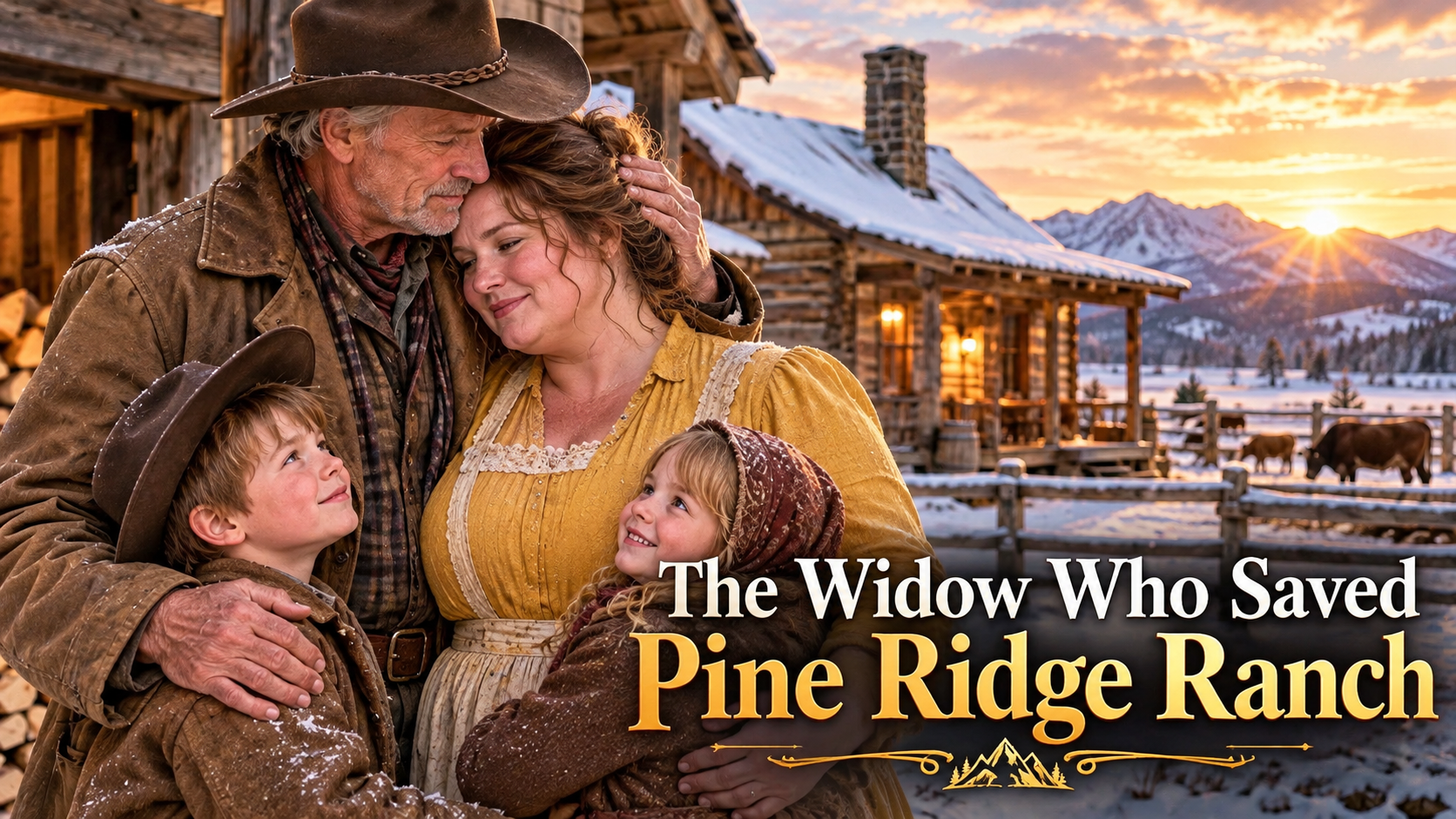
The story of Pine Ridge began with three silver dollars, a cold winter, and a bargain made out of desperation.
It ended with a family, a flourishing ranch, and a truth no hardship could erase.
Cora Dotson had not been too large to be loved, too poor to succeed, or too broken to begin again.
She had simply been waiting for a place where her strength would be recognized.
And Harlan Croft, the old mountain man who had once offered her nothing more than a job and a roof, had given her that place.
In return, she gave him something far greater than a clean house or a thriving ranch.
She gave him back his life.
And when winter came to Pine Ridge again, no one in that little cabin faced the cold alone.
The End.