PART 2: The Name She Tried to Bury
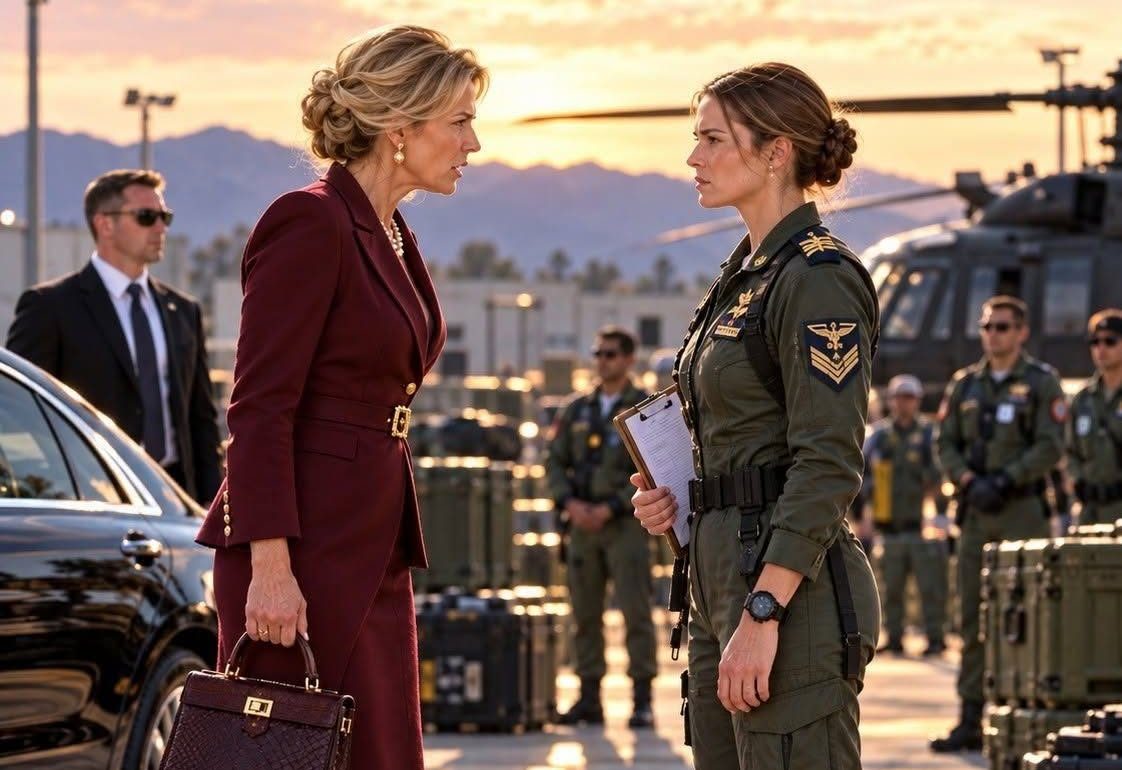
The four-star general looked at Vivian Harmon for exactly three seconds.
Then she said something that made the colonel’s wife turn pale.
“Hello, Evelyn.”
Nobody moved.
Not Private Dewitt. Not Private Salas. Not even the security officers who had begun approaching the black truck.
Vivian’s expensive handbag slipped slightly in her grip.
“My name is Vivian Harmon,” she replied sharply. “And I don’t know who you think you are.”
The general studied her face.
“Twenty-eight years,” she said quietly. “And you’re still pretending Evelyn Mercer never existed.”
I stood beside the barrier, my cheek throbbing, trying to understand what I had just heard.
The general turned toward me.
“Sergeant. Name.”
“Sergeant Katherine Conroy, ma’am.”
“Who ordered this road closed?”
“The garrison commander, General. Restricted airfield movement until sixteen hundred hours. Authorized vehicles only.”
“Was Mrs. Harmon’s vehicle authorized?”
“No, ma’am.”
“Then why is she standing on my restricted road?”
Before I could answer, Vivian stepped forward.
“General, this woman assaulted me. I expect her immediate removal and disciplinary action. My husband is Colonel Bruce Harmon, and I assure you—”
“I know who your husband is.”
The general’s voice wasn’t loud.
It didn’t need to be.
She glanced at my fallen cap, then at the red mark spreading across my left cheek.
“Sergeant Conroy, did this woman strike you?”
“Yes, ma’am.”
“Did you strike her?”
“No, ma’am.”
“Witnesses?”
“Two, ma’am.”
General Margaret Voss turned toward Dewitt and Salas.
Both young men snapped to attention.
“Privates. Did you witness Mrs. Harmon strike your sergeant?”
Salas answered first.
“Yes, General.”
Dewitt swallowed.
“Yes, ma’am.”
“Did Sergeant Conroy threaten her?”
“No, ma’am.”
“Then explain why I saw you attempting to remove your own noncommissioned officer from her assigned post.”
Dewitt’s face drained of color.
For one terrible second, I thought he might faint.
“General, Mrs. Harmon told us her husband could have us transferred if we didn’t obey.”
“And you believed her?”
Neither answered.
General Voss stepped closer.
“Listen carefully. A colonel’s spouse has no military command authority. Not over a private. Not over a sergeant. Not over anyone wearing this uniform.”
She paused.
“And the moment you allow someone’s social position to replace lawful orders, you become a danger to the soldiers standing beside you.”
Dewitt lowered his eyes.
“Yes, ma’am.”
“Return to your positions. Neither of you is to touch Sergeant Conroy.”
They moved immediately.
Then the general did something I hadn’t expected.
She bent down, picked up my cap, brushed the dust from its brim, and handed it back to me.
“Your uniform deserves better treatment than this, Sergeant.”
My throat tightened.
“Thank you, General.”
But Vivian was not finished.
“This is outrageous!” she shouted. “I have spent twenty years supporting this installation. I’ve raised money for military families. I’ve hosted generals in my home. You cannot humiliate me in front of enlisted personnel!”
General Voss looked at her.
“You’re right about one thing, Evelyn.”
Vivian froze.
“You have spent a very long time making people believe you’re someone else.”
The silence that followed seemed to swallow the entire airfield.
Then Vivian whispered, “You promised.”
The general’s expression changed.
Not to anger.
To something much colder.
“No,” she replied. “Your husband promised. I never did.”
I felt the hairs rise along my arms.
General Voss reached into the pocket of her field jacket and removed a folded photograph.
It was old.
The edges had yellowed, and a white crease ran across the middle.
She held it where Vivian could see.
I couldn’t make out the details, but I saw three women standing beside what appeared to be a military ambulance.
One wore a nurse’s uniform.
Another held a baby.
The third looked remarkably like Vivian Harmon.
Except she was much younger.
Vivian took a step backward.
“Where did you get that?”
“I kept it.”
“You had no right.”
“I had every right.”
The general folded the photograph again.
“Because I was there that night.”
Vivian’s mouth opened, but no words came out.
For the first time since her Mercedes arrived, she looked genuinely frightened.
General Voss turned toward one of the officers who had stepped out of the armored truck.
“Major Ellis, contact the installation commander. Tell him I need Colonel Bruce Harmon at Gate Six immediately. And request the military police duty officer.”
“Yes, General.”
Vivian lunged forward.
“You cannot call Bruce!”
General Voss didn’t flinch.
“Why not?”
“Because he’s preparing for his promotion board!”
“Then I suggest he arrives quickly.”
Vivian lowered her voice.
“Margaret. Please.”
The general’s eyes narrowed.
“You didn’t use that tone twenty-eight years ago.”
I had no idea what they were talking about.
But something about the photograph had changed everything.
Vivian’s anger had disappeared.
Now she looked like a woman standing at the edge of a cliff.
And then she turned toward me.
Not with contempt this time.
With something that looked disturbingly like recognition.
“Conroy,” she whispered.
Her eyes moved from my face to the name tape on my uniform.
“Katherine Conroy?”
I stiffened.
“Yes, ma’am.”
She stared at me.
“How old are you?”
I didn’t answer.
General Voss stepped between us.
“That question is not relevant to the gate incident.”
But Vivian kept staring.
“Forty-four?” she whispered. “Are you forty-four?”
My stomach tightened.
I had already given my age during an earlier identification check, but I couldn’t understand why it mattered to her.
Then Vivian said something I hadn’t heard anyone say in more than thirty years.
“Did your mother ever call you Katie Rose?”
My breath stopped.
Katie Rose.
That was what my mother called me when I was little.
Before she disappeared.
Before the foster homes.
Before I learned that some questions could follow you through an entire lifetime without ever receiving an answer.
I hadn’t heard that name since I was twelve.
“How do you know that?” I asked.
Vivian’s lips trembled.
General Voss closed her eyes briefly.
As though something she had feared for decades was finally happening.
“Sergeant Conroy,” she said, “I need you to remain calm.”
I looked from one woman to the other.
“What is going on?”
Vivian shook her head violently.
“No. No, Margaret. You don’t get to do this here.”
“Then you should have thought about that before striking her.”
“You don’t understand!”
“I understand more than you think.”
A siren sounded somewhere near the hangars.
The general lowered her voice.
“Twenty-eight years ago, at a military hospital in Germany, a young civilian woman disappeared after an emergency evacuation. Her records were altered. Her identity was buried. And an eight-year-old girl was told that her mother had abandoned her.”
My knees almost gave way.
Eight years old.
Germany.
My mother had disappeared when I was eight.
We had been living near an American military installation outside Frankfurt.
For years, I’d believed she’d simply walked away.
That was what the social worker told me.
That was what the documents said.
That was the story I had repeated to myself every time I wondered why she hadn’t come back.
I looked at Vivian.
Her face was wet with tears.
“No,” I whispered.
General Voss spoke carefully.
“Sergeant, your mother’s name was Rebecca Conroy.”
I felt the world tilt.
“How do you know my mother’s name?”
“Because she worked with me.”
Vivian made a broken sound.
The general continued.
“Rebecca was a civilian medical records specialist. She discovered evidence that emergency medical supplies intended for wounded service members were being diverted through a private contractor.”
I stared at her.
“That has nothing to do with me.”
“It does,” General Voss replied. “Because your mother refused to falsify the records.”
Vivian backed against the Mercedes.
“Stop talking.”
“And the person who helped conceal those shipments,” the general continued, “was a young administrative assistant named Evelyn Mercer.”
Vivian covered her mouth.
“She later changed her name,” General Voss said. “Married an ambitious Army officer. Became Vivian Harmon.”
I looked at the woman who had slapped me.
The woman who had called me trash.
The woman who had threatened two young soldiers simply because I wouldn’t open a gate.
“You knew my mother?”
Vivian began crying harder.
“I didn’t know who you were.”
“That wasn’t my question.”
She looked away.
General Voss answered for her.
“Yes, Sergeant. She knew your mother.”
My hands were trembling now.
I had spent thirty-six years believing Rebecca Conroy had abandoned me.
Every birthday.
Every Christmas.
Every time one of my children asked about their grandmother.
And now a four-star general was standing at my gate telling me that the woman who had destroyed my afternoon might know what happened to her.
“Where is she?” I whispered.
General Voss hesitated.
That hesitation frightened me more than anything she’d said.
“General. Where is my mother?”
Before she could answer, another vehicle approached.
A dark military SUV.
It stopped behind the armored truck.
Colonel Bruce Harmon climbed out.
He was tall, broad-shouldered, and immaculate in his uniform.
His eyes moved from his crying wife to General Voss.
Then to me.
And he stopped walking.
I watched the color leave his face.
He wasn’t looking at my bruised cheek.
He was looking at my eyes.
“Rebecca?” he whispered.
I couldn’t move.
General Voss turned slowly toward him.
“No, Colonel.”
Her voice was almost gentle.
“This is Rebecca’s daughter.”
Bruce Harmon grabbed the edge of his SUV door.
For several seconds, he seemed unable to breathe.
Then he looked at his wife.
“What have you done?”
Vivian shook her head.
“Bruce, I swear I didn’t recognize her.”
He stared at her.
“You struck her?”
She said nothing.
“You put your hands on Rebecca’s little girl?”
His voice cracked on the final word.
And suddenly I understood something terrible.
Colonel Harmon knew my mother, too.
General Voss stepped toward him.
“Colonel, we need to discuss the missing medical records from 1998.”
He looked at her.
“Margaret, please. Not here.”
“Twenty-eight years, Bruce. You’ve had twenty-eight years to tell the truth.”
He lowered his head.
Then he said something that made my blood run cold.
“I thought Rebecca was gone.”
General Voss went perfectly still.
“What do you mean, you thought?”
Bruce looked up.
His eyes filled with terror.
“Three weeks ago, I received a letter.”
Vivian gasped.
“Bruce, don’t.”
He ignored her.
“The letter contained a photograph. Rebecca was older. Her hair was gray. But it was her.”
I could barely hear him over the pounding of my heart.
“Are you saying my mother is alive?”
Bruce looked directly at me.
“I don’t know, Sergeant.”
Then he reached into his jacket and removed a small white envelope.
On the front, written in faded blue ink, were four words.
For my Katie Rose.
My childhood nickname.
In my mother’s handwriting.
I recognized it instantly.
My knees finally gave way, and I caught myself against the concrete barrier.
General Voss reached for my arm.
But I was staring at the envelope.
Because beneath those four words was a date.
August 12, 2026.
Three days ago.
My mother hadn’t written that letter twenty-eight years ago.
Someone had written it three days earlier.
And then Colonel Harmon said the words that changed everything.
“Sergeant Conroy, your mother didn’t abandon you.”
He looked toward his wife.
“She was trying to protect you from us.”
But before he could explain, Vivian suddenly shouted toward the airfield.
“Don’t let that helicopter take off!”
Every head turned.
Beyond Gate Six, a transport helicopter had begun spinning its rotors.
And through the open side door, I saw a woman with silver hair being helped aboard.
She was holding a red leather handbag.
My mother’s handbag.
The one I had kept beside my bed as a child until the foster home took it away.
General Voss snatched the radio from Major Ellis.
“Ground control, this is General Voss. Hold all departures from the south apron. Immediately.”
The helicopter’s engine roared louder.
Colonel Harmon stared at the aircraft.
Then at his wife.
“Vivian,” he whispered. “Who is on that helicopter?”
She began shaking.
And for the first time, I saw genuine horror in her eyes.
“Bruce,” she whispered, “I thought you knew.”
The helicopter started lifting from the ground.
General Voss raised her radio again.
But Vivian grabbed my wrist and whispered something only I could hear.
“Your mother isn’t the woman they’re taking away.”
I stared at her.
“Then who is?”
Vivian’s fingers tightened around my sleeve.
“The woman who has been pretending to be her for twenty-eight years.”
And just as the helicopter rose above the runway, Colonel Harmon pulled a second photograph from his pocket.
Two women stood beside each other.
They had the same face.
The same eyes.
The same smile.
My mother had an identical twin.
And one of them had spent twenty-eight years living under the other’s name.
END OF PART 2
PART 3: The Woman on the Helicopter
The general ordered the helicopter grounded, but the woman inside was carrying a classified medical file bearing my mother’s name. And when the aircraft finally returned to the runway, I discovered that the greatest lie wasn’t about who had disappeared twenty-eight years ago.
It was about which sister had raised me for the first eight years of my life.