The Mountain Man Knew Her Secret Name — Part 2: The Final Reckoning
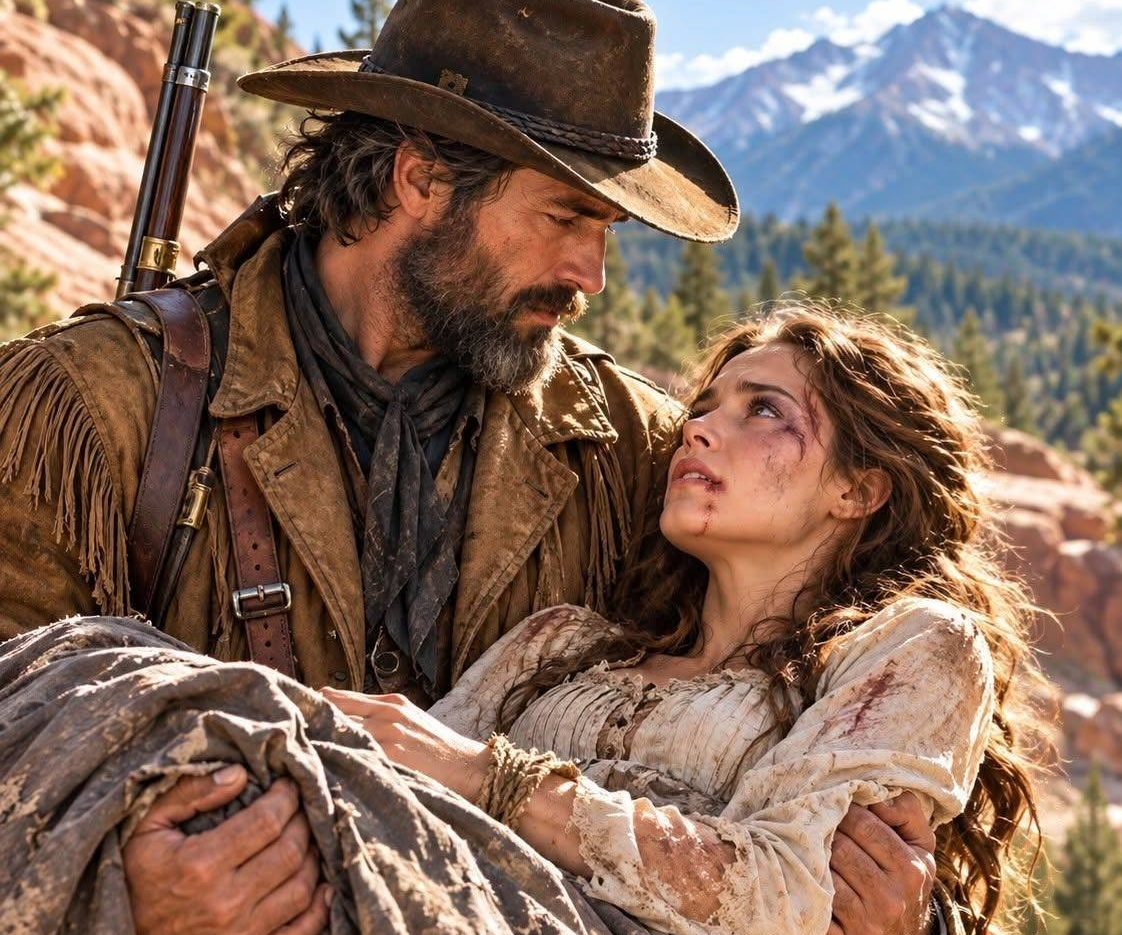
The first thing Eliza Mercer heard when she awakened was a man speaking to someone outside the cabin.
“If he comes looking for her, he’ll have to come through me.”
The voice belonged to Rowan Creed.
But it was the second voice that made her blood turn cold.
“Then you’d better know what kind of man you’re protecting her from.”
Eliza opened her eyes.
A small fire burned in a stone hearth. Sunlight slipped through the cracks between rough pine logs, illuminating shelves of dried herbs, a battered coffee pot, and a pair of worn boots beside the door.
Her left hand had been carefully splinted. Clean bandages covered her ribs. Someone had washed the blood from her face and placed a folded blanket beneath her head.
She was alive.
For a moment, that realization seemed impossible.
Then she remembered the mountain road, the iron skillet, and Caleb standing over her with murder in his eyes.
She tried to sit up.
Pain shot through her chest.
A chair scraped outside.
“Don’t move too quickly.”
Rowan stepped through the doorway, carrying a tin cup of water.
Behind him stood a gray-haired man wearing a deputy’s badge.
Eliza immediately pulled the blanket toward her throat.
Rowan noticed.
“He’s not here to take you anywhere,” he said. “His name is Deputy Thomas Bell. He brought supplies from Fairplay.”
The deputy removed his hat.
“Ma’am.”
Eliza looked from one man to the other.
“How long have I been here?”
“Three days,” Rowan answered.
Three days.
Caleb would have discovered by now that she had survived.
Or perhaps he believed she was still lying among the rocks.
She could not decide which possibility frightened her more.
Rowan placed the water beside her.
“You had a fever. Your ribs are badly bruised, possibly cracked. Your wrist is broken. Bell brought a physician yesterday, and he said you’re fortunate to be breathing.”
Eliza swallowed.
“Why?”
Rowan frowned.
“Why what?”
“Why would you do all this for a stranger?”
For the first time, the mountain man’s expression changed.
He glanced toward the deputy.
“Give us a moment, Tom.”
Bell hesitated, then stepped outside.
Rowan pulled a chair beside the bed.
“Eliza,” he said quietly, “there’s something I need to ask you.”
She stiffened.
He reached into the inside pocket of his coat and withdrew a small object wrapped in faded blue cloth.
When he unfolded it, Eliza stopped breathing.
A silver locket lay in his palm.
Its surface was scratched. One hinge had been repaired with a tiny piece of brass. Across the front, someone had engraved a single word.
Wren.
Eliza stared at it.
She had not seen that locket in eleven years.
“Where did you get that?”
Rowan watched her carefully.
“Your mother gave it to me.”
The room seemed to tilt.
“My mother died.”
“I know.”
“She died in Missouri.”
“I know that too.”
Eliza’s lips trembled.
“Then how do you know the name?”
Rowan lowered his eyes.
“Because when you were seven years old, you used to follow me around your father’s orchard, carrying a wooden bird you insisted was a real sparrow.”
A memory struck her so sharply that she gasped.
A summer afternoon.
Apple trees.
A tall young man laughing as a little girl ran after him through the grass.
And her mother’s voice calling from the porch.
“Wren! Come back before supper!”
Eliza pressed her good hand against her mouth.
“No.”
Rowan’s voice became unsteady.
“You called me Mountain Rowan because I told you stories about the Rockies.”
She stared at him.
“You were supposed to be dead.”
He nodded slowly.
“So I was told.”
Eleven years earlier, Rowan Creed had worked alongside Eliza’s father, Samuel Mercer, transporting supplies between Missouri and the western territories.
He had been more than a hired hand.
He had been Samuel’s closest friend.
When Eliza was a child, Rowan had carved toys for her, taught her to identify animal tracks, and promised that one day he would show her mountains tall enough to touch the clouds.
Then everything changed.
Samuel Mercer disappeared during a business journey.
Within weeks, word arrived that Rowan Creed had been killed in a robbery near the Arkansas River.
Eliza’s mother, Margaret, received two letters confirming the news.
After that, the Mercer household collapsed.
Debts appeared.
Land deeds vanished.
Men came demanding payment for obligations Samuel had never mentioned.
And eventually, Margaret remarried a man named Nathaniel Voss.
Eliza’s childhood ended the day Voss entered their home.
“He told us you murdered my father,” Eliza whispered.
Rowan went completely still.
“What?”
“Voss said you stole Father’s money. He said you killed him and escaped west.”
Rowan stood so abruptly that his chair struck the wall.
For several seconds, he said nothing.
Then he turned toward the window.
“Nathaniel Voss.”
The name came from his mouth like a curse.
Eliza watched his shoulders tighten.
“You know him?”
Rowan slowly faced her.
“Your father was investigating that man before he disappeared.”
Eliza felt the cold settle deeper inside her.
“What are you saying?”
Rowan knelt beside her bed.
“I’m saying your father did not disappear because of a robbery.”
He hesitated.
“And I’m beginning to think the man who hurt you on that mountain road wasn’t acting alone.”
Outside, a horse suddenly whinnied.
Rowan turned toward the sound.
Then came three sharp knocks against the cabin door.
Deputy Bell called out.
“Rowan. You need to see this.”
On the doorstep lay a small leather pouch.
Inside were six silver coins.
And a folded piece of paper.
Rowan opened the note.
The handwriting was unmistakably deliberate.
“Return the woman before sundown, or the next grave will be yours.”
Beneath the message was a signature.
C. Mercer.
Eliza stared at the initials.
Caleb had found her.
And he had already reached the cabin.
***
Caleb Mercer had not always been cruel.
That was the part Eliza hated remembering.
When they first met in Kansas City, he had been charming, attentive, and almost painfully gentle.
He brought her flowers from roadside fields.
He listened when she spoke about her mother’s illness.
He promised that marriage would give her the safety she had never known under Nathaniel Voss’s roof.
She had believed him.
She had wanted so desperately to believe him.
Their wedding took place in a small church on a rainy Thursday.
Three months later, Caleb struck her for the first time.
He apologized afterward.
He cried.
He blamed whiskey, money troubles, and the humiliation of losing work.
Then he did it again.
And again.
Eventually, apologies disappeared.
When Margaret died, Eliza inherited a small sum of money and a packet of documents sealed inside a wooden box.
Caleb immediately demanded both.
Eliza surrendered the money she had openly received.
But she concealed the documents.
Her mother had warned her about them.
“Never let Nathaniel see these,” Margaret had whispered during her final illness. “And never trust anyone who asks about the western property.”
Eliza had not understood.
She only knew that the papers included an old survey, a letter bearing her father’s signature, and a map of land near South Park, Colorado.
She hid them beneath the lining of her traveling trunk.
When Caleb announced that they were moving west, she assumed he was searching for work.
Now, lying inside Rowan Creed’s cabin, she understood that the journey might never have been about work at all.
“Caleb asked about the papers,” she told Rowan.
They sat beside the fire after Deputy Bell departed to summon help.
“He asked three times before we left Kansas. He said my mother’s box contained property worth more than I knew.”
Rowan leaned forward.
“What papers?”
“A survey. A letter. Something about a claim.”
“Did you bring them?”
Eliza shook her head.
“I hid them.”
“Where?”
She hesitated.
Rowan did not press her.
At last, she whispered, “Inside the false bottom of my trunk. Caleb left it at the boardinghouse in Fairplay.”
Rowan’s face darkened.
“Then we need that trunk.”
Eliza studied him.
“Why?”
He stood and crossed to a shelf above the hearth.
From behind a loose wooden board, he withdrew an oilskin packet.
Inside was a weathered sheet of paper.
He spread it across the table.
Eliza recognized the handwriting immediately.
Her father’s.
Samuel Mercer had written a letter dated eleven years earlier.
Rowan read the opening aloud.
“If anything happens to me, the eastern survey must reach Margaret. Voss has altered the records, and I fear he means to take what belongs to my family.”
Eliza gripped the blanket.
“Father knew?”
“He knew Voss was stealing land through forged claims,” Rowan said. “He had evidence. I was carrying part of it to a federal land office when someone ambushed me.”
“You survived.”
“Barely.”
“Why didn’t you come back?”
Rowan looked at her with an expression she could not bear.
“Because when I recovered, I learned your father was gone and your mother had married Voss. I sent letters. None were answered. Later, a man told me you and Margaret had both died during an epidemic.”
Eliza closed her eyes.
Voss had controlled every letter that entered their house.
Every visitor.
Every account.
Even the stories they were allowed to believe.
“He lied to both of us,” she whispered.
Rowan nodded.
“And now Caleb is hunting the last piece of evidence.”
A sudden realization struck her.
“Caleb’s surname.”
Rowan looked up.
“Mercer?”
“It wasn’t his name when we first met.”
The fire snapped loudly.
“He told me he had changed it after a dispute with his family. I thought it was romantic. He said he wanted us to share a new beginning.”
Rowan’s expression became terrible.
“What was his original name?”
Eliza’s voice nearly failed.
“Caleb Voss.”
Silence filled the cabin.
Then Rowan spoke.
“Nathaniel’s son.”
Eliza nodded.
The truth was so monstrous that she could barely form the words.
“My stepfather arranged my marriage.”
***
By the following morning, Rowan had made his decision.
They would leave the cabin.
Not because he feared Caleb.
Because he understood the danger of waiting for a man who had already demonstrated his willingness to kill.
Deputy Bell returned shortly after sunrise with two horses and a wagon.
He had also brought troubling news.
Caleb Voss had visited the sheriff’s office in Fairplay the previous evening.
He claimed his wife suffered from spells of confusion and had been abducted by a dangerous mountain trapper.
He carried a marriage certificate.
He showed bruises on his own arms.
And he told the sheriff that Rowan Creed had stolen valuable property belonging to the Voss family.
“Sheriff Harlan doesn’t know what to believe,” Bell admitted.
Rowan gave a humorless laugh.
“Then he can start by looking at her wrist.”
Bell lowered his eyes.
“I told him that.”
“And?”
“He said the husband claimed she fell from a horse.”
Eliza felt nausea rise in her throat.
Caleb had always been good at explaining away her injuries.
A fall.
A clumsy accident.
A misunderstanding.
Now he was doing it again.
Rowan crouched beside her.
“Eliza, listen carefully. We can go north, across the pass. I know a place where no one will find you. You can recover there.”
She looked at him.
“And Caleb?”
“He won’t reach you.”
“And the papers?”
Rowan hesitated.
“They can wait.”
Eliza stared into the fire.
For years, she had survived by waiting.
Waiting for Caleb’s temper to cool.
Waiting for Nathaniel to stop shouting.
Waiting for someone to believe her.
Waiting for a day when she would no longer be afraid.
She was tired of waiting.
“No,” she said.
Rowan frowned.
“Eliza—”
“I want my trunk.”
“It’s dangerous.”
“I know.”
“He may be watching the boardinghouse.”
“I know that too.”
Her voice trembled, but she continued.
“If those papers can prove what happened to my father, then I won’t run away and leave them behind.”
Rowan studied her for a long moment.
Then he nodded.
“All right.”
Deputy Bell looked between them.
“You’re both mad.”
“Probably,” Rowan said.
“But we’re going to Fairplay.”
***
They reached town shortly before noon.
Fairplay was crowded with freight wagons, miners, merchants, and ranch hands moving along the dusty main street.
Eliza wore a loose coat that concealed her bandaged ribs.
Rowan kept close beside her.
Every raised voice made her flinch.
Every horse passing behind them sent her heart racing.
But she kept walking.
The boardinghouse stood near the far end of the street.
A faded sign swung above the porch.
Mrs. Abigail Finch, the proprietor, opened the door and immediately recognized Eliza.
“My goodness!”
Her gaze moved to the bruises on Eliza’s face.
“What happened to you?”
Eliza swallowed.
“My husband hurt me.”
Mrs. Finch’s expression hardened.
For one moment, Eliza feared the familiar response.
A wife’s duty.
A husband’s temper.
Private matters best left behind closed doors.
Instead, the older woman stepped aside.
“Then you’d better come in before he sees you.”
Eliza nearly cried.
Her trunk remained in the upstairs room.
But when Rowan lifted it onto the bed, the lock had been broken.
The contents were scattered.
Dresses.
A hairbrush.
A small Bible.
Letters tied with ribbon.
The false bottom had been pried open.
It was empty.
Eliza sank onto the mattress.
“No.”
Rowan examined the broken compartment.
“Someone got here first.”
Mrs. Finch appeared in the doorway.
“A man came yesterday afternoon,” she said. “Claimed he was collecting his wife’s belongings.”
“Caleb?” Eliza asked.
The woman shook her head.
“No. Older fellow. Gray mustache. Fine black coat. Walked with a silver-headed cane.”
Eliza’s blood went cold.
Nathaniel Voss.
He was in Colorado.
And he had the documents.
Rowan slowly straightened.
“Did he say where he was staying?”
Mrs. Finch nodded.
“At the Silver Crown Hotel.”
Then she hesitated.
“He left something.”
She reached into her apron and withdrew a small folded envelope.
“He said to give this to Mrs. Mercer if she returned.”
Eliza took it with trembling fingers.
Inside was a single sheet.
“My dear daughter,
You have caused enough trouble.
Come to the Silver Crown at six o’clock, alone, and we may yet settle this as a family.
Refuse, and your mountain friend will answer for your father’s crimes.
Nathaniel.”
Eliza read the letter twice.
Then she turned it over.
Something had been written on the back in smaller handwriting.
A sentence she recognized.
Her father’s handwriting.
“The truth lies beneath the third stone.”
Eliza stared.
Rowan leaned closer.
“What is it?”
She looked at him, her heart hammering.
“It’s a message Father used to leave for me.”
“What does it mean?”
Eliza’s eyes filled.
“When I was little, we had a garden wall behind the orchard. He hid little gifts beneath the third stone from the gate.”
Rowan looked at the note.
“Why would Voss write that?”
“He wouldn’t.”
She turned the paper toward him.
“Father did.”
Rowan’s face changed.
He examined the writing carefully.
Then he looked toward the window.
“Eliza, your father may have left another record.”
“And Voss knows where it is?”
“Maybe.”
She shook her head.
“No. The garden wall is gone. Nathaniel tore it down after Mother married him.”
Rowan thought for a moment.
“Was there another place your father called the garden?”
Eliza closed her eyes.
A memory surfaced.
Her father kneeling beside her beside a creek.
Red stones.
Wildflowers.
The sound of rushing water.
And a mountain-shaped mark scratched into a flat rock.
She opened her eyes.
“Yes.”
Her voice was barely audible.
“He called it his mountain garden.”
Rowan leaned forward.
“Where?”
Eliza looked at him.
“South Park.”
***
At five that evening, Nathaniel Voss sat in the private dining room of the Silver Crown Hotel.
A glass of whiskey rested beside his hand.
Across from him stood Caleb.
His jaw was swollen, and there was a fresh cut above his eyebrow.
“You told me she was dead,” Nathaniel said.
Caleb stared at the floor.
“She should have been.”
“That was not the arrangement.”
“She wouldn’t tell me where the documents were.”
Nathaniel slammed his cane against the floor.
“You were supposed to keep her obedient until the transfer was completed.”
Caleb lifted his head.
“I married her, didn’t I?”
“And you nearly ruined everything.”
Caleb’s expression twisted.
“She humiliated me.”
Nathaniel leaned back.
For several seconds, he studied his son with cold disgust.
“Your feelings are of no consequence.”
Caleb’s fists tightened.
“Then why did you send me after her?”
“Because the Mercer claim requires her signature.”
“And if she refuses?”
Nathaniel smiled.
“Then she will no longer be in a position to refuse.”
Neither man noticed the small figure standing beyond the partially open service door.
Mrs. Abigail Finch had come to deliver fresh linens to the hotel.
She heard enough.
And when Nathaniel began discussing the forged transfer papers, she quietly backed away.
Ten minutes later, she was riding toward Deputy Bell’s office.
***
Eliza and Rowan did not go to the Silver Crown.
They went east.
Beyond town, past a narrow valley, toward a rocky creek bordered by aspens.
The journey was slow.
Every jolt of the wagon sent pain through Eliza’s ribs.
But as the landscape changed, memories returned.
She had visited this place once with her father.
She remembered a little cabin, a wooden bridge, and a cluster of red stones beside the water.
The cabin had long since collapsed.
The bridge was gone.
But the stones remained.
Rowan helped her down from the wagon.
“Stay here,” he said.
Eliza shook her head.
“I need to see.”
Together, they approached the creek.
Three large stones stood beside a twisted pine.
Rowan knelt.
The first stone moved easily.
Nothing beneath it.
The second revealed only damp earth.
The third was heavier.
Rowan braced his shoulder and pushed.
The stone shifted.
Underneath lay a rusted iron box.
Eliza made a small sound.
Rowan lifted it from the earth.
The lock had corroded.
A blow from the butt of his knife broke it.
Inside were oilskin-wrapped papers.
A leather notebook.
And a small daguerreotype portrait.
Eliza picked up the portrait with her good hand.
Her father looked back at her.
Samuel Mercer.
Smiling.
Alive forever inside that tiny silver image.
She pressed it against her chest and wept.
Rowan turned away to give her privacy.
Then he opened the notebook.
As he read, his expression changed.
Page after page recorded transactions involving Nathaniel Voss.
False mineral claims.
Forged signatures.
Payments to officials.
Land parcels transferred under fictitious names.
And one final entry, dated the week before Samuel disappeared.
“Voss has threatened my family. If I do not return, the enclosed records must be delivered to the territorial authorities. Rowan Creed knows the truth.”
Rowan’s hands trembled.
For eleven years, he had carried the weight of a crime he had never committed.
Now the evidence lay before him.
Eliza wiped her face.
“Is it enough?”
Rowan looked at the pages.
“It may be.”
Then they heard a rifle being cocked.
“Put the box down.”
Caleb stood ten yards away.
Behind him were two armed men.
And Nathaniel Voss.
The older man smiled pleasantly.
“Well, Eliza.”
His gaze dropped to the iron box.
“You’ve always been such a clever girl.”
***
Rowan moved instinctively in front of her.
Caleb raised his rifle.
“Don’t.”
Nathaniel tapped his cane against the ground.
“Mr. Creed, I believe you’ve caused this family quite enough inconvenience.”
Rowan’s voice was low.
“Eleven years ago, you tried to kill me.”
Nathaniel shrugged.
“An unfortunate misunderstanding.”
“You murdered Samuel Mercer.”
Eliza stared at her stepfather.
For a moment, Nathaniel’s smile disappeared.
Then he laughed softly.
“Samuel Mercer was a fool who believed honesty could protect him.”
The words struck Eliza harder than any blow Caleb had delivered.
“You killed my father?”
Nathaniel looked at her.
“He refused a generous offer.”
“He was your friend.”
“He was an obstacle.”
Eliza felt something inside her break.
Not her spirit.
Something older.
The last fragile belief that Nathaniel had ever possessed even a fragment of human kindness.
“You married my mother,” she whispered.
“Yes.”
“You let her grieve.”
“Yes.”
“You watched her become ill while she waited for news of him.”
Nathaniel sighed.
“Margaret was an emotional woman.”
Rowan took one step forward.
Caleb aimed the rifle at his chest.
“Another step and I shoot.”
Nathaniel extended his hand.
“The box, please.”
Rowan did not move.
Nathaniel’s expression hardened.
“Give it to me, and perhaps your little bird will live.”
Eliza heard the name.
Little bird.
Wren.
The name her father had given her.
The name Nathaniel had forbidden her mother to use after their marriage.
Suddenly, something became clear.
Nathaniel had spent eleven years trying to erase Samuel Mercer.
His name.
His work.
His memory.
Even the childhood nickname that reminded Eliza she had once been loved.
She stepped around Rowan.
“No.”
Nathaniel blinked.
“What?”
“You don’t get the box.”
Caleb laughed harshly.
“Eliza, don’t start.”
She turned toward him.
For years, his voice had been enough to silence her.
Now she looked directly into his eyes.
“You left me on that mountain to die.”
Caleb shifted his weight.
“You made me angry.”
“You broke my hand.”
“You wouldn’t listen.”
“You stole my mother’s money.”
“Because it belonged to us!”
Eliza shook her head.
“No. It belonged to me.”
Caleb’s face flushed.
He took a step toward her.
Rowan moved.
Everything happened at once.
Caleb swung the rifle toward Eliza.
Rowan seized the barrel and drove it upward.
A shot cracked across the valley.
Birds exploded from the trees.
One of Nathaniel’s men lunged forward.
Rowan struck him with the rifle stock.
The second man fired.
Wood splintered from the wagon behind them.
Eliza dropped beside the iron box, protecting it with her body.
Rowan shouted.
“Get down!”
Caleb slammed into him.
The two men fell against the rocks.
Rowan was stronger, but Caleb was younger and desperate.
He struck Rowan across the temple with a stone.
Blood ran into Rowan’s beard.
Eliza screamed his name.
Nathaniel grabbed the iron box.
“Enough!”
He turned toward the horses.
But before he could reach them, a voice rang out from the ridge.
“Drop it!”
Deputy Bell stood above the creek with Sheriff Harlan and four armed riders.
Mrs. Finch had told them everything she overheard.
And Bell, knowing where Rowan intended to go, had led them straight to the mountain garden.
Nathaniel froze.
Sheriff Harlan aimed his rifle.
“Put the box down, Voss.”
For one terrible moment, no one moved.
Then Nathaniel reached inside his coat.
A pistol appeared in his hand.
He pointed it directly at Eliza.
“If I go down,” he said, “she comes with me.”
Rowan struggled to rise.
Caleb held him down.
Eliza stared at the pistol.
Her heart pounded.
She could hear the creek.
The wind.
The faint creak of leather as the sheriff shifted his rifle.
Nathaniel smiled.
“You should have stayed obedient, girl.”
Then Eliza did something no one expected.
She stood.
Slowly.
Pain tore through her ribs, but she stood anyway.
“You took my father,” she said.
Nathaniel tightened his grip.
“You took my mother.”
“Be quiet.”
“You took my childhood.”
“Eliza!”
“But you don’t get the rest of my life.”
Nathaniel’s hand shook.
And behind him, Caleb suddenly spoke.
“Father.”
Nathaniel glanced back.
Caleb was staring at the pistol.
For the first time, he seemed to understand that the woman he had abused was no longer merely a means to an inheritance.
She was a witness.
And Nathaniel intended to silence her permanently.
“Put it down,” Caleb said.
Nathaniel stared at him.
“What?”
“She’s my wife.”
Nathaniel laughed.
“You were never supposed to grow attached.”
Caleb’s expression changed.
“Put the gun down.”
Nathaniel turned back toward Eliza.
That moment of distraction was enough.
Rowan surged forward.
He struck Nathaniel’s arm.
The pistol discharged.
The bullet tore through Rowan’s shoulder.
He staggered.
Eliza screamed.
Sheriff Harlan fired.
Nathaniel’s pistol flew from his hand as a bullet struck the rock beside him.
Deputy Bell and the other riders rushed down the slope.
Within seconds, Nathaniel was on the ground.
Caleb attempted to flee.
He reached the horses before Bell tackled him into the dirt.
One of Nathaniel’s hired men surrendered immediately.
The other dropped his rifle after the sheriff ordered him to do so.
And Rowan Creed fell beside the creek.
***
Eliza crawled to him.
Her injured hand burned.
Her ribs felt as though they were splitting apart.
But she barely noticed.
“Rowan!”
He lay on his back, blood spreading across his buckskin coat.
His eyes were open.
He looked at her and attempted a smile.
“Easy, Wren.”
She pressed her good hand against the wound.
“Don’t you dare.”
His smile faded.
“Don’t I dare what?”
“Don’t you dare leave me.”
Rowan closed his eyes for a moment.
“Eliza—”
“No.”
Her voice broke.
“You found me. You brought me home. You don’t get to disappear again.”
Deputy Bell knelt beside them.
He examined the wound.
“The bullet went through.”
Eliza looked up desperately.
“Will he live?”
Bell hesitated.
“We need to stop the bleeding.”
She tore a strip from her skirt with her good hand and pressed it against Rowan’s shoulder.
Rowan groaned.
“That’s a good dress.”
Eliza laughed through her tears.
“It’s a terrible dress.”
“Still.”
“Be quiet.”
His eyes opened again.
And for the first time since she had known him, Rowan Creed looked frightened.
Not for himself.
For her.
“You have the papers?”
Eliza nodded.
“The sheriff has them.”
“Good.”
“Don’t talk.”
He caught her wrist gently.
“Your father would be proud of you.”
The words shattered her.
She bent over him and cried.
For her father.
For her mother.
For the little girl who had spent eleven years believing that everyone she loved eventually disappeared.
And for the man who had carried her out of the mountains when she had almost stopped believing she deserved to be saved.
***
Rowan survived.
But the weeks that followed were not easy.
The physician removed fragments of cloth from the wound and warned that infection remained a danger.
For several nights, Rowan burned with fever.
Eliza sat beside his bed, changing damp cloths, feeding him broth, and refusing to leave even when Mrs. Finch insisted she needed rest.
Her own injuries healed slowly.
The swelling around her eye faded.
Her ribs stopped aching with every breath.
Her wrist remained stiff, and the physician warned that she might never regain its full strength.
But something else changed.
She no longer apologized whenever she entered a room.
She no longer flinched at every unexpected sound.
And when a man raised his voice in the street, she reminded herself that she had the right to keep walking.
Meanwhile, the authorities began unraveling Nathaniel Voss’s affairs.
The records recovered from the iron box revealed years of fraudulent transactions.
Investigators located surviving witnesses who remembered Samuel Mercer’s final business journey.
A former clerk admitted that Nathaniel had ordered him to alter land records.
Another man identified payments made to the attackers who had ambushed Rowan eleven years earlier.
Nathaniel’s carefully constructed reputation began collapsing.
Caleb, hoping to reduce his own punishment, gave a statement about his father’s plans.
He admitted that Nathaniel had arranged the marriage to gain control of Eliza’s inheritance.
He admitted that he had searched her belongings for the survey documents.
And he admitted that he had abandoned her on the mountain road after beating her.
The sheriff recorded every word.
But Eliza did not attend Caleb’s first hearing.
She was sitting beside Rowan’s bed when Deputy Bell arrived with the news.
“Caleb wants to see you,” Bell said.
Eliza looked up.
“Why?”
“He says he needs to apologize.”
She stared at the fire.
For a long time, she said nothing.
Then she asked, “Would seeing him help the case?”
Bell shook his head.
“Not necessarily. He’s already given a statement.”
Eliza nodded.
“Then no.”
Bell seemed surprised.
“He says he still loves you.”
Eliza’s expression remained calm.
“No,” she said. “He loved having someone he could control.”
Rowan watched her from the bed.
She turned toward him.
“And I’m not going back.”
***
Winter arrived early in the mountains.
Snow gathered along the cabin roof.
The creek froze at its edges.
Eliza learned to split kindling with one hand, bake bread in Rowan’s iron oven, and identify the tracks of elk moving through the pine forest.
Rowan recovered slowly.
His shoulder remained weak, and some mornings he struggled to lift his arm.
Eliza teased him about being a terrible patient.
He accused her of making coffee strong enough to dissolve horseshoes.
They argued over the proper way to stack firewood.
They laughed.
At first, laughter felt unfamiliar to Eliza.
Then it became something she looked forward to.
One evening, as snow fell beyond the windows, Rowan found her sitting beside the hearth with her father’s notebook open on her lap.
She had been reading Samuel’s final entries.
Rowan sat beside her.
“Anything new?”
Eliza shook her head.
“Just memories.”
He glanced at the portrait resting on the table.
“Your father loved you fiercely.”
She smiled sadly.
“I wish I remembered more.”
Rowan leaned back.
“He used to say you were the most stubborn child west of the Mississippi.”
Eliza laughed.
“I was seven.”
“You were terrifying.”
She looked at him.
“Tell me something about him.”
Rowan thought for a moment.
Then he smiled.
“Once, during a storm, he rode twelve miles because he’d promised to bring you a blue ribbon for your birthday.”
Eliza blinked.
“I remember that ribbon.”
“He fell off his horse crossing a creek. Came back soaked to the bone. Your mother was furious.”
She laughed softly.
“And he still gave it to me.”
“Wouldn’t have missed it for anything.”
Tears gathered in her eyes.
Rowan reached for the silver locket on the table.
“I kept this because Margaret asked me to give it to you when you were older.”
Eliza accepted it.
Inside was a tiny folded piece of paper.
She had never noticed it before.
Her fingers trembled as she opened it.
The writing was faded but legible.
“To our little Wren,
May you always remember that no cage can make a bird forget the sky.
Love, Mother.”
Eliza pressed the note to her lips.
For several minutes, neither spoke.
Then she looked at Rowan.
“Why didn’t you marry?”
He seemed startled.
“That’s a curious question.”
“You never mention a wife.”
“Never had one.”
“Why?”
He considered the fire.
“I spent too many years chasing ghosts.”
Eliza looked down.
“And now?”
Rowan turned toward her.
“Now I think I’ve finally found something worth staying for.”
The room grew very quiet.
Eliza’s heart began to beat faster.
But Rowan did not reach for her.
He did not demand an answer.
He simply sat beside her, allowing the silence to remain gentle.
And that was when Eliza realized how different love could feel when it did not arrive carrying fear.
***
The trial began the following spring.
By then, Eliza had recovered enough to travel.
She entered the courthouse wearing a simple blue dress and her mother’s silver locket.
Rowan walked beside her.
He did not hold her arm until she reached for his.
Nathaniel Voss sat at the defense table, his silver-headed cane resting beside him.
Caleb sat several feet away, guarded by a deputy.
When Eliza entered, Caleb looked up.
For a moment, she saw the familiar expression.
The expectation that she would lower her eyes.
That she would hesitate.
That she would remember her place.
Instead, she walked past him.
She took the witness stand.
And she told the truth.
She described her father’s disappearance.
Her mother’s warnings.
The hidden documents.
The arranged marriage.
The violence.
The mountain road.
The reins around her wrists.
And the moment Rowan Creed found her beneath the Colorado sun.
The courtroom remained silent.
When the prosecutor asked whether she could identify the man who had attacked her, Eliza looked directly at Caleb.
“Yes.”
Her voice did not shake.
“That’s my husband, Caleb Voss.”
Caleb lowered his head.
Later, Rowan testified about the ambush eleven years earlier.
Deputy Bell described the injuries he had seen at the cabin.
Mrs. Finch repeated the conversation she had overheard at the Silver Crown Hotel.
The recovered notebook and land records were presented as evidence.
And a former associate of Nathaniel’s testified that Samuel Mercer had been killed after refusing to surrender the documents exposing the fraudulent claims.
The proceedings lasted several days.
When the verdicts were announced, Nathaniel Voss was found guilty of multiple crimes connected to the fraudulent land scheme and Samuel Mercer’s murder.
Caleb was convicted for his attack on Eliza and his role in the conspiracy.
Their sentences would keep them imprisoned for many years.
But Eliza felt no sudden rush of happiness.
No triumph.
No desire to watch them suffer.
Only a quiet, almost unfamiliar sense of release.
Outside the courthouse, Caleb called her name as deputies led him toward the waiting wagon.
“Eliza!”
She stopped.
Rowan stood beside her.
Caleb looked desperate.
“I never meant for it to go this far.”
Eliza studied him.
Once, those words might have made her hesitate.
Once, she might have searched his face for the man who had brought her wildflowers.
Now she saw him clearly.
“You meant every blow,” she said.
Caleb’s face crumpled.
“Eliza, please.”
She shook her head.
“You don’t get to decide when my suffering becomes too much for you to bear.”
Then she turned away.
And this time, she did not look back.
***
The Mercer property was eventually restored to Eliza through the legal process.
Some of the land had already been sold.
Other parcels remained tied up in disputes.
But the central claim near South Park was recognized as part of Samuel Mercer’s estate.
Eliza could have sold everything and moved east.
She could have purchased a fine house in Denver.
She could have begun a comfortable life far from the mountains.
Instead, she returned to Rowan’s cabin.
One afternoon, as summer sunlight poured across the valley, she found him repairing a fence.
He looked up when she approached.
“Thought you were meeting with the attorney.”
“I was.”
“How’d it go?”
She smiled.
“I’ve made a decision.”
Rowan set down his hammer.
“About the land?”
“Yes.”
“What are you going to do?”
Eliza looked across the valley.
At the pines.
The creek.
The mountains rising blue against the distant sky.
“I’m keeping it.”
Rowan nodded.
“Good land.”
“And I want to build something.”
“A house?”
“Eventually.”
“What first?”
She turned toward him.
“A place for women who have nowhere safe to go.”
Rowan stared at her.
She continued.
“A house where they can rest. Work if they choose. Learn a trade. Bring their children. A place where no one tells them they deserve what happened to them.”
Rowan’s expression softened.
“That’s a mighty undertaking.”
“I know.”
“You’ll need timber.”
“I have timber.”
“Money.”
“I have some.”
“Help.”
Eliza smiled.
“I was hoping I might have that too.”
Rowan looked at her for a long moment.
Then he picked up his hammer.
“Well,” he said, “I suppose we’d better get started.”
***
The first building rose before autumn.
It was modest.
Three rooms.
A kitchen.
A wide porch facing the mountains.
Mrs. Finch donated bedding.
Deputy Bell arranged for a carpenter to help.
Several local families contributed furniture, tools, and supplies.
Eliza named the place Wren House.
The first woman arrived in October.
Her name was Hannah Price.
She carried a baby wrapped in a thin blanket and had walked nearly twenty miles after fleeing a violent husband.
When Eliza opened the door, Hannah stood trembling on the porch.
“I don’t have any money,” she whispered.
Eliza looked at the exhausted young mother.
Then she stepped aside.
“You don’t need any.”
Hannah began to cry.
Eliza remembered another day.
Another mountain.
Another moment when a stranger had offered help without demanding anything in return.
She reached for the woman’s bag.
“Come inside,” she said. “There’s a fire.”
Over the following months, more women arrived.
Some stayed only a few days.
Others remained long enough to learn sewing, bookkeeping, or ranch work.
A widow with two children became the housekeeper.
A former schoolteacher began offering lessons.
A young woman who had escaped an abusive employer helped establish a vegetable garden.
Slowly, Wren House became more than a refuge.
It became a community.
And Eliza Mercer, who had once been left to die beside a mountain road, became the woman others sought when they had nowhere else to turn.
***
One evening, almost a year after Rowan found her, Eliza walked down to the creek.
The sun was setting behind the mountains.
Rowan stood beside the water, watching the light fade.
He had grown quieter over the months.
Not distant.
Thoughtful.
Eliza approached him.
“Something wrong?”
He shook his head.
“Just thinking.”
“About what?”
He smiled faintly.
“How strange life can be.”
She stood beside him.
“Strange how?”
“I spent eleven years believing I’d failed your father.”
Eliza turned toward him.
“You didn’t.”
“I couldn’t save him.”
“You saved me.”
Rowan looked down.
“I nearly lost you too.”
“But you didn’t.”
He drew a slow breath.
Then he reached into his coat.
Eliza watched as he withdrew a small wooden box.
Her heart began to race.
“Rowan?”
He opened it.
Inside lay a simple silver ring.
Nothing elaborate.
No precious stone.
Just a narrow band polished smooth.
“I had this made in Fairplay,” he said.
Eliza stared at it.
Rowan’s voice grew rough.
“I know what marriage has meant to you. I know what promises have cost you. And I won’t ask you to give up the life you’ve fought so hard to reclaim.”
He paused.
“I don’t want to own your days, Eliza. I want to share them.”
Tears filled her eyes.
“If you never want another husband, I’ll understand. I’ll still help with the house. I’ll still mend the fences. And I’ll still be grateful that I found you.”
She laughed softly through her tears.
“You are making a terrible proposal.”
Rowan blinked.
“I am?”
“You haven’t actually asked me anything.”
He looked genuinely alarmed.
Then he lowered himself onto one knee.
His injured shoulder protested, and he winced.
Eliza covered her mouth, laughing and crying at once.
“Rowan Creed,” she whispered.
He looked up.
“Eliza Mercer, would you do me the honor of marrying me?”
She gazed at the man who had carried her through the mountains when she could no longer walk.
The man who had stopped reaching for her when she flinched.
The man who had given her choices when the rest of the world had taken them away.
The man who had loved her without asking her to become smaller.
“Yes,” she whispered.
Rowan stared.
“Yes?”
She nodded.
“Yes.”
He rose carefully.
And when he took her into his arms, he held her as gently as he had on the day he found her.
Only this time, she was not broken and unconscious.
She was standing.
She was choosing.
And she was home.
***
They married beneath the pines the following spring.
Mrs. Finch arranged the flowers.
Deputy Bell stood beside Rowan.
The women of Wren House decorated the clearing with ribbons and wildflowers.
Hannah Price’s little boy carried the rings in a wooden box.
Eliza wore a cream-colored dress sewn by the women she had helped shelter.
Around her neck rested her mother’s silver locket.
When Rowan saw her approaching, he removed his hat.
His eyes filled with tears.
Eliza smiled.
She had never seen him cry before.
The ceremony was simple.
No grand promises of wealth.
No declarations of ownership.
Only two people choosing to walk beside one another.
When the officiant asked Rowan whether he would honor and cherish Eliza, he answered without hesitation.
“I will.”
When Eliza was asked the same question, she looked directly into Rowan’s eyes.
“I will.”
And when they kissed, the women of Wren House cheered so loudly that a flock of birds rose from the nearby trees.
Rowan laughed.
Eliza laughed with him.
For the first time in her life, a wedding did not feel like the closing of a door.
It felt like opening every window in the world.
***
Years passed.
Wren House grew.
The original three-room building became a larger home with a schoolroom, workshop, and garden.
Women who once arrived frightened and exhausted left with money they had earned, skills they had learned, and the knowledge that they deserved lives free from cruelty.
Some returned to visit.
Others wrote letters from distant towns.
A few stayed and helped run the refuge.
Eliza kept every letter in a wooden chest.
Rowan built a larger porch so the women could sit outside on warm evenings.
He taught their children to fish.
He repaired wagons.
He carved wooden birds for the youngest visitors.
And every spring, he planted wildflowers beside the creek because Eliza loved watching them bloom.
They did not have a perfect life.
There were harsh winters.
Failed crops.
Illness.
Arguments over money and work.
There were mornings when Eliza woke from nightmares and could still feel the reins cutting into her wrists.
On those nights, Rowan never told her to forget.
He simply sat beside her until she remembered where she was.
Sometimes he held her hand.
Sometimes he brought tea.
Sometimes he said nothing at all.
And slowly, the past became something she remembered rather than something she lived inside.
One autumn evening, many years after their wedding, Eliza found Rowan sitting on the porch with a small girl on his knee.
The child belonged to one of the women staying at Wren House.
She was holding a wooden sparrow.
Rowan had carved it that morning.
“What’s its name?” he asked.
The little girl thought carefully.
“Wren.”
Eliza stopped in the doorway.
Rowan looked up at her.
His beard had turned almost entirely gray.
Deep lines framed his eyes.
But his smile was the same.
The little girl jumped down and ran toward the house.
Eliza walked to the porch.
“Another bird?” she teased.
Rowan shrugged.
“Can’t help myself.”
She sat beside him.
The mountains glowed gold beneath the setting sun.
For a long while, they watched the valley in comfortable silence.
Then Rowan reached for her hand.
“Do you ever think about that day?”
Eliza knew which day he meant.
The road.
The blood.
The broken wrist.
The shadow falling across her face.
She looked toward the distant mountains.
“Sometimes.”
“Does it still frighten you?”
She considered the question.
“Yes,” she admitted. “But not the way it used to.”
Rowan nodded.
“I still remember how light you felt when I picked you up.”
Eliza leaned against his shoulder.
“I remember thinking you were going to hurt me.”
He looked down.
“And now?”
She smiled.
“Now I know you were the first person in a very long time who was willing to let me say no.”
Rowan kissed her forehead.
Eliza watched the last sunlight disappear behind the peaks.
She thought of Samuel Mercer and the orchard in Missouri.
Of Margaret and the little silver locket.
Of the frightened woman lying among the red rocks, convinced that the world had nothing left for her.
And she wished she could reach backward through the years.
Not to change what had happened.
Not to erase the suffering.
But to whisper something to that broken woman beneath the Colorado sun.
You will live.
You will be believed.
You will find your voice again.
And one day, the name you buried because it reminded you of everything you lost will become the name of a home where others learn to begin again.
Eliza turned toward Rowan.
“Do you know what Father used to tell me?”
Rowan smiled.
“What?”
“He said a bird doesn’t need to be fearless to fly.”
Rowan squeezed her hand.
“He was right.”
Eliza looked across the valley toward Wren House, where warm lamplight glowed in the windows and the sound of laughter drifted into the evening air.
Then she rested her head against her husband’s shoulder.
For years, she had believed her story ended on that lonely mountain road.
But the road had not been the ending.
It had been the place where another life began.
And the mountain man who found her had not rescued a helpless woman who would forever need saving.
He had helped a wounded woman survive long enough to discover that the strength she needed had been hers all along.
THE END.