PART 3: HE CAME FOR MY FATHER’S HOUSE—BUT LEFT WITHOUT THE WIFE HE THOUGHT HE OWNED
My husband arrived at my father’s farmhouse carrying white roses, a leather folder, and the confidence of a man who still believed he could talk me into anything.
He left forty-seven minutes later without the roses, without my signature, and without the marriage he’d spent fifteen years taking for granted.
But the most revealing moment came when I opened that folder.
Because tucked behind the bank documents was a page Russ had clearly hoped I wouldn’t read carefully.
And for the first time, I understood exactly how much he had been counting on my obedience.
“Can I come in?” Russ asked.
I stepped aside.
He entered the farmhouse, looked around the living room, and frowned.
“God, Ellie. It’s freezing in here.”
“The heater’s working.”
“Barely.”
He put the flowers on the kitchen table.
White roses.
My least favorite flower.
I’d told him that during our second date.
I preferred yellow tulips.
He’d forgotten.
Or perhaps he’d never listened.
“You look tired,” he said.
“I didn’t sleep much.”
He reached for my hand.
I moved it toward my coffee cup.
The gesture was small.
But he noticed.
“Come on, El. Are we really doing this?”
I looked at him.
“Doing what?”
“This whole punishment routine.”
I said nothing.
He sighed.
“Look, last night got out of hand. Wayne was drinking. Everybody was laughing. I made a stupid joke.”
“Yes.”
“And I’m sorry.”
“Thank you.”
He smiled hopefully.
“So we’re good?”
“No.”
His smile disappeared.
“Ellie.”
“You didn’t come here just to apologize, Russ.”
He glanced at the leather folder.
Then back at me.
“I’m trying to save our business.”
“Your business.”
He blinked.
“What?”
“Hartley Building Supply belongs to you. I’ve supported it, but I don’t own it.”
“We’re married.”
“I know.”
“Then stop talking like some hostile investor.”
I pulled out a chair.
“Sit down.”
He hesitated.
Something about the instruction seemed to irritate him.
Perhaps because he’d spent years calling me Commander Ellie whenever I expected basic responsibility from his family.
But he sat.
I sat opposite him.
The folder lay between us.
“What’s in there?” I asked.
“Options.”
“What kind of options?”
“Ways to get through the next few months without destroying everything we’ve built.”
I waited.
He opened the folder.
There were three documents inside.
The first was a revised bridge-loan agreement.
It proposed extending my $150,000 loan for another eighteen months.
No additional security.
No scheduled principal payments for the first year.
The second was a proposed guarantee for the expansion credit facility.
The third concerned my farmhouse.
Russ slid it toward me.
“Before you get upset, just hear me out.”
I looked at the heading.
PROPOSED REAL ESTATE COLLATERAL ARRANGEMENT.
My father’s property address appeared beneath it.
For a moment, I heard nothing but the old refrigerator humming.
“You want me to pledge the farmhouse.”
“Temporarily.”
“As collateral.”
“Only until the contract starts paying out.”
“The contract you told me was completely under control.”
“It is under control.”
“Then why do you need my house?”
Russ rubbed his forehead.
“Because banks need security, Ellie. You know how business works.”
“I know how financial risk works.”
“Good. Then you understand.”
“Yes,” I said. “I understand that you want me to risk the only property I own separately so you can borrow more money for a company that already owes me $150,000.”
He sat back.
“You make it sound terrible.”
“I didn’t write the documents.”
He looked toward the window.
“It’s not like we’re going to lose the place.”
“You can’t promise that.”
“Don’t be so negative.”
I turned to the last page.
There was a signature line.
Mine.
Blank.
Beneath it was a paragraph authorizing a lender to evaluate the property as potential security, subject to further documentation.
Nothing had been signed.
Nothing had been approved.
But Russ had brought it here hoping I would make the first commitment.
I looked up.
“When were you going to tell me you wanted to use Dad’s house?”
“I am telling you.”
“After I refused the loan extension.”
“Because you forced me to find another solution.”
That sentence settled between us.
You forced me.
There it was again.
Every consequence was somebody else’s fault.
Every financial shortfall became my emergency.
Every boundary I drew became an act of aggression.
I placed the paper on the table.
“No.”
Russ stared.
“No what?”
“No extension. No guarantee. No farmhouse.”
He gave a short laugh.
“Ellie, be reasonable.”
“I am.”
“You’re letting your emotions cloud your judgment.”
“I’m making a decision based on documents you brought me.”
He pushed his chair back.
“You’ve always done this.”
I waited.
“You turn everything into some kind of administrative process. Forms. Rules. Lists. You can’t just be a wife for five minutes.”
I looked at him carefully.
“A wife.”
“Yes.”
“What exactly does that mean to you?”
He spread his hands.
“It means supporting your husband.”
“Financially?”
“Emotionally. Financially. Whatever it takes.”
“And what does supporting your wife mean?”
His expression changed.
“Don’t twist my words.”
“I’m asking.”
“I’ve given you a good life.”
I looked around the kitchen.
At the faded curtains.
The scratches in the wooden table.
The family photographs.
Then I looked back at him.
“Russ, I had a good life before you.”
He stared as though I’d slapped him.
For fifteen years, I’d softened that truth.
I had allowed him to speak as though he had rescued me from loneliness, uncertainty, and financial insecurity.
But when we married, I already owned my car.
I had a career.
A pension plan.
Savings.
A home.
Friends.
I hadn’t needed rescuing.
I’d wanted a partner.
Somewhere along the way, Russ had mistaken being chosen for being indispensable.
He leaned forward.
“Are you saying you regret marrying me?”
I thought about the anniversary dinner.
His laughter.
The way he looked straight into my eyes before humiliating me.
The way nobody followed when I left.
“No,” I answered. “I’m saying I regret how much of myself I surrendered trying to keep you happy.”
For a moment, he looked genuinely hurt.
Then his phone vibrated.
He checked it.
His expression hardened.
“Neil says the bank wants confirmation by Monday morning.”
“Then you should speak with the bank.”
“Ellie.”
“Russ.”
“If you don’t help me, I could lose the Hartley contract.”
“Then you’ll need to negotiate with your customer and suppliers.”
“And if that doesn’t work?”
“You’ll need to make difficult business decisions.”
He stared at me.
“You sound like you don’t care.”
“I care. But caring doesn’t mean I must put everything I own at risk.”
He shook his head.
“You’re unbelievable.”
Then he said the words that finally made the decision for me.
“After everything my family has done for you.”
I looked at him.
“Your family?”
“Yes.”
I reached for my laptop.
Opened the spreadsheet.
Turned it toward him.
“Then let’s discuss your family.”
He frowned.
“What is that?”
“Records.”
I scrolled slowly.
Dolores Merritt.
Forty-eight monthly payments.
$88,800.
Wayne Merritt.
Truck and equipment assistance.
$31,000.
Joanne Merritt.
Mortgage, taxes, and legal expenses.
$19,600.
Other documented family assistance.
$37,030.
Total.
$176,430.
Russ stared at the screen.
I watched the color leave his face.
Not dramatically.
Not all at once.
But enough.
“Where did you get that?”
“From my bank accounts.”
He said nothing.
“Do you recognize the payments?”
“Ellie, why are you keeping score?”
I almost smiled.
“Because apparently nobody else has.”
“Those were family expenses.”
“They were mostly voluntary payments from my separate savings.”
“We help each other.”
“Then tell me something, Russ.”
He looked away.
“When was the last time Wayne helped me?”
Silence.
“When was the last time Joanne asked whether I needed anything?”
Nothing.
“When was the last time your mother thanked me for helping pay for her care?”
He rubbed his jaw.
“She doesn’t know you were doing that.”
“I know.”
His eyes shifted back toward mine.
“And whose decision was that?”
He didn’t answer.
I closed the laptop.
“I’m not asking to be reimbursed for every gift. I’m not asking you to recover money from your family. I’m showing you what the word support has meant in this marriage.”
He leaned back.
“Fine. You want credit? Take the credit.”
I shook my head.
“That’s not what I want.”
“Then what do you want?”
For fifteen years, that question had appeared only after every other strategy failed.
Not at the beginning of a disagreement.
Not when I was exhausted.
Not when I came home from managing disaster operations and found his company’s paperwork waiting on the kitchen counter.
Only when he needed something.
“I want a life,” I said.
Russ looked confused.
“You have a life.”
“No. I have responsibilities.”
He opened his mouth.
I raised one hand.
“Please let me finish.”
To my surprise, he did.
“I want to wake up without wondering whose crisis I’ll have to fix. I want to spend my own money without being told someone else needs it more. I want to visit my father’s house without hearing that I should sell it. I want to sit at a dinner table and know my husband won’t turn my dignity into entertainment.”
His eyes dropped.
“And I want to stop feeling guilty every time I say no.”
For several seconds, neither of us spoke.
Then Russ looked at the flowers.
“I really am sorry about last night.”
I believed him.
At least part of him.
I believed he regretted the consequences.
I wasn’t sure he regretted the cruelty.
“I’m glad,” I said.
He reached across the table.
“Then let’s go home.”
I looked at his hand.
Fifteen years.
We had celebrated birthdays together.
Buried relatives.
Survived financial scares.
Taken road trips through Tennessee.
Danced barefoot in our kitchen.
There had been good days.
Real ones.
I wouldn’t erase them simply because the ending hurt.
But good memories weren’t permission to continue a bad pattern forever.
“I’m not coming home today.”
His hand withdrew.
“How long are you staying here?”
“I don’t know.”
“What am I supposed to tell Mom?”
I looked at him.
“Whatever you like.”
“And Wayne?”
“Whatever you like.”
“And Joanne?”
“Russ, you are forty-nine years old. You can decide what to tell your family.”
He stood so suddenly the chair scraped against the floor.
“This isn’t the woman I married.”
I stood too.
“No,” I said quietly. “She’s finally learning something.”
He grabbed the leather folder.
Left the roses.
And walked toward the front door.
At the threshold, he turned.
“You know the worst part, Ellie?”
I said nothing.
“You’re willing to throw away fifteen years over one joke.”
I looked at him.
“No, Russ. The worst part is that you still think this is about one joke.”
He walked out.
I watched his SUV disappear down the driveway.
Then I locked the door.
Not because I was afraid of him.
Because it was my door.
And I wanted to decide when it opened.
Monday morning arrived cold and clear.
At 8:30, Neil confirmed that I had not authorized an extension of the bridge loan.
The repayment obligation remained in place under the existing agreement.
He also confirmed that Russ had begun discussions with the bank about reducing the company’s expansion plans and securing alternative financing.
There was no dramatic collapse.
No sheriff arriving to padlock the warehouse.
No employees suddenly thrown onto the street.
Just a business owner facing financial obligations he could no longer automatically transfer to his wife.
That distinction mattered to me.
I didn’t want revenge against the people working at Hartley Building Supply.
I wanted the company to meet its responsibilities without treating my savings as a permanent emergency fund.
At 10:15, I met Margaret Bell.
We reviewed the deed.
My financial records.
The bridge agreement.
Our joint accounts.
The documentation relating to the proposed guarantee.
Then we discussed separation.
Margaret did not promise that fifteen years of marriage could be untangled easily.
She explained that marital property, separate property, debts, and financial contributions would need careful review.
She encouraged me to document everything and avoid making assumptions about the outcome.
For once, I didn’t need someone to promise me a perfect result.
I just needed a process that didn’t depend on Russ’s permission.
Before I left, I asked her to prepare the initial separation documents.
She looked at me.
“Are you sure?”
I thought about the anniversary dinner.
The way Russ had laughed.
The way his family had joined him.
The farmhouse.
The flowers.
The folder.
And finally, the fact that my husband had come to apologize carrying paperwork that could have put my father’s home at risk.
“Yes,” I said.
“I am.”
By Wednesday, Dolores had called six more times.
Her messages grew less angry after Russ informed her that the three Merritt siblings would need to manage her care expenses.
Joanne called asking how to arrange payments directly with the facility.
I gave her the billing office’s number.
Wayne sent a short text.
Didn’t realize how much you’d helped over the years.
It wasn’t an apology.
But it was the first acknowledgment I’d ever received from him.
Russ sent flowers twice.
The second bouquet contained yellow tulips.
I stood looking at them for a long time.
He remembered now.
Perhaps he had always remembered.
Perhaps he’d simply never believed the distinction mattered.
I put them in a vase.
Then continued with the separation paperwork.
Three weeks later, I returned to the farmhouse after meeting a contractor about the heating system.
His estimate was reasonable.
The roof would need repairs before winter.
The porch steps needed replacing.
And Dad’s old workshop could be converted into the small woodworking studio I’d dreamed about for years.
For the first time in fifteen years, I was making plans without calculating whether someone else would approve.
That evening, Russ called.
I answered.
His voice was quiet.
“Ellie.”
“Hello, Russ.”
“I got the attorney’s letter.”
“I expected you would.”
He was silent for a moment.
Then he said, “I never thought you’d actually leave.”
I looked out at the fields.
The sun was setting behind the trees.
“Neither did I.”
He exhaled.
“I thought we were stronger than this.”
“So did I.”
Another silence.
Then, quietly, he asked, “Did I really make you that unhappy?”
I sat down.
It was the first question he’d asked that didn’t begin with what he needed.
I answered carefully.
“Not every day, Russ.”
He said nothing.
“There were good years. Good memories. Times when I was very happy with you.”
“Then why can’t we fix it?”
“Because I spent years telling you what hurt me, and you treated it like another problem I should learn to manage.”
He breathed unevenly.
“I didn’t know you were serious.”
“I know.”
And that was the saddest part.
He hadn’t believed my unhappiness mattered until it changed his life.
He asked if I would consider counseling.
I told him I would discuss it with my attorney and think about whether it could help us communicate.
But I was not withdrawing the separation request.
And I was not resuming financial support.
He didn’t argue.
For once, he simply said, “Okay.”
After we hung up, I stayed at the table until the room grew dark.
There was no triumphant feeling.
No sudden rush of happiness.
Ending a marriage wasn’t winning a prize.
It was grieving a future I’d once believed in.
But grief and regret weren’t the same thing.
I could mourn what we had lost without returning to what had hurt me.
By early November, the farmhouse had heat again.
The kitchen smelled of fresh paint.
I bought a new mattress, replaced the worn curtains, and planted yellow tulip bulbs along the front walkway.
They wouldn’t bloom until spring.
I liked that.
For once, I was doing something good for a future nobody else had demanded I create.
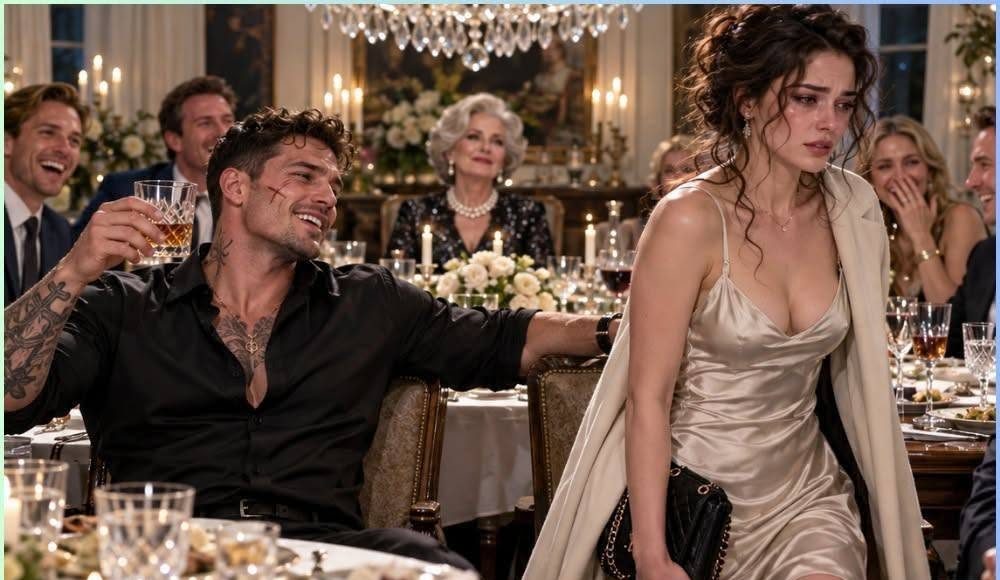
One Sunday afternoon, I found the anniversary photograph Joanne had mailed me.
It showed the entire family beneath Dolores’s chandelier.
Russ had his arm around my chair.
Wayne was raising his bourbon glass.
Everyone looked delighted.
Everyone except me.
I studied the woman in the cream-colored dress.
Her smile was polite.
Her shoulders were tight.
Her hands were folded carefully in her lap.
She looked like someone waiting for permission to leave.
I placed the photograph in a drawer.
Not because I hated the people in it.
But because I no longer needed a picture to remind me of what I’d survived.
Then I walked outside.
The air smelled of fallen leaves and damp earth.
Across the fields, the late afternoon sun rested on the fence posts.
I thought about my father.
About the note in his toolbox.
About the fifteen years I’d spent being the strongest beam in a house where everybody else had forgotten to hold up their share.
And I finally understood something.
I hadn’t destroyed my marriage by leaving that dinner.
I had simply stopped pretending it was healthy because I was strong enough to carry it.
Russ had stood beneath a chandelier and told his family he wished he’d never said “I do.”
He thought he was making a joke.
He thought I would lower my eyes, swallow the humiliation, and return to work the next morning fixing whatever problem waited for him.
But the next morning, I made a different choice.
I let a loan expire.
I protected my father’s home.
I stopped financing people who mistook my generosity for an obligation.
And I began building a life that belonged to me.
That winter, I hung Dad’s old note beside the front door.
A house needs a strong foundation, but that doesn’t mean one beam should carry the whole roof.
Every morning, I read it before making coffee.
And every morning, I remembered the last words I’d spoken to Russ at the anniversary dinner.
“Then consider your wish granted.”
At the time, I thought I was granting his wish.
Months later, I realized something else.
I had finally granted my own.
The freedom to be loved without being used.
The freedom to help without being expected to sacrifice everything.
And the freedom to walk away from a table where everyone was laughing, even when I was the only one who understood there was nothing funny about it.
For fifteen years, I had been Commander Ellie.
The woman who could fix anything.
Now, standing in my own kitchen, with warm floors beneath my feet and spring waiting quietly beneath the soil, I was simply Ellen.
And for the first time in a very long time, that was enough.
THE END.