Part 5: The Blue Box
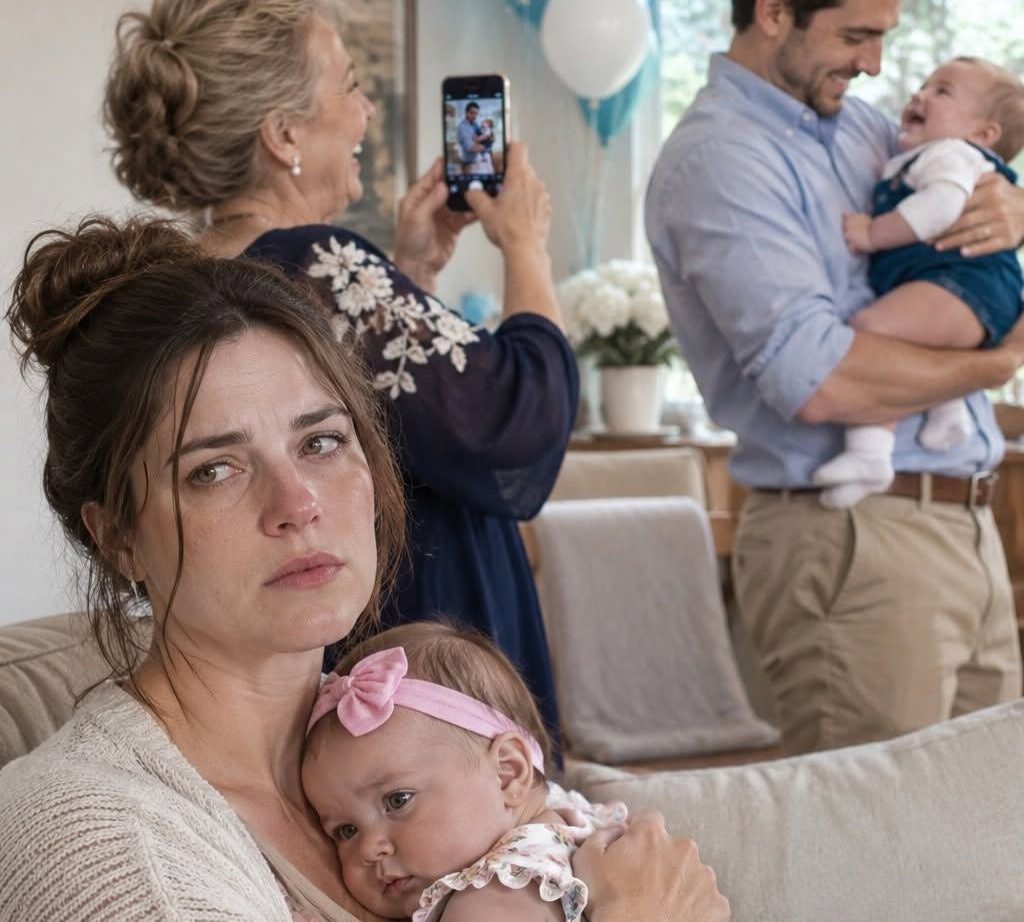
My mother-in-law invited eighty-four people to celebrate my newborn son while planning to hide his twin sister upstairs.
She believed I would arrive quietly, sign away my rights, and let her announce Henry as the future of the Whitmore family.
Instead, I arrived carrying both babies.
My attorney came with me.
And inside my diaper bag was a blue box that would change everything.
But the greatest surprise wasn’t what Eleanor had left me.
It was what my husband had done before the party began.
Saturday morning arrived bright and unusually warm.
For the first time in weeks, I slept more than four hours.
Not because my problems had disappeared.
But because I finally had a plan.
The blue box had been found the previous evening.
Erin remembered seeing it in Eleanor’s old bedroom, inside a cedar cabinet.
She went to the family house while Barbara was shopping for party decorations.
The box was exactly where Eleanor’s letter suggested.
Small.
Blue velvet.
With a brass lock.
Inside were three envelopes, a flash drive, and a handwritten note.
The note said:
“For Natalie, when the people who claim to love her forget what love means.”
I cried when I read it.
Eleanor had written those words years before Henry and Lily were born.
She had somehow understood the people around her better than I ever had.
The first envelope contained the original trust documents.
The second contained correspondence between Eleanor and my mother.
The third was addressed to Adam.
And the flash drive contained a video recording.
I watched it with Michael, Erin, and Rebecca.
Eleanor appeared on the screen, sitting in an armchair beside a window.
Her silver hair was neatly pinned.
She looked directly into the camera.
“My name is Eleanor Whitmore. I am making this recording because I have learned that money can turn a family into strangers.”
Her voice was steady.
She explained how my mother had cared for her during a long illness.
How Margaret had stayed through difficult nights.
How she had refused extra payment when Eleanor needed more help than expected.
Then Eleanor smiled.
“Margaret used to bring her little girl to visit me. Natalie was a serious child. She asked questions about everything.”
I covered my mouth.
I had forgotten those visits.
But as Eleanor spoke, fragments returned.
A garden.
A white dog.
An old woman who always kept peppermint candies in her purse.
Then Eleanor said something that changed the meaning of everything.
“I created a fund for Natalie because she was never treated as an outsider in my home. But I also made a separate provision for every child born into my family, without regard to whether that child was a boy or a girl.”
Rebecca paused the video.
“Every child?” I asked.
She nodded.
“Keep watching.”
Eleanor continued.
“No son is worth more than a daughter. No grandchild is worth more than another. And anyone who uses my name to suggest otherwise has misunderstood everything I tried to build.”
My eyes filled with tears.
Then she delivered the sentence that explained why Barbara had been so determined to exclude Lily.
“If any descendant attempts to establish an exclusive male inheritance arrangement using my assets, that arrangement shall have no authority over the funds I placed in independent trusts.”
Rebecca turned to me.
“That’s why they wanted your signature.”
I stared at her.
“Because Lily had rights?”
“Because both children had rights. And you had a separate claim. They needed you to release your interests so Richard could present a simplified arrangement.”
The final minutes of the recording contained something even more remarkable.
Eleanor had named an independent trustee.
A woman called Margaret Sullivan.
Not my mother.
A retired judge who had been Eleanor’s closest friend.
Margaret Sullivan was still alive.
Rebecca had already contacted her.
And she was coming to the party.
At one thirty that afternoon, I walked through Barbara’s front gate.
Henry was in a pale blue outfit.
Lily wore a cream dress with tiny pink flowers.
I carried Lily.
Michael carried Henry.
Rebecca walked beside us.
Erin followed with her two daughters.
Barbara was standing beneath a balloon arch.
When she saw us, her smile vanished.
“Natalie.”
“Hello, Barbara.”
She looked at Lily.
Then at Rebecca.
“What’s going on?”
“We came to celebrate the twins.”
Barbara stepped closer.
“I thought we agreed—”
“We didn’t agree to anything.”
Her eyes moved toward the guests.
Several people had begun watching.
“Natalie, please don’t make a scene.”
I smiled.
“Then don’t give me a reason.”
Inside, the house was decorated exactly as the messages had described.
Blue ribbons.
Blue flowers.
Blue tablecloths.
A huge cake bearing Henry’s name.
There wasn’t a single photograph of Lily.
Then I noticed something.
Near the entrance stood a display of framed family portraits.
Richard and Barbara.
Adam as a child.
Erin and her husband.
Henry’s hospital photograph.
But Erin’s daughters were missing too.
I looked at Sophie and Madison.
They were standing beside their mother, holding hands.
Suddenly, the cruelty of it felt much older than my own children.
Barbara hadn’t simply excluded Lily.
She had spent years teaching the girls in her family that they mattered less.
Not today.
I asked the photographer to take a picture.
“Of whom?” he asked.
“All four grandchildren.”
Barbara opened her mouth.
I looked directly at her.
“All four.”
The photographer smiled.
“Of course.”
Sophie stood beside me.
Madison held Erin’s hand.
Henry slept in Michael’s arms.
Lily stared solemnly at the camera.
For the first time, every grandchild appeared in the same family photograph.
Barbara looked furious.
At two o’clock, Richard stepped onto the small platform near the garden.
He tapped a microphone.
“Thank you all for coming to celebrate a very special day.”
The guests applauded.
Richard smiled proudly.
“Today, we welcome the next generation of the Whitmore family.”
He gestured toward a large blue banner.
“Our grandson, Henry James.”
More applause.
Then he reached into his jacket.
“As part of this occasion, we are also pleased to announce an important family arrangement—”
“Richard.”
The voice came from behind the guests.
Everyone turned.
A silver-haired woman in a navy suit was walking toward the platform.
Margaret Sullivan.
The retired judge.
Eleanor’s appointed trustee.
Richard’s face drained of color.
“Margaret?”
She stopped in front of him.
“I believe you’re about to announce something that doesn’t belong to you.”
The garden fell silent.
Richard tried to laugh.
“This is a private family celebration.”
“Then perhaps you shouldn’t have invited eighty-four witnesses to a trust announcement.”
A few guests exchanged startled looks.
Barbara hurried forward.
“Margaret, this is highly inappropriate.”
Margaret looked at her.
“So is using a newborn child to pressure her mother into signing away financial rights.”
Someone gasped.
Barbara’s face turned crimson.
“That is a disgusting accusation.”
Rebecca stepped forward.
“We have the proposed agreements, the original trust records, and evidence that Mrs. Whitmore’s signature was placed on a document without her authorization.”
Richard stared at her.
“Who are you?”
“Natalie’s attorney.”
Barbara looked at me.
“You brought a lawyer to a baby party?”
I held Lily closer.
“You brought legal paperwork to a baby party.”
Nobody spoke.
Then Margaret Sullivan opened a folder.
“Eleanor appointed me to oversee the independent family trusts. Richard, you were notified of that appointment years ago.”
Richard’s jaw tightened.
“The company needed restructuring.”
“That did not give you authority to use Natalie’s fund.”
Barbara stepped between them.
“This family has worked for generations to preserve its legacy.”
Margaret’s expression hardened.
“Eleanor’s legacy was not a boy.”
She turned toward the guests.
“It was the belief that every child deserved to be valued.”
Then she looked at Sophie, Madison, Henry, and Lily.
“Every single one.”
The applause began quietly.
One person.
Then another.
Soon, several guests were clapping.
Barbara stood motionless.
But I wasn’t watching her anymore.
I was watching the garden gate.
Because Adam had just arrived.
He wore the same blue shirt he had worn when Henry and Lily were born.
His face looked exhausted.
He walked toward me.
“Natalie.”
I stepped back.
“Don’t.”
He stopped.
“I know I don’t deserve your trust.”
“No, you don’t.”
He nodded.
“You’re right.”
Then he turned toward his father.
“Dad, I need to say something.”
Richard glared at him.
“Not now.”
“Yes. Now.”
Adam reached into his jacket.
He removed a folder.
“I submitted a sworn statement to Rebecca yesterday.”
I stared at him.
“What statement?”
He looked at me.
“The truth about the paperwork.”
Richard’s expression changed.
“Adam, be careful.”
Adam ignored him.
“I knew my father wanted Natalie to sign a release. I knew my mother was treating Lily differently. And I kept telling myself I could fix everything later.”
His voice cracked.
“I was wrong.”
He looked toward the babies.
“I let my wife stand alone when she needed me most.”
Barbara shook her head.
“Adam, you are humiliating your family.”
He turned toward her.
“No, Mom. You humiliated my family.”
Silence.
Then he said the words I had waited five weeks to hear.
“My family is Natalie, Henry, and Lily. All three of them. And I will never allow anyone to treat my daughter as less than my son again.”
Tears filled my eyes.
But I didn’t move toward him.
An apology could not erase what had happened.
Adam seemed to understand.
He handed Rebecca the folder.
“I’ve also provided the original emails I received from Dad and Mom. And I told the attorney handling the trust petition that Natalie’s signature wasn’t authorized.”
Richard closed his eyes.
Margaret Sullivan nodded.
“That was the right thing to do.”
Then Adam looked at me.
“I also need to tell you something else.”
My stomach tightened.
“What?”
“The night I met you at the fundraiser, Mom introduced us because she knew your mother had worked for Grandma.”
I felt my chest constrict.
“But I didn’t know about the trust. Not then.”
He swallowed.
“I asked you out because you spent twenty minutes helping an elderly volunteer find her missing coat. Everyone else was busy talking to donors. You were the only person who noticed she needed help.”
I remembered that night.
The volunteer.
The coat.
Adam standing beside the refreshment table.
He gave a small, broken smile.
“I fell in love with you before I knew anything about Eleanor’s paperwork.”
I wanted to believe him.
This time, however, I knew that belief alone wasn’t enough.
“I need time,” I said.
He nodded immediately.
“As much as you need.”
Then he looked at Lily.
“Can I say hello to my daughter?”
I hesitated.
Finally, I stepped closer.
He gently touched Lily’s tiny hand.
She wrapped her fingers around his thumb.
Just as she had in the hospital.
Adam began crying.
And for the first time, he didn’t try to hide it.
The party ended early.
Richard and Barbara left before the remaining guests.
Within days, the disputed trust petition was withdrawn.
An independent accounting began.
The forged signature was referred for investigation, and Richard stepped away from managing the family accounts.
The legal process took months.
But the original documents were eventually upheld, and my separate fund was restored through a settlement supervised by the independent trustee.
Eleanor’s provisions for her descendants remained intact.
Henry and Lily received equal treatment under the family trust.
So did Sophie and Madison.
But the money was never the greatest gift.
The greatest gift was discovering that my mother had once been loved by a woman who believed kindness mattered more than a family name.
And that Eleanor had tried to protect me long before I understood why.
Adam and I separated for four months.
He moved into a small apartment nearby.
He attended counseling.
He learned how to care for both babies alone.
He changed diapers, washed bottles, attended pediatric appointments, and showed up when he said he would.
He never once asked me to forgive him before I was ready.
Slowly, painfully, we began rebuilding.
Not because of the trust.
Not because of his family’s reputation.
But because he finally understood that being a father meant protecting both children, even when it cost him something.
We eventually reconciled.
On the twins’ first birthday, we held a celebration in our own backyard.
No grand speeches.
No inheritance announcements.
No eighty-four guests.
Just the people who genuinely loved our children.
Erin came with Sophie and Madison.
Michael brought an enormous cake.
Margaret Sullivan arrived carrying two small wrapped boxes.
One blue.
One pink.
Inside each was a silver bracelet engraved with Eleanor’s words:
“Always equal. Always loved.”
I cried when I saw them.
Then Adam brought out the birthday cake.
It had two names written in the same size letters.
HENRY & LILY.
Two candles.
Two little crowns.
Two children surrounded by love.
That evening, after everyone had gone home, Adam sat beside me on the porch.
Henry was asleep against his chest.
Lily was curled in my arms.
He looked at the photograph we had taken earlier.
All four of us smiling.
Then he opened Facebook.
I watched him type.
One year ago, I made the worst announcement of my life.
I celebrated one child while failing to honor the other.
Today, I want the world to know what I should have understood from the beginning.
Our family was never waiting for a boy.
Our family was waiting for Henry and Lily.
Both of them.
Always.
He posted two photographs.
One of Henry.
One of Lily.
And then a third.
The four of us together.
Within an hour, hundreds of people had responded.
But I didn’t care about the number.
I was looking at the comments when one caught my eye.
It came from Margaret Sullivan.
She had written:
“Eleanor would be proud.”
I smiled through my tears.
Then I looked down at my daughter.
Lily opened her eyes and gave me the same unimpressed expression she’d worn on the day she was born.
I laughed.
“Don’t worry, sweetheart,” I whispered. “Nobody’s putting you upstairs ever again.”
Adam reached for my hand.
This time, I let him take it.
And as our children slept beneath the evening sky, I finally understood the greatest twist of all.
The family had spent generations waiting for a boy to carry its legacy.
But it was a little girl they tried to exclude who brought the family back to the values Eleanor had left behind.
THE END.