PART 5: THE WEDDING THAT BECAME A BEGINNING — FINAL TWIST
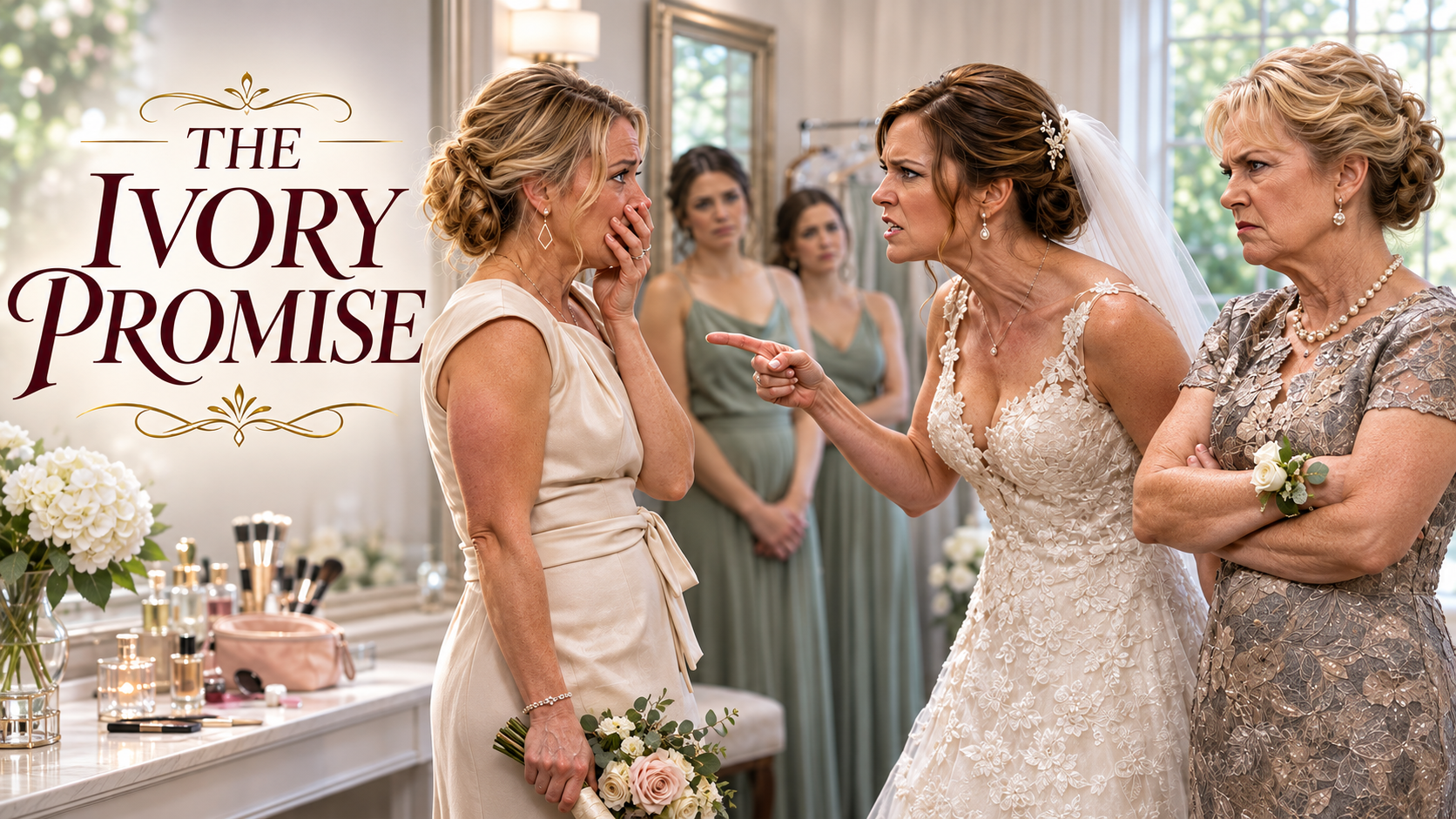
The wedding guests were still sitting in their seats when Claire walked back into the ceremony hall without her veil.
I followed her.
Grant was beside us.
Thomas Ellery carried the documents.
Margaret came last, her face pale and rigid.
One hundred and forty people turned to look.
The officiant stepped away from the altar.
Claire took the microphone.
“I’m sorry for the delay,” she said.
Her voice trembled.
“There’s something I need to understand before I marry anyone.”
Margaret moved toward her.
“Claire, this is completely unnecessary.”
Grant stepped between them.
“Mom. Sit down.”
The room went silent.
I had known Grant for almost three years.
I’d never heard him speak to his mother that way.
Margaret stared at him.
Then she sat.
Claire turned to me.
“Lauren, please come here.”
I hesitated.
Only an hour earlier, she’d told me I wasn’t welcome.
Now every guest was watching.
I walked toward her.
She looked at my ivory dress.
Then she started crying.
“I chose that dress,” she said into the microphone.
A murmur spread through the room.
“I chose it because Lauren and I made a promise when we were sixteen. We said that if either of us got married, we’d wear ivory together in the wedding pictures.”
She wiped her cheeks.
“I forgot the promise when it mattered most.”
I shook my head.
“Claire, you didn’t forget.”
She looked at me.
“Someone made you doubt it.”
Thomas stepped forward.
With Claire’s permission, he explained the trust, the protected land, and the documents that had been submitted using signatures neither of us recognized.
He was careful not to accuse anyone of a crime before the documents could be examined.
But the meaning was unmistakable.
Someone had tried to obtain control of the property without our informed consent.
Margaret stood.
“This is absurd.”
Grant turned toward her.
“Then explain the investors.”
She froze.
He continued.
“Explain why you told Claire the papers were routine marriage documents.”
Claire looked at him.
“You knew about that?”
“I knew she wanted you to sign paperwork. I didn’t know what it contained until today.”
Margaret’s voice rose.
“I was trying to secure your future!”
“No,” Grant said quietly. “You were trying to secure your investment.”
Then Olivia stood from the front row.
She was still holding my bouquet.
“Mom,” she whispered. “Please stop.”
Margaret turned toward her.
“Olivia, sit down.”
But Olivia didn’t.
She walked toward the altar.
Her hands were shaking.
“I knew Lauren was being replaced yesterday.”
Claire stared at her.
“What?”
“Mom told me Lauren had decided not to attend. She gave me the bouquet and the new ceremony schedule.”
She swallowed.
“And she told me that if I helped keep everything calm, she’d finally let me work in the family business.”
Margaret looked furious.
“Olivia!”
“I thought Lauren had agreed,” Olivia continued. “But when she walked out today, I knew something was wrong.”
She looked at me.
“I’m sorry.”
I could see how frightened she was.
But I could also see that she was telling the truth.
At least about what she’d been told.
Then Diane stepped forward.
She showed Claire the photograph of Olivia holding the bouquet the previous evening.
And the forged letter.
Claire read it.
Her face crumpled.
“I thought you wrote this.”
“I know.”
“I thought you hated Grant.”
“I never hated Grant.”
She looked at me.
“Then why didn’t you show me your messages?”
I thought about that question.
About the moment I’d stood in the bridal suite with my phone in my hand.
About how badly I’d wanted to defend myself.
“Because I didn’t want your wedding day to become a courtroom,” I said.
Claire began crying harder.
“And I turned it into one anyway.”
She reached for my hand.
“I’m so sorry.”
I held it.
For twenty-eight years, Claire had been the closest thing I had to a sister.
I wasn’t ready to pretend the hurt had disappeared.
But I wasn’t willing to let Margaret decide how our friendship ended.
“I love you,” I told her. “But we’re going to need time.”
Claire nodded.
“I know.”
Grant approached the microphone.
“I love Claire,” he said. “And I still want to marry her. But I won’t ask her to do it while she’s questioning whether she can trust me.”
He turned to her.
“If you need a week, a month, or a year, I’ll wait.”
Claire looked at him for a long moment.
Then she took his hand.
“That’s the first thing anyone has said today that actually sounds like love.”
The ceremony was postponed.
Not canceled.
The guests were invited to stay for dinner, and the quartet began playing again.
Margaret left shortly afterward.
She did not take the property documents with her.
Within days, Rebecca Hale began a formal review of the attempted trust dissolution.
The disputed signatures were referred for independent examination, and the proposed property transfer was suspended.
Grant withdrew from the hospitality negotiations.
Olivia resigned from her mother’s company.
And Claire moved out of the apartment Margaret had helped furnish.
For the first time in months, she began making decisions without asking anyone else’s permission.
I thought that was the end of the surprises.
I was wrong.
Three weeks after the wedding, Rebecca called me into her office.
Thomas Ellery was waiting.
On the table lay a second envelope.
My father’s handwriting was on the front.
Lauren and Claire — Together.
I sat down slowly.
“Another letter?”
Thomas nodded.
“The first letter was meant to explain the property. This one was meant to explain why the trust existed.”
Claire reached for my hand.
Rebecca opened the envelope.
Inside was a photograph.
Two men stood outside the estate.
My father, Henry Whitmore.
And Claire’s grandfather, Arthur Collins.
Between them was a young woman holding a baby.
I recognized the woman immediately.
My mother.
But the baby wasn’t me.
On the back of the photograph were three words.
Claire. Six months old.
I looked at Claire.
She looked at me.
Neither of us spoke.
Thomas unfolded the letter.
And then the truth we’d spent our entire lives without knowing finally emerged.
Claire’s parents had struggled financially when she was an infant.
Her grandfather had been forced to sell the family estate to cover mounting debts.
During that time, Claire’s mother had become seriously ill.
My parents had helped care for Claire while her family recovered.
For almost eleven months, she had lived in our home.
My father had carried her through sleepless nights.
My mother had fed her, comforted her, and taken her to doctor’s appointments.
And when Claire’s family was finally able to bring her home, my father made Arthur Collins a promise.
He would never allow financial hardship to separate Claire from the people who loved her.
The trust wasn’t simply a business arrangement.
It was a promise between two families.
My father had wanted both of us to have a voice in the future of the place where we’d grown up together.
But the final paragraph was the part that broke me.
Lauren, you always called Claire your sister.
You were more right than you knew.
Love made her part of our family before either of you understood what family meant.
If this letter reaches you on a difficult day, remember that a promise is worth protecting only when it protects people, not possessions.
I looked at Claire.
She was crying silently.
“I lived with your family?”
I nodded, unable to speak.
Then she laughed through her tears.
“That explains something.”
“What?”
“When we were little, your mom always knew exactly how to calm me down.”
I smiled.
“She knew how to calm everyone down.”
Claire shook her head.
“No. She used to sing a particular song to me. My mother never knew where I’d learned it.”
I remembered the song.
My mother used to sing it when either of us had nightmares.
And suddenly the photograph, the trust, and the strange timing of my father’s letters made sense.
He had known that marriage could change our lives.
He had wanted us to remember that our bond existed long before any wedding.
But there was one final surprise.
Rebecca slid a document across the table.
“The trust has an additional provision,” she said.
Claire and I exchanged glances.
“What kind of provision?”
“The beneficiaries may jointly designate the protected portion of the estate for a charitable purpose.”
I looked at the photograph again.
Then at Claire.
And for the first time since the wedding, we both smiled at exactly the same moment.
Six months later, we stood beneath the oak tree.
This time, neither of us wore ivory.
Claire wore a simple blue dress.
I wore sage green.
Grant stood beside her, holding a small velvet box.
There were no elaborate floral arrangements.
No luxury investors.
No one telling Claire what her wedding should look like.
Just thirty people who genuinely loved her.
Claire and Grant had spent six months rebuilding trust.
He had started a business independent of his mother.
Claire had returned to counseling, something she’d wanted to do long before the wedding.
And I had learned that forgiving someone didn’t mean pretending they’d never hurt me.
It meant deciding whether we could build something better from what remained.
When the officiant asked Claire if she was ready, she looked at me.
“Not quite.”
My stomach dropped.
For one ridiculous second, I thought history was repeating itself.
Then Claire smiled.
“Lauren, come here.”
I walked toward her.
She handed me a small ivory box.
Inside was the silver locket from the garden.
But the photographs had been replaced.
One side showed us at sixteen.
The other showed us three weeks earlier, sitting together in Rebecca’s office, crying and laughing over my father’s letter.
On the back were four engraved words.
Sisters by every promise.
I looked up.
Claire was crying.
So was I.
“Will you stand beside me?” she asked.
I laughed.
“Only if you promise not to complain about my dress.”
Everyone laughed.
Even Grant.
I took my place beside her.
The ceremony was beautiful.
Not because everything went perfectly.
But because no one had to pretend.
Afterward, we walked to the western garden, where a new sign stood beneath the oak tree.
THE WHITMORE-COLLINS HOUSE
A community space dedicated to families, friendship, and second chances.
We had used the trust to preserve the historic garden and establish a nonprofit that offered family support programs, community gatherings, and educational scholarships.
The main estate remained privately operated under new management, but its protected grounds would never become the hotel complex Margaret had planned.
That afternoon, Claire and I sat beneath the tree with two glasses of lemonade.
Just like we had when we were children.
“I keep thinking about that first wedding,” she said.
“So do I.”
“I almost lost you over a dress.”
I shook my head.
“It wasn’t the dress.”
“I know.”
She leaned against my shoulder.
“It was everything I let other people make me believe.”
We sat quietly.
Then Claire reached into her purse.
“I found something else.”
She handed me an old photograph.
Two little girls stood on the estate lawn.
One wore a white dress.
The other wore an almost identical ivory dress.
Both were covered in grass stains.
On the back, my father had written:
Lauren and Claire, practicing for the day they’ll stand beside each other as grown women.
I stared at the picture.
Then I began to laugh.
Because the final twist wasn’t that my father had left us valuable property.
It wasn’t that Margaret had tried to take it.
And it wasn’t even that Claire had once lived with my family.
It was that the ivory dress had never been a mistake.
It was the oldest promise we had.
Twenty-eight years earlier, two little girls had decided they would stand beside each other on their wedding days.
And after everything that had happened, we’d finally kept that promise.
Claire took my hand.
“Same time next year?” she asked.
“For what?”
She smiled toward the garden.
“Our anniversary.”
I laughed.
“Your wedding anniversary?”
“No.”
She squeezed my hand.
“The day we found our way back to each other.”
And as the afternoon sunlight filtered through the branches above us, I realized something my father had understood long before I did.
Some families are built by birth.
Others are built by the people who keep choosing one another.
Even after the worst day.
Especially after the worst day.
THE END.