Mother Finally Sees Her Baby’s Eyes After Rare Birth Defect Surgery
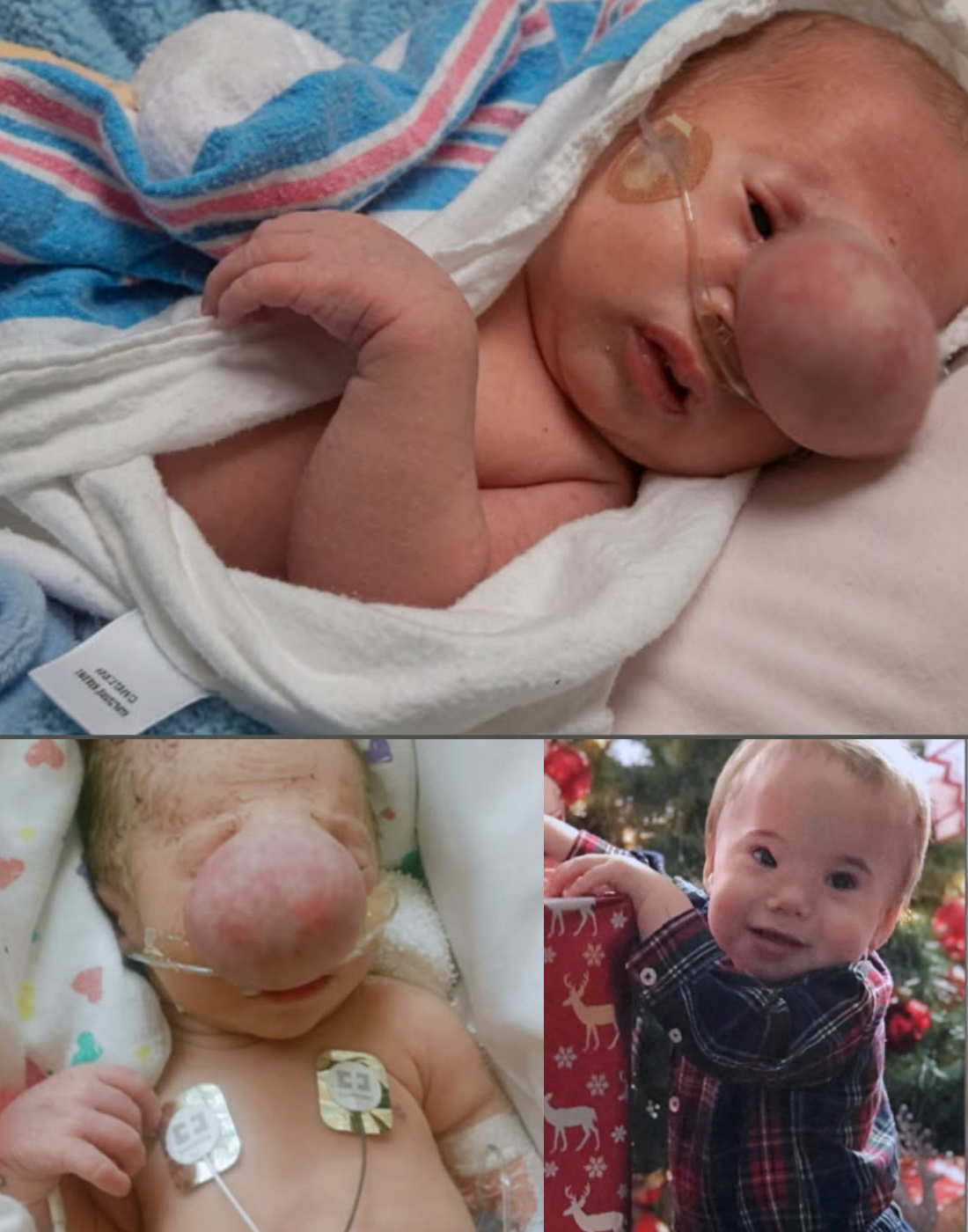
When Valeka Riegel gave birth to her son Zakary on December 29, 2016, she could see only a tiny mouth. A large sac of tissue and fluid covered the rest of his face, stretching from his forehead down to his upper lip and completely obscuring his eyes and nose.
Zakary was born with a rare neural tube defect known as a frontoethmoidal (or sincipital) encephalocele. During early development, a gap remained in the bone between his eyes. Brain tissue and cerebrospinal fluid herniated through the opening and formed a prominent, skin-covered sac. The condition occurs in roughly 1 in 10,500 to 12,200 U.S. births.
Doctors first suspected a facial cyst on ultrasound around the fifth month of pregnancy. A fetal MRI at Cincinnati Children’s Hospital Medical Center confirmed the far more serious diagnosis. A multidisciplinary team of 22 specialists prepared for the high-risk delivery. Zakary arrived by cesarean section and was immediately transferred to the neonatal intensive care unit.
The heavy sac compressed his nasal passages and airway, so caregivers fashioned a supportive sling that lifted the mass off his face around the clock. He required a feeding tube and supplemental oxygen while the medical team waited for him to grow strong enough for surgery. He spent four and a half months in the NICU.
In April 2017, when Zakary weighed about 15 pounds, pediatric neurosurgeon Dr. Charles Stevenson and pediatric plastic surgeon Dr. Brian Pan performed a complex nine-hour operation. The procedure included a craniotomy to access the defect, careful removal of the non-functional herniated tissue, repair of the skull opening, reconstruction of protective layers around the brain, and rebuilding of the nasal bridge and facial contours. Pathology confirmed the tissue was benign.
When Riegel walked into the recovery room, she finally saw her son’s face. “I walked into that room and I just cried,” she later recalled. “I couldn’t imagine seeing his eyes, and his mouth and his nose. And I just kept staring thinking, there’s really a baby in there.” She was especially struck by his long eyelashes and brown eyes.
By his first birthday, Zakary was thriving. He had begun crawling and pulling himself to stand, though he remained a few months behind typical developmental milestones. His surgeons expressed optimism about his long-term outlook and did not anticipate further major neurological interventions.
Riegel, an experienced neurological intensive-care nurse, later shared her experience in an open letter to her son published by Cincinnati Children’s. She described the fear, anger, and eventual gratitude she felt, and publicly thanked the surgical team that made her son’s face visible for the first time.
Zakary’s story highlights both the challenges of rare congenital craniofacial conditions and the power of coordinated, specialized pediatric care.
Sources
- CincinnatiChildren’sHospitalMedicalCenterpatientstoryandblog