Natalie’s Superhero Mask: A Baby Born with a Striking Facial Birthmark
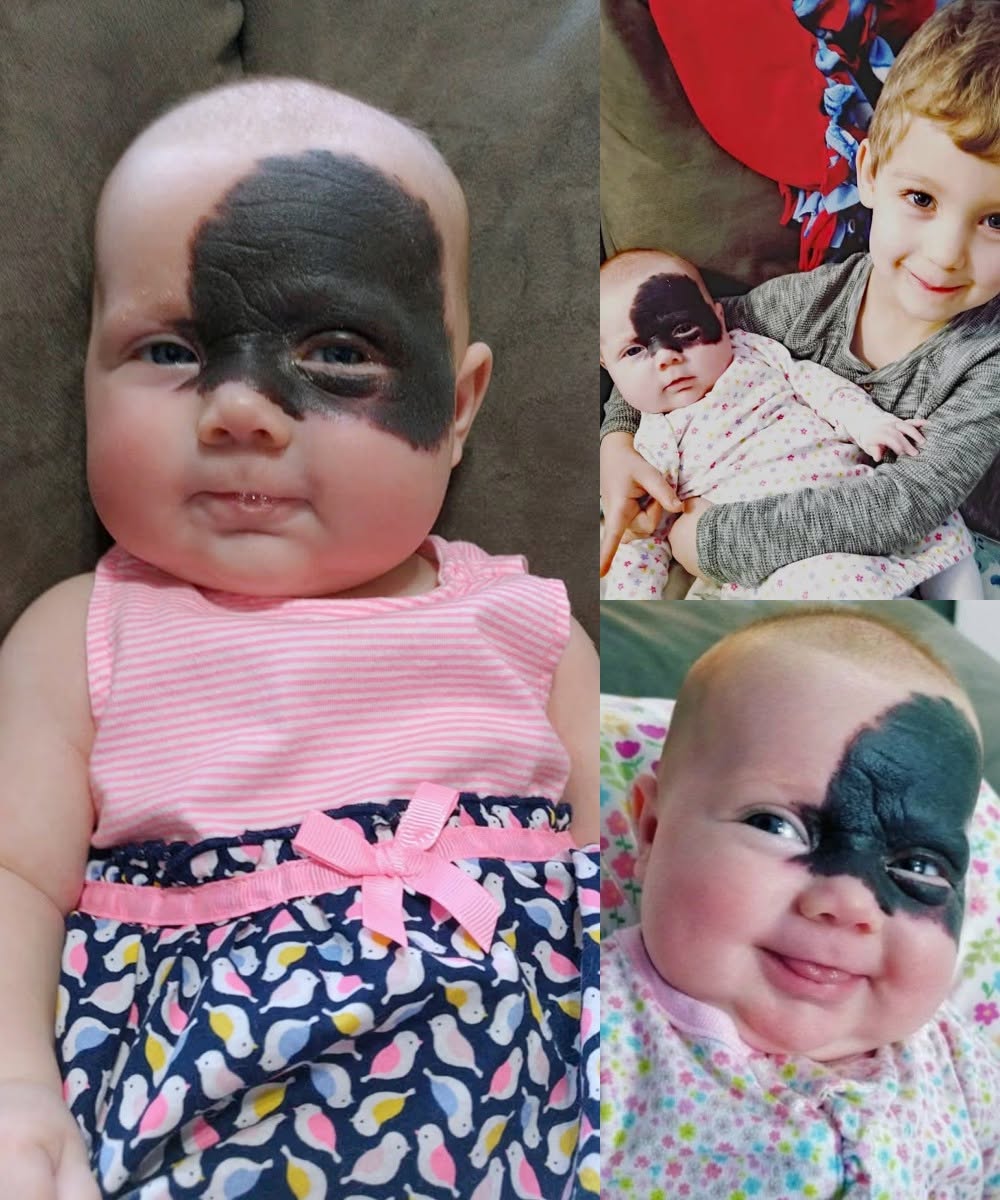
When Andrew and Lacey Jackson welcomed their daughter Natalie into the world on January 9, 2018, they expected the usual first glimpse of their newborn. Instead, they were met with a striking dark birthmark covering a large portion of the left side of her face.
Natalie was delivered by Caesarean section at Sanford USD Medical Center in Sioux Falls, South Dakota. As the nurse lifted her up, Lacey immediately noticed the large black mark that stretched across her forehead, around her left eye, and onto her cheek. At first, Lacey was filled with panic. The mark looked almost like a bruise, and she worried that something might have happened during pregnancy or delivery.
Doctors quickly reassured the new parents that Natalie was otherwise healthy, breathing normally, and doing well. The mark was a congenital melanocytic nevus (CMN)—a type of mole present at birth caused by an overgrowth of pigment-producing cells (melanocytes). Large facial CMNs are relatively uncommon and can vary in size and appearance. In Natalie’s case, it covered roughly a third of her face and gave her a distinctive look that many later compared to a Batman-style superhero mask.
Andrew, originally from Hull in the UK, and Lacey, an autopsy technician, have two older sons, Elliott and Devin. When the boys first met their baby sister, one of them asked about the black mark. Lacey told them it was her “superhero mask,” and the nickname stuck. The family chose not to pursue surgical removal. Instead, they decided to help Natalie grow up proud of the feature that makes her unique. “People tell us how amazing her birthmark is and how gorgeous she is and we couldn’t agree more,” Lacey has said.
Medical follow-up included visits to an ophthalmologist to check her vision, a dermatologist, and an MRI to rule out any associated internal concerns such as neurocutaneous melanosis. All results came back reassuring. While large congenital melanocytic nevi carry a slightly elevated lifetime risk of melanoma and require ongoing monitoring, Natalie’s doctors emphasized that in her case it was primarily a cosmetic difference. Over the years, the nevus has naturally lightened somewhat, and smaller satellite spots that were present at birth have faded—an uncommon and positive development noted by the family.
Congenital melanocytic nevi range from small to giant in size. Giant or large facial ones can prompt discussions about surgical options, laser treatments, or simply careful observation, depending on location, risk factors, and the family’s preferences. Many families, like the Jacksons, choose to embrace the mark as part of their child’s identity while remaining vigilant with regular skin checks.
Natalie’s story, which first drew widespread attention when she was a few months old, continues to highlight both the initial shock parents can feel when a visible difference is unexpected and the power of reframing that difference with love and confidence. What began as a moment of fear became a symbol of strength—a little superhero mask that her family celebrates every day.
Sources
- BBC News, Hull Daily Mail, Mirror, and Metro reports (May 2018) on Natalie Jackson’s birth, the congenital melanocytic nevus, parental reaction, and the “superhero” nickname
- Later family updates and features (including Newsner and related coverage) confirming diagnosis of congenital melanocytic nevus (CMN), medical monitoring, natural lightening of the mark, and the family’s ongoing positive outlook