Heloísa and Helena: The Two-Year-Old Twins Who Never Gave Up on the Dream of Separation
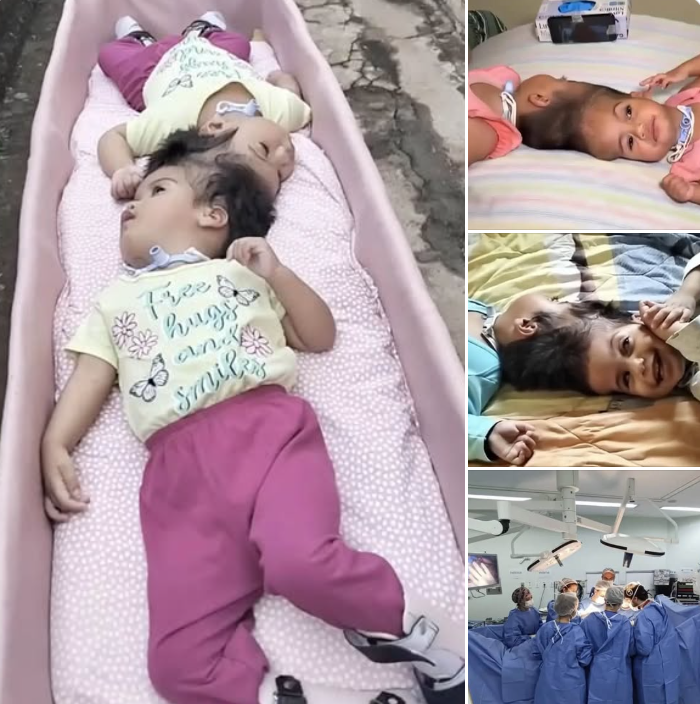
For more than two years, Heloísa and Helena Batista da Silva shared almost every moment of their young lives. Born joined at the head, the sisters faced an extraordinarily complex medical condition that required months of preparation and multiple major operations.
Their family and doctors hoped that, after a carefully planned series of procedures, the girls would finally be separated and able to live independently.
That hope ended tragically on August 15, 2026, when both children died during the final stage of the separation procedure at the Hospital das Clínicas in Ribeirão Preto, São Paulo, Brazil. The operation lasted approximately 15 hours and involved more than 50 medical and support professionals.
A Rare and Complex Beginning
Heloísa and Helena were craniópagas — conjoined twins joined through the skull. Their condition involved shared brain structures and blood vessels, making any attempt at separation extraordinarily dangerous.
The hospital began planning their treatment in 2024. Rather than attempting one enormous operation, doctors decided to divide the separation into several stages. The approach was designed to gradually separate the shared structures while giving the girls’ bodies time to recover between procedures.
The first operation took place on August 23, 2025. Doctors were able to achieve approximately 25% of the planned separation.
A second operation followed in November and lasted around 10 hours.
Then, in February 2026, the girls underwent their third procedure. Doctors reported that approximately 75% of the shared brain and blood vessels had by then been separated.
Preparing for the Final Operation
The fourth surgery, performed in March, had a different purpose.
Doctors placed tissue expanders beneath the girls’ scalp skin. These devices were gradually filled to increase the amount of skin available, because once the twins were completely separated, surgeons would need sufficient tissue to close the skulls of both children.
The family was approaching the final stage after nearly a year of preparation.
The ultimate goal was deeply personal: for the sisters to finally be physically independent and able to interact face-to-face. Their father, Amarildo Batista da Silva, had spoken about his hope of seeing his daughters separated and able to look at one another.
The 15-Hour Final Surgery
The fifth and final operation began on the morning of Saturday, August 15.
More than 50 professionals participated in the procedure, which lasted approximately 15 hours. The medical team eventually completed the physical separation of the sisters at around 11 p.m., after disconnecting the final structures that still linked them.
But almost immediately afterward, the girls developed severe hemodynamic instability.
According to doctors who later explained the operation, one sister developed very low blood pressure while the other experienced dangerously high blood pressure. The medical team had been managing fluctuations throughout the surgery, but the instability became significantly worse at the moment of final separation.
The sisters had also been medically fragile. Doctors said they had experienced repeated episodes of pneumonia and had required both a tracheostomy and a gastrostomy for feeding. Their previous health problems had reduced their ability to withstand the enormous physiological stress of the final operation.
A Tragic Final Moments
After the girls had been completely separated, Helena suffered a cardiorespiratory arrest at approximately 11:12 p.m.
Doctors immediately began resuscitation efforts and continued for about 25 minutes, but they could not restore her condition. She was pronounced dead at 11:37 p.m.
While medical staff were still treating Helena, Heloísa suffered a cardiorespiratory arrest at approximately 11:26 p.m. Resuscitation efforts were again continued for about 25 minutes, but she could not be saved. Her death was pronounced at 11:51 p.m.
The girls had survived the complex separation itself, but their bodies were unable to recover from the severe instability that followed.
A Family’s Gratitude Amid Unimaginable Loss
The deaths left their parents and family devastated after years of medical appointments, surgeries and hope.
Yet their father, Amarildo Batista da Silva, publicly expressed gratitude toward the doctors and medical professionals who had cared for his daughters throughout their journey. He returned to the hospital after their deaths to thank the team for its efforts.
The sisters were laid to rest in São José dos Campos, where the family lived, on August 16. Their mother, Claudilene Aparecida dos Santos, shared an emotional farewell to her daughters following their deaths.
A Story of Hope, Courage and Love
Heloísa and Helena’s story was never simply about a medical procedure.
For their family, it was about giving two little girls the possibility of an independent future.
The doctors had carefully divided the process into five operations, using advanced imaging, three-dimensional models and other planning techniques to understand the sisters’ shared anatomy and reduce the risks as much as possible. The case was the third involving craniopagus twins treated by the Hospital das Clínicas in Ribeirão Preto. The two previous cases at the hospital had resulted in successful separations.
This time, however, the outcome was heartbreaking.
Heloísa and Helena endured months of preparation and four difficult surgeries before reaching the final operation. Their family held onto the hope that one day the sisters would be able to live separately, look directly at each other and experience childhood in a completely different way.
That dream was never fulfilled.
But their story remains a testament to the love of their family and to the extraordinary efforts of the medical team that fought for them. Their journey also illustrates just how complex and unpredictable the separation of conjoined twins can be, even after years of preparation and advances in modern medicine.
For Heloísa and Helena, their lives were brief, but they were surrounded by a family that never stopped hoping for them.
Sources: UOL — Medical team explains the circumstances surrounding the twins’ deaths