Learning Without Limits: The Inspiring Story of Tiyo Satrio, the Indonesian Boy Who Refused to Let Disability Define Him
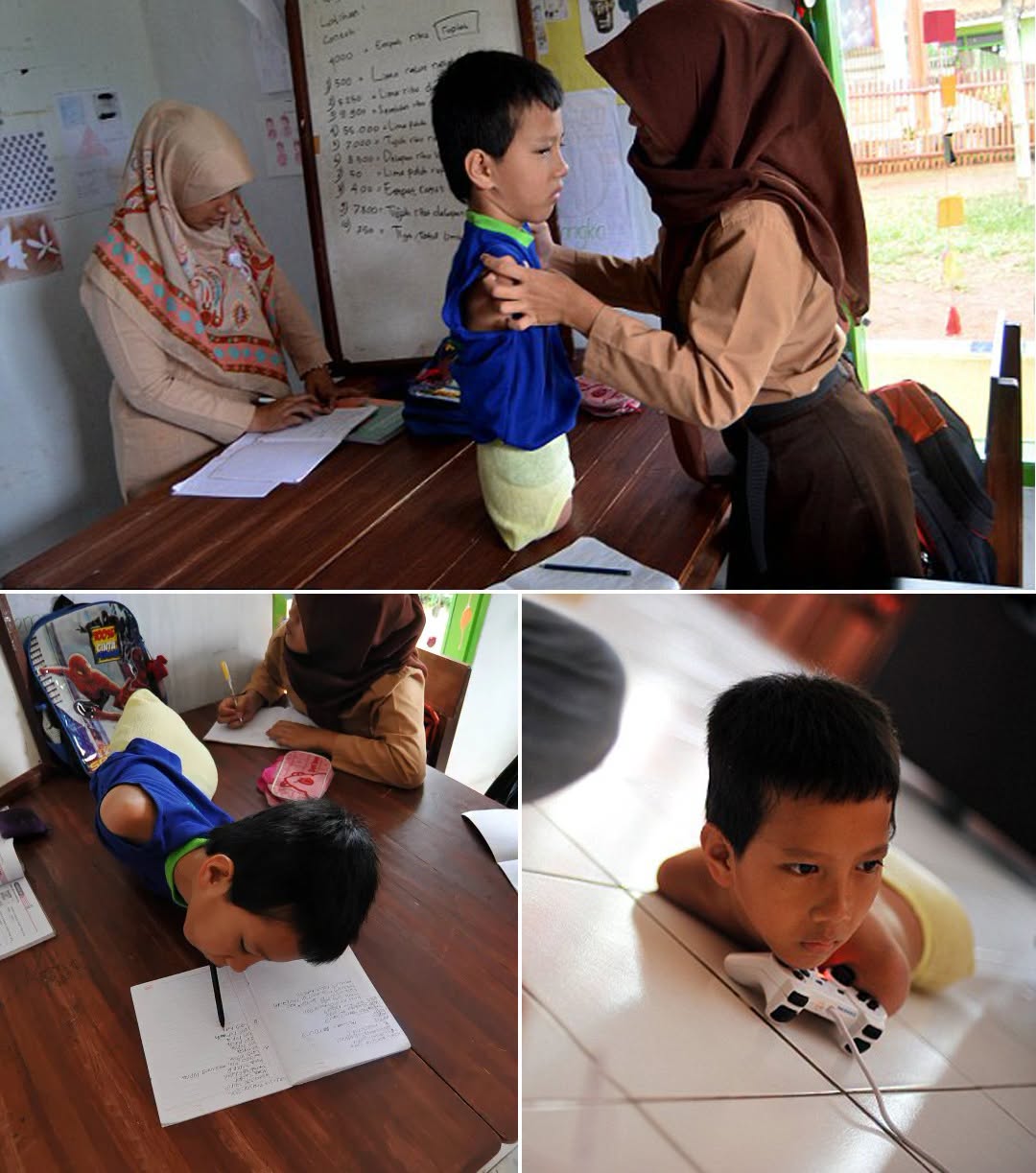
For most children, holding a pencil or playing a video game is an ordinary part of growing up. For Tiyo Satrio, both activities required him to find completely different ways of using his body.
Born without arms and legs, Tiyo grew up in West Java, Indonesia, learning to navigate everyday life through creativity, determination and the support of his family. By the time he was 11, his story had attracted international attention—not simply because of his physical condition, but because of the remarkable ways he had learned to study, play and participate alongside other children.
A Childhood That Required Constant Adaptation
Tiyo was born in Penawangan, Ciamis, West Java, as the youngest of seven children. His mother, Mimi, said she had not known during pregnancy that her baby would be born without arms and legs. According to Indonesian media reports, the family was initially shocked, but Mimi gradually accepted her son’s condition and focused on helping him grow up with confidence.
As a young child, Tiyo depended on his parents for many everyday activities. Getting around often required assistance, and he used a wheelchair. Bathing, dressing and other personal tasks could also require help.
But dependence in some areas did not stop Tiyo from seeking independence in others.
His determination became particularly evident when he began attending school.
Writing With His Mouth
Tiyo attended SLB Firdaus, a special-education school in Ciamis. Because he had no hands, he developed his own method of writing: holding a pencil between his lips and using his mouth to guide it across the page.
Teachers reported that he was an enthusiastic student and performed particularly well in mathematics. Indonesian reports from 2016 said that although Tiyo was still in second grade, he could solve multiplication and division problems typically associated with older students.
His academic ability challenged assumptions that physical disability necessarily limits a child’s intellectual development.
Teachers also described him as cheerful and well-liked. His optimistic personality and infectious laughter helped him become a favorite among classmates and teachers.
That was an important change for Tiyo. Earlier in childhood, reports said he had struggled with insecurity and sometimes avoided going outside because of his physical differences. Over time, however, school gave him an opportunity to interact with other children and demonstrate what he could do.
His Favorite Hobby: PlayStation
Perhaps the most unexpected part of Tiyo’s story was his love of video games.
Like millions of other children, Tiyo enjoyed playing PlayStation. But without hands, he had to develop a completely different technique.
He learned to use his chin and shoulders to operate the controller, pressing buttons and manipulating the controls with remarkable precision. Reports said that he played whenever he had the opportunity—even before school and again after returning home. His mother joked that sometimes his teacher had to take him away from the game when it was time for class.
Videos of Tiyo playing spread internationally, introducing audiences around the world to a child whose physical differences had not prevented him from enjoying one of his favorite childhood activities.
Rather than seeing the controller as something he could not use, Tiyo approached it as a problem that could be solved.
He simply had to find another way.
The Importance of Family Support
Tiyo’s achievements did not mean that he suddenly became completely independent.
His family continued to provide essential assistance with many aspects of daily life. His parents helped transport him to school, and he still relied on others to move around when his wheelchair could not be used independently.
This is an important part of his story that can sometimes be lost when inspirational stories are shared online.
Disability does not have to mean doing everything alone.
For Tiyo, independence meant finding the things he could do for himself while accepting support where he needed it. His ability to write, study and play games was not evidence that he no longer needed assistance. It was evidence that, with encouragement and adaptation, he could participate in activities that might initially have seemed impossible.
Redefining What Is Possible
Tiyo’s story became widely known after international media reported on his abilities in 2016 and 2017.
The attention was not simply about the fact that he was born without four limbs. It was about what happened afterward.
He went to school.
He learned to write.
He excelled in mathematics.
He made friends.
And he played video games using a controller in a way that was entirely his own.
Each achievement represented a small act of adaptation, but together they created a much larger message: the way a person accomplishes something can be completely different from the way everyone else does it.
The goal does not necessarily have to change simply because the method does.
A Lesson Beyond Inspiration
Tiyo’s story is often described as inspirational, but there is a deeper lesson behind it.
Children with disabilities should not be defined solely by what their bodies cannot do. They should also be given opportunities to discover what they can do—with accessible education, supportive families, adaptive equipment and environments that allow them to participate.
Tiyo’s experience demonstrates the importance of that opportunity.
His family could not change the circumstances of his birth. His teachers could not give him arms and legs. But together, they helped create an environment in which he could learn, socialize and develop his own abilities.
And Tiyo himself kept experimenting.
A pencil became something he could control with his mouth.
A PlayStation controller became something he could operate with his chin and shoulders.
A classroom became a place where his mathematical ability could shine.
Finding His Own Way
There is something deeply powerful about watching a child discover an alternative way to do an ordinary task.
Tiyo did not learn to write in the conventional way.
He did not play video games in the conventional way.
He did not move through the world in the conventional way.
But he learned to do these things nonetheless.
His journey reminds us that accessibility is not about expecting everyone to perform tasks in exactly the same manner. It is about creating opportunities for people to participate and allowing them to discover methods that work for them.
Tiyo’s story also offers a more realistic definition of resilience. Resilience does not mean never needing help. It means continuing to learn, adapt and participate despite challenges—and being willing to accept support along the way.
A Different Way to See Ability
When Tiyo Satrio sat at his desk with a pencil in his mouth, he was not simply overcoming a physical limitation.
He was learning.
When he picked up a PlayStation controller with his chin, he was not simply entertaining himself.
He was playing, competing and enjoying childhood.
And when he entered his classroom, he was not simply a child with a disability.
He was a student—with strengths, interests, friendships and ambitions of his own.
Perhaps that is the most important lesson from Tiyo’s journey:
Sometimes ability is not about having the same tools as everyone else. It is about discovering what you can accomplish with the tools you have.
Sources
- Contemporary Indonesian reporting on Tiyo’s school life, mathematics ability, family and PlayStation skills.