I Never Wanted to Be the Next Bruce Lee: How Jackie Chan Created His Own Legacy
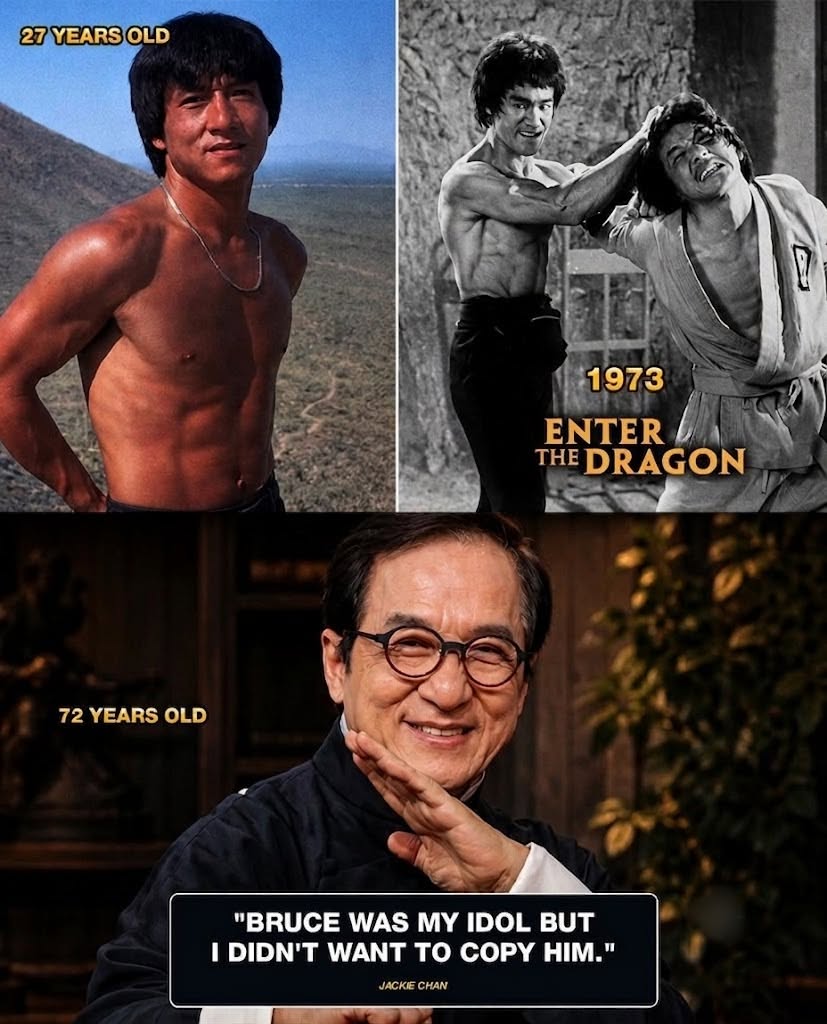
When Bruce Lee died in 1973, the world of martial arts cinema was left without its brightest superstar. Hollywood and Hong Kong studios immediately began searching for someone who could fill the enormous void he had left behind. A wave of imitators emerged, attempting to reproduce Lee’s legendary intensity, explosive movements, facial expressions, and unmistakable fighting style.
Among those caught in that wave was a young Jackie Chan.
At the time, Chan was still struggling to establish himself in the film industry. Like many martial artists of his generation, he was encouraged to follow the formula that had made Bruce Lee a global icon. But Chan soon discovered a problem: no matter how hard he tried, he could never become Bruce Lee—and, more importantly, he realized that he didn’t want to.
“Bruce was my idol, but I didn’t want to copy him.”
That realization would change the history of action cinema.
The Man Who Refused to Become Bruce Lee
Bruce Lee and Jackie Chan represented two completely different approaches to martial arts filmmaking.
Lee’s screen persona was powerful, confident, and almost unstoppable. His characters often entered a fight as the most dangerous person in the room. Every movement was precise, every strike carried authority, and his presence alone could dominate a scene.
Chan chose another path.
Instead of creating invincible heroes, he created characters who were vulnerable, frightened, and often completely outmatched. They fell down. They made mistakes. They screamed in pain. They ran away when necessary.
And then they fought back.
Chan understood that audiences didn’t always need to see a perfect fighter. Sometimes, they wanted to see an ordinary person desperately trying to survive.
His philosophy was summed up perfectly by the famous idea:
“If Bruce kicked high, I kicked low.”
It wasn’t simply about fighting techniques. It represented Chan’s determination to develop an identity completely separate from his idol.
Turning Weakness Into Entertainment
Jackie Chan’s greatest innovation was combining martial arts with physical comedy.
His background in Peking Opera training gave him extraordinary control over his body, while the influence of performers such as Buster Keaton and Charlie Chaplin helped him understand the power of timing, movement, and visual comedy.
The result was something audiences had rarely seen before.
A fight could suddenly become a comedy routine. A dangerous situation could turn into an elaborate stunt. A simple object could become an essential part of the choreography.
A ladder could become a weapon.
A chair could become a shield.
An umbrella could become part of a fight.
A table, a pole, a shopping cart—or almost anything within reach—could be transformed into part of the action.
Chan didn’t just choreograph fights. He turned the entire environment into the fight.
From Failure to a New Kind of Action Hero
Chan’s early attempts at following the Bruce Lee formula were not successful. But those failures ultimately became some of the most important experiences of his career.
Instead of continuing to imitate what audiences already loved, he began asking a different question:
What can Jackie Chan do that Bruce Lee couldn’t?
The answer became his entire cinematic identity.
Chan developed a style built around creativity, humor, elaborate choreography, dangerous stunts, and characters who survived through determination rather than sheer strength.
He wasn’t trying to replace Bruce Lee.
He was building something Bruce Lee had never created.
And that distinction allowed Jackie Chan to become a superstar in his own right.
Two Legends, Two Different Legacies
Bruce Lee changed martial arts cinema by showing the world what a martial artist could truly look like on screen. He brought speed, philosophy, charisma, and authenticity to an international audience and became an icon whose influence continues decades after his death.
Jackie Chan followed a different road.
He showed that an action hero didn’t have to be invincible.
He could be clumsy.
He could be scared.
He could get hurt.
He could make the audience laugh while performing stunts that looked impossibly dangerous.
And somehow, that vulnerability made him even more heroic.
Bruce Lee became legendary by redefining the martial arts hero.
Jackie Chan became legendary by refusing to become Bruce Lee.
Their legacies are therefore connected—but never identical.
Perhaps the greatest tribute an artist can give to an idol is not imitation. It is inspiration.
Bruce Lee showed Jackie Chan what was possible.
Jackie Chan then found the courage to become something completely different.
He didn’t want to be the next Bruce Lee.
He wanted to be the first Jackie Chan.
And that decision helped create one of the most unique and influential action stars in the history of cinema.