A Family’s Unconditional Love Helped Maria Build a Life Without Limits
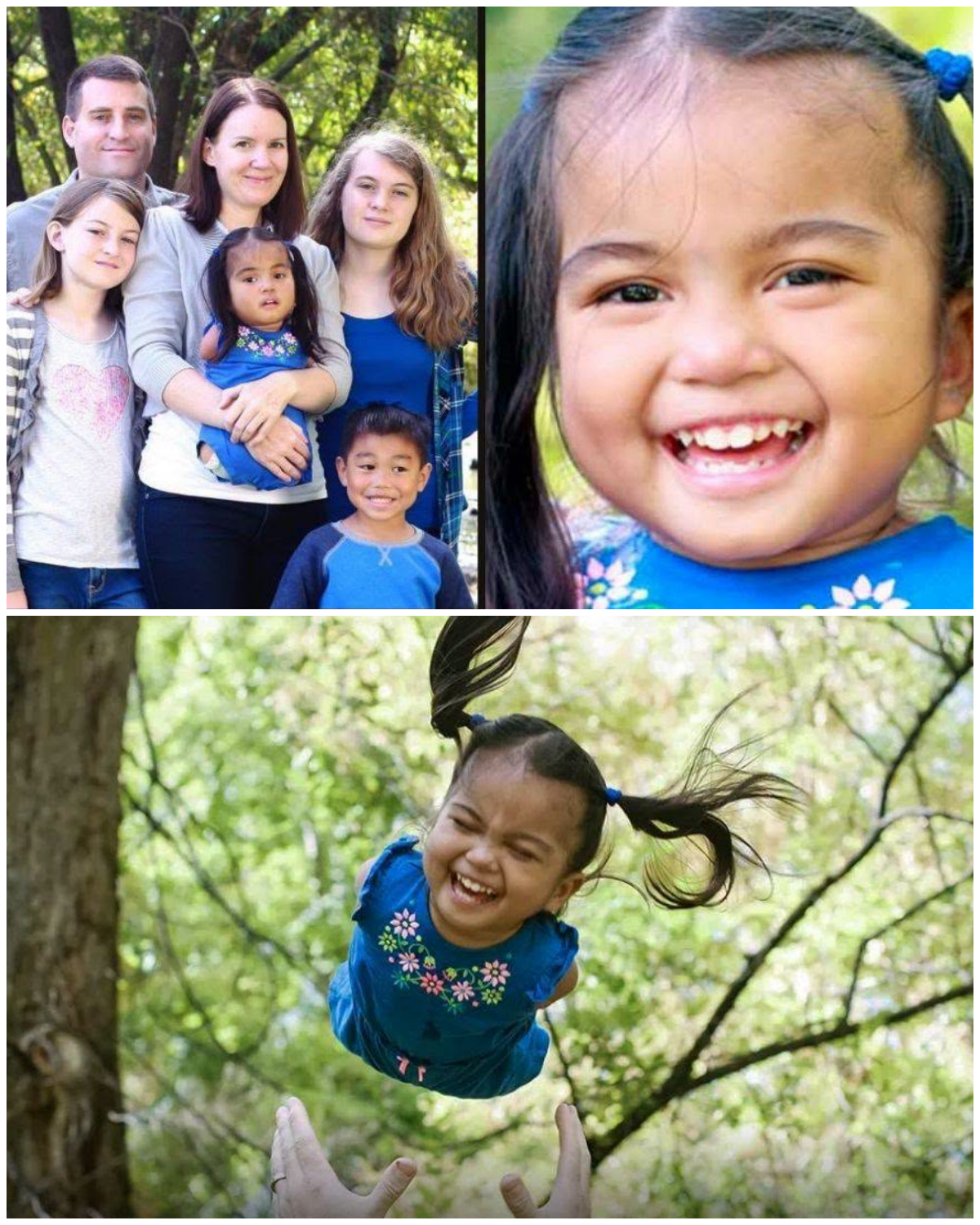
Maria was born in the Philippines with an extremely rare congenital condition known as tetra-amelia syndrome, a disorder characterized by the absence of all four limbs. From the beginning of her life, she faced challenges that would require extraordinary medical care, patience and support.
But Maria’s story changed when Adrianne and Jason decided to adopt her.
At the time, the couple already had children and had never raised a child with a significant disability. When they first saw Maria’s photograph, they understood that adopting her would bring new responsibilities and challenges. Yet instead of allowing uncertainty to stop them, they chose to move forward.
Maria was eventually welcomed into their family when she was just over two years old.
The transition was not always easy. According to her adoptive parents, Maria initially had difficulty knowing how to play and interact with her new surroundings. The family had to learn alongside her, searching for appropriate resources, connecting with other families and discovering new ways to help her develop her independence.
Rather than assuming what Maria could or could not do, her parents learned to let her find her own solutions.
That approach became one of the most important parts of her development.
Her parents recalled that they would sometimes try to show Maria how to perform a particular activity, only for her to reject their method and discover another way to accomplish it herself. She also developed her own interests, including enjoying movement and spending time on swings.
For Adrianne and Jason, watching those small discoveries become new abilities was one of the most rewarding parts of raising their daughter.
Tetra-amelia syndrome is extraordinarily rare. Medical literature describes it as a congenital condition involving complete absence of the four limbs, and it can occur alongside other serious abnormalities. In some cases, the condition has been associated with genetic changes affecting the WNT3 signaling pathway. Because of its rarity and severity, children born with tetra-amelia may require extensive medical and developmental support.
Maria’s experience also challenged some of the assumptions her parents initially had about what life might look like for someone born without arms and legs.
Before adopting her, they searched for other people living with similar limb differences. Seeing individuals with tetra-amelia who had grown into productive and independent adults gave the couple reassurance about the possibilities for their daughter.
Over time, Maria continued to surprise them.
Her parents described her as intelligent, determined and willing to try new things. Instead of measuring her life only by the things she could not physically do, they focused on helping her discover what she could accomplish.
Their story also carries a broader message about adoption and disability. Children with significant disabilities can face additional barriers when families consider adoption. Adrianne and Jason initially worried about the financial and practical responsibilities involved in raising a child with special needs. They eventually learned that resources and support networks were available and that they did not have to navigate the journey alone.
Most importantly, they discovered that Maria did not need to be treated as someone defined by her condition. She needed the same fundamental things every child needs: security, encouragement, patience and love.
Today, Maria’s story stands as an example of how a supportive family can help a child develop confidence and independence despite extraordinary physical challenges.
Her journey was never about pretending that her disability did not exist. It was about refusing to allow disability to determine the limits of her future.
The family that once wondered how they would care for a child with such complex needs eventually found themselves watching Maria teach them something they had not expected: children often discover possibilities when the people around them are willing to believe in them.
Maria was not simply given a home through adoption. She was given a family willing to learn alongside her, adapt to her needs and celebrate every new achievement.
And in return, she showed them that there are many different ways to play, learn, communicate, explore the world and build an independent life.
Sources
Orange Socks, “Adrianne and Jason: Tetra-Amelia Syndrome”
Orange Socks Podcast, “Episode 31: Adoption: Adrianne and Jason – Tetra-Amelia Syndrome”
National Center for Biotechnology Information, MedGen, Tetraamelia Syndrome
PubMed, medical literature on tetra-amelia syndrome
American Journal of Medical Genetics, research on tetra-amelia syndrome