A Mass on the Nose: Nasofrontal Encephalocele, Gorongosa, and the Distance to a Theatre
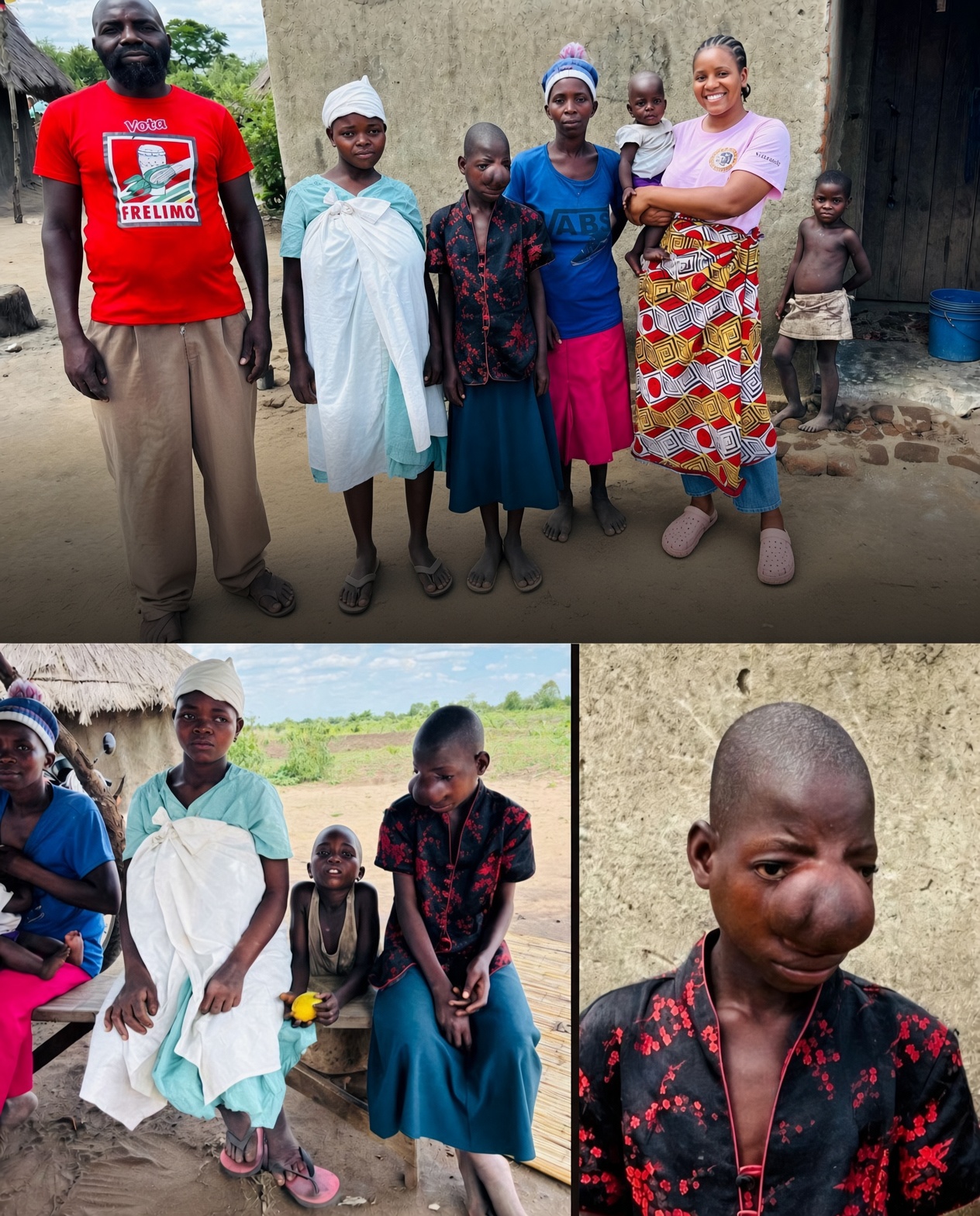
A nasofrontal encephalocele is a gap at the junction of the forehead and the nose through which meninges, fluid, and sometimes brain tissue push forward. The child is born with a swelling on the bridge of the nose or between the eyes. In parts of Africa and Southeast Asia this anterior form is more common than the occipital encephaloceles seen in Europe. Left unrepaired, the sac can leak, bleed, obstruct breathing, and pull the eyes apart. School becomes impossible not only because of the airway but because of how the face is read.
The photographs and the Spanish caption describe a girl named Yassa, living near Gorongosa National Park in central Mozambique, whose mass grew, bled, and began to block her nose. The post says an international campaign was moving her more than 1,300 kilometres to South Africa for neurosurgery and paediatric craniofacial repair — to reduce the herniated tissue, seal the bone, and open the airway so she could go back to class. Gorongosa is a real district. Mozambique does not have spare paediatric craniofacial units in every province. Johannesburg, Cape Town and Durban do. That route is how many such children leave Sofala or Manica: a local clinic names the defect, a photograph travels, a charity books a bus or a flight.
What could not be confirmed in major English-language outlets is a complete, named case file for “Yassa of Gorongosa” with dates, hospital and outcome. The images themselves are consistent with a long-standing sincipital encephalocele in a school-age child, not with a newborn’s fresh sac. Growth and bleeding later in childhood happen when the covering thins or the defect is stressed. Surgery at that age is still the same operation in principle: define the neck of the hernia, decide how much tissue can be reduced, close dura and bone, rebuild the nasal dorsum. Hydrocephalus and CSF leak are the usual postoperative risks. The child does not become “normal.” She becomes a child whose brain is no longer sitting on her face.
If the transfer took place, the solidarity in the caption is logistics — visas, kilometres, a theatre slot — not a metaphor. If it did not, the medicine remains. An open skull at the nose is a surgical problem. Distance is the other diagnosis.
—
Sources: Clinical reviews of nasofrontal and frontoethmoidal encephalocele (incidence in Africa and Southeast Asia; surgical approaches); BMJ Paediatrics Open meta-analysis of encephalocele birth prevalence in Africa; reports of craniofacial encephalocele repair in low-resource and southern African settings. The specific campaign named for Yassa was not independently verified in major press archives.