Pan Xianhang and the Skin That Never Rests
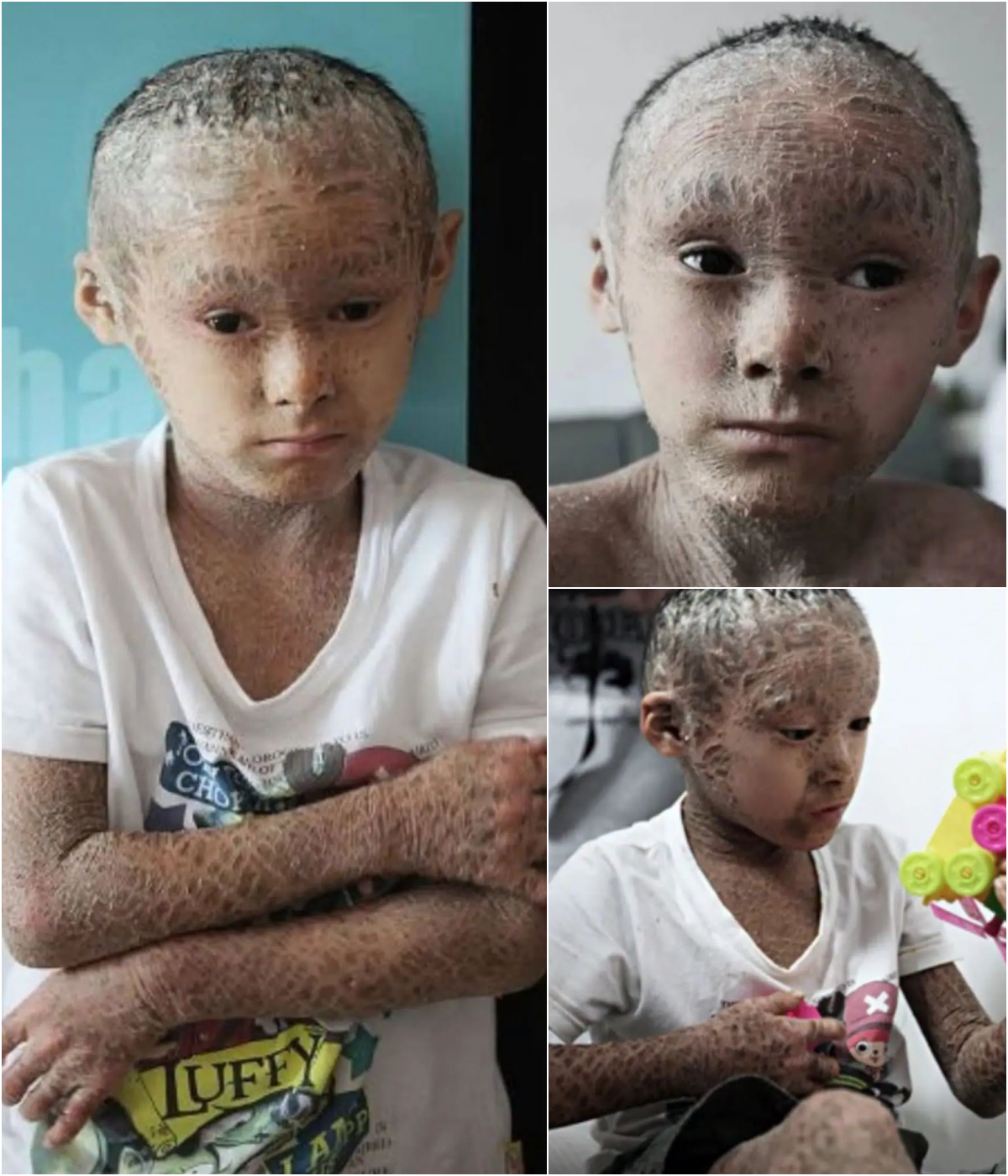
In 2013, photographs of an eight-year-old boy from Wenling, in Zhejiang province, eastern China, circulated far beyond his hometown. Pan Xianhang’s skin was thickened, dry, and covered in scales from scalp to limbs. Neighbors called him “fish boy,” a nickname taken from the Greek root of the disease he was born with: ichthyosis.
Ichthyosis is a group of genetic disorders in which the skin fails to shed and renew normally. In milder forms the scaling is limited. In Pan’s case it was nearly total. The plates of keratin pulled at his eyelids, nose, mouth, and ears. They restricted the movement of his arms and legs. Because the skin barrier did not work as it should, he overheated easily and could not sweat properly. The itching was constant. Sleep was broken. Cracks invited infection.
There is no cure. Treatment is lifelong management: thick emollients, oils, cool water to lower temperature, vigilance against fever and sepsis. Doctors from Hangzhou Jingdu Hospital visited the family that July, reviewed his records, and began treatment in Hangzhou. His mother’s stated hope was simple. She wanted him to go to school without unbearable pain.
That wish defined the public story more than the nickname did. Pan wanted to study, to play, to have an ordinary childhood inside a body that made ordinary things costly. Media coverage in China and abroad used the same images: a child holding a plastic truck, arms crossed over a graphic T-shirt, face set in the effort of living with skin that never stops announcing itself.
Severe congenital ichthyosis—especially harlequin and related autosomal recessive types—is rare. Many infants with the most extreme presentations do not survive the first weeks without intensive care. Those who do face years of contractures, eye complications, growth delay, and social isolation. Pan’s case was presented as one of those survivals: not a miracle of disappearance, but a child still here, still itching, still asking for a classroom.
Later public updates on Pan Xianhang are scarce. The 2013 record remains what is widely documented: a boy in Wenling, a hospital visit, a family asking for relief rather than spectacle, and a disease that turns the largest organ into a daily labor.
A rare skin disorder does not invent a personality. It only raises the price of every ordinary hour. Pan’s reported desire was not to become a symbol. It was to sit at a desk without scratching until he bled.
Sources
- HuffPost / HuffPost UK, coverage of Pan Xianhang, July–August 2013
- New York Daily News, “Chinese ‘Fish Boy’ covered head to toe with itchy scales,” July 2013
- The Korea Times, “Pan Xianhang suffers from itchy scale skin disease Ichthyosis,” August 2013
- Imaginechina / Alamy photo captions from Wenling and Hangzhou Jingdu Hospital visit, July 2013
- Foundation for Ichthyosis & Related Skin Types (FIRST) and Ichthyosis Support Group statements on incidence and care
- Clinical overviews of congenital ichthyosis and harlequin-type disease (DermNet, NORD, Orphanet)