A Strawberry Mark That Would Not Wait: Anabelle Vance and Infantile Hemangioma
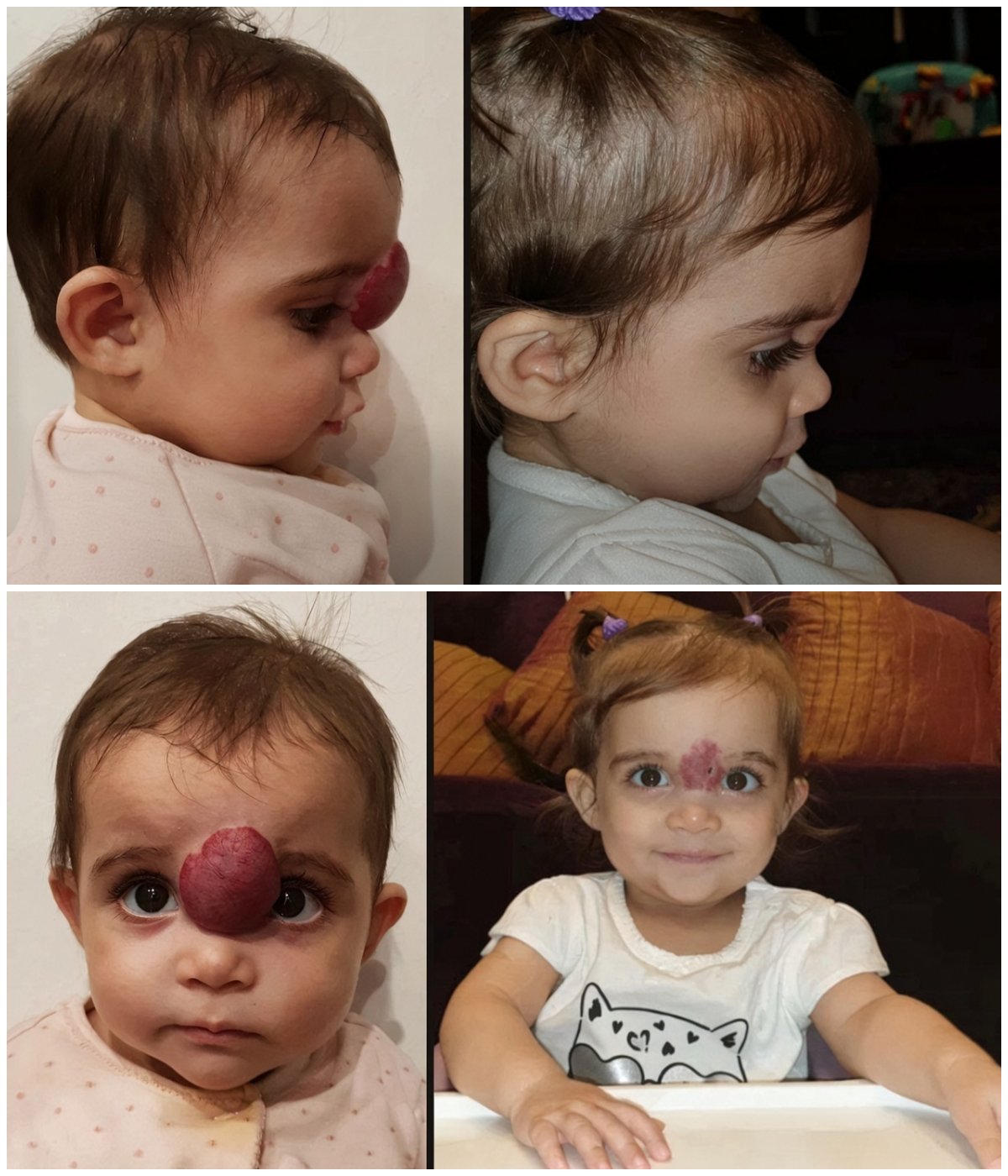
Anabelle Vance was born looking like any other newborn. Then a small pink mark on her face began to grow. Within weeks it had become a raised, deep-red mass sitting over the bridge of her nose and between her eyes—an infantile hemangioma, the most common benign tumor of infancy.
Hemangiomas are made of extra blood vessels. They are not cancer. About 4 to 10 percent of babies develop one. Most appear in the first weeks of life, proliferate rapidly for several months, then slowly fade over years. When the lesion sits on the face, grows quickly, ulcerates, or threatens vision, feeding, or facial nerves, doctors do not wait for nature.
Anabelle’s mass distorted her features and risked the tissues around her eyes and mouth. First-line treatment is usually oral propranolol (sold as Hemangeol in liquid form for infants). The drug shrinks the vessels and can stop ulceration. Many children improve on medicine alone. When a large residual lump remains, or when the lesion interferes with comfort and function, surgeons excise it—often after the first birthday, when the growth phase has slowed and the scar can be planned along natural creases.
The photographs that circulated online show the classic sequence: a toddler with a grape-sized red tumor on the midface, then the same child months later with only a faint pink patch and two small pigtails. That pattern matches published before-and-after cases from pediatric plastic surgeons: medication first, then careful removal that preserves the smile and eyelid movement.
The Spanish caption that travels with the pictures calls the outcome a “rotund success.” Medically, that means the bulk is gone, facial motion is intact, and the remaining discoloration is expected to fade further as the child grows. Infantile hemangiomas leave a mark of some kind—thin skin, extra vessels, or a pale scar—but they do not have to leave a life lived behind a mask.
Anabelle’s story, as told by her family, is not rare in kind. It is rare in how completely a single growing lesion can dominate a baby’s first year, and how quickly modern treatment can return an ordinary face. The tumor was never malignant. The emergency was time, location, and a child’s right to eat, see, and be seen without pain.
Sources
- American Academy of Pediatrics / pediatric dermatology guidance on infantile hemangioma and propranolol (Hemangeol)
- Dr. Rachel Ruotolo / NYPSG public education posts on surgical excision after medical treatment of rapidly growing facial hemangiomas
- Vascular Birthmark Institute and Little Baby Face Foundation case descriptions of midface hemangioma surgery
- Standard reviews: hemangiomas occur in 4–10% of infants; facial lesions near eyes or mouth warrant early treatment
- Family-circulated before-and-after photographs and caption identifying the child as Anabelle Vance