They Shared Most of Their Lower Bodies — Then a 17-Hour Surgery Gave Erika and Eva a Life Apart
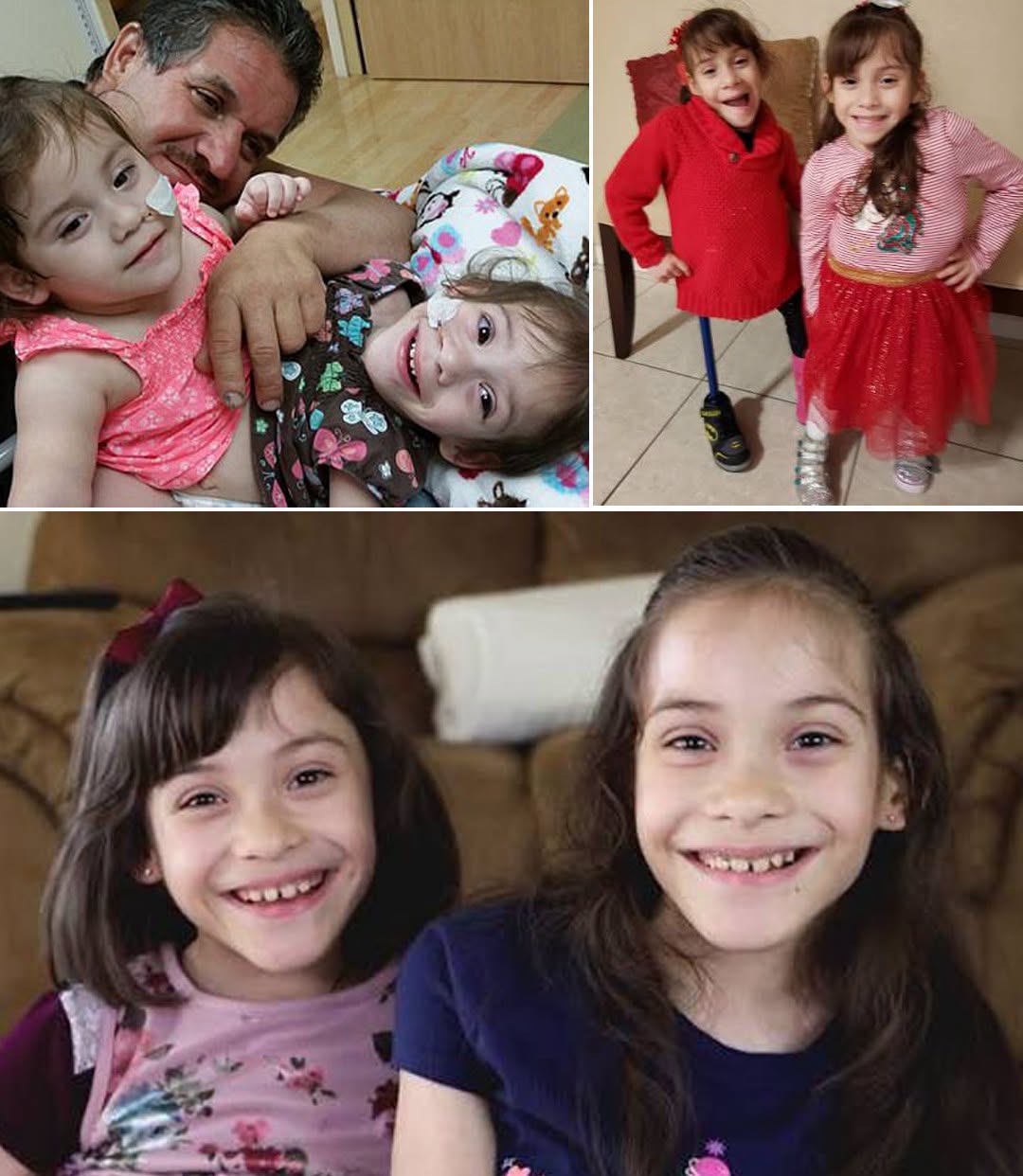
For the first two years of their lives, Erika and Eva Sandoval had never experienced life apart.
Born in California in 2014, the sisters were conjoined twins, connected from the lower chest and abdomen through the pelvis. Their bodies were joined in ways that made separation an extraordinarily complex medical challenge.
They had separate hearts and lungs, but shared a liver, a bladder and portions of their digestive system.
Together, they had three legs.
When the twins were born, doctors could not say with certainty whether separation would ever be possible. As the girls grew older, however, their health began to deteriorate, forcing their family to confront an incredibly difficult decision.
Surgeons warned their parents that the operation carried a serious risk. They estimated that there was roughly a 30% chance that one or both girls might not survive.
Despite the danger, their parents decided to give Erika and Eva a chance at separate lives.
In December 2016, when the twins were two years old, approximately 50 medical professionals came together for an extraordinary operation.
The surgery lasted around 17 hours.
Doctors carefully separated the girls’ shared organs and reconstructed their bodies. Tissue from their third leg was used to help close Erika’s surgical site.
Then came a moment that their family had never experienced before.
For the first time since the twins had developed together before birth, Erika and Eva were placed in separate beds.
Both girls survived.
Each eventually had one leg and one kidney, and both faced the enormous task of learning how to move and function independently.
Their recovery would require patience, rehabilitation and continued medical care.
But their progress surprised even some of the doctors involved.
The sisters gradually learned to sit independently and were fitted with custom prostheses. Over time, they became increasingly mobile and began developing their own ways of interacting with the world.
By the time they reached kindergarten, Erika and Eva were doing many of the things children their age enjoy—playing, learning, exploring and developing increasingly distinct personalities.
Their mother described their progress with a simple observation:
“They’re just thriving and amazing me every day.”
Their story is remarkable not because separation erased every challenge, but because it gave the sisters an opportunity that had once seemed uncertain: the chance to grow as two individuals.
For their first two years, Erika and Eva shared almost everything—their body, their space and their physical connection.
After one of the most complicated decisions their family would ever face, they began discovering something entirely new.
Life as sisters, rather than conjoined twins.
Their journey is a powerful example of the extraordinary possibilities—and risks—that modern medicine can confront when families and medical teams are faced with conditions few people ever encounter.