The Man With No Face: Mohammad Latif Khatana and Life With Neurofibromatosis in Kashmir
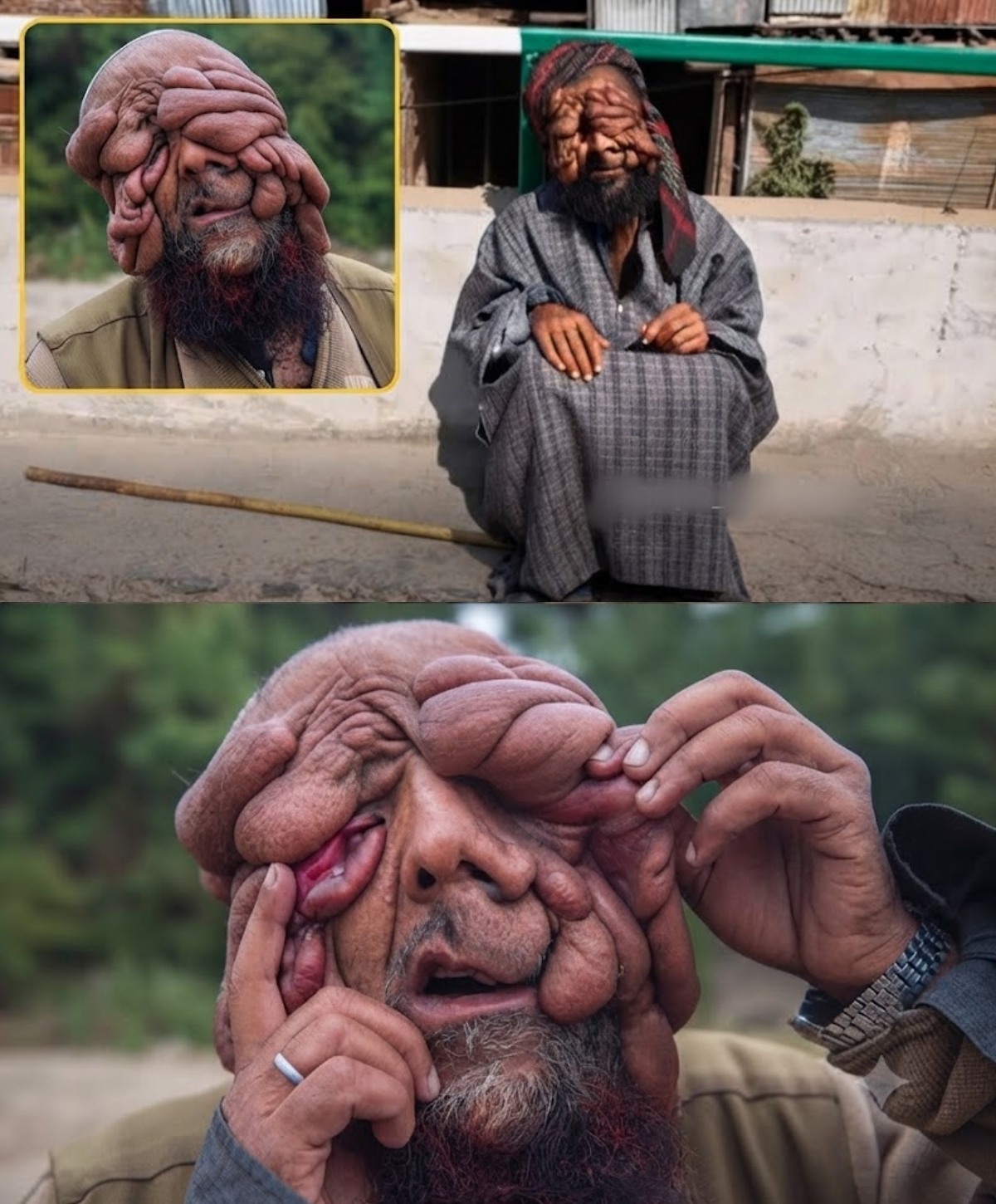
Mohammad Latif Khatana was born in a farming family in Tuli Bana, Reasi district, in the Jammu region of Indian-administered Kashmir. As an infant he had a small lump on his face. The lump did not stay small. Over years it thickened into heavy, hanging folds of skin that buried his eyes, distorted his mouth and left him, in the words of the people who photographed him, a man without a face.
Doctors later identified the condition as neurofibromatosis — a genetic disorder in which tumors grow on nerve tissue. (Early photo captions sometimes mislabeled it as human papillomavirus; later interviews and medical descriptions align with neurofibromatosis.) Tumors appeared on his body as well, but the largest masses were on his head. One eye went blind. Vision in the other was reduced as folds of tissue covered the lids. Local hospitals told his parents they could not treat the disease.
Growing up meant stares, insults and fear. Soldiers once pointed weapons at him, he said, mistaking him for an animal; he had to beg them not to shoot and insist that he was a man. Work was almost impossible. For part of each year he travelled to Srinagar to beg by the roadside, then returned to his village.
In August 2008 he married Salima, who had been born with one foot. They recognized each other’s isolation. In November 2012 their first daughter, Ulfat — Urdu for love — was born at home in Reasi, healthy and with an ordinary face. Latif examined her immediately. “When I saw that she was pretty and fine, it was a great relief,” he said. “She has a beautiful face, just like an angel.” A second daughter followed. Neither child, as of later interviews, had shown the same growths. Neurofibromatosis can be inherited; he still feared that time might change that.
By his late thirties and early forties the facial masses had grown further. Sight was worse. A 2020 documentary for the series Born Different found him still married, still a father, still describing his daughters as the reason he kept going. “They have become my hope,” he said.
Plastic and reconstructive surgeons sometimes offer staged excision of giant facial neurofibromas: lifting or cutting hanging tissue to free an eyelid, open a mouth, or reduce weight. The operations are high-risk. The tumors are densely vascular; bleeding can be catastrophic, and nerves that control the face and vision run through the mass. Public records of Latif’s life emphasize family and endurance more than a completed Delhi reconstruction. What is documented is dignity under a condition that never stopped advancing — a farmer’s son who became a husband and father while the world looked away or looked too hard.
Sources
Getty Images photo essay by Yawar Nazir, Srinagar, October 2012
New York Daily News and News Ghana reports on the birth of his daughter Ulfat (2012)
Truly / Born Different documentary interview with Latif Khatana and Salima (2020)
The Sun feature on his later vision loss and family life
Liputan6 and Eastern Herald summaries of his diagnosis and marriage
Medical reviews of neurofibromatosis types 1 and 2 (Deutsche Ärzteblatt International and related literature)