Everyone Saw a Dying Farm. An 8-Year-Old Girl Saw a Patch of Green Grass—and Changed Everything
**They Shut Off His Farm’s Water and Waited for Him to Lose Everything, but His Eight-Year-Old Daughter Found What They Had Missed for Sixty Years**
By the time the sun cleared the ridge, the cattle had stopped walking toward the trough.
That was how Elias Marsh knew the farm was in real trouble.
Cattle were creatures of habit. Every morning for as long as he could remember, they came down from the north pasture in a slow dusty line, shoulders bumping, tails twitching at flies, heading for the galvanized trough beside the cottonwoods.
That morning they didn’t bother.
They stood scattered along the fence with their heads hanging low beneath a white Colorado sky, as though even the animals understood there was no point waiting for water that wasn’t coming.
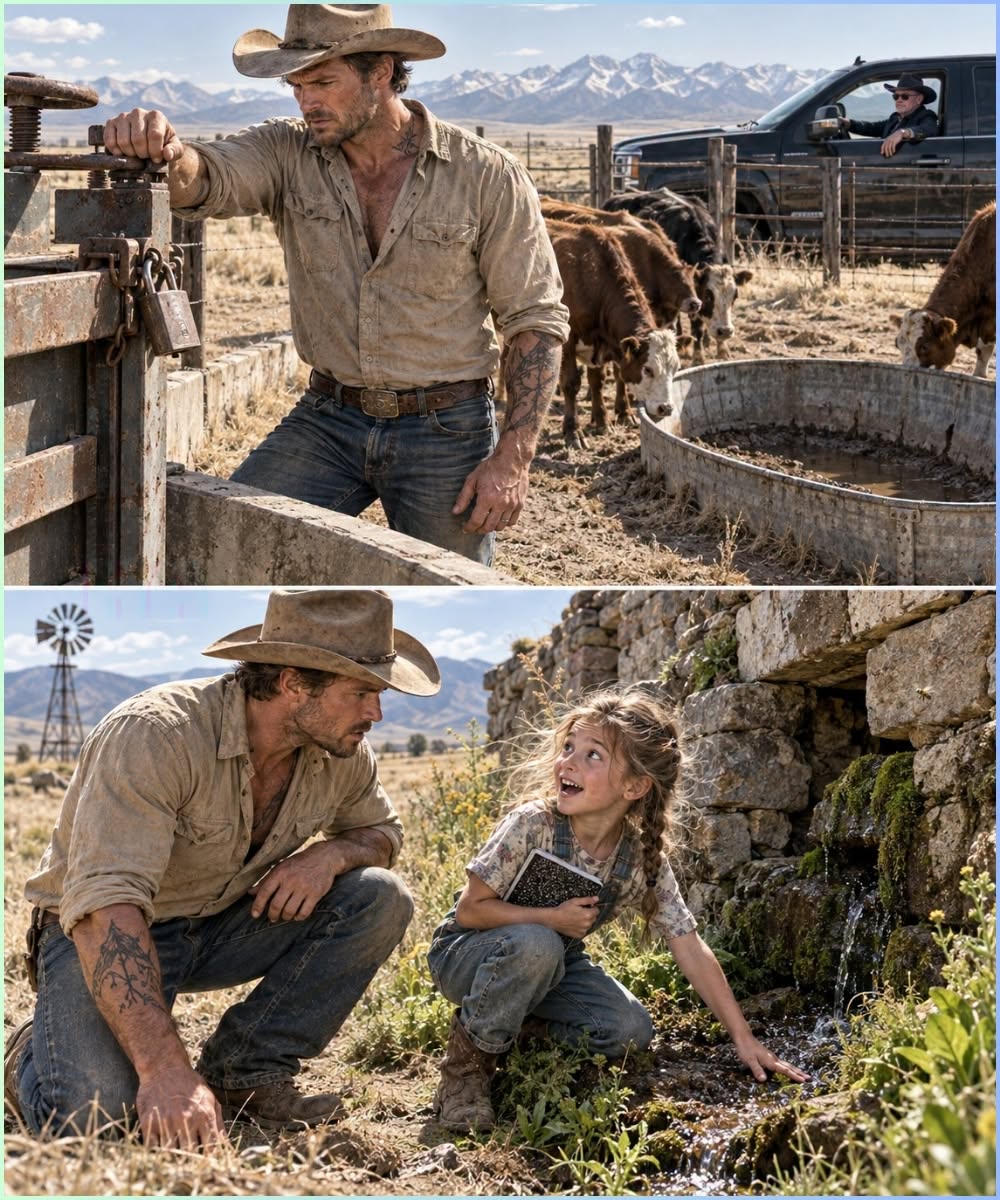
Elias stood beside the irrigation head gate and watched a county contractor snap a steel padlock onto the valve his family had used for three generations.
The contractor was young enough to be Elias’s nephew. He wore mirrored sunglasses and kept glancing at a clipboard.
“You understand this isn’t my decision, Mr. Marsh.”
Elias stared at the lock.
“No,” he said. “But you’re the one putting it on.”
The young man shifted uncomfortably. “There’s a temporary allocation order.”
“My share was already allocated.”
“I’m just following the authorization I was given.”
“By who?”
The contractor hesitated. That told Elias more than the answer would have.
Finally the man folded the paperwork against his chest. “You’ll have to call the district office.”
Then he got into a county truck that still had a temporary dealership tag in the rear window and drove away, leaving a tail of dust floating over forty acres that were already beginning to turn brown.
Elias remained beside the gate. He was thirty-nine, broad through the shoulders, sun-browned around the neck and forearms, with the patient stillness of a man who had spent more time around animals than arguments.
His father used to say Elias could stand quietly long enough to make guilty people confess things nobody had accused them of.
That morning, silence gave him nothing.
Behind him, somewhere up the slope near the ruins of an old stone springhouse, his eight-year-old daughter was crouched in the weeds.
Elias didn’t notice her. Nobody did.
Ren Marsh had a composition notebook open on one knee. She was staring at a narrow strip of grass running behind the collapsed stones.
Everything else around it had gone the color of rope.
That grass was green. Not bright spring green. But alive.
Ren pressed two fingers into the dirt.
Cool.
She wrote three words in her notebook.
*Grass still green.*
Then underneath them:
*Ground feels cold.*
She closed the notebook when she heard her mother calling from the house.
That evening Garrett Voss arrived.
He didn’t come to the porch. He stopped his black pickup on the other side of the fence and left the engine running.
Garrett owned the neighboring Voss Ranch, nearly four thousand acres compared with Elias’s forty. His grandfather and Elias’s grandfather had once shared meals, equipment, labor, and water.
Those days had become stories old men told.
Garrett had inherited land and expanded it. Then he bought neighboring parcels. Then grazing rights. Then water rights.
For years nobody had paid much attention because nobody worried about water until there wasn’t enough.
Now a national beverage distributor had signed a supply agreement with Garrett’s ranch operation, and water had become more valuable than cattle.
“Hard year,” Garrett called through the open window.
Elias leaned against a fence post. “Sure is.”
Garrett smiled faintly. “I heard about the shutoff.”
“You heard fast.”
“Small valley.”
“My share of that ditch has been coming through that gate since 1959.”
Garrett drummed two fingers against his steering wheel. “Handshakes aren’t permits.”
“It wasn’t a handshake to my father.”
“Your father isn’t here.”
Elias’s jaw tightened. Garrett saw it. He always saw weakness the way a hawk saw movement in grass.
“I’m not trying to make this ugly,” Garrett said. “Actually, I came to help.”
“You locked my water and came to help?”
“The district locked your water.”
“Funny how the district suddenly discovered a problem the same month you signed a bottling contract.”
Garrett’s expression cooled. Then he leaned across the seat and reached for a folder.
“I’ll give you one hundred and twenty thousand for the farm.”
Elias almost laughed. The Marsh place wasn’t enormous, but it included the house, barns, equipment sheds, pasture, and forty acres of land his grandfather had broken by hand.
“Land around here is worth twice that without a house.”
“Land with reliable water is.”
Garrett held his gaze. “That’s the problem.”
For several seconds neither man spoke.
Then Elias stepped away from the fence. “Go home, Garrett.”
Garrett put the truck in gear. Before leaving, he said, “Offer won’t stay that high.”
He drove off.
Three weeks later, it was ninety-five thousand.
Two weeks after that, eighty.
The drought tightened over the valley like wire.
Elias rented a five-hundred-gallon tank and drove forty minutes into town twice a day. Diesel cost money. Water cost money. The tank rental cost money. Everything cost money except despair, which seemed to multiply for free.
Dana Marsh, Elias’s wife, picked up extra evening shifts at the medical clinic in Cedar Ridge. She came home after ten with her hair still pinned back and purple shadows under her eyes.
They stopped turning on the air conditioner. They stopped buying meat.
Elias sold his father’s old flatbed trailer. Then his backup generator. Then the antique saddle his grandfather had used.
Dana found him sitting alone in the barn afterward, staring at the empty hook where the saddle had hung.
“You didn’t tell me you were selling that.”
“We needed fuel.”
“We could’ve figured something else out.”
“We’re running out of something else.”
She sat beside him on an overturned feed bucket. Through the open barn door they could see Ren carrying a metal bowl toward the chicken coop.
Dana lowered her voice. “How long?”
Elias knew what she meant. “Maybe six weeks.”
“And after that?”
“We sell part of the herd.”
“And after that?”
He didn’t answer. He didn’t have to.
Ren kept going back to the springhouse.
She didn’t tell anyone. Grown-ups were busy with locks and folders and numbers that made her mother’s mouth go tight. Ren only knew that the grass behind the stones stayed green while the rest of the farm turned the color of old rope, and that the dirt there stayed cold even in the afternoon.
One Saturday she brought a small trowel from the garden shed. She dug carefully, the way she had seen her father work around a sick calf’s hoof—slow, so she wouldn’t break what she couldn’t see.
Six inches down, the soil darkened.
Twelve inches down, her fingers found wet.
Not mud. Water. A thin, steady seep that darkened the sides of the hole and filled the bottom with a clear film.
She sat back on her heels, heart knocking.
That night she waited until her parents were both in the kitchen, tired and quiet. She laid her notebook on the table and opened it to the page with the three words.
Then she said, “The old springhouse isn’t dry.”
Elias looked at her for a long time.
The next morning he went with her.
They cleared fallen stone and rotten timber. Beneath the rubble they found what sixty years of weather, weeds, and official maps had missed: a lined stone basin, a short run of buried clay pipe, and a spring that had never belonged to the ditch.
It had never been part of the 1959 allocation.
It predated the district.
It predated the Voss expansion.
It predated the handshake that everyone later decided was only a handshake.
Elias called a surveyor. Then a water-rights attorney who still remembered how senior claims were supposed to work. Then the county clerk, who pulled a faded plat from a drawer nobody had opened in decades.
The spring had been recorded in 1898.
It had simply been forgotten when the ditch company drew its neat lines and the valley decided water only existed where paper said it did.
Garrett’s offer dropped to sixty thousand the week the surveyor’s flags went up.
Elias did not return the call.
The district sent another contractor. This one did not lock anything. He stood at the old springhouse, looked at the green strip of grass, and said almost nothing.
The cattle began walking toward water again—not the empty trough by the cottonwoods, but the lower pasture where Elias had run a short line from the rediscovered spring.
It was not enough for four thousand acres.
It was enough for forty.
Enough for the house, the barns, the girl with the notebook, and the man who had almost sold the last thing his grandfather left him.
One evening late in the season, Garrett’s black pickup stopped again on the other side of the fence. The engine stayed running.
Elias did not walk over.
Ren did.
She stood at the wire with her notebook under her arm and looked at the man who had waited for them to lose everything.
She did not say much.
She only pointed up the slope, toward the place the maps had missed for sixty years, where the grass was still green.
Then she turned and walked back to the house, where her father was waiting, and the water, quiet and cold, kept coming.