She Hid Beneath a Rancher’s Blankets and Whispered Pretend I’m Your Wife Until We’re Out of Town
**She Hid Beneath a Rancher’s Blankets and Whispered Pretend I’m Your Wife Until We’re Out of Town**
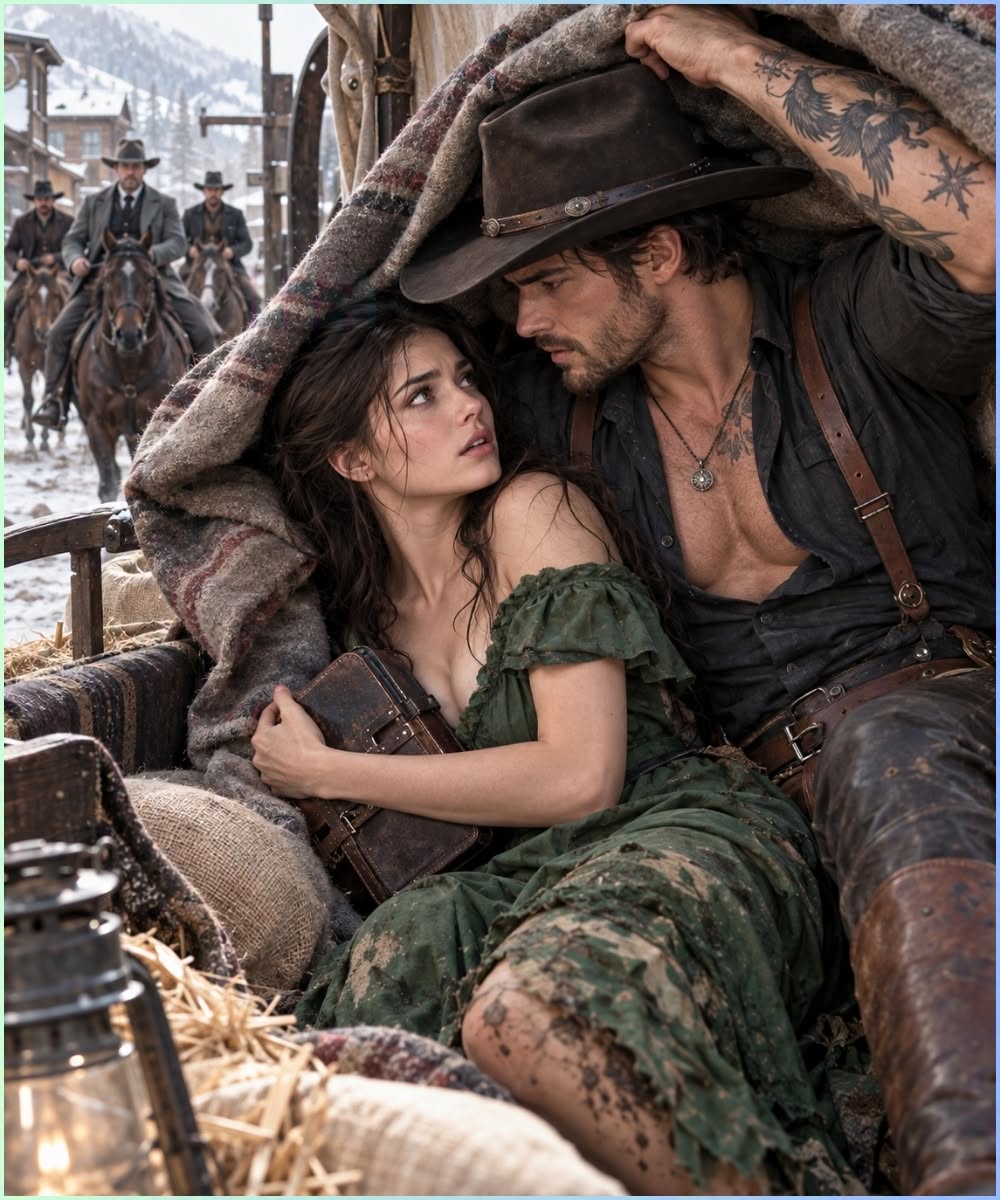
The first thing Caleb Rowan noticed was the mud on the hem of the green dress.
The second was the woman wearing it.
She was crouched beneath two horse blankets in the back of his supply wagon, one hand clamped over her mouth, the other gripping a leather case against her ribs as if whatever was inside mattered more than breathing.
Caleb stared at her.
She stared back.
For half a second, neither moved.
Then voices sounded from the alley behind the feed store.
Men.
Close.
The woman grabbed Caleb’s sleeve.
“Please.”
Her whisper was so quiet he almost mistook it for the wind.
“Get out of my wagon.”
“I can’t.”
“You climbed into the wrong wagon.”
“I know.”
“That doesn’t improve things.”
The voices came closer. Boot heels struck the boardwalk.
The woman looked toward the alley entrance, and something changed in her face. Until then Caleb had seen fear.
Now he saw recognition.
She knew exactly who was coming.
“Tell them I’m your wife,” she whispered.
Caleb almost laughed.
“I don’t have a wife.”
“For thirty seconds, you do.”
Three men appeared beside the feed store.
Caleb stopped smiling.
The man in front wore a gray coat too expensive for Red Willow and carried himself with the loose confidence of someone accustomed to other people stepping aside.
“Rowan.”
Caleb nodded.
“Mercer.”
“You heading home?”
“That was the idea.”
Mercer’s gaze moved over the wagon.
“You see a woman come through here?”
“What woman?”
“Dark hair. Green dress.”
“No.”
The blankets shifted behind Caleb.
Barely.
But Mercer saw it.
His eyes narrowed.
“Mind if I look?”
“Yes.”
Mercer smiled. It wasn’t friendly.
“Mr. Voss would appreciate the courtesy.”
“Mr. Voss doesn’t own my wagon.”
“He owns quite a lot around here.”
“He can admire it from a distance.”
The two men behind Mercer separated slightly.
Caleb counted them without moving his head.
Three.
He had a revolver under the wagon seat, but that didn’t mean he intended to turn Market Street into a graveyard over a stranger who had climbed into his flour sacks.
Mercer rested one hand on the wagon rail.
“We’re looking for a woman who left something unfinished.”
“Then you haven’t found her.”
A small sound came from beneath the blankets.
A cough.
Caleb shut his eyes for one brief, furious second.
Mercer leaned sideways.
“What was that?”
Caleb looked back.
The woman emerged slowly.
Dark hair spilled loose over her shoulders. Mud stained her green dress. Her face was pale, but when she looked at Caleb, something startling happened.
She smiled.
Not because she felt safe.
Because she understood the lie had begun.
“Caleb,” she said, putting just enough irritation into his name to sound married. “Are we leaving or not?”
Mercer’s eyebrows rose.
Caleb felt his future becoming considerably more complicated.
“In a minute.”
The woman tucked her hair behind one ear.
Mercer removed his hand from the rail.
“Your wife?”
Caleb looked directly at him.
“My wife.”
“Didn’t know you’d married.”
“Didn’t ask you.”
The woman gave a tired little sigh.
“He promised we’d be home before supper.”
Caleb glanced at her.
She glanced back.
There was something almost reckless in her expression now.
He understood the invitation.
Play along or destroy me.
“I was wrong,” Caleb said.
Mercer studied them both.
Then he tipped his hat.
“Safe road.”
“Planning on it.”
Caleb slapped the reins.
The wagon rolled onto Market Street.
He did not look back until Red Willow’s last buildings disappeared behind the cottonwoods.
Then he turned.
“Are they following?”
The woman was kneeling on the wagon floor, watching the road through a gap in the canvas.
“Not yet.”
“Good.”
“The east road is faster.”
“That’s the road I’m taking.”
Her face tightened.
“That’s where they’ll expect me to go.”
Caleb looked behind them.
Three riders had just appeared at the crest outside town.
“Now they’re following.”
The woman pointed toward a narrow track disappearing between dead cornfields.
“Mill Road.”
“That’s barely a road.”
“It joins North Fork behind the old sawmill.”
“You know that?”
“I know Red Willow better than they think I do.”
Caleb pulled the reins left.
The wagon lurched violently into the ruts.
The woman slammed into a sack of flour.
“Hold the rail.”
“I am!”
“You’re holding the flour.”
“Then stop trying to kill me!”
“I’m not. The road is.”
The wagon bounced hard enough to make a wheel leave the ground.
Behind them came the distant thunder of horses.
Caleb drove faster.
By the time they reached the abandoned sawmill, sleet had begun tapping against the wagon canvas.
The riders were gone.
For the moment.
Caleb slowed the horses.
“Start over.”
The woman sat opposite him, breathing hard.
“Nora Whitfield.”
“I know your name now.”
“No, you know the name I gave you.”
“That encouraging?”
“It happens to be real.”
“Good beginning.”
She looked down at the leather case.
“Harlan Voss expected to marry me at two o’clock this afternoon.”
Caleb waited.
“Expected?”
“He had a church, witnesses and a dress.”
“But not a willing bride.”
“I told him no yesterday.”
“Seems clear enough.”
“He arranged the wedding anyway.”
Caleb looked at her mud-soaked green dress.
“Then why were you dressed for one?”
Her mouth hardened.
“Because after I said no again, he locked me upstairs.”
Something cold moved through Caleb that had nothing to do with the sleet.
He glanced toward the case.
“And that?”
“My mother’s receipts.”
“Receipts?”
“Not store receipts.” Nora opened the clasp with fingers that still shook. “Deeds. Notes. A survey from 1871. Proof that the north half of what Voss calls his home pasture was never his to begin with. My mother signed it over to a holding company before she died. Voss has been collecting rent and water fees on land that still belongs to her estate.”
Caleb stared at the papers.
“And you were going to walk into a church and give him the rest.”
“I was going to walk into a church because he had the key to the room.” Her voice flattened. “These papers were in a floorboard. I found them last night. I climbed out a window. The dress was what I was wearing when he put me there.”
Caleb looked at the road behind them, then at the woman who had turned his supply run into a lie that could get them both killed.
“You picked my wagon.”
“Yours was the only one leaving.”
“That’s not a compliment.”
“It wasn’t meant as one.”
He almost smiled. Almost.
“Where were you going with those?”
“Cedar Ridge. There’s a lawyer there who handled my mother’s will. If I can file before Voss claims I left of my own accord as his wife, the land stays out of his name.”
“And if he catches you first?”
Nora closed the case.
“Then there is no filing.”
Caleb sat with that for a long moment. The sleet thickened. The horses stamped.
He had a ranch twenty miles north, a hired man who expected him back with flour and salt, and no interest in Harlan Voss’s unfinished business.
He also had a woman in a ruined wedding dress who had just asked him, in front of three armed men, to be her husband until they were out of town.
They were not out of town yet.
“You’ll freeze in that,” he said.
He pulled a dry coat from under the seat and held it out.
Nora looked at it as if kindness were a trick she had not budgeted for.
Then she took it.
They followed North Fork until dark. The riders did not reappear. Either Mill Road had worked, or Mercer had gone back to tell Voss that Rowan now had a wife.
At a stand of pines Caleb stopped the wagon.
“We sleep here. If they find us on the open road, I can’t outrun them loaded.”
Nora nodded. She did not ask for a separate fire. She did not pretend the blankets were enough. She sat with the case in her lap and watched the dark the way a person watches a door that has already failed once.
Caleb kept the revolver closer than usual.
Near midnight she spoke without looking at him.
“You didn’t have to keep going.”
“I know.”
“Why did you?”
Caleb fed the small fire a stick.
“Because you said please like you meant it. And because Mercer smiles like a man who enjoys unfinished things.”
She was quiet after that.
In the morning the coat was still around her shoulders and the case was still unopened. They reached Cedar Ridge before noon.
The lawyer was an old man named Pell who remembered Nora’s mother and did not like Harlan Voss. He read the papers twice. Then he locked them in his safe and sent a boy for the county clerk.
By late afternoon the filing was recorded.
By evening a rider from Red Willow arrived with a message that did not need to be opened for Caleb to know its contents.
Voss knew.
Caleb stood on Pell’s porch with Nora while the lawyer finished the last of the ink.
“He’ll come,” Nora said.
“Yes.”
“You can leave. This was never your fight.”
Caleb looked at the green dress, now hidden under his coat, and at the woman who had made him a husband for thirty seconds and then for twenty miles.
“It became mine the minute I said the word.”
Voss came two days later, not with Mercer this time but with a sheriff who looked unhappy to be there.
The papers were already recorded. The land was already out of Voss’s reach. The forced marriage had never taken place.
Voss stood in the street and looked at Caleb the way a man looks at a fence he did not expect.
“You don’t even know her.”
Caleb did not raise his voice.
“I know enough.”
Nora stepped up beside him. She no longer whispered.
“I’m not your wife, Harlan. I never was. And the north pasture was never yours either.”
Voss left without the land and without the bride.
The sheriff left with him, looking relieved.
That night Nora stood in the doorway of the small room Pell had given her and held out Caleb’s coat.
“You can have this back.”
Caleb took it.
Then he didn’t put it on.
“You still need a way north,” he said. “My ranch is on the way to nowhere useful, but the road is quiet.”
Nora studied his face.
“Is that an offer or another thirty seconds?”
Caleb thought of mud on a green hem, of a cough under blankets, of a lie spoken in a street that could have ended with gunfire.
“It’s longer than thirty seconds,” he said. “If you want it to be.”
Nora did not smile the reckless smile from the wagon.
She smiled the other one.
The quieter kind.
The kind a person uses when the town is finally behind them and the road ahead is still open.
“Then I’ll need a proper introduction,” she said. “Not the one we gave Mercer.”
Caleb nodded.
“Caleb Rowan. I haul flour. I keep to myself. I don’t usually acquire wives in alleys.”
“Nora Whitfield. I climb into the wrong wagons. I keep receipts. I don’t usually ask strangers to lie for me.”
They stood there a moment longer.
Then Caleb said, “Wagon’s out front if you’re coming.”
Nora picked up the empty leather case.
She did not look back at Cedar Ridge.
She climbed onto the seat beside him, and this time she held the rail.