THE SONG THEY NEVER FORGOT (PART 2 — THE CHILD WHO WAS LEFT BEHIND)
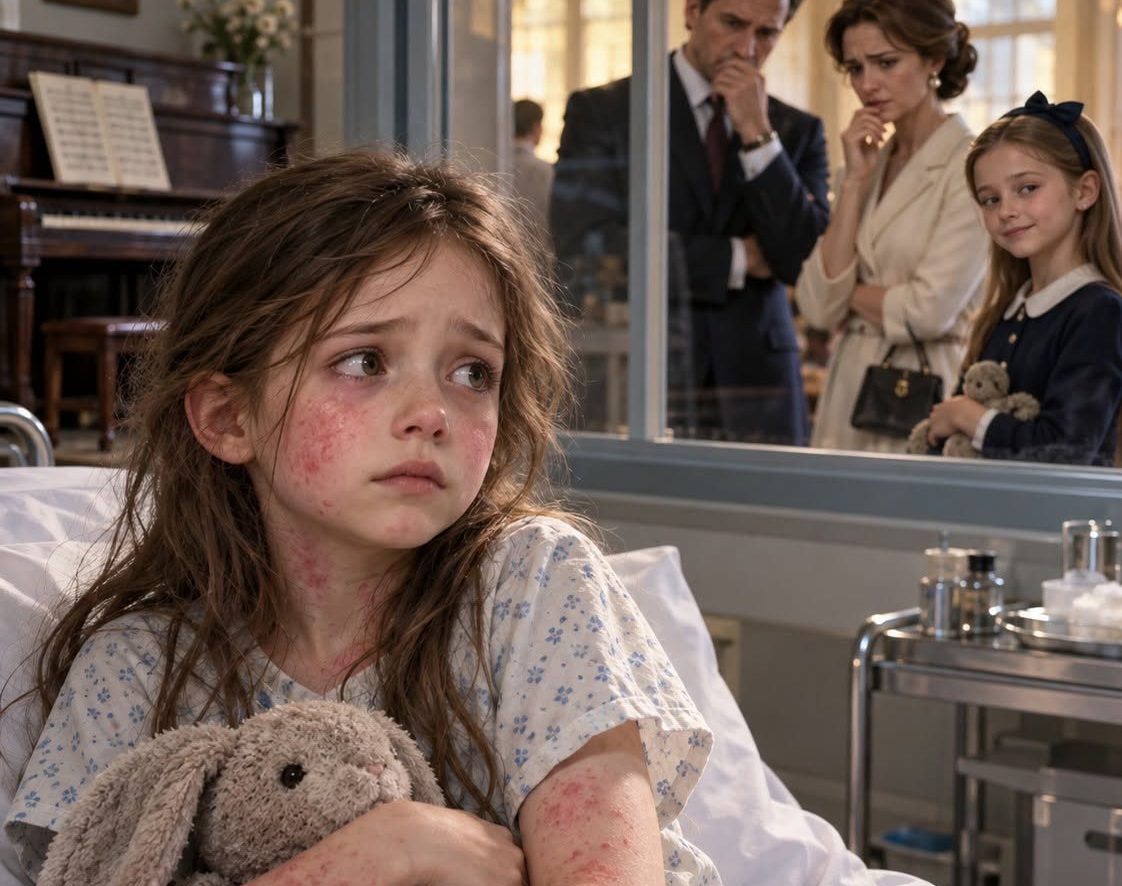
For weeks after leaving the hospital, Emma barely touched the piano.
The old upright instrument still stood in the recreation room exactly where it always had.
The chipped ivory key.
The scratched wooden side.
The little bench that squeaked whenever she moved.
Nothing had changed.
And somehow, that made everything worse.
Because Emma had changed.
Every time she looked at the piano, she remembered Claire standing beside it.
She remembered Daniel smiling when she said she wanted to write music.
She remembered the suitcase she had packed.
The clothes she had folded.
The night she had been too excited to sleep.
And then she remembered waking up in the hospital and hearing one sentence that seemed to erase all of it.
“They adopted Sophie.”
Emma stopped asking questions after that.
The adults assumed she was simply heartbroken.
They were right.
But there was something else.
Emma blamed herself.
Maybe she had gotten sick at the worst possible time.
Maybe Daniel and Claire had decided she was too much trouble.
Maybe families wanted healthy children.
Easy children.
Children who didn’t ruin everything just days before they were supposed to go home.
One evening, Mrs. Collins found Emma sitting alone beside the recreation room window.
“You haven’t played in almost a month,” she said.
Emma shrugged.
“I don’t feel like it.”
Mrs. Collins sat beside her.
“The piano didn’t leave you, Emma.”
Emma looked away.
“People do.”
Mrs. Collins had no answer for that.
Across town, Sophie was learning how to live inside the life Emma had imagined.
The Whitmore house was larger than anything Sophie had ever seen.
She had her own bedroom.
Her own desk.
A closet full of new clothes.
Claire let her choose the color of the curtains.
Daniel bought her a bicycle.
There were family dinners, weekend trips, photographs, birthday celebrations.
Everything Sophie had once watched other children receive from a distance was finally hers.
And she was careful.
Very careful.
She thanked Claire for everything.
She helped clear the table.
She never complained about school.
Whenever Emma’s name was mentioned, Sophie lowered her eyes and spoke softly.
“I hope she’s okay.”
At first, Claire believed her completely.
But Sophie soon discovered something she hadn’t expected.
Emma had not disappeared from the Whitmores’ lives.
Claire still asked about her.
Sometimes she called St. Anne’s.
Sometimes Daniel asked whether Emma’s health had improved.
And late at night, Sophie occasionally heard Claire playing the piano downstairs.
Always the same melody.
Seven notes.
The same seven notes Emma used to play.
One night, Sophie stood hidden at the top of the stairs.
Claire played the melody again.
Then stopped.
Daniel was sitting beside her.
“You’re still thinking about that girl,” he said quietly.
Claire stared at the keys.
“She shouldn’t have known that melody.”
Daniel didn’t answer.
“I never published it,” Claire continued.
“I never performed it anywhere.”
“I know.”
“Then how did she know it?”
Sophie froze.
For the first time, she realized there had been something about Emma that Daniel and Claire had never explained.
Something bigger than adoption.
She quietly returned to her room.
But she didn’t forget what she heard.
Back at St. Anne’s, life moved on.
Children arrived.
Children left.
Some stayed for weeks.
Others stayed for years.
Emma stayed.
A year passed.
Then another.
Families visited.
Some spoke with her.
A few showed interest.
But Emma had changed after Daniel and Claire.
Whenever adults asked what she liked to do, she answered politely.
Whenever they asked whether she wanted a family, she smiled.
But she no longer allowed herself to hope too much.
Hope, she had learned, could hurt more than loneliness.
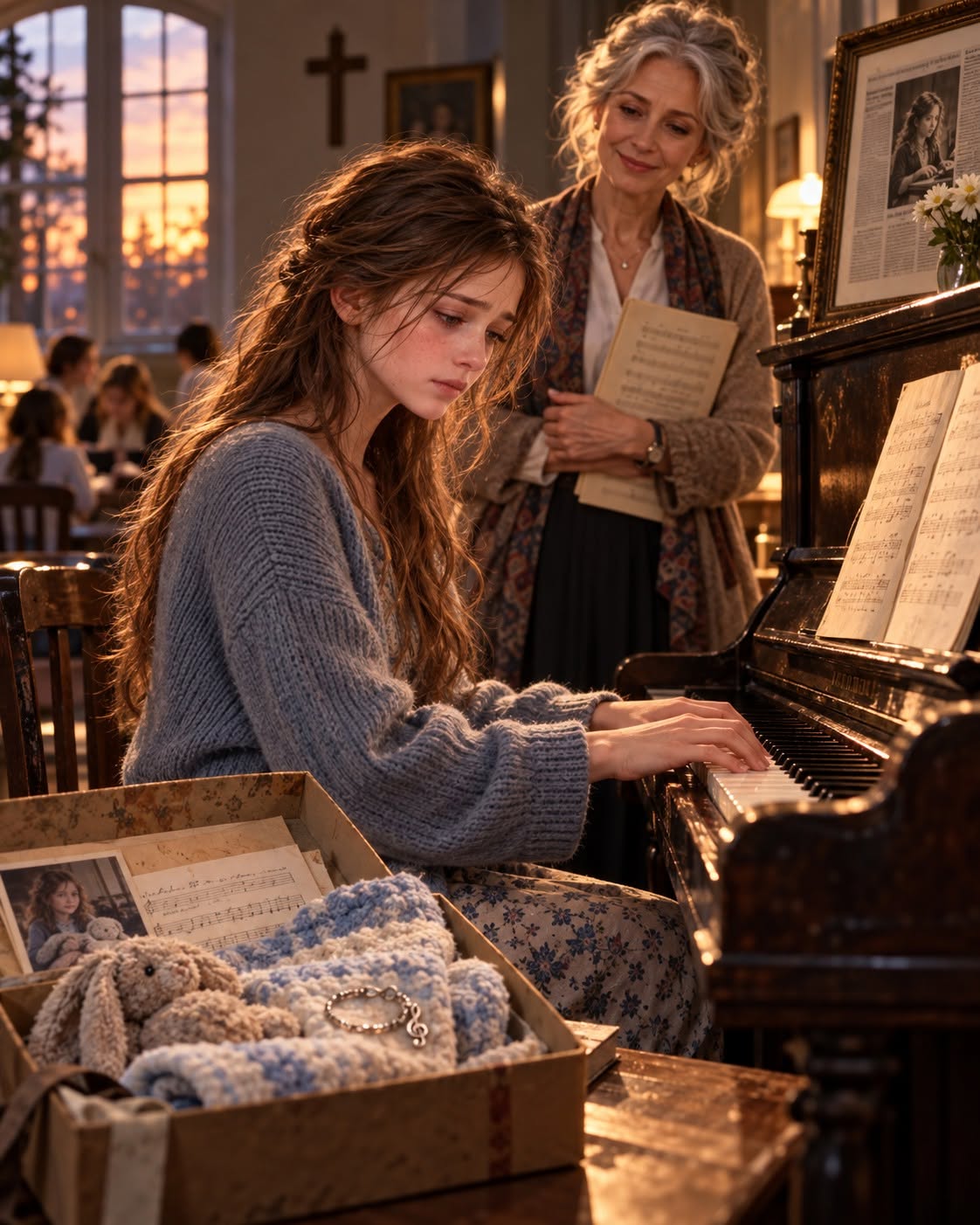
The only thing that slowly returned was music.
It happened because of a woman named Margaret Hale.
Mrs. Hale was a retired music teacher who volunteered at St. Anne’s every Thursday afternoon.
She had silver hair, sharp blue eyes, and the habit of tapping rhythms against tables whenever she was thinking.
The first time she heard Emma play, she stopped halfway through the doorway.
Emma was twelve by then.
Her fingers moved across the old piano almost absentmindedly.
She was playing a difficult classical piece she had heard another volunteer perform only once.
Mrs. Hale waited until Emma finished.
“Who taught you that?”
Emma turned.
“No one.”
Mrs. Hale frowned.
“What do you mean, no one?”
“I heard someone play it last week.”
“Once?”
Emma nodded.
Mrs. Hale sat beside her.
“Play this.”
She played a short sequence of notes.
Emma repeated it perfectly.
Mrs. Hale added more.
Emma repeated those too.
Then she played a long, unusual progression.
Emma listened.
Paused.
And played it back without a mistake.
Mrs. Hale stared at her.
“Emma, do you know what perfect pitch is?”
Emma shook her head.
“You hear music differently from most people.”
Emma looked uncertain.
“Is that bad?”
Mrs. Hale smiled.
“No, sweetheart.”
“It is extremely rare.”
From that day forward, Thursday became Emma’s favorite day of the week.
Mrs. Hale taught her to read music properly.
Then harmony.
Composition.
Theory.
She brought books.
Old recordings.
Blank manuscript paper.
Emma absorbed everything.
By fourteen, she was composing short piano pieces.
By fifteen, Mrs. Hale had entered one of them into a regional youth competition without telling her.
Emma won.
The prize was small.
But for the first time, her name appeared in a newspaper.
EMMA REED, 15, WINS YOUNG COMPOSER AWARD.
Mrs. Collins framed the clipping.
Emma pretended it wasn’t a big deal.
But that night, she stared at it for nearly an hour.
Maybe there was something in the world that couldn’t leave her.
Music.
Years passed.
Emma grew taller.
Her hair grew longer.
The shy little girl became a quiet, striking young woman.
But one habit never changed.
Whenever she felt lost, she played those seven notes.
Mrs. Hale often heard them.
One afternoon, she finally asked:
“That melody again.”
Emma smiled.
“It follows me.”
“Did you write it?”
“I don’t think so.”
“Then where did it come from?”
Emma looked down at the keyboard.
“I wish I knew.”
A few weeks before Emma turned eighteen, Mrs. Collins called her into the office.
There was a cardboard box on the desk.
“What is that?”
Mrs. Collins looked uncomfortable.
“Something I should have given you a long time ago.”
Emma sat down.
Mrs. Collins opened the box.
Inside were a few objects.
A faded baby blanket.
A tiny silver bracelet.
An old photograph too damaged to clearly see the faces.
And a small envelope.
Emma stared.
“What is all this?”
“These were with you when you arrived at St. Anne’s.”
Emma looked sharply at her.
“Why have I never seen them?”
“The records from that period were poorly organized. These were placed in storage with several older files.”
Emma reached for the bracelet.
There was a tiny symbol engraved into the silver.
Not a name.
Not initials.
A musical symbol.
Two notes connected by a curved line.
Emma’s breathing changed.
She had drawn that exact symbol dozens of times without knowing why.
In school notebooks.
In the corners of music sheets.
On the wooden edge of the piano bench.
Mrs. Collins noticed her expression.
“You recognize it?”
Emma slowly nodded.
“I don’t know from where.”
Then she opened the envelope.
Inside was a yellowed piece of paper.
Most of the writing had faded.
Only a few words remained readable.
“…our little song…”
“…always find your way home…”
And beneath them were seven handwritten musical notes.
Emma stopped breathing.
The room became silent.
She knew those notes.
She had known them her entire life.
It was the melody.
Her melody.
The one she had played at nine years old when Claire Whitmore first walked into St. Anne’s.
The one Emma had always believed came from a dream.
Her hands began trembling.
“Mrs. Collins…”
“Yes?”
“Who brought me here?”
Mrs. Collins looked away.
“We don’t know.”
“There has to be something.”
“There was one record.”
Emma stood.
“What record?”
Mrs. Collins hesitated.
“A report from the night you arrived.”
Emma’s heart pounded.
“What did it say?”
Mrs. Collins opened an old folder.
“The person who brought you never gave a name.”
Emma stared at her.
“But there was one detail.”
“What?”
Mrs. Collins turned the page.
“They told the staff that your parents were dead.”
Emma’s face went pale.
Mrs. Collins continued.
“But years later, someone came looking for a missing little girl whose age and description were almost identical to yours.”
Emma gripped the edge of the desk.
“Who?”
Mrs. Collins slowly shook her head.
“The name isn’t in this copy.”
Emma looked back at the seven notes.
For almost eighteen years, she had believed she had no family.
Now, for the first time, a different possibility entered her mind.
Maybe she hadn’t been abandoned.
Maybe someone had lied.
And somewhere beyond the walls of St. Anne’s…
someone might have spent all those years looking for her.
Emma picked up the old piece of paper.
At the bottom, almost completely faded away, was one final mark.
A single letter.
C.
Emma had no idea what it meant.
But fifteen miles away, inside a piano bench in the Whitmore home, Claire kept an old notebook filled with unfinished songs.
On the first page was the same symbol.
The same seven notes.
And beneath them, written eighteen years earlier:
“For my little Emma.
No matter where life takes you, this song will always bring you home.”
TO BE CONTINUED..