PART 2 — The Six Chairs That Had Waited Six Years
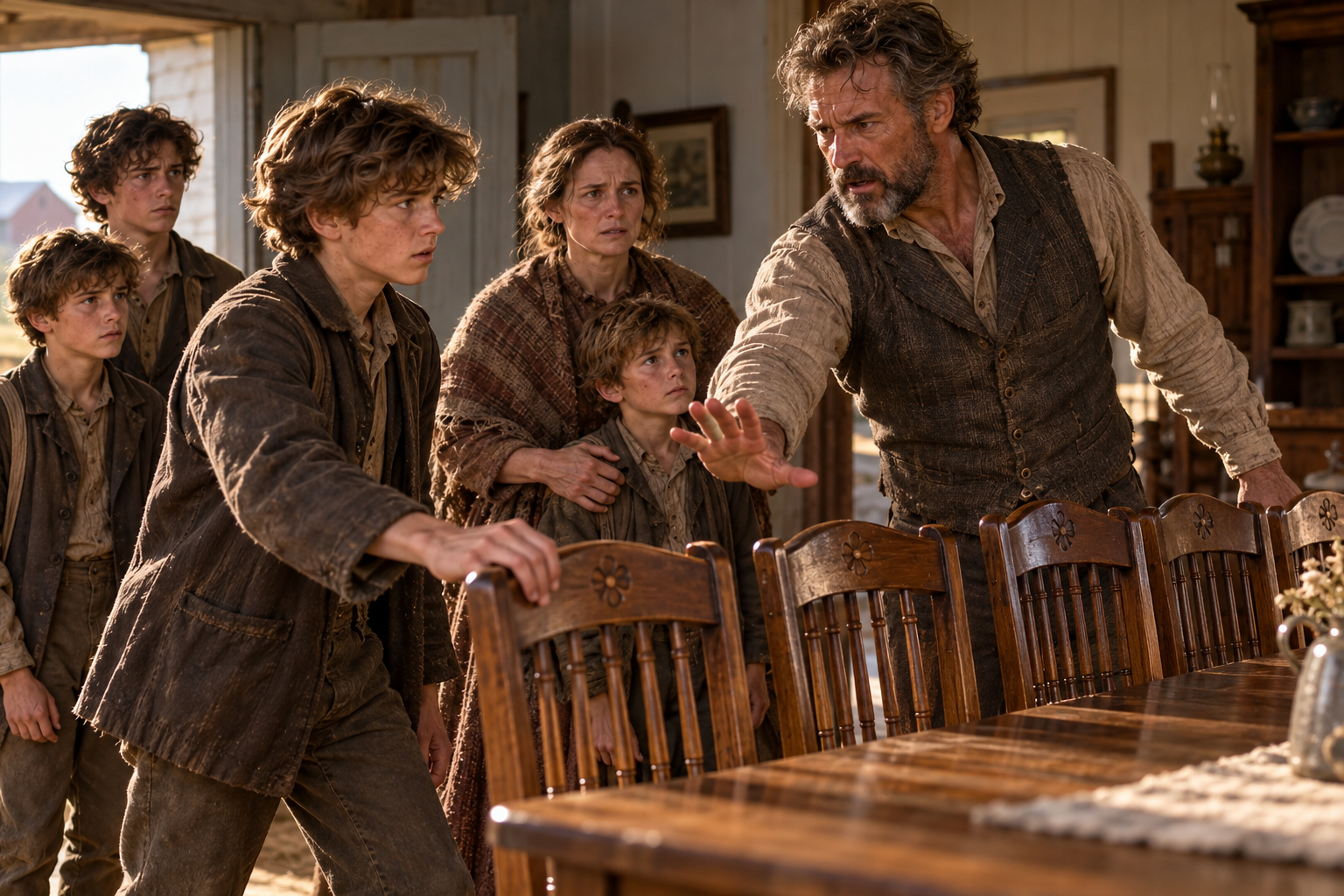
The moment Thomas Carter reached for the empty chair, Jonathan Reed lunged forward.
“Don’t!”
His voice cracked through the farmhouse like a rifle shot.
Thomas froze.
The other three boys stopped moving. Evelyn instinctively pulled James closer, her heart pounding as Jonathan seized the back of the chair.
For several seconds, nobody spoke.
Then Jonathan looked at Thomas’s frightened face.
Something in his expression broke.
“I’m sorry,” he whispered.
He released the chair as though it had burned his hands.
“You haven’t done anything wrong.”
Evelyn watched him carefully.
The chair was ordinary enough. Solid oak, straight-backed, with a small flower carved into the upper rail.
But Jonathan’s hands were trembling.
“I should have explained,” he said.
Thomas swallowed.
“Is it broken, sir?”
“No.”
Jonathan looked at the five untouched chairs surrounding the table.
“It’s just been a long time since anyone sat there.”
He turned away before anyone could ask another question.
“There’s bread in the pantry. I’ll fetch some milk.”
Evelyn waited until he disappeared through the kitchen doorway.
Then she looked at her sons.
“Nobody touches those chairs until Mr. Reed says otherwise.”
The boys nodded.
But James, who had always noticed things the others missed, leaned toward his mother.
“Mama?”
“Yes, sweetheart?”
“Why would somebody keep chairs nobody uses?”
Evelyn glanced toward the kitchen.
“Sometimes people hold on to things because letting go hurts too much.”
She had no idea how close she had come to the truth.
That evening, Jonathan brought out a long bench from the barn.
He scrubbed it clean, carried it into the dining room, and placed it against the wall.
The boys sat together while Evelyn took a stool from the kitchen.
Jonathan remained in his usual chair.
They ate beans, cornbread, potatoes, and the last of a smoked ham.
For the first time in four days, Evelyn watched her children eat until they were satisfied.
James fell asleep with a piece of cornbread still in his hand.
Jonathan noticed.
Without a word, he removed the bread, wrapped it in a clean cloth, and placed it beside the boy for morning.
Evelyn saw the gesture.
She also noticed that Jonathan had barely touched his own supper.
After the boys were settled upstairs, she found him standing beside the dining table.
“I owe you thanks,” she said.
“You owe me tomorrow’s work.”
She almost smiled.
“Then I’ll thank you for giving us the opportunity to earn our keep.”
Jonathan looked toward the staircase.
“They’re good boys.”
“They’ve had to grow up quickly.”
He nodded.
“So have you.”
The words surprised her.
Most people saw only a desperate widow with four mouths to feed.
Jonathan seemed to understand that desperation was not the same as weakness.
“I’ll have breakfast ready before sunrise,” she said.
“Six o’clock will do.”
“I’ve always risen earlier.”
“Then perhaps this house will finally have somebody awake before me.”
For the first time, a faint smile touched his face.
It vanished almost immediately.
But Evelyn remembered it.
The following morning, the Carter family began working.
Thomas accompanied Jonathan to the north pasture, where nearly a quarter mile of fencing had collapsed.
Samuel helped repair the chicken coop.
Henry collected eggs, carried water, and learned to measure grain.
James, being the youngest, was assigned lighter chores around the house.
He complained bitterly until Jonathan gave him the important responsibility of feeding an elderly mule named Abraham.
“He’s stubborn,” Jonathan warned.
James studied the animal.
“So am I.”
Jonathan laughed.
It was a rusty sound, as though his throat had forgotten how to make it.
Evelyn heard it through the kitchen window.
She stood still with a dishcloth in her hands.
For a moment, the farmhouse seemed less lonely.
Within a week, the transformation was impossible to ignore.
Bread cooled on the windowsill.
Freshly washed curtains moved in the afternoon breeze.
Boots gathered near the door.
The sound of four boys arguing over chores filled rooms that had been silent for years.
Jonathan began coming inside for meals instead of eating alone in the barn.
Yet the six chairs remained untouched.
Every evening, the Carter boys sat on the bench.
Every evening, Jonathan occupied the same chair.
And every evening, Evelyn noticed his eyes drifting toward the five empty places.
On the ninth day, a storm rolled across the Nebraska plains.
Rain hammered the roof.
Lightning flashed beyond the barn.
Jonathan and Thomas were outside securing the horses when Evelyn heard a crash upstairs.
She rushed toward the sound.
James stood in the hallway, pale and trembling.
Beside him lay a broken wooden crate.
“I didn’t mean to, Mama.”
“What happened?”
“I was looking for another blanket. The crate fell.”
Evelyn knelt to gather the scattered objects.
There were old books, a child’s wooden horse, a blue ribbon, and a small pair of leather shoes.
Then she saw the photograph.
It had slipped from between two books.
Six people stood before the very farmhouse in which she now lived.
A younger Jonathan Reed stood beside a beautiful dark-haired woman.
Around them were four children.
Three girls and one boy.
Evelyn’s breath caught.
She looked more closely.
The eldest girl appeared fourteen.
The boy perhaps eleven.
The younger girls could not have been older than eight and five.
All four children were smiling.
And Jonathan looked like a completely different man.
His face was open.
His shoulders relaxed.
One hand rested on his wife’s waist.
The other held his youngest daughter’s fingers.
On the back of the photograph, written in faded ink, were six names.
Jonathan.
Margaret.
Clara.
Benjamin.
Rose.
Annie.
Below them was a date.
June 1878.
Evelyn stared at the photograph.
Six years earlier.
Six chairs.
Six people.
She heard footsteps behind her.
Jonathan stood at the top of the staircase, rain dripping from his coat.
His eyes went immediately to the photograph.
For one terrible moment, Evelyn thought he might order them out of his house.
Instead, he stood perfectly still.
“Where did you find that?”
His voice was barely audible.
“The crate fell. James was looking for a blanket.”
Jonathan looked at the boy.
James began to cry.
“I’m sorry, Mr. Reed.”
Jonathan closed his eyes.
Then he knelt in front of the child.
“No, son.”
He took the photograph gently from Evelyn.
“You haven’t done anything wrong.”
His fingers moved across the faces.
“My family,” he said.
Evelyn waited.
Jonathan looked toward the window, where rain streamed down the glass.
“They died six years ago.”
James covered his mouth.
“All of them?”
Jonathan nodded.
“All five.”
Evelyn felt the hallway tilt beneath her feet.
She understood the chairs now.
And the silence.
And the locked room.
Jonathan rose slowly.
“There was a fever in the county that summer. Started with the children down near the river.”
He swallowed.
“Margaret took food to a sick neighbor. She came home feeling poorly. Two days later, Annie developed a fever.”
His voice became distant.
“I sent for the doctor. The roads were flooded. He couldn’t reach us.”
Evelyn said nothing.
“Clara fell ill next. Then Rose. Then Benjamin.”
He pressed his thumb against the photograph.
“Margaret kept trying to care for them, even when she could barely stand.”
Thunder rolled across the fields.
Jonathan stared at the faces of his children.
“By the time the doctor arrived, there was nothing he could do.”
James began sobbing.
Evelyn gathered him against her.
Jonathan looked at the boy with such unbearable sadness that she almost reached for him too.
“I buried them beneath the cottonwoods behind the orchard,” he whispered.
“Five graves in eleven days.”
Nobody moved.
Then Jonathan said something Evelyn would remember for the rest of her life.
“Annie was five years old. The last thing she asked me was whether I would save her chair at supper.”
His voice broke.
“I told her I would.”
He looked at Evelyn.
“And I have.”
That night, after the storm passed, Evelyn found Jonathan sitting alone on the back porch.
She carried two cups of coffee.
He accepted one without speaking.
For a long time, they listened to the rain dripping from the eaves.
Finally, Evelyn said, “William died in October.”
Jonathan looked toward her.
“My husband.”
“I know.”
“He was sick for nine days. The doctor said there was nothing more to be done.”
Her hands tightened around the cup.
“I thought the worst part would be watching him go.”
She stared into the darkness.
“But it wasn’t.”
Jonathan waited.
“The worst part was the first morning afterward. I woke up and reached across the bed.”
Her voice trembled.
“For one second, I forgot he was gone.”
Jonathan lowered his head.
“That happened to me for years.”
Evelyn turned toward him.
“I don’t believe loving someone means we must stop living when they do.”
Jonathan’s expression changed.
“No,” he said quietly.
“But sometimes living feels like leaving them behind.”
Evelyn understood.
She understood so completely that tears filled her eyes.
“They’re not behind you, Mr. Reed.”
He looked at her.
“They’re part of everything you carry forward.”
Neither spoke again for several minutes.
Then Jonathan asked, “Do your boys remember their father?”
“Thomas remembers everything. Samuel remembers the farm. Henry remembers William teaching him to whistle.”
“And James?”
Evelyn smiled sadly.
“James remembers being carried on his father’s shoulders.”
Jonathan looked toward the dark staircase.
“That’s a good memory.”
“It is.”
He nodded slowly.
“I used to carry Annie that way.”
For the first time, he spoke about his daughter without immediately turning away.
And Evelyn realized something.
Jonathan Reed had not forgotten how to love.
He had simply become terrified of losing anyone else.
Over the next month, the farm began to prosper.
Thomas repaired the northern fences with Jonathan.
Samuel discovered a talent for working with horses.
Henry helped Evelyn preserve vegetables and learned to keep the farm accounts.
James became inseparable from Abraham the mule.
And Evelyn brought order to the household without ever disturbing the locked room or the six chairs.
Jonathan began leaving small gifts where the boys would find them.
A better pair of boots for Thomas.
A pocketknife for Samuel.
A slate and chalk for Henry.
A wooden whistle for James.
When Evelyn asked about the gifts, Jonathan shrugged.
“Found things they could use.”
She knew better.
One evening, she discovered him repairing William’s old pocket watch, which Thomas had carried since his father’s death.
Jonathan worked by lamplight, carefully fitting the damaged mechanism together.
“That watch hasn’t run in eight months,” Evelyn said.
Jonathan turned the tiny winding stem.
A faint ticking began.
“Sometimes things only need somebody willing to work on them.”
Evelyn looked at him.
“And sometimes they need time.”
He met her eyes.
“That too.”
Something unspoken passed between them.
Neither dared give it a name.
Then, on a cold October afternoon, a black carriage arrived at the farm.
A neatly dressed man stepped down, carrying a leather briefcase.
He introduced himself as Mr. Wallace, an attorney from Lincoln.
Jonathan’s expression hardened.
“What business brings you here?”
The attorney removed a folded document.
“I’m afraid it concerns the Reed property.”
Evelyn stood in the doorway behind Jonathan.
Wallace glanced at her and the boys.
Then he delivered the news.
“Mr. Reed, unless the outstanding obligations are settled by November first, this farm will be subject to foreclosure proceedings.”
Evelyn felt her stomach drop.
Jonathan did not move.
“How much?”
“One thousand eight hundred dollars.”
The amount seemed impossible.
Jonathan looked toward the fields.
Evelyn suddenly understood why he had spoken of land he could not manage.
Why the fences had remained broken.
Why the barn needed repairs.
Why a man with such a large property lived so modestly.
He had not merely been lonely.
He had been losing the last thing his family had left him.
Wallace replaced the document in his briefcase.
“You have twenty-one days, Mr. Reed.”
Then he climbed into his carriage and departed.
For a long time, Jonathan stood in the yard.
Evelyn approached him.
“Why didn’t you tell me?”
He gave a bitter smile.
“Would you have brought your boys into a house that might be taken away?”
“Yes.”
He stared at her.
“If I’d known there was honest work here, yes.”
“Evelyn—”
“You gave us a chance when nobody else would.”
Her voice strengthened.
“Now let us give you one.”
Jonathan shook his head.
“There’s nothing you can do. The harvest won’t bring enough.”
Evelyn looked toward the barn.
Then toward the fields.
Then toward the four boys watching from the porch.
“Perhaps not the harvest alone.”
Jonathan frowned.
“What are you thinking?”
Evelyn lifted her chin.
“I’m thinking that for six years you’ve been trying to save this farm by yourself.”
She stepped closer.
“And you aren’t alone anymore.”
But neither Evelyn nor Jonathan knew that the greatest threat to the farm was not the money.
It was a document hidden inside the locked room.
And when that document finally came to light, it would reveal a promise Margaret Reed had made before her death.
A promise that could change all six of their lives forever.
FINAL: The Family That Filled the Empty Chairs
On the morning of October 12, 1884, Evelyn Carter stood before the six empty chairs and made a decision.
She would not allow Jonathan Reed to lose his home.
Not after everything he had done for her children.
Not after watching Thomas smile for the first time since his father’s funeral.
Not after hearing James call the lonely farmhouse “home” without realizing what he had said.
And certainly not after discovering that the man who had opened his door to five strangers was quietly preparing to lose the last place where his wife and children had lived.
But one thousand eight hundred dollars was a fortune.
A sum that could not be earned through ordinary farm labor in three weeks.
Evelyn understood that.
She also understood something Jonathan had forgotten.
A farm was more than land.
It was what people could accomplish together.
At breakfast, she spread a sheet of paper across the table.
The boys gathered around.
Jonathan watched suspiciously.
“What’s that?”
“A plan.”
“I told you, Evelyn, there’s no sense—”
“Then you can tell me again after you’ve heard it.”
Thomas hid a smile.
Jonathan looked surprised.
Nobody had interrupted him so confidently in years.
Evelyn pointed toward the paper.
“We have cattle ready for market, corn that can still be sold, timber stacked behind the barn, and two horses you haven’t worked in months.”
Jonathan folded his arms.
“The cattle won’t bring half what we need.”
“Then we’ll find the rest elsewhere.”
“Where?”
Evelyn met his eyes.
“First, we find out exactly what is owed, and to whom.”
That afternoon, Jonathan reluctantly brought out the farm ledgers.
Evelyn examined every entry.
She had kept William’s accounts for seventeen years.
She knew the difference between a farm struggling to survive and a farm being slowly strangled by debt.
After two hours, she found something peculiar.
“Jonathan.”
He looked up.
“Why are you paying interest on a loan that should have been settled four years ago?”
His face darkened.
“Because the bank says I still owe it.”
“But your records show a payment.”
He leaned forward.
Evelyn pointed to an entry dated March 1880.
Eight hundred dollars had been paid to the Prairie County Land and Trust Company.
Yet the later statements showed no reduction in the original principal.
Jonathan frowned.
“I remember that payment.”
“Do you have the receipt?”
“I kept everything Margaret thought important.”
He stopped.
His eyes moved toward the staircase.
Toward the locked room.
Evelyn followed his gaze.
Neither spoke.
Finally, Jonathan whispered, “She kept the papers.”
The room had belonged to Margaret.
For six years, Jonathan had not opened its door.
He had polished the brass handle occasionally, the way a man might tend a grave, but had never crossed the threshold.
Inside were her dresses.
Her sewing basket.
Her Bible.
And the little desk where she had managed the household accounts.
Evelyn reached across the table.
“You don’t have to go in there today.”
Jonathan looked at her.
Then at the four boys sitting nearby.
James was carving a tiny wooden horse.
Henry was copying figures from the ledger.
Samuel was mending a harness.
Thomas was quietly studying the overdue notices.
Jonathan took a long breath.
“No,” he said.
“I think I do.”
He climbed the stairs alone.
Evelyn heard the key turning in the lock.
Then silence.
Ten minutes passed.
Twenty.
Finally, she heard something that made her heart ache.
A grown man crying behind a closed door.
She did not follow him.
She did not call his name.
She simply sat at the bottom of the staircase and waited.
Nearly an hour later, Jonathan appeared.
His eyes were red.
In one hand he carried a bundle of documents.
In the other, a small folded letter.
“I found the receipt,” he said.
Evelyn stood.
“And something else.”
They returned to the dining room.
The receipt confirmed the eight-hundred-dollar payment.
It bore the signature of the bank’s former manager and the official stamp of the institution.
Evelyn studied it carefully.
“If this was never credited, the amount they claim you owe may be wrong.”
Jonathan nodded.
But he was barely looking at the receipt.
His attention remained on the folded letter.
“Margaret wrote this,” he whispered.
“Before she died.”
Evelyn stepped back.
“Then perhaps you should read it alone.”
Jonathan shook his head.
“I’ve spent six years alone.”
His fingers trembled as he opened the paper.
The handwriting was delicate, the ink faded.
He began reading.
“My dearest Jonathan,
If you are reading this, then the Lord has called me somewhere you cannot yet follow.
I know you.
I know you will blame yourself for every fever you could not cool, every prayer that seemed unanswered, and every moment you were not beside us.
Please don’t.
You gave us a beautiful life.
You gave our children a home filled with laughter, warm bread, Christmas mornings, and the sound of your boots coming through the door.
But there is something I need you to promise.
Do not turn our home into a monument to sorrow.
Clara would hate the silence.
Benjamin would want horses in the yard.
Rose would want flowers beneath the windows.
And little Annie would want someone sitting beside her at supper.
If one day strangers come to your door needing shelter, remember how much love this house once held.
There is room for more.
Love does not disappear when we are gone, Jonathan.
It waits for somewhere new to live.
Your Margaret.”
Jonathan could not finish the final sentence aloud.
The paper shook in his hands.
Evelyn’s eyes filled with tears.
Thomas lowered his head.
Samuel wiped his face with his sleeve.
Even James understood that something sacred had just been shared.
Jonathan folded the letter.
For a long moment, he looked at the six chairs.
Then he whispered, “I’ve been keeping everything exactly as it was.”
Evelyn answered softly.
“She wasn’t asking you to forget them.”
“No.”
His voice broke.
“She was asking me to live.”
That evening, Jonathan did something nobody expected.
He pulled one of the unused chairs away from the table.
He carried it outside.
And he sat beneath the cottonwood trees where five white crosses stood in a quiet row.
Evelyn watched from the kitchen window.
She could see him speaking.
Not loudly.
Not desperately.
Simply speaking to the family he had loved.
When he returned, his face was tired.
But something about him had changed.
The next morning, Jonathan rode into town with Evelyn and the original receipt.
Mr. Wallace examined the document.
Then he asked them to wait.
An hour later, he returned carrying the bank’s older records.
His expression was grave.
“Mr. Reed, I owe you an apology.”
Jonathan stiffened.
“What happened?”
“The payment was entered into the bank’s general receipts, but it was never properly applied to your mortgage.”
Evelyn felt Jonathan’s hand tighten around the edge of the desk.
Wallace continued.
“With that payment credited and the related interest recalculated, the outstanding amount is substantially lower.”
“How much?” Evelyn asked.
The attorney checked his figures.
“Approximately six hundred and forty dollars, subject to the bank’s final reconciliation.”
Jonathan stared at him.
Six hundred and forty dollars.
Still a difficult sum.
But no longer impossible.
Wallace cleared his throat.
“I’ll request a postponement of the proceedings while the accounts are corrected.”
Evelyn nodded.
“And we want every adjustment in writing.”
The attorney looked at her with new respect.
“Of course, Mrs. Carter.”
On the ride home, Jonathan remained silent for nearly five miles.
Then he turned toward Evelyn.
“You saved my farm.”
“Not yet.”
“You found what I never thought to look for.”
She smiled.
“That’s because you were too busy carrying the weight of the whole world.”
Jonathan looked at her for a long moment.
“How did you become so strong?”
Evelyn considered the question.
“I wasn’t given much choice.”
He shook his head.
“No. Plenty of people face hardship and become bitter.”
His voice softened.
“You became brave.”
Evelyn looked away before he could see her blush.
Over the following two weeks, the entire Carter family worked harder than ever.
Thomas and Jonathan drove cattle to market.
Samuel helped a neighboring rancher break two young horses in exchange for wages.
Henry organized the accounts and discovered unused supplies that could be sold.
James collected eggs, helped gather vegetables, and insisted on contributing the few coins he earned delivering produce.
Evelyn baked bread and pies for neighboring farms.
She took in sewing.
She sold preserves.
She negotiated with merchants who had never expected a widow to understand prices better than they did.
And Jonathan worked beside them.
Not ahead of them.
Not above them.
Beside them.
Word spread through the county.
The lonely farmer who had buried his family six years earlier was no longer alone.
People began stopping by.
Some brought work.
Some bought produce.
Some simply came to see whether the rumors were true.
Was Jonathan Reed really laughing again?
Was there truly a woman running his kitchen?
Were four boys helping him restore the farm?
And had the old Reed house finally opened its doors?
One Sunday, the pastor from the nearby church arrived with his wife.
They brought two jars of peach preserves and a basket of biscuits.
The pastor stood on the porch, looking at the boys racing around the yard.
“I haven’t heard this much noise here in years.”
Jonathan watched James chasing Abraham the mule.
“Neither have I.”
The pastor smiled.
“It’s a good sound.”
Jonathan nodded.
“The best.”
By October 29, they had gathered five hundred and eighty dollars.
Sixty dollars remained.
Evelyn sat at the kitchen table that night, exhausted.
Her hands were sore from sewing.
Jonathan entered carrying a small wooden box.
He placed it before her.
“What’s this?”
“Something I should have done sooner.”
Inside lay a silver pocket watch and a gold wedding band.
Evelyn looked up sharply.
“Jonathan, no.”
“The watch belonged to my father. The ring was mine.”
“You cannot sell those.”
“I can.”
“But they’re important.”
He sat across from her.
“Not more important than keeping this house.”
Evelyn touched the wedding band.
“You’ve already lost so much.”
Jonathan looked toward the staircase.
Then back at her.
“For six years, I thought the only way to honor my family was to hold on to everything.”
He closed the box.
“But I’ve learned that some things are worth more when they’re used to protect the living.”
Evelyn’s eyes filled.
Still, she pushed the box back.
“Wait until morning.”
“Why?”
“Because I have one more idea.”
The next day, she approached the local grain merchant with a proposal.
Jonathan had several acres of winter wheat planted on his southern land.
The crop would not be ready for months.
But the merchant knew the soil was good.
Evelyn negotiated an advance against a portion of the expected harvest, with a written agreement that protected Jonathan from excessive deductions.
The merchant offered seventy-five dollars.
She returned to the farmhouse before sunset.
Jonathan was repairing the barn door when she climbed down from the wagon.
“Well?” he asked.
Evelyn held up the signed agreement.
“We have enough.”
Jonathan stared.
Then he laughed.
A full, astonished laugh.
He lifted his hat and threw it into the air.
Thomas shouted.
Samuel whooped.
Henry dropped his ledger.
James began jumping up and down without knowing exactly what had happened.
Evelyn stood in the middle of the yard, laughing through her tears.
And Jonathan Reed, who had not celebrated anything in six years, crossed the distance between them and took both her hands.
“You did it.”
“We did it.”
He looked at her.
His expression changed.
For one breathless moment, Evelyn thought he might kiss her.
Instead, he pressed her hands gently.
“Thank you for coming to my door.”
She smiled.
“Thank you for opening it.”
On November first, the bank accepted the corrected amount, the final payments were recorded, and the foreclosure proceedings were withdrawn.
Jonathan received written confirmation that the mortgage obligation had been satisfied.
The Reed farm was safe.
That evening, Evelyn prepared a special supper.
Roast chicken.
Potatoes.
Fresh bread.
Apple pie.
She arranged six plates on the table.
Then she hesitated.
For weeks, the family had continued using the bench and kitchen stool.
The six chairs had remained in their places, untouched.
Jonathan entered the room.
He stopped when he saw the table.
Evelyn turned.
“I’m sorry. I should have asked.”
Jonathan looked at the plates.
Then at the chairs.
His face became unreadable.
The boys appeared in the doorway.
Nobody spoke.
Finally, Jonathan approached the chair with the little flower carved into its back.
Annie’s chair.
He ran his hand over the wood.
“I made this one for her fifth birthday.”
Evelyn swallowed.
“It’s beautiful.”
“She wanted a flower because Rose had one on her bedroom door.”
He smiled faintly.
“Annie always wanted whatever her older sisters had.”
Then he looked toward the other chairs.
“Margaret sat here.”
He touched the chair beside his own.
“Clara sat there. Benjamin was beside her. Rose sat near the window.”
His voice trembled.
“I haven’t moved them since that summer.”
Evelyn stepped closer.
“We can keep using the bench.”
Jonathan shook his head.
“No.”
He looked toward the boys.
“Thomas.”
The eldest Carter son straightened.
“Yes, sir?”
“Would you help me move these chairs?”
Thomas nodded.
Together, they rearranged the furniture.
Jonathan placed the six original chairs around the table.
Then he brought the bench closer, making room for everyone without crowding the doorway.
He took his usual seat.
Evelyn stood uncertainly.
Jonathan pulled out the chair beside him.
Margaret’s chair.
“Mrs. Carter.”
She looked at him.
“Are you sure?”
He glanced toward the window.
Beyond it, the cottonwood branches moved gently in the evening wind.
“I think Margaret would be disappointed in me if I let a good woman stand while supper got cold.”
Evelyn laughed softly.
Then she sat.
Thomas took the chair once used by Benjamin.
Samuel sat beside Henry.
James climbed onto the bench, where Jonathan joined him for a moment to adjust the cushion.
One of the old chairs remained empty.
The little chair with the carved flower.
Jonathan looked at it.
Then at James.
“Would you like that one, son?”
James stared.
“Me?”
Jonathan nodded.
“If you’d be comfortable.”
The boy looked toward Evelyn.
She smiled through her tears.
“It’s all right.”
James climbed down from the bench and approached the chair.
He touched the flower.
Then he sat very carefully.
Jonathan watched him.
For a moment, grief crossed his face.
Then James looked up.
“Mr. Reed?”
“Yes?”
“Did Annie like apple pie?”
Jonathan swallowed.
“More than anything.”
James smiled.
“Then I think she’d be happy about supper.”
Jonathan covered his eyes with one hand.
Evelyn reached for his other.
And there, at the table where sorrow had sat undisturbed for six years, Jonathan Reed finally allowed himself to cry without hiding.
They did not pretend his first family had never existed.
They spoke of them.
Jonathan told the boys about Clara’s love of books.
About Benjamin’s determination to ride the most stubborn horse on the farm.
About Rose’s habit of bringing injured birds into the kitchen.
And about Annie, who once insisted that the moon followed her everywhere because it was lonely too.
The boys listened.
They asked questions.
They laughed at the funny stories.
And when the meal ended, Jonathan realized something extraordinary.
The memories no longer hurt quite so sharply.
They had become something he could share.
Winter arrived early that year.
Snow settled across the Nebraska plains.
The farmhouse windows glowed each evening.
Jonathan taught Thomas to manage the cattle accounts.
Samuel became skilled with horses.
Henry spent long evenings reading beside the stove.
James grew so attached to Abraham that he insisted the mule needed a Christmas stocking.
Evelyn laughed more often.
And Jonathan began finding reasons to linger in the kitchen after the boys went upstairs.
Sometimes he helped dry dishes.
Sometimes they talked beside the fire.
Sometimes they simply sat together in a silence that no longer felt empty.
One December evening, Evelyn found him standing near the Christmas tree.
He held a small wooden ornament.
A star.
“I made these for the children,” he said.
“Years ago.”
Evelyn approached.
There were five ornaments in the box.
Each bore a name.
Margaret.
Clara.
Benjamin.
Rose.
Annie.
“Would you like to hang them?” she asked.
Jonathan hesitated.
Then nodded.
Together, they placed the ornaments on the tree.
Five small reminders of the people who had made the farmhouse a home long before Evelyn arrived.
When they finished, Jonathan turned toward her.
“Evelyn.”
Something in his voice made her heart quicken.
“Yes?”
“I’ve been meaning to ask you something.”
She waited.
He looked suddenly nervous.
More nervous than he had been facing the bank.
“When you came here, I offered you work.”
“You did.”
“And a place to stay.”
“Yes.”
He took a breath.
“But somewhere along the way, this stopped feeling like an arrangement.”
Evelyn felt tears gathering.
Jonathan continued.
“I never expected to care for anyone again.”
He looked toward the staircase.
“Your boys have become important to me. Every one of them.”
She nodded.
“I know.”
“And you…”
His voice faltered.
Evelyn stepped closer.
“Jonathan.”
He met her eyes.
“You don’t have to find perfect words.”
He gave a small, helpless smile.
“That’s fortunate, because I haven’t got any.”
She laughed softly.
He reached for her hand.
“I love you, Evelyn.”
The words were quiet.
But they seemed to fill the entire house.
“I don’t love you because you saved my farm. Or because you cook my meals. Or because you’ve brought order to this place.”
His fingers tightened around hers.
“I love you because you saw a broken man and treated him like someone worth knowing.”
Evelyn could no longer hold back her tears.
“Jonathan…”
“I know William will always be part of your heart.”
He glanced toward the five ornaments.
“And Margaret will always be part of mine.”
He took another breath.
“But I believe there’s room for us too.”
Evelyn placed her hand against his cheek.
“Yes,” she whispered.
“There is.”
He kissed her gently.
Not with the urgency of young love.
But with the tenderness of two people who understood exactly how precious another chance could be.
They were still standing beside the Christmas tree when a voice came from the staircase.
“Mama?”
James stood in his nightshirt, rubbing his eyes.
Evelyn stepped back, blushing.
“James Carter, you’re supposed to be asleep.”
The boy ignored her.
He looked at Jonathan.
“Are you going to marry my mama?”
Jonathan froze.
Evelyn covered her face.
“James!”
“What? I only asked.”
Jonathan crouched before him.
“Would that trouble you?”
James considered the question seriously.
“Would we have to leave?”
“No.”
“Would we still get to feed Abraham?”
“Of course.”
“Would Mama still make apple pie?”
Jonathan laughed.
“I certainly hope so.”
James nodded.
“Then I think it’s a fine idea.”
By morning, all four boys knew.
Thomas approached Jonathan while they were feeding the horses.
“Sir?”
Jonathan looked up.
“Yes?”
Thomas stood very straight.
“I wanted to tell you something.”
“Go ahead.”
“My father was a good man.”
Jonathan nodded.
“Your mother has told me.”
“I don’t want anyone to forget him.”
“Neither do I.”
Thomas looked relieved.
Then Jonathan added, “You don’t have to stop loving your father to care about me.”
Thomas swallowed.
“I know.”
He hesitated.
Then held out his hand.
“If you’re going to marry Mama, I think you should know we’re a troublesome lot.”
Jonathan shook his hand.
“I’ve noticed.”
Thomas smiled.
“And we’d like you to stay.”
Jonathan looked away for a moment.
When he turned back, his eyes were wet.
“I’d like that very much.”
They married the following spring.
It was a simple ceremony beneath the cottonwood trees.
Evelyn wore a pale blue dress she had sewn herself.
Jonathan wore his best dark coat.
Thomas stood beside him.
Samuel and Henry carried flowers.
James insisted on holding the rings, though everyone worried he might lose them.
The pastor spoke of patience.
Of kindness.
Of the courage required to begin again.
And when Jonathan promised to love Evelyn through whatever years remained to them, she knew he understood the meaning of those words better than most men ever would.
After the ceremony, they walked together to the five white crosses beneath the trees.
Jonathan placed fresh flowers at each grave.
Evelyn stood beside him.
For a long time, neither spoke.
Then Jonathan whispered, “I hope I’ve done right by you.”
The wind moved through the cottonwood branches.
Evelyn took his hand.
“I think they would be proud.”
He nodded.
And together, they returned to the house.
Years passed.
The Reed farm prospered.
Thomas eventually managed much of the land.
Samuel became known throughout the county for his skill with horses.
Henry pursued his education and later returned to help expand the family business.
James grew tall and strong, though he never stopped insisting that Abraham had been the wisest mule in Nebraska.
Jonathan grew older.
His beard turned white.
Evelyn’s hair silvered at the temples.
But every evening, whenever possible, they ate together at the same wooden table.
The six original chairs remained.
They were repaired when needed.
Their legs were strengthened.
Their seats were polished by years of use.
And as the family grew, Jonathan built more chairs.
He made them for grandchildren.
For visiting relatives.
For neighbors who had nowhere else to spend Christmas.
For travelers who arrived hungry and left with full stomachs.
One autumn evening, nearly twenty years after Evelyn first knocked on his door, Jonathan sat on the porch watching his grandchildren race across the yard.
Evelyn brought him a cup of coffee.
He smiled.
“Do you remember the day you came here?”
“How could I forget?”
“You looked as though you expected me to send you away.”
“I did.”
He nodded.
“I almost did.”
Evelyn turned toward him.
“Why didn’t you?”
Jonathan looked through the open doorway.
Inside, the dining room was filled with laughter.
Children were setting the table.
Someone was arguing about where to place the pies.
The old house was noisy.
Warm.
Alive.
He smiled.
“Because when I opened that door, I saw a woman with four hungry boys.”
He paused.
“And for the first time in six years, I remembered what it felt like to be needed.”
Evelyn rested her head against his shoulder.
“You saved us that day.”
Jonathan shook his head.
“No, my dear.”
He looked toward the cottonwood trees.
“We saved each other.”
That night, the entire family gathered for supper.
There were more than twenty people in the house.
The dining table had been extended with additional boards.
Children sat on benches.
Grandchildren squeezed between parents.
And the six original chairs stood at the center of it all.
Before they ate, little Margaret Reed, Jonathan and Evelyn’s granddaughter, climbed onto his knee.
“Grandpa?”
“Yes, sweetheart?”
“Why does this old chair have a flower on it?”
Jonathan looked down.
His fingers traced the carving.
For a moment, he was no longer an elderly man surrounded by family.
He was a young father holding a little girl named Annie.
He remembered her laughter.
Her small hands.
Her voice asking him to save her place at supper.
Then he looked at the granddaughter sitting on his knee.
“Because a little girl I loved very much once asked me to make it.”
“Where is she now?”
Jonathan looked toward the window.
The cottonwood trees swayed beneath the evening sky.
“She’s somewhere beautiful, sweetheart.”
The child considered that.
“Do you miss her?”
“Every day.”
“Does that make you sad?”
“Sometimes.”
She touched his cheek.
“Then why are you smiling?”
Jonathan looked around the table.
At Thomas and Samuel.
At Henry and James.
At Evelyn, whose eyes were still as kind as the day she had arrived.
At the children and grandchildren filling every corner of the room.
Then he answered.
“Because I finally understand something.”
“What, Grandpa?”
He kissed her forehead.
“Missing someone doesn’t mean you have to stop being happy.”
Across the table, Evelyn smiled through her tears.
And Jonathan Reed, the lonely Nebraska farmer who had once guarded six empty chairs as though time itself must never move forward, bowed his head and gave thanks.
Not because he had forgotten the family he lost.
But because he had learned that love was never meant to remain locked inside an empty room.
It was meant to be given.
To be shared.
To be carried forward.
And sometimes, when life has taken nearly everything, the greatest blessing arrives as a tired widow with four hungry boys, standing on your doorstep, asking for nothing more than a chance.
THE END.