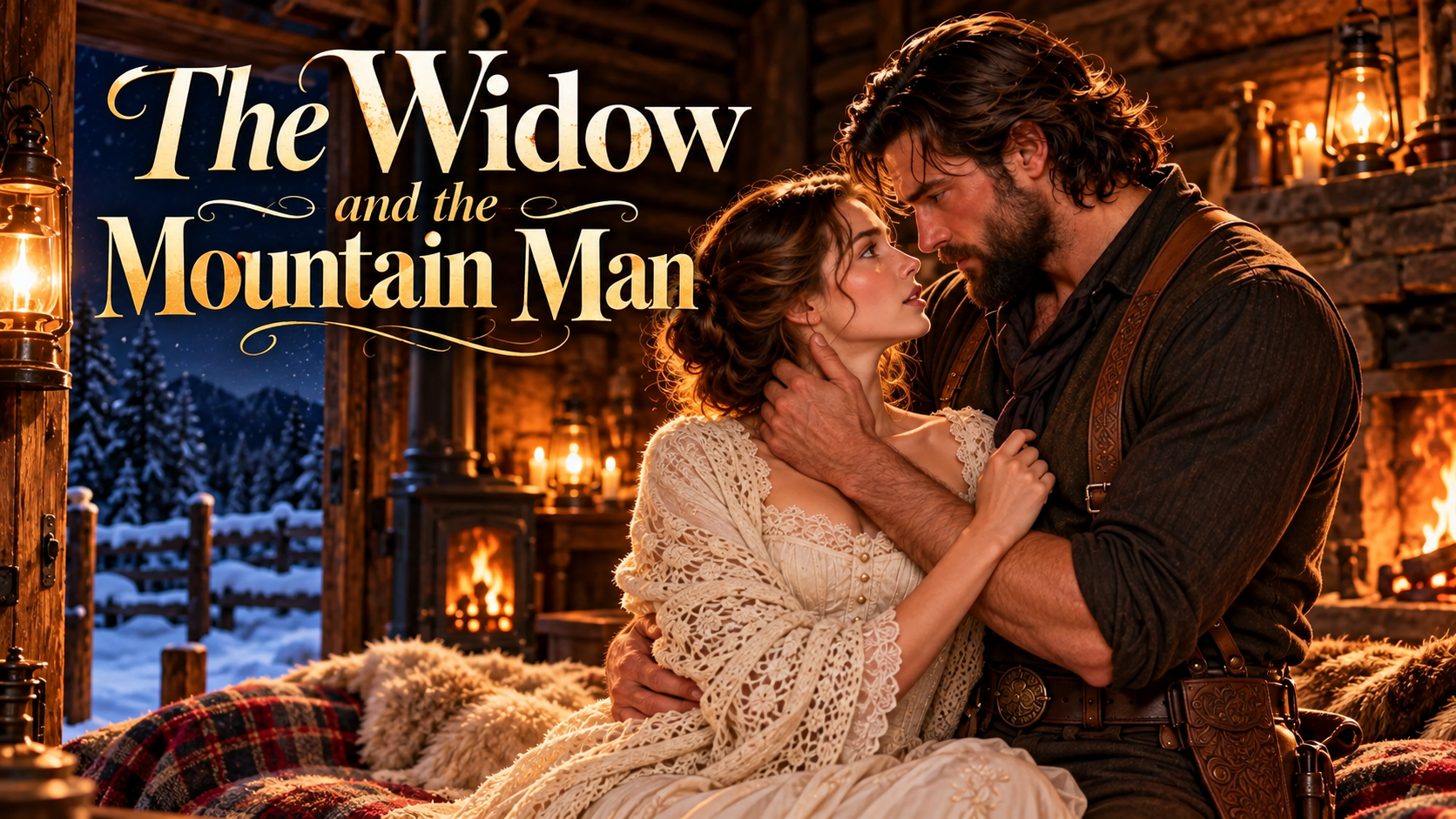
The Widow and the Mountain Man — Part 5: The Final Wedding Vow
Henry Whitmore pointed his revolver at the man Eleanor had married only one day earlier.
“Move away from her, Mercer.”
Caleb did not move.
Behind him, Rose held Thomas tightly.
Eleanor stood beside the underground chamber’s only exit, staring at the husband she had once trusted with her entire future.
Henry smiled.
“You always were too sentimental, Eleanor.”
She looked at the revolver.
“You planned all of this?”
“Not all of it. Mercer was supposed to find Rose, bring her back, and lead me to the trust records. I didn’t expect him to marry you quite so eagerly.”
Caleb’s jaw tightened.
“You told me the children were being held by traffickers.”
Henry shrugged.
“People believe almost anything when children are involved.”
Eleanor felt her anger settle into something colder.
“Those children were real. Their suffering was real.”
“An unfortunate complication.”
Caleb moved forward.
Henry cocked the revolver.
“Another step, and your new husband doesn’t leave this mine.”
Eleanor raised both hands.
“Henry, listen to me.”
He glanced toward her.
“I still have the iron box.”
Henry froze.
“Where?”
“Hidden outside.”
“Then bring it to me.”
“You need more than that box.”
She reached into her coat and removed the folded bank document.
Henry’s eyes widened.
Eleanor continued.
“The trust account contains far more money than you stole. But the bank requires two signatures before the remaining funds can be released.”
Henry stared at her.
“Yours and mine.”
“Exactly.”
It was a lie.
But Henry had always believed Eleanor knew nothing about financial documents.
And his greed made him careless.
“Then we can settle this,” he said.
Eleanor slowly approached.
“First, put down the gun.”
Henry laughed.
“You must think I’m a fool.”
“No,” she replied quietly. “I think you’re exactly the man I finally understand.”
She threw the document toward the lantern.
Henry instinctively turned to catch it.
Caleb lunged.
The revolver discharged.
The shot struck the ceiling.
A shower of stones fell.
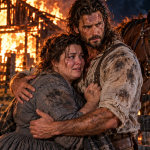
Caleb slammed Henry against the wall while Eleanor pulled Rose and Thomas toward the exit.
But the mine had been weakened by years of neglect.
The gunshot triggered a collapse.
Timbers cracked.
Rocks thundered down.
And the passage disappeared beneath a wall of debris.
For one terrible moment, Eleanor could not see Caleb.
“Caleb!”
Dust filled the chamber.
Henry lay pinned beneath a fallen beam.
Caleb was trapped beside him.
“Take the children!” Caleb shouted.
Eleanor refused to move.
“Not without you!”
“Eleanor, please!”
She looked at the fallen support beam.
Then she noticed something Henry had overlooked.
An old mining winch stood beside the wall, its chain connected to the timber above the collapsed passage.
Eleanor had grown up around her father’s Baltimore shipping warehouse.
She understood pulleys.
She understood counterweights.
And she understood that a single determined person could sometimes move what ten men could not lift.
She wrapped the chain around the beam and turned the rusted wheel.
Nothing happened.
She tried again.
The mechanism groaned.
Rose rushed to help.
Together, they pulled.
The beam shifted.
Caleb dragged himself free.
But Henry remained trapped.
“Leave him!” Rose cried.
Caleb looked at Eleanor.
For a moment, she remembered every cruelty Henry had inflicted upon her.
Then she shook her head.
“We’re not becoming him.”
Caleb returned.
With Eleanor guiding the winch, he freed Henry and carried him toward the opening.
They emerged into daylight just as the mine entrance collapsed behind them.
Three days later, federal marshals arrived in Black Hollow.
Henry and Silas Vane were arrested after Eleanor provided the forged bank records and testimony from the rescued children.
But the investigation uncovered something none of them expected.
The charitable trust had not been created by Henry.
It had been established decades earlier by Eleanor’s father.
And the missing money had originally been intended to support abandoned children throughout Colorado.
When the authorities restored the trust, Eleanor was named its lawful administrator.
The woman who had arrived in the mountains with almost nothing suddenly possessed the means to give dozens of children a future.
Yet that was not the greatest surprise.
A week later, Caleb found a sealed letter among the documents recovered from Henry’s possessions.
It was addressed to him.
The handwriting belonged to his father.
Caleb had believed his father died nineteen years earlier.
But the letter revealed that he had survived for several more years while secretly investigating the disappearance of children from mountain settlements.
Before his final illness, he had discovered the trust’s original purpose.
He had also learned that Eleanor’s father had been one of the few men willing to help him.
The two fathers had worked together to protect the children.
And long before Eleanor and Caleb ever met, they had exchanged letters about their families.
One passage made Caleb stop reading.
“If our children should ever find themselves alone in this world, I hope they might find in one another the kindness that has carried us through these difficult years.”
Caleb read the words twice.
Then he looked at Eleanor.
“Our fathers knew each other.”
She nodded through tears.
“They wanted us to find someone kind.”
Caleb smiled faintly.
“Seems we took the long way around.”
But Eleanor still had one final truth to tell him.
She reached into her trunk and removed a yellowed envelope.
Inside was the original marriage advertisement.
Caleb recognized his own reply.
Then Eleanor showed him a second letter.
It was dated two months before she left Baltimore.
Caleb stared at the signature.
It belonged to Rose.
The girl had secretly written to Eleanor after discovering Henry’s connection to the stolen trust money.
She had begged Eleanor to find Caleb Mercer, the brother she had spent years searching for.
Eleanor had answered Caleb’s advertisement because she needed security.
But she had also hoped the mountain man might help her discover the truth about Henry.
“I didn’t know whether I could trust you,” she admitted.
Caleb looked at her for a long moment.
“Neither did I.”
“Are you angry?”
He shook his head.
“We both came into this marriage carrying secrets.”
Eleanor took his hand.
“And now?”
“Now I’d like us to start again.”
That spring, they stood outside the same little cabin where their marriage had begun.
Rose and Thomas scattered wildflowers across the porch.
Several rescued children gathered beside the fence.
The mountains were green again.
Caleb wore his best shirt.
Eleanor wore the same ivory dress she had worn on their first wedding day.
But this time there were no debts.
No hidden motives.
No fear of what the other might demand.
Only two people choosing each other freely.
Caleb took Eleanor’s hands.
“I don’t have much experience being a husband,” he whispered.
She smiled.
“You’ve learned quickly.”
“I still have one question.”
“What is it?”
He leaned closer.
“Would you marry me again, knowing everything you know now?”
Eleanor kissed him before he could finish.
“Every winter. Every spring. Every lifetime.”
Years later, the Mercer home became a refuge for children who had nowhere else to go.
Rose grew into a confident young woman.
Thomas became Caleb’s constant companion in the workshop.
And Eleanor transformed her father’s restored trust into a network of safe homes throughout the mountains.
But Caleb’s favorite moment remained the same.
Every evening, he would sit at the supper table and listen to the voices filling the cabin.
Sometimes there were six people.
Sometimes twelve.
Sometimes more.
He never ate alone again.
And whenever Eleanor passed behind his chair, she would lean down and whisper the words he had asked her on their first wedding night.
“Would you like me to teach you something?”
Caleb would smile, pull her gently into his arms, and answer exactly as he had that snowy evening.
“Only if you promise never to stop.”
The mountain man who had once been afraid to kiss his own bride had finally discovered that love was never something he needed to earn.
It was something two people chose to give each other.
And the widow who had once locked a cabin door out of fear now left it open every evening.
Because inside that little house, nobody had to face the wilderness alone.
The End.