PART 2 — THE WOMAN WHO REFUSED TO BREAK
He Wanted a Wife to Tend the Chickens—She Turned His Bankrupt Homestead Into a Frontier Legend
“Thirty days, Mrs. Tucker.”
Harrison Caldwell stood on the Broken Spur porch, smiling as though he had just offered Martha Tucker a wedding present instead of a death sentence.
“Thirty days to settle every outstanding obligation,” he continued. “After that, the ranch, the livestock, the buildings, and every miserable chicken on this property belong to my bank.”
Griffin Tucker stepped forward, his fists tightening.
“You can’t take my father’s land.”
Caldwell turned toward him with amusement.
“Your father should have taught you how to keep it.”
The words struck harder than a fist.
Griffin had spent seven years trying to save the Broken Spur. Seven years watching the cattle grow thinner, the fences collapse, and the creek shrink until it looked like a scar across the earth.
And now this banker intended to take everything.
But Mattie was not watching Caldwell’s face.
She was studying the document in his hand.
“Thirty days,” she repeated.
Caldwell gave a theatrical bow.
“Assuming you understand what thirty days means, madam.”
“I understand perfectly.”
She closed her brass-cornered ledger.
“It means you’ve given me four weeks to make you regret coming here.”
The deputy standing beside Caldwell coughed into his sleeve.
One of the hired gunmen laughed.
Caldwell’s smile disappeared.
“Be careful, Mrs. Tucker. A woman in your position ought to be grateful that respectable men are willing to overlook certain… disadvantages.”
His eyes traveled deliberately over her large figure.
Griffin felt his stomach tighten.
He had made his own assumptions about Mattie’s size when she first stepped off the train. He had wondered whether a woman built like her could survive the hard physical demands of frontier life.
Hearing Caldwell make the same judgment aloud suddenly sounded uglier than Griffin cared to admit.
Mattie merely tilted her head.
“Mr. Caldwell, I’ve never found a man’s opinion of my appearance particularly useful for paying debts.”
She stepped closer.
“But I have found that men who spend too much time insulting women usually do so because they’re afraid of what those women know.”
Caldwell’s face hardened.
For one brief moment, the banker looked genuinely frightened.
Then he mounted his horse.
“Thirty days.”
He pulled the reins.
“And if you intend to challenge my figures, Mrs. Tucker, I suggest you hire a lawyer who knows how to count.”
Mattie smiled.
“I already know how to count.”
Caldwell rode away without another word.
For several minutes, Griffin and Mattie stood in silence.
Then Griffin turned on her.
“What in God’s name were you thinking?”
Mattie faced him calmly.
“I was thinking about your interest payments.”
“You humiliated the most powerful banker in Laramie County!”
“He was already attempting to humiliate us.”
“He can destroy this ranch!”
“He’s been destroying it for years.”
Griffin opened his mouth, then closed it.
Mattie glanced toward the distant hills.
“Now, Mr. Tucker, unless you intend to spend the rest of the afternoon arguing with your wife, I have chickens to examine.”
She walked past him.
Griffin watched her go, anger boiling beneath his exhaustion.
He had sent for a wife to help him survive.
Instead, he had married a woman who seemed determined to start a war.
And somehow, despite himself, he was beginning to wonder whether she could win it.
By sunrise the next morning, Mattie had already declared war on the Broken Spur.
Not with a rifle.
Not with shouting.
With a shovel, a notebook, and three enormous sacks of spoiled chicken feed.
Griffin found her behind the henhouse, standing beside a pile of gray, moldy grain.
“What are you doing?”
“Saving your chickens.”
“By throwing away their food?”
“By removing what has been making them sick.”
He stared at the sacks.
“That feed cost money.”
“So will burying forty dead hens.”
Griffin rubbed his forehead.
“We don’t have money for fresh grain.”
“Then we won’t begin with grain.”
Mattie pointed toward the fence.
“There’s lamb’s-quarter growing along the north pasture. Purslane behind the washhouse. Beet greens from your abandoned garden. And I saw insects gathering beneath the old manure boards.”
Griffin looked at her.
“You intend to feed my hens weeds and bugs?”
“I intend to feed them things chickens are perfectly capable of eating.”
She opened her ledger.
“Your problem, Mr. Tucker, isn’t simply that you lack resources.”
She looked directly at him.
“It’s that you’ve stopped seeing the ones you already possess.”
That afternoon, Griffin returned from repairing a fence to discover the chicken yard transformed.
The rotten feed was gone.
The water troughs had been scrubbed.
The sick birds had been separated from the healthy ones.
Fresh bedding covered the nesting boxes.
And Mattie had somehow convinced a neighboring widow named Mrs. Beatrice Harlow to exchange three bushels of barley for a promise of future eggs.
Griffin stared at the arrangement.
“You traded eggs we haven’t collected yet?”
“Certainly.”
“What happens if the hens don’t lay?”
Mattie smiled.
“Then I suppose I’ll have to encourage them.”
For the first time in months, Griffin almost laughed.
Almost.
But the following morning, he discovered six eggs in the nesting boxes.
Three more than the day before.
By the end of the week, there were fourteen.
Mattie recorded every one.
She recorded the feed.
The weather.
The condition of the birds.
The cost of supplies.
The names of families who might purchase eggs.
She wrote everything in that mysterious velvet ledger.
Griffin began to realize that his wife was doing something he had never learned to do.
She was treating the ranch like a business instead of a burden.
On the ninth morning, Mattie made another discovery.
She had been walking along the dried creek bed, carrying a walking stick and a tin cup, when Griffin found her examining a patch of unusually green grass.
“What now?”
She pointed at the ground.
“Dig here.”
Griffin frowned.
“Why?”
“Because the soil is damp.”
“We haven’t had rain in three weeks.”
“Exactly.”
He crouched and pushed his fingers into the earth.
Beneath the dry surface, it was cool.
Moist.
He looked up.
Mattie’s eyes were shining.
“Your creek hasn’t disappeared, Griffin.”
She smiled slowly.
“It has gone underground.”
He stared at her.
“That’s impossible.”
“Water doesn’t care what you believe is possible.”
By noon, Griffin had dug a narrow trench along the bank.
At three feet, the soil darkened.
At four feet, water began gathering at the bottom.
By sundown, a shallow pool had formed.
It wasn’t enough to water a hundred cattle.
Not yet.
But it was water.
Real water.
Griffin knelt beside the muddy pool, cupped his hands, and lifted it toward his face.
He could barely remember the last time something on the Broken Spur had gone right.
His father had always said the old creek flowed beneath the stones during the driest summers.
Griffin had dismissed it as an old man’s story.
Now he understood.
His father had been trying to tell him something.
And Mattie had listened to the land closely enough to find it.
When Griffin returned to the cabin that evening, he found her standing at the stove.
The kitchen smelled of onions, fresh biscuits, and chicken stew.
He stood in the doorway longer than necessary.
“Mattie?”
“Yes?”
“How did you know?”
She continued stirring.
“Know what?”
“About the water.”
She paused.
“My father worked with agricultural surveyors for a time. I learned to observe soil, plants, and drainage before I was old enough to understand why those things mattered.”
Griffin looked toward the window.
“You were right.”
Mattie turned.
“About the water?”
He swallowed.
“About more than that.”
For a moment, neither spoke.
Then she gave him a small smile.
“Careful, Mr. Tucker. If you start admitting I’m right, we may both become accustomed to it.”
This time, Griffin laughed.
A real laugh.
Low and rusty from lack of use.
Mattie looked startled.
Then she laughed too.
It was the first peaceful supper they had shared since her arrival.
But peace had never lasted long at the Broken Spur.
Three days later, Harrison Caldwell received an unwelcome visitor.
A rancher named Amos Bell entered his bank carrying a basket of eggs.
Caldwell looked up irritably.
“What is that?”
“Payment.”
“For what?”
“Mrs. Tucker bought some barley from me. Paid in eggs. Best eggs my wife has seen this season.”
Caldwell frowned.
“What does that have to do with me?”
Amos shrugged.
“Nothing, I suppose. Just thought you’d want to know that Tucker ranch is doing better.”
The banker went very still.
“Better?”
“They found water, too.”
Caldwell set down his pen.
“Who told you that?”
“Everybody knows by now.”
Amos smiled.
“Seems that new wife of his is something special.”
Caldwell dismissed him so abruptly that the old rancher nearly dropped his basket.
When the door closed, the banker summoned his bookkeeper.
“Fetch the Broken Spur account.”
The young man obeyed.
Caldwell opened the file.
He studied the debt.
The land measurements.
The tax records.
And the boundary map attached to the original mortgage.
Then he leaned back slowly.
“Water,” he whispered.
His expression changed.
It was no longer simple irritation.
It was hunger.
Because Caldwell knew something Griffin Tucker did not.
The underground water beneath the Broken Spur extended farther than anyone in the county realized.
Years earlier, a private survey had identified a deep natural spring system beneath the ranch.
A dependable source that could supply livestock, irrigation, and possibly an entire settlement.
The report had never reached Griffin.
Caldwell had made certain of that.
He had spent years manipulating the ranch’s debts because he knew the land was worth ten times what Griffin believed.
And now a large, sharp-eyed woman from back east was threatening to ruin everything.
Caldwell called for his foreman, a narrow-faced man named Silas Rourke.
Rourke entered wearing dusty riding boots and a gun low on his hip.
“You wanted me?”
Caldwell closed the account book.
“I want the Tucker woman frightened.”
Rourke smiled.
“How frightened?”
“Enough to leave.”
“And if she doesn’t?”
Caldwell looked toward the window.
“Then make sure the ranch has nothing left for her to save.”
That same evening, Griffin found Mattie sitting at the kitchen table, repairing a torn apron.
Her sleeves were rolled above her elbows.
Her dark hair had escaped its pins.
A smudge of flour marked one cheek.
She looked tired.
But she also looked content.
Something about the sight made Griffin stop.
He had spent so long viewing the cabin as a place where he ate, slept, and worried that he had forgotten it could feel like a home.
Mattie looked up.
“Have you eaten?”
“Not yet.”
“There’s stew.”
He stepped inside.
“You ought to rest.”
She raised an eyebrow.
“Are you giving me orders again?”
“No.”
Griffin hesitated.
“I mean you’ve been working harder than anyone I’ve ever seen.”
Mattie’s expression softened.
“Hard work isn’t unfamiliar to me.”
“I know.”
He pulled out the chair opposite her.
For a while, he watched her sew.
Then he said something that surprised both of them.
“I was wrong about you.”
Her needle stopped.
Griffin looked down at his hands.
“When you stepped off that train, I thought you weren’t what I’d asked for.”
“I gathered as much.”
“I thought you couldn’t do what this ranch needed.”
Mattie waited.
He lifted his eyes.
“I was a fool.”
The room grew quiet.
Outside, the evening wind moved through the cottonwoods.
Mattie placed the apron aside.
“Griffin, I’ve spent most of my life being told what a woman my size cannot do.”
Her voice remained steady.
“Cannot work hard enough. Cannot walk far enough. Cannot be wanted. Cannot be useful unless someone decides she’s useful.”
She looked at him without bitterness.
“I learned a long time ago that proving people wrong is exhausting.”
Griffin swallowed.
“Then why keep doing it?”
“Because I refuse to let their opinions become my limits.”
He stared at her.
There were fine lines beside her eyes.
A small scar near her chin.
Strong hands marked by years of labor.
He suddenly wondered how many men had looked at this woman and failed to see her.
How many had judged her before hearing a single intelligent word.
How many had missed the courage standing directly in front of them.
“I don’t think you’re invisible, Mattie.”
She looked away quickly.
But not before he saw the tears gathering in her eyes.
“That’s a kind thing to say,” she whispered.
He shook his head.
“It isn’t kindness.”
He reached across the table.
His hand stopped beside hers.
“It’s the truth.”
For one brief moment, Mattie allowed her fingers to rest against his.
Then a horse screamed outside.
Griffin stood instantly.
Another scream followed.
Sharp.
Terrified.
He grabbed his rifle.
“Stay here.”
Mattie was already rising.
“Absolutely not.”
They hurried into the yard.
One of the mares was thrashing against the corral fence.
The animals were restless.
Something was wrong.
Griffin approached cautiously.
Then he saw it.
The water trough had been overturned.
The gate chain had been cut.
And scattered across the ground lay several pieces of meat.
Mattie bent to examine one.
“Don’t touch that!”
Griffin caught her wrist.
She looked at him.
He pointed toward a dead coyote near the fence.
The animal’s body lay twisted in the dirt.
Poison.
Someone had placed poisoned bait inside his livestock enclosure.
Mattie’s expression hardened.
“Caldwell.”
Griffin looked toward the darkness beyond the fence.
“We can’t prove it.”
“Not yet.”
She stood slowly.
“But someone wants your animals dead.”
The next morning, they found seven chickens lifeless inside the henhouse.
Three more were sick.
Mattie knelt among the birds, her broad shoulders trembling.
Griffin had never seen her look so defeated.
She lifted one small brown hen into her lap.
“Poor little thing.”
The bird had been one of the first to recover after Mattie changed the feed.
Now it lay motionless in her hands.
Griffin crouched beside her.
“Mattie.”
She didn’t answer.
He placed a hand on her shoulder.
“We’ll get more.”
She looked at him sharply.
“This isn’t about replacing chickens.”
Her voice broke.
“Those birds were getting healthy. They were laying again. We were making something out of nothing, Griffin.”
A tear slipped down her cheek.
“And somebody killed them because they couldn’t stand to see us succeed.”
Griffin’s chest tightened.
He had seen her confront an arrogant banker without flinching.
He had seen her work until her hands blistered.
He had seen her smile through insults that would have broken a lesser spirit.
But seeing her cry over seven dead chickens struck him harder than anything Caldwell had done.
He lowered himself beside her.
“You listen to me.”
Mattie wiped her cheek angrily.
“Don’t tell me it’s all right.”
“It isn’t.”
He took the dead bird gently from her hands.
“It isn’t all right. And I’m done pretending it is.”
She stared at him.
Griffin stood.
“This is my ranch. My home. And you’re my wife.”
His voice grew rough.
“Anybody who comes after you comes through me.”
Mattie’s eyes widened.
For the first time since arriving at Bitter Creek, she looked at him not as a difficult husband or an exhausted rancher.
But as a man who might finally stand beside her.
That afternoon, Griffin rode to town.
He purchased fresh feed on credit.
He spoke with the sheriff.
And he returned carrying something Mattie had not requested.
A new lock for the henhouse.
He installed it himself.
Then he reinforced the doors.
By evening, every animal enclosure was secured.
Mattie watched him from the porch.
“You’re going to wear yourself out.”
Griffin hammered another nail.
“Good.”
“Griffin.”
He looked up.
She smiled.
“Thank you.”
He nodded once.
But his expression softened.
“You’re welcome, Mrs. Tucker.”
For the next five days, the ranch fought back.
Mattie refused to surrender.
She established a new feeding routine.
She separated every suspicious supply.
She persuaded Mrs. Harlow to help inspect the surviving birds.
She sold eggs in town and accepted sewing repairs from neighboring families.
She began preserving vegetables, rendering soap, and drying herbs that could be traded.
Griffin repaired fences, cleared irrigation channels, and slowly moved the healthiest cattle toward fresh grazing.
The creek trench deepened.
The spring grew stronger.
And something extraordinary began happening.
The Broken Spur started making money.
Not much.
Not enough to pay Caldwell.
But actual profit.
For the first time in years, Griffin could purchase supplies without promising half his remaining herd in return.
Then Mattie made her boldest decision yet.
“We’re going to hold a market.”
Griffin looked up from his coffee.
“A what?”
“A Saturday market. Right here.”
He stared.
“On this ranch?”
“Why not?”
“Because nobody comes all the way to Bitter Creek to buy eggs.”
“They will if we offer more than eggs.”
Mattie opened her ledger.
“Mrs. Harlow makes excellent cheese. Amos Bell has honey. The Henderson family makes preserves. We have eggs, soap, vegetables, and fresh water.”
Griffin frowned.
“Fresh water isn’t merchandise.”
“Not directly. But every traveler between Laramie and the western cattle trails needs a place to water their horses.”
She tapped the table.
“Food brings them here. Water brings them back.”
Griffin studied her.
“You’ve been planning this.”
“Since the day I arrived.”
He shook his head.
“You’re impossible.”
Mattie smiled.
“And yet remarkably difficult to ignore.”
The market opened the following Saturday.
Griffin expected three visitors.
By noon, seventeen wagons had arrived.
Ranch wives traded preserves.
Cowboys purchased biscuits and eggs.
Travelers filled their canteens.
Children chased one another around the barn.
Mrs. Harlow sold every round of cheese she brought.
And Mattie stood at the center of it all, her dark dress covered by a white apron, directing customers with the authority of a general commanding an army.
Griffin watched from beside the corral.
Amos Bell approached him.
“Quite a wife you’ve got there.”
Griffin said nothing.
Amos chuckled.
“I remember when you told me all you wanted was somebody to feed the hens.”
Griffin looked toward Mattie.
She was laughing with two women beside a table of fresh bread.
The afternoon sunlight caught in her dark hair.
Her cheeks were flushed.
She looked alive.
Confident.
Beautiful in a way Griffin had not known how to recognize.
“Yeah,” he said quietly.
“I was a damned fool.”
Amos grinned.
“Most married men are, son.”
By sunset, Mattie counted the day’s earnings.
Thirty-eight dollars and forty cents.
Griffin stared at the coins spread across the kitchen table.
“That’s more than I’ve made in a month.”
“After expenses, we’ve cleared twenty-six dollars and ten cents.”
She opened the ledger.
“And we’ve secured orders for another forty dollars’ worth of goods.”
He sank slowly into a chair.
“Mattie…”
She looked up.
“We’re going to save it,” he whispered.
For the first time, the words didn’t sound impossible.
Mattie reached across the table.
“We’re going to try.”
Griffin caught her hand.
He held it longer than necessary.
Then he stood and walked around the table.
Mattie’s smile faded into nervous uncertainty.
“Griffin?”
He bent down.
Slowly.
Giving her every chance to pull away.
And kissed her forehead.
It was a simple gesture.
Gentle.
Almost shy.
But Mattie closed her eyes as though no man had ever given her something so precious.
When Griffin stepped back, her cheeks were pink.
“What was that for?”
He swallowed.
“For staying.”
She looked down at their joined hands.
“Where would I go?”
Griffin’s voice turned quiet.
“I hope nowhere.”
That night, Mattie lay awake in the small bedroom Griffin had prepared for her.
She touched her forehead where he had kissed her.
For a moment, she allowed herself to imagine a life in which she was not merely useful.
A life where she was wanted.
A life where Griffin might someday look at her with love instead of obligation.
But then she remembered the letter hidden beneath the velvet lining of her traveling case.
The letter she had promised herself she would destroy.
The letter that connected her to Harrison Caldwell.
And the happiness in her chest turned suddenly to fear.
Because Mattie had not come to Wyoming entirely by chance.
And the truth was growing harder to hide.
Three nights later, disaster struck.
Griffin woke to the sound of pounding hooves.
Then a shout.
“FIRE!”
He bolted upright.
Orange light flickered across the bedroom wall.
Outside, someone was screaming his name.
“GRIFFIN! YOUR BARN!”
He snatched his trousers and boots.
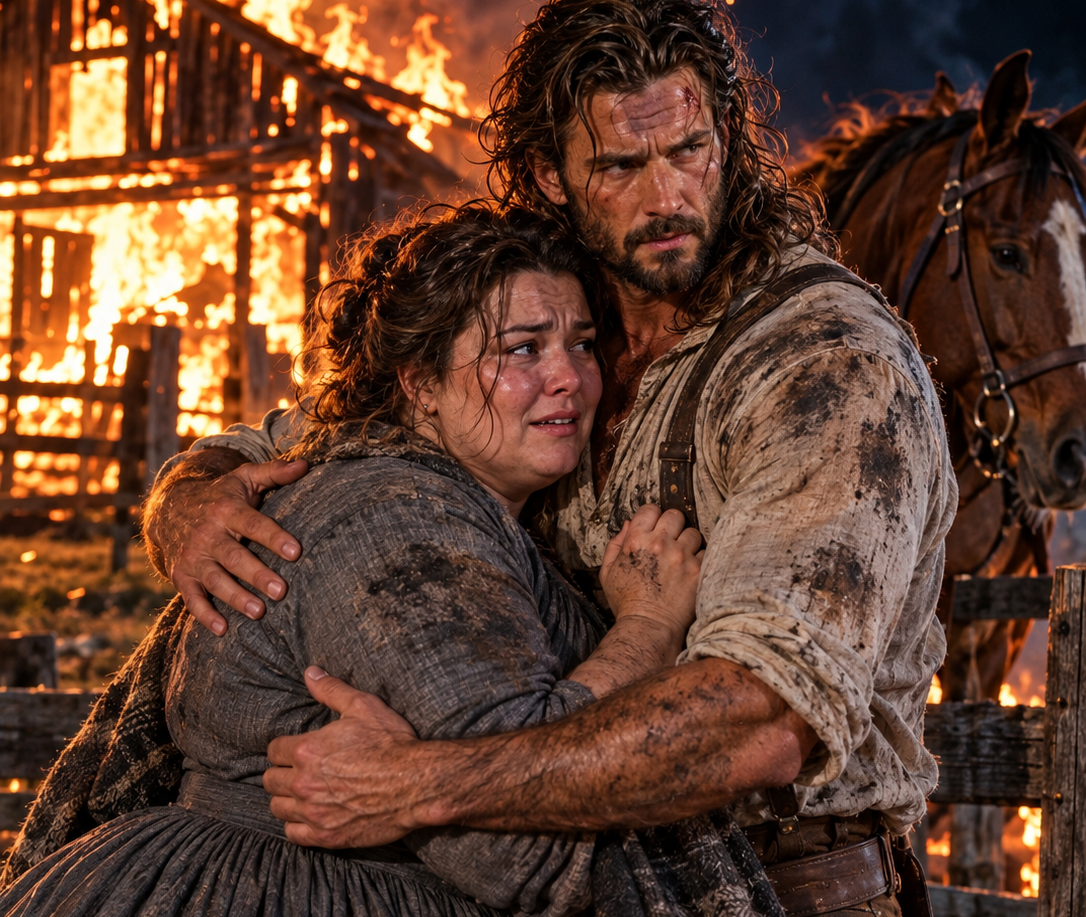
By the time he reached the porch, flames were climbing the eastern wall of the feed barn.
The dry timber caught like kindling.
Smoke rolled into the night sky.
Horses shrieked in their stalls.
Griffin ran.
“GET THE ANIMALS OUT!”
A neighbor who had been passing along the road rushed to help.
Together, they fought the latches.
One horse broke free.
Then another.
But the old mare, Daisy, remained trapped behind a fallen beam.
Griffin pushed toward the flames.
The heat struck his face like an open furnace.
He covered his mouth with his sleeve.
“Come on, girl!”
Daisy screamed.
A burning support cracked overhead.
Then someone grabbed Griffin’s arm.
Mattie.
She wore her nightdress beneath a heavy wool shawl.
Her hair hung loose around her shoulders.
“What are you doing?” Griffin shouted.
“Helping!”
“Get back!”
“Not while she’s trapped!”
Mattie seized a long fence rail lying near the barn door.
“Lift that end!”
Griffin understood immediately.
Together, they forced the rail beneath the fallen timber.
He pushed upward.
Mattie braced her weight against the other end.
Her strong legs dug into the dirt.
The beam shifted.
Just enough.
“NOW!” she shouted.
Griffin pulled the mare forward.
Daisy staggered free.
Seconds later, the barn roof collapsed.
A roar of sparks exploded into the sky.
The blast knocked Griffin to his knees.
Mattie threw herself against him, shielding his face from flying embers with her shawl.
For one terrible moment, the world became heat and smoke.
Then Griffin dragged her backward.
They stumbled into the yard.
He caught her by both shoulders.
“Are you hurt?”
Mattie coughed.
“No.”
“Are you sure?”
“Yes!”
He stared at her.
Her shawl was scorched.
Her hands were blackened.
A narrow burn marked her forearm.
Griffin felt fear claw through his chest.
“You could have died.”
“So could you.”
“You had no business coming into that fire!”
Mattie’s expression changed.
“No business?”
Griffin realized his mistake too late.
She pulled away.
“Those animals are my responsibility too.”
“Mattie—”
“You don’t get to call this our home when things are going well, then decide it belongs only to you when danger arrives.”
His anger collapsed.
It had never really been anger.
It was terror.
Terror at the thought of losing her.
Griffin reached for her again.
This time, gently.
“I wasn’t trying to shut you out.”
His voice broke.
“I thought that roof was going to fall on you.”
Mattie stood very still.
The flames lit his face.
He looked older suddenly.
Frightened.
Vulnerable.
“Griffin…”
He pulled her into his arms.
Not carefully.
Not politely.
He held her with the desperation of a man clinging to the only solid thing left in his world.
Mattie froze for a heartbeat.
Then she wrapped her arms around him.
And for several seconds, with the barn burning behind them, neither moved.
By dawn, the feed barn was gone.
So were most of their winter supplies.
Three wagonloads of hay.
Two barrels of grain.
Their seed reserves.
Everything Mattie had worked to gather.
Griffin stood in the ashes, staring at what remained.
His face was gray.
His eyes hollow.
Mattie approached quietly.
“We can rebuild.”
He shook his head.
“Not this time.”
“Griffin—”
“We were finally getting ahead.”
He gestured toward the ruin.
“And now this.”
She looked around.
Near the rear wall, something caught her attention.
A shattered lantern.
Its glass was blackened.
The metal handle was twisted.
Mattie crouched.
“Griffin.”
He turned.
She lifted the lantern with a scrap of cloth.
“Was this yours?”
He examined it.
“No.”
“Are you certain?”
“We only have two lanterns. One in the cabin, one in the chicken house.”
He stared at the broken object.
“Where did that come from?”
Mattie looked toward the northern trail.
Fresh hoofprints marked the soft dirt beyond the barn.
Two horses.
Maybe three.
Someone had ridden in during the night.
And someone had left before the flames were noticed.
“This wasn’t an accident,” she whispered.
Griffin’s jaw tightened.
“Caldwell.”
Mattie nodded.
But there was something about the lantern that troubled her.
A small symbol had been scratched into its metal base.
A crescent surrounding the letter R.
She had seen that mark before.
Years ago.
On a shipping invoice in an office hundreds of miles away.
An office where Harrison Caldwell’s name had appeared beside transactions that were never supposed to exist.
Her breath caught.
Griffin noticed.
“What is it?”
Mattie quickly lowered the lantern.
“Nothing.”
He frowned.
“Mattie.”
She forced herself to meet his eyes.
“I’m just tired.”
But she was not merely tired.
She was terrified.
Because the lantern suggested something far worse than a vindictive banker.
It suggested that the men Caldwell had once employed in his eastern operations had followed her west.
And if that was true, the Broken Spur was in greater danger than Griffin could imagine.
Two days later, Sheriff Walter Briggs arrived at the ranch.
He did not come alone.
Deputy Mercer rode beside him.
And behind them, wearing a satisfied smile, came Harrison Caldwell.
Griffin stepped onto the porch.
“What do you want?”
The sheriff dismounted.
“I’m sorry, Griffin.”
Those four words sent a cold feeling through Mattie’s stomach.
Briggs removed a folded document from his coat.
“I have a warrant to search the property.”
“For what?” Griffin demanded.
Caldwell answered.
“Bank theft.”
Griffin stared at him.
“You’ve lost your mind.”
Caldwell smiled.
“Several hundred dollars disappeared from my office last Thursday. Along with confidential account records.”
He turned toward Mattie.
“And a witness identified a large woman in a dark dress near the rear entrance.”
Mattie did not move.
The description was deliberate.
Cruel.
Convenient.
Griffin stepped between them.
“My wife hasn’t been to town since Saturday.”
Caldwell shrugged.
“Then perhaps she won’t mind proving it.”
The sheriff looked uncomfortable.
“Mrs. Tucker, I’m required to conduct a search.”
Mattie lifted her chin.
“Of course, Sheriff.”
Griffin turned.
“Mattie!”
She touched his arm.
“Let him.”
The search lasted nearly an hour.
They examined the kitchen.
The storage room.
The bedroom.
The locked desk.
Then Deputy Mercer emerged from the rear pantry carrying a small canvas pouch.
“Sheriff?”
Briggs took it.
Inside were forty silver dollars.
And a bundle of banknotes wrapped in a paper bearing Caldwell’s bank seal.
Griffin stared.
“I’ve never seen that before.”
Caldwell sighed theatrically.
“How unfortunate.”
Mattie looked at the pouch.
Then at the deputy.
Then at Caldwell.
Her expression was perfectly calm.
“Sheriff,” she asked, “would you mind telling me where that was found?”
“In the flour barrel.”
Mattie nodded slowly.
“The flour barrel.”
“Yes, ma’am.”
“How interesting.”
Caldwell frowned.
“What is interesting?”
Mattie turned toward him.
“That barrel has been empty since Tuesday.”
The sheriff blinked.
Mattie continued.
“I scrubbed it myself and turned it upside down to dry. We haven’t purchased new flour since the fire.”
She looked at Deputy Mercer.
“So perhaps your deputy can explain how a pouch containing several pounds of silver managed to remain inside a barrel that was emptied, washed, and inverted.”
Mercer’s face reddened.
“I don’t know anything about that.”
“Neither do I,” Mattie said pleasantly.
“Which makes us equally puzzled.”
Griffin stared at the deputy.
Then he looked at Caldwell.
“You planted it.”
Caldwell snapped.
“Watch your accusations!”
Mattie raised one finger.
“There is another problem.”
Everyone turned.
She nodded toward the banknotes.
“Those bills are remarkably clean.”
The sheriff frowned.
“What do you mean?”
“Three days ago, our barn burned. Ash and soot entered this house through every window. I spent yesterday washing gray dust off every shelf.”
She indicated the pouch.
“Yet that fabric is spotless.”
Silence settled over the kitchen.
Mattie looked directly at Caldwell.
“Whoever placed it there arrived after the cleaning.”
For the first time, the banker’s confidence faltered.
Sheriff Briggs studied the money.
Then his deputy.
“Mercer.”
The young man swallowed.
“Sir?”
“Wait outside.”
“But Sheriff—”
“Outside.”
Mercer obeyed.
Caldwell’s face darkened.
“You’re allowing this woman to make fools of you.”
Briggs folded the warrant.
“No, Mr. Caldwell. I’m allowing her to answer an accusation.”
The sheriff turned toward Mattie.
“I won’t be making an arrest today.”
Caldwell stepped forward.
“This is outrageous!”
Briggs met his gaze.
“Then bring me evidence that hasn’t appeared in a clean pouch inside an empty flour barrel.”
The banker looked as though he might strike someone.
Instead, he shoved his hat onto his head.
“You have twenty days left, Tucker.”
His eyes moved toward Mattie.
“And I suggest your wife spend them preparing to leave.”
They departed in a cloud of dust.
Griffin remained motionless until the riders disappeared.
Then he turned toward Mattie.
“How did you know?”
She looked at him.
“Know what?”
“That the money was planted.”
“Because it was.”
“No.”
He stepped closer.
“How did you know exactly where to look for a mistake?”
Mattie’s face changed.
Only slightly.
But Griffin saw it.
“You’ve dealt with something like this before,” he said.
She looked away.
“Griffin, there are things about my life—”
“What things?”
She closed her eyes.
“Things I hoped would remain in the past.”
His stomach tightened.
“Mattie.”
She faced him.
“Please. Trust me a little longer.”
He wanted to.
God help him, he wanted to more than anything.
But trust was becoming difficult when every disaster seemed to lead back to a secret she refused to explain.
That evening, Griffin rode to Amos Bell’s ranch to borrow a wagon.
Mattie remained behind.
She waited until he disappeared over the ridge.
Then she went into her bedroom.
She opened her traveling case.
Beneath the velvet lining lay a folded letter.
Yellowed.
Creased.
Worn from being opened too many times.
She held it for a long moment.
Then she unfolded it.
The handwriting belonged to a man who had once trusted the wrong business partner.
A man whose life had been destroyed by fraudulent loans, stolen property, and a carefully manufactured disgrace.
Her father.
At the bottom of the letter appeared a familiar name.
Harrison Caldwell.
And beneath it, another.
Nathaniel Tucker.
Griffin’s father.
Mattie’s hands began trembling.
“I tried to do this without hurting him,” she whispered.
But the truth was no longer something she could keep buried.
She returned the letter to its hiding place.
Then she sat at the table and opened her ledger.
On a fresh page, she wrote three words.
THE CALDWELL ACCOUNT.
Beneath them, she began listing dates, payments, and names.
She worked until the lamps burned low.
Outside, the wind rose.
The empty barn creaked in the darkness.
And somewhere beyond the fence, a rider watched the cabin window.
The stranger remained still until Mattie finally closed her ledger.
Then he turned his horse toward Laramie.
He had seen enough.
The woman was still investigating.
And Caldwell would not be pleased.
Griffin returned after midnight.
The cabin was silent.
Mattie’s lamp had been extinguished.
He removed his coat and crossed the room.
Then he noticed a drawer beside the desk standing slightly open.
A corner of yellow paper protruded beneath the folded linens inside.
Griffin reached to close it.
But something caught his eye.
His father’s name.
Nathaniel Tucker.
Written in a hand he did not recognize.
He stopped.
Slowly, he pulled the paper free.
It was a letter.
Dated eleven years earlier.
Griffin read the first line.
Then the second.
By the fourth, his hands had begun to shake.
The letter described a secret business arrangement involving Harrison Caldwell.
It mentioned falsified accounts.
Stolen land.
And a financial scandal that had destroyed an innocent family.
Then Griffin reached the final paragraph.
His breath stopped.
Because written there, in unmistakable ink, were words that changed everything he believed about the woman sleeping beneath his roof.
“Martha knows the truth. If she ever comes west, she must never reveal what happened between Caldwell and Nathaniel Tucker. The consequences would destroy the Tucker family forever.”
Griffin stared at the page.
Martha.
His Mattie.
She had known about Caldwell.
She had known his father.
She had known something about the Broken Spur before she ever answered his advertisement.
And suddenly he remembered the day she stepped off the train.
The velvet ledger.
The certainty in her voice.
The way she recognized Caldwell’s dishonesty before examining half the documents.
The way she seemed almost prepared for every attempt to ruin them.
He looked toward the bedroom door.
A terrible thought entered his mind.
What if Mattie had never come to Bitter Creek to become his wife?
What if their marriage had been part of something planned years ago?
What if the woman he was beginning to love had been keeping the most dangerous secret of his life?
Griffin folded the letter.
His face hardened.
Then, from behind the bedroom door, Mattie’s voice broke the silence.
“Griffin?”
He turned.
She stood in the doorway, her dark hair falling loose over her nightdress.
Her eyes moved to the paper in his hand.
Every trace of color drained from her face.
For several seconds, neither spoke.
Then Griffin lifted the letter.
His voice was low.
Cold.
And filled with pain.
“Tell me the truth, Mattie.”
She gripped the doorframe.
“Griffin, please—”
He took one step toward her.
“Did you marry me because you wanted a husband…”
His voice broke.
“Or because you came here to settle a debt with my dead father?”
Mattie covered her mouth.
And when she finally answered, the words shattered what little peace remained between them.
“Griffin…”
Tears filled her eyes.
“Your father didn’t die owing Harrison Caldwell money.”
She swallowed.
“He died because he discovered what Caldwell had done.”
Outside, thunder rolled across the Wyoming mountains.
And Griffin Tucker realized that the fight for his ranch had only just begun.
END OF PART 2
TO BE CONTINUED IN PART 3 — THE SECRET BEHIND HER MARRIAGE