PART 3 — THE FATHER WHO SOLD HIS DAUGHTER’S FUTURE
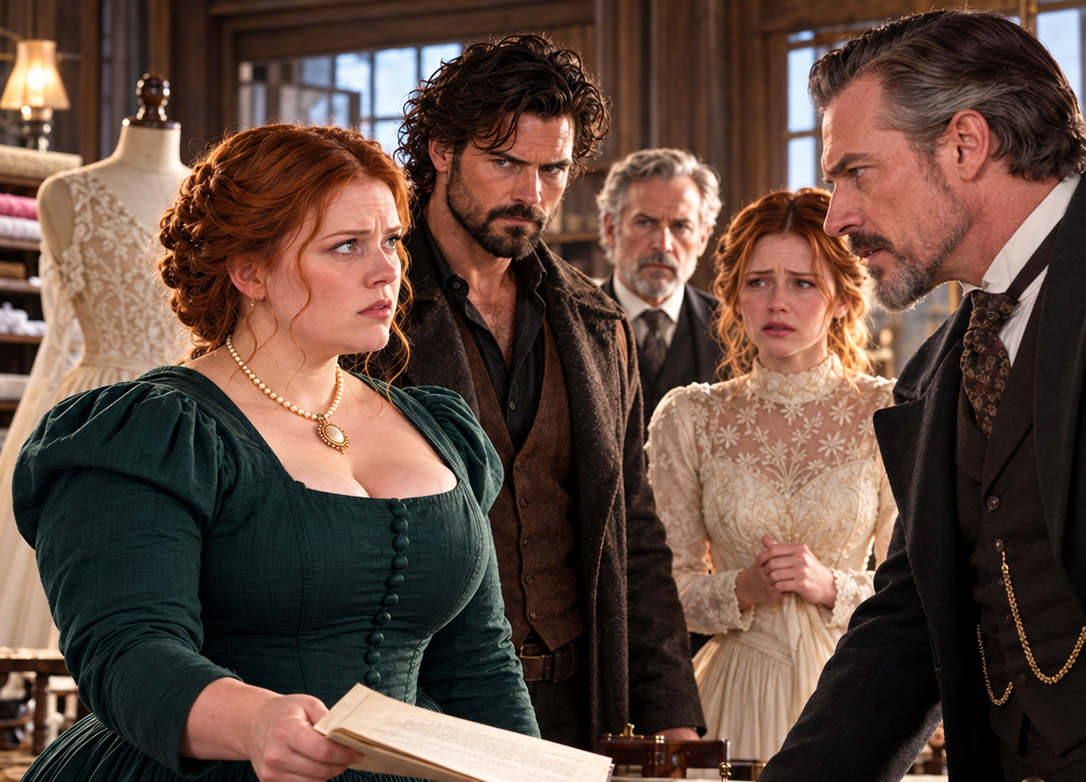
Mabel Hart stared at the financial document in her trembling hands.
Her name appeared beneath a figure so large that she had to read it three times.
Eight thousand dollars.
That was the amount her father had borrowed from Edwin Blackwood.
And somehow, without her knowledge or permission, Amos Hart had pledged her dressmaking business as collateral.
The little shop she had rented for eight dollars a month.
The sewing machines she had purchased with her own earnings.
The dresses she had worked through countless nights to complete.
Everything she had built after walking away from her father’s house.
All of it now appeared on a document carrying Amos Hart’s signature.
Grant Mercer stood beside her, his expression dangerously still.
“He had no right,” he said.
Mabel looked at the signature again.
“Then why does it say he did?”
Thomas Reed shifted uncomfortably near the doorway.
“Blackwood’s men have been telling people your father financed the shop. They’re claiming everything inside belongs to Hart Grain.”
Mabel felt her stomach tighten.
Her father had never given her a penny.
Not for rent.
Not for fabric.
Not even for the first wooden sign she had hung above her door.
But she had made one mistake.
When she first opened the shop, she had used the Hart family name.
And Amos had apparently decided that anything bearing that name belonged to him.
Outside, winter wind rattled the windows.
Grant reached toward her.
“Mabel, we’ll find a lawyer.”
She stepped away.
“No.”
Grant stopped.
“No?”
She folded the document carefully.
“We’ll find the truth first.”
The following morning, a polished black carriage stopped outside Mabel’s shop.
Edwin Blackwood stepped down wearing an expensive charcoal coat, polished boots, and a silver watch chain that glittered against his waistcoat.
He was forty-seven, with neatly trimmed whiskers and the confident expression of a man accustomed to being obeyed.
Two men accompanied him.
One carried a leather briefcase.
The other remained beside the carriage.
Mabel watched them approach through the front window.
She did not hide.
When Blackwood entered, he removed his gloves slowly.
“Miss Hart.”
“Mr. Blackwood.”
He glanced around the shop.
“Charming little establishment.”
“Thank you.”
“Your father tells me you’ve been very industrious.”
Mabel kept her expression neutral.
“My customers seem satisfied.”
Blackwood smiled.
“Unfortunately, industry and ownership are two different matters.”
He motioned toward the man carrying the briefcase.
A document appeared on her counter.
“Your father’s obligations have become due. Under our agreement, certain assets must now be surrendered.”
Mabel did not touch the paper.
“Which assets?”
Blackwood’s smile widened.
“This property. Its equipment. Current inventory. Outstanding customer payments.”
“And who signed that agreement?”
“Your father.”
“Not me?”
Blackwood paused.
“Your father represents the Hart family’s financial interests.”
Mabel looked directly at him.
“I’m twenty-eight years old, Mr. Blackwood. I operate this business independently. My father does not represent me.”
His smile faded slightly.
“I suggest you avoid making a difficult situation worse.”
Mabel folded her hands on the counter.
“And I suggest you explain how my father was able to mortgage property he doesn’t own.”
Blackwood leaned closer.
“Miss Hart, women in your position often misunderstand the complexities of business.”
Mabel felt the familiar sting of condescension.
For years, men had spoken to her that way.
As though her size made her foolish.
As though her quietness meant she lacked intelligence.
As though a woman who spent her days sewing couldn’t possibly understand a contract.
But this time, she did not lower her eyes.
“Then you won’t mind explaining the complexities to my attorney.”
Blackwood straightened.
“Your attorney?”
The shop door opened.
Mrs. Eleanor Whitcomb entered, followed by a gray-haired gentleman carrying a leather satchel.
“That would be me,” the gentleman said.
Blackwood turned.
His expression changed immediately.
“Samuel Whitaker.”
The older man nodded.
“Edwin.”
Mabel watched Blackwood’s confidence falter.
For the first time since entering her shop, he seemed uncertain.
Mr. Whitaker placed his satchel on the counter.
“I understand you’ve come to seize Miss Hart’s property.”
Blackwood cleared his throat.
“A lawful business arrangement.”
“Then I assume you brought proof that Amos Hart had authority to pledge these assets.”
A long silence followed.
Blackwood looked toward the briefcase.
Mr. Whitaker smiled faintly.
“That’s what I thought.”
Within an hour, the truth began to unravel.
Amos Hart had signed a loan agreement claiming Mabel’s business operated as a branch of Hart Grain.
He had listed her equipment and inventory among the company’s assets.
He had also declared that Mabel was working under his financial supervision.
Every statement was false.
But Blackwood had accepted the papers.
Or perhaps he had known they were false all along.
Mr. Whitaker studied the signatures carefully.
“Miss Hart, did you authorize any of these transactions?”
“No.”
“Did your father provide the original capital for your shop?”
“No.”
“Have you maintained your own accounts?”
“Every purchase and every sale.”
“Excellent.”
He looked at Blackwood.
“Then there appears to be no lawful basis for claiming her property merely because her father represented it as collateral.”
Blackwood’s face reddened.
“That matter would need to be decided in court.”
“Indeed,” Whitaker replied. “And if you attempt to seize anything before establishing your rights, we’ll seek an order preventing it.”
Mabel exhaled slowly.
She wasn’t safe yet.
But for the first time, she understood something important.
Her father’s signature was not more powerful than the truth.
Blackwood gathered his documents.
Before leaving, he stopped beside Mabel.
“You’re making an unfortunate enemy, Miss Hart.”
She looked at him steadily.
“No, Mr. Blackwood.”
Her voice was quiet.
“You came here as my enemy.”
By sunset, the story had spread through the entire town.
Amos Hart’s eldest daughter had challenged Edwin Blackwood.
Not with tears.
Not with pleading.
But with an attorney and a stack of account books.
For some people, it was scandalous.
For others, it was the most interesting thing that had happened all winter.
Inside the Hart family home, Amos was furious.
“She has humiliated us!”
Celia sat across from him, twisting a handkerchief between her fingers.
“She didn’t do anything wrong.”
Amos turned sharply.
“What did you say?”
Celia swallowed.
“I said Mabel didn’t do anything wrong.”
He slammed his palm onto the desk.
“That little shop exists because she carries my name!”
“She paid for it herself.”
“She wouldn’t have a name worth putting above the door without me!”
Celia flinched.
Amos pointed toward her.
“And you will keep your engagement with Blackwood. Do you understand?”
Tears filled her eyes.
“Father, I don’t love him.”
“Love doesn’t pay debts.”
“Neither does giving away your daughters.”
The words escaped before she could stop them.
Amos stared at her.
Then his expression hardened.
“Perhaps you’ve spent too much time listening to your sister.”
Celia rose shakily.
“Perhaps I haven’t spent enough.”
For the first time in her life, she walked out while her father was still speaking.
That night, Celia arrived at Mabel’s shop carrying a small wooden chest.
Her cheeks were red from crying.
Mabel opened the door.
“Celia?”
“I need to show you something.”
Inside the chest were letters, receipts, and a worn blue ledger.
Mabel recognized the handwriting immediately.
Their mother’s.
Her breath caught.
“Where did you get these?”
“Father kept them locked in his study. I found the key.”
Mabel opened the ledger carefully.
The first pages contained household expenses.
Fabric purchases.
Grain payments.
Notes about the family’s savings.
Then she found an entry dated shortly before her mother’s illness.
For Mabel — $3,200 reserved from my personal inheritance. To be kept for her future, education, or independent establishment.
Mabel stared at the words.
She remembered her mother speaking about a little shop someday.
A place where Mabel could make dresses without asking anyone’s permission.
But after her mother’s passing, Amos had always insisted there was no money.
Not for schooling.
Not for business.
Not for anything Mabel wanted.
Celia watched her sister’s expression change.
“There’s more.”
She handed Mabel a letter.
It was addressed to Amos.
Inside, their mother had written:
Our daughters must never feel that their futures depend entirely on the men who choose them. Mabel has a gift, Amos. Promise me you’ll protect it.
Mabel pressed her fingers against her lips.
For nearly twenty years, she had believed her mother left her nothing but memories and a few lengths of silk.
Now she was holding proof that her mother had tried to give her something more.
A beginning.
A choice.
A future.
“Where did the money go?” Mabel whispered.
Celia lowered her eyes.
“That’s what I think Father has been hiding.”
The next morning, Samuel Whitaker examined the ledger.
His face became increasingly serious.
Mrs. Whitcomb stood near the fireplace, watching him turn the pages.
Finally, the attorney removed his spectacles.
“Miss Hart, this changes things.”
Mabel leaned forward.
“How?”
“Your mother’s inheritance was separate property. According to these records, she intended this money to be set aside for your benefit.”
“Can we prove Father took it?”
“We need the original estate records and bank transactions. But these entries give us a place to begin.”
Mabel looked at the faded blue cover.
“All those years…”
Her voice broke.
“All those years, he told me I was a burden.”
Grant, who had been standing quietly near the window, turned toward her.
Mabel continued.
“He said feeding me was expensive. That buying fabric for my sewing was foolish. That nobody would ever pay good money for anything I made.”
She looked down at the ledger.
“And Mother had left me enough to begin a business before I was even grown.”
Grant approached slowly.
“Mabel.”
She shook her head.
“I spent eleven months making a wedding dress because I couldn’t imagine anyone ever choosing me.”
Tears slipped down her cheeks.
“And all that time, my own mother had already chosen to believe in me.”
Grant took her hand.
This time, Mabel did not pull away.
Three days later, Mabel entered the Hart family home for the first time since the harvest party.
She was not alone.
Grant accompanied her.
So did Samuel Whitaker.
And to Amos Hart’s astonishment, Celia stood beside her elder sister.
Amos rose from his desk.
“What is the meaning of this?”
Mabel placed the blue ledger before him.
“Mother’s inheritance.”
His face drained of color.
For a moment, the room was so quiet that the ticking clock seemed unbearably loud.
Then Amos recovered.
“You had no right going through my private papers.”
Celia stepped forward.
“They were Mother’s papers.”
Amos turned toward her.
“You ungrateful little—”
“Enough,” Grant said.
His voice was low.
But it stopped Amos immediately.
Mabel opened the ledger.
“Mother left money for me.”
Amos looked away.
“That was years ago.”
“Where is it?”
“The family needed it.”
“Where is it, Father?”
He struck the desk.
“I kept this family alive!”
Mabel flinched instinctively.
Grant took one step forward.
But Mabel raised her hand.
“No.”
She looked at her father.
For the first time, she saw not the powerful man who had ruled her childhood, but a frightened businessman surrounded by debts of his own making.
“You spent my inheritance,” she said.
Amos remained silent.
“And then you tried to take the business I built without it.”
He looked at her with sudden bitterness.
“You think you’re better than your own family now?”
Mabel shook her head.
“No.”
She closed the ledger.
“I simply know I deserve better than what you’ve given me.”
Samuel Whitaker placed a formal notice on the desk.
“We will be requesting a complete accounting of Mrs. Hart’s estate and the disposition of these funds.”
Amos stared at the paper.
Then he laughed bitterly.
“You’ll destroy this family over money?”
Mabel looked at Celia.
Then back at him.
“No, Father.”
Her voice remained steady.
“I’m trying to save what you haven’t already destroyed.”
That evening, Grant walked Mabel back to her shop.
Snow fell softly over the rooftops.
For a long while, neither spoke.
Then Grant stopped beneath the wooden sign bearing her name.
“Mabel Hart — Dressmaker.”
“I brought something for you.”
Mabel turned.
Grant reached into his coat.
The little velvet box was still there.
The same one he had tried to open before Thomas arrived with news of the warehouse fire.
Mabel’s heart quickened.
“Grant…”
He took her hands.
“I’ve thought about this more times than I can count.”
She watched him nervously.
“I know your work matters to you. I know you’ve fought too hard for your independence to surrender it to anyone.”
He paused.
“And I don’t want you to.”
Mabel’s eyes filled with tears.
Grant opened the box.
Inside lay a simple gold ring with a small oval sapphire.
It wasn’t extravagant.
But it was beautiful.
“My mother wore this,” he said. “She was a strong woman. My father never tried to make her anything else.”
His voice softened.
“I want to spend my life beside someone just as strong.”
Mabel began to cry.
Grant lowered himself onto one knee in the snow.
“Mabel Hart, will you marry me?”
For one breathtaking moment, the world seemed to disappear.
There was no father.
No stolen inheritance.
No cruel whispers.
Only Grant, looking up at her as though she were the most beautiful woman he had ever seen.
Mabel smiled through her tears.
“Yes.”
Grant’s face changed.
“Yes?”
She laughed.
“Yes, you stubborn rancher.”
He rose and gathered her into his arms.
And when he kissed her, Mabel finally understood something she had been learning all winter.
Love was not supposed to make her smaller.
It was supposed to give her room to grow.
Their happiness lasted four days.
On the fifth morning, Samuel Whitaker arrived at the shop carrying a sealed envelope.
His expression was grave.
“Mabel, we found your mother’s estate records.”
She set down her scissors.
“And?”
The attorney hesitated.
“Your father didn’t merely spend the money intended for you.”
Mabel felt her stomach tighten.
“What else?”
Whitaker placed an old deed on the table.
“Your mother purchased a small commercial property shortly before she died. She arranged for it to be held for your benefit.”
Mabel stared at him.
“Property?”
He nodded.
“A building and the land beneath it.”
“Where?”
Whitaker turned the deed around.
Mabel read the address.
Then read it again.
Her breath stopped.
It was the building where her dressmaking shop stood.
The little abandoned saddler’s shop she had believed she was renting from a distant property owner.
The building she had scrubbed, repaired, and transformed with her own hands.
Her mother had purchased it for her years before.
“But I’ve been paying rent,” Mabel whispered.
Whitaker nodded slowly.
“Yes.”
“To whom?”
The attorney’s expression darkened.
“To an agent working for Amos Hart.”
Mabel gripped the edge of the table.
Her father had collected rent from her for property her mother had intended her to own.
For months, Mabel had paid for the privilege of working in what might already have been hers.
And now Amos had tried to use that same property to secure his debts.
Grant, standing beside her, looked furious.
But Whitaker wasn’t finished.
“There’s something else.”
He removed another document.
Mabel saw Edwin Blackwood’s name.
“What is that?”
“A transfer agreement.”
Her pulse quickened.
“Transfer of what?”
Whitaker looked directly at her.
“The property your mother intended for you.”
Mabel shook her head.
“Father couldn’t have sold it.”
“He appears to have tried.”
She stared at the date.
The agreement had been prepared only three days earlier.
After Amos learned that she had discovered the ledger.
Mabel’s hands went cold.
“Does Blackwood own my shop?”
“Not yet. The validity of the transfer is disputed, and we may be able to stop it.”
Grant stepped closer.
“Then we’ll fight it.”
Whitaker remained silent.
Mabel noticed.
“What aren’t you telling us?”
The attorney slowly unfolded the final page.
“The transfer is scheduled to be completed tomorrow morning.”
Mabel looked at the clock.
Tomorrow.
By tomorrow, Edwin Blackwood could claim ownership of the building her mother had meant to leave her.
Everything Mabel had fought for was suddenly balanced on the edge of a single day.
Then Whitaker spoke again.
“And there’s one more complication.”
He pointed to a second signature beneath Amos Hart’s name.
Mabel leaned closer.
Her heart seemed to stop.
Because the signature did not belong to Edwin Blackwood.
It belonged to someone she trusted.
Someone who had stood beside her when she confronted her father.
Someone she had finally begun to forgive.
Celia Hart.
Mabel slowly lifted her eyes.
And for the first time since finding her sister in the stolen wedding dress, she wondered whether Celia had ever truly stopped betraying her.
TO BE CONTINUED — PART 4
Mabel thought she had finally escaped her father’s control. She had built a business, discovered her mother’s hidden inheritance, and accepted the love of a man who respected her independence.
But the signature on the property transfer threatened to destroy everything.
Had Celia betrayed her sister a second time—or was someone using her name to conceal an even darker secret?
Comment “YES” below if you want Part 4, when Mabel discovers who really signed the document—and makes a decision that leaves the entire town speechless. 👇