THE WIDOW’S $200 DEBT — PART 2: THE FINAL SHOWDOWN
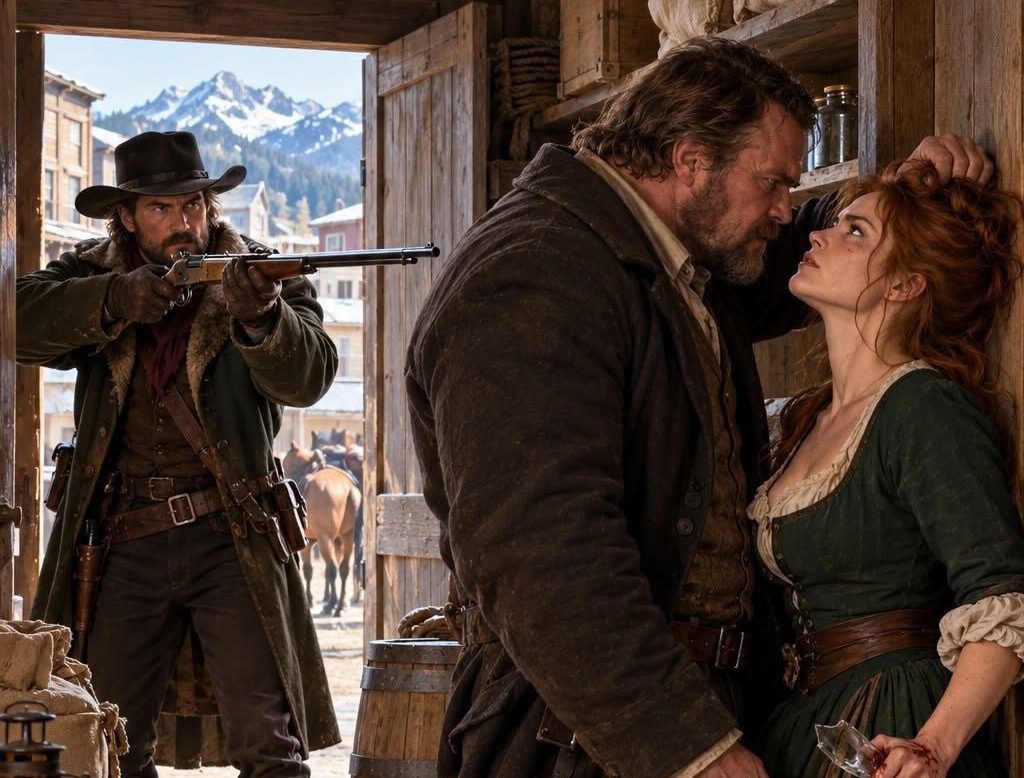
Aldous was still laughing when the metallic click came from the doorway.
It was a small sound.
Barely louder than a spoon striking the edge of a tin cup.
But Everett Voss had spent six years surviving in country where small sounds meant everything. The snap of a twig could mean a mountain lion. The sudden silence of birds could mean a stranger approaching. And the unmistakable click of a rifle being cocked meant that somebody’s life was about to change.
Aldous stopped laughing.
Everett stood in the storeroom doorway, his long rifle resting against his shoulder, its dark barrel pointed directly at the heavy man’s chest.
“Take your hand out of her hair.”
Aldous turned his head slowly.
“Who the devil are you?”
“Man buying salt.”
“This doesn’t concern you.”
“Then you shouldn’t have made so much noise.”
Aldous tightened his fist in Maren’s copper hair.
She winced but refused to cry out.
“You pull that trigger,” Aldous said, “and you’ll hang before sundown.”
Everett’s expression didn’t change.
“Maybe.”
The word hung in the cold storeroom.
“Let her go.”
Aldous studied the rifle, then the man holding it.
Something in Everett’s face made him reconsider whatever threat had been forming on his tongue.
He released Maren.
She stumbled sideways, catching herself against a stack of flour sacks. The broken glass remained clenched in her bleeding hand.
Everett didn’t look at her.
Not yet.
“Now step away from the lady.”
Aldous obeyed, though his face had turned a furious shade of red.
“You don’t know what you’re interfering with, mountain man. That woman owes me two hundred dollars.”
“Then take her to court.”
“I have a signed agreement.”
“Good. Show it to a judge.”
Aldous sneered.
“Her husband borrowed the money before he died. She inherited the obligation.”
Everett glanced at Maren.
Her dress was torn at the shoulder. There was a bruise darkening along her jaw, and blood dripped steadily from her right hand.
Yet she stood straight.
Proud.
Angry.
More angry than frightened.
Everett had seen that look before.
It belonged to people who had already lost nearly everything and were deciding whether the last thing they owned was worth dying for.
“What’s your name?” he asked.
“Maren Whitcomb.”
“Mrs. Whitcomb, do you owe this man money?”
“No.”
Aldous barked a laugh.
“She’s lying!”
Everett ignored him.
“Then why does he say you do?”
Maren swallowed.
“Because my husband isn’t alive to contradict him.”
For the first time, Everett saw something change behind her eyes.
Not fear.
Grief.
The kind that had settled too deep to show itself easily.
Aldous reached toward the paper sticking out of his coat pocket.
“Here! Here’s the agreement!”
Everett raised the rifle an inch.
“Slowly.”
Aldous pulled out a folded document and shook it triumphantly.
“Signed by Thomas Whitcomb himself. Two hundred dollars, payable upon demand.”
Maren stared at the paper.
Then she said something that made Everett turn toward her.
“Mr. Voss, before you decide whether to help me, would you do one thing?”
Everett frowned.
“What?”
“Ask him what happened to my husband’s body.”
The storeroom became utterly silent.
Even Aldous stopped breathing for a moment.
Everett looked from one face to the other.
“What happened to it?”
Maren’s voice remained steady.
“They told me Thomas drowned in the river last spring. They buried a closed coffin. They wouldn’t let me see him.”
Aldous recovered first.
“She’s a grieving woman. Her mind’s been disturbed since—”
“Ask him,” Maren interrupted, “why my husband’s wedding ring was found in his stable three days after the funeral.”
Everett’s rifle didn’t move.
But something behind his eyes went cold.
Aldous took one step backward.
“That ring was payment on the debt.”
Maren shook her head.
“Thomas never took it off. Not once in eleven years.”
Everett studied Aldous.
“Where’s the body?”
“Buried.”
“Where?”
“Church cemetery.”
“Who prepared it?”
Aldous hesitated.
“Undertaker.”
“Name?”
Silence.
Everett took one deliberate step forward.
“Name.”
“Silas Bream.”
Maren laughed once.
It was a terrible sound.
“Silas Bream left Colton’s Ferry two winters ago.”
Everett watched Aldous’s face.
There it was.
The flicker.
The tiny, involuntary movement that separated a practiced liar from a man suddenly confronted with a fact he hadn’t prepared for.
Everett lowered the rifle slightly.
“Mrs. Whitcomb, get your things.”
Aldous straightened.
“She’s not leaving.”
Everett looked at him.
“Then you’re going to have a difficult afternoon.”
***
The merchant behind the counter was named Jeremiah Beckett.
He had spent fifteen years selling flour, salt, coffee, and everything else the settlement needed.
He had also spent fifteen years learning which men could be challenged and which men should be allowed to do whatever they pleased.
Aldous Pike belonged to the second category.
His brother controlled the ferry crossing.
His cousin served as deputy sheriff.
And Aldous himself held the debts of nearly every struggling family within thirty miles.
People who crossed him tended to lose their property.
Occasionally, they disappeared.
Beckett had never asked questions.
Questions were expensive.
But when Everett marched Aldous out of the storeroom at rifle point, Beckett understood that his carefully arranged world was about to become very expensive indeed.
“You can’t do this in my establishment!” he protested.
Everett stopped.
“Then perhaps you should’ve done something before I arrived.”
Beckett opened his mouth.
Nothing came out.
Maren followed, holding a strip of clean canvas against her injured palm.
Aldous’s eyes moved toward the front window.
Outside, three men stood beside a wagon.
One wore a deputy’s badge.
Everett noticed them immediately.
“Friends of yours?” he asked.
Aldous smiled.
“Family.”
The deputy pushed through the door moments later.
He was a narrow-faced man with yellow teeth and a revolver hanging low on his hip.
“What’s going on here?”
Aldous pointed at Everett.
“Arrest him, Calvin. Threatened me with a rifle.”
Deputy Calvin Pike looked at the mountain trapper.
“Put that weapon down.”
Everett did not move.
“Your brother was assaulting this woman.”
Calvin glanced at Maren.
Then he shrugged.
“Debt collection.”
Everett’s jaw tightened.
“Is that what you call it?”
“That’s what the law calls it.”
“No,” Maren said quietly. “It isn’t.”
Calvin turned toward her.
“You’d best keep your mouth shut, widow.”
Everett stepped between them.
The deputy’s hand dropped toward his revolver.
Everett spoke softly.
“Don’t.”
Calvin froze.
There was something about the word.
Not its volume.
Not even its threat.
It was the certainty behind it.
The deputy had met plenty of dangerous men.
Most advertised their danger with loud voices, swaggering shoulders, and hands that never strayed far from their guns.
Everett Voss stood perfectly still.
And that frightened Calvin more.
“You’re making enemies,” the deputy warned.
Everett nodded.
“Seems so.”
“Big ones.”
“Then they’d better bring big coffins.”
Nobody laughed.
Maren stared at the mountain man.
For the first time since Thomas had disappeared, somebody had stood between her and the men who believed they owned her.
She didn’t know whether to feel grateful or terrified.
Because she understood something Everett did not.
Aldous Pike didn’t forgive humiliation.
And he had just been humiliated in front of witnesses.
***
They left the store together.
Everett carried his supplies in two canvas sacks, while Maren walked beside him with a small leather satchel pressed against her chest.
The entire street seemed to be watching.
Nobody spoke.
Nobody offered help.
At the hitching post, Everett began loading his pack mule.
“Where do you live?” he asked.
“About three miles east. Small cabin beyond Miller Creek.”
“Family?”
“None left nearby.”
“Neighbors?”
“Two farms. Both belong to men who owe Aldous money.”
Everett tightened a saddle strap.
“Then you shouldn’t go home tonight.”
Maren looked at him.
“And where exactly do you suggest I go?”
“There’s a church at the north end of town.”
“The minister owes Aldous forty dollars.”
“Boardinghouse?”
“Owned by his sister.”
Everett stopped working.
He looked down the muddy street.
At the buildings.
The watching faces.
The deputy still standing outside Beckett’s store.
Then he looked at Maren.
“How long has he been doing this?”
“Longer than I’ve been here.”
“And nobody stops him?”
“People have children, Mr. Voss. Farms. Businesses. Things they can lose.”
Everett understood.
He had once possessed those things himself.
A house.
A wife.
A little boy who liked to sit on his shoulders and pretend he could see all the way to heaven.
Then winter fever had come through the valley.
Within eleven days, everything that had made Everett’s life worth living was buried beneath frozen ground.
He had gone into the mountains because mountains didn’t ask him to remember.
And now this woman was looking at him as though he might be the only person capable of changing her fate.
He hated that look.
Because he knew what it demanded.
“Get on the horse,” he said.
Maren blinked.
“What?”
“My horse. You’re coming with me.”
“Where?”
“Somewhere they won’t follow easily.”
She glanced toward the distant mountains.
“Thorn Ridge?”
Everett nodded.
Maren studied him.
“Why?”
He didn’t answer immediately.
Finally, he said, “Because I’m tired of watching cowards mistake silence for permission.”
***
They were barely two miles outside Colton’s Ferry when the first shot rang out.
The bullet struck a pine tree inches above Everett’s shoulder.
His horse reared.
Maren cried out, grabbing the saddle horn.
Everett was already moving.
He seized the reins, dragged the horse toward a shallow ditch, and pushed Maren down behind a fallen log.
“Stay low!”
Another shot shattered bark overhead.
Everett dropped to one knee and scanned the ridge.
Three riders.
Maybe four.
Spread among the trees.
He saw the flash of a rifle barrel.
Then another.
Aldous had wasted no time.
“Can you shoot?” Everett asked.
Maren stared at him.
“My father taught me.”
He handed her a small revolver from his saddlebag.
“Six cartridges. Don’t waste them.”
She took the weapon.
Her bleeding hand trembled.
“How many men?”
“Enough.”
Everett fired.
One rider disappeared behind his horse.
A scream followed.
The others scattered.
Maren watched the mountain man work with terrifying precision.
He never fired blindly.
Never shouted.
Never exposed himself longer than necessary.
Each movement was economical, almost weary.
As though violence was a chore he despised but knew how to finish.
A bullet struck the log beside Maren.
She flinched.
Everett glanced at her.
“Look at me.”
She did.
“Breathe.”
She inhaled shakily.
“Now crawl toward those rocks. Keep your head down.”
“What about you?”
“I’ll follow.”
She hesitated.
Everett’s voice hardened.
“Move.”
Maren crawled.
Halfway across the ditch, she heard a horse approaching from behind.
She turned.
A rider was coming fast through the trees.
Deputy Calvin Pike.
His revolver was raised.
Everett was reloading.
There wasn’t time.
Maren lifted the little pistol.
Her father’s voice returned from twenty years earlier.
Don’t look at the gun, sweetheart.
Look where you want the bullet to go.
She fired.
The shot struck Calvin’s horse in the shoulder.
The animal stumbled, throwing the deputy into the dirt.
His revolver flew from his hand.
Everett spun around.
For one terrible second, he stared at Maren.
Then he shouted, “Run!”
They reached the rocks just as another volley tore through the clearing.
Everett fired twice more.
The remaining riders retreated.
But not before one of them shouted something that made Maren’s blood turn cold.
“Tell the widow her husband screamed for her!”
Everett heard it too.
He looked at Maren.
Her face had gone white.
“Thomas,” she whispered.
The rider vanished into the trees.
And suddenly the mystery of the empty coffin was no longer the worst possibility.
***
They reached Everett’s cabin after dark.
It stood beneath a granite cliff, surrounded by tall pines and protected from the northern wind by a wall of black stone.
Inside, the cabin was clean, spare, and almost painfully quiet.
A narrow bed stood against one wall.
There was a stone fireplace, a table, two chairs, and shelves filled with dried herbs, cartridges, and neatly stacked books.
Maren stood in the doorway.
“You live here alone?”
“Yes.”
“Always?”
Everett set down the supplies.
“Long enough.”
He built a fire, heated water, and brought out a small tin containing bandages and salve.
“Let me see your hand.”
Maren hesitated.
Then she sat.
Everett carefully unfolded the bloodstained canvas.
The cut was deep but clean.
He washed it with warm water while she gripped the edge of the table.
“You’ve done this before,” she said.
“More times than I’d like.”
“To yourself?”
“Mostly.”
His hands were large, rough, and scarred.
Yet he handled her injury with extraordinary gentleness.
Maren watched him work.
“Did you have a wife?”
His hands stopped.
Only for a second.
“Yes.”
“What happened?”
“Fever.”
“I’m sorry.”
Everett wrapped the bandage.
“Was a long time ago.”
Maren looked toward the fireplace.
“People say that as though time changes what happened.”
Everett tied the final knot.
“No,” he said. “It doesn’t.”
For several minutes, neither spoke.
Then Maren opened her leather satchel.
Inside were three objects.
A small Bible.
A folded photograph of a smiling man with dark hair.
And a brass key attached to a length of faded blue ribbon.
Everett studied the key.
“What’s that open?”
“I don’t know.”
“Where’d you get it?”
“Thomas left it inside the Bible.”
She turned to a page in the Book of Psalms.
Between the thin sheets was a handwritten note.
Everett leaned closer.
Maren read aloud.
“If anything happens to me, remember where the river bends twice.”
Everett frowned.
“That’s all?”
She nodded.
“I thought he meant our fishing place. But I searched there. Nothing.”
“Where does the river bend twice?”
“About six miles west of town. Near the abandoned silver mill.”
Everett went very still.
Maren noticed.
“What?”
He looked at the brass key again.
“That mill isn’t abandoned.”
She stared at him.
“What do you mean?”
“Two winters ago, I followed a wounded elk down from the ridge. Saw wagons moving through the old mill yard after midnight.”
“Miners?”
“No.”
“Then who?”
Everett looked into the fire.
“Men carrying crates marked as agricultural machinery.”
Maren waited.
He continued.
“Only the crates were too heavy for machinery that size. And every man guarding them carried a repeating rifle.”
Maren’s fingers tightened around the Bible.
“Thomas worked as a bookkeeper for the ferry company.”
Everett looked up.
“He kept accounts?”
“Every shipment. Every payment. Every wagon crossing.”
“And Aldous Pike owns half the ferry company.”
Maren nodded slowly.
The pieces began settling into place.
Thomas hadn’t borrowed two hundred dollars.
He had discovered something.
Something worth killing for.
***
At dawn, Everett found fresh tracks below the cabin.
Six horses.
Two wagons.
And the unmistakable marks of men carrying heavy equipment uphill.
He crouched beside the tracks.
Aldous wasn’t merely sending a few hired guns.
He was bringing a hunting party.
Everett returned to the cabin.
Maren was standing beside the fireplace, fully dressed.
She had already packed the Bible and brass key.
“They’re coming,” she said.
It wasn’t a question.
Everett nodded.
“How long?”
“Hour. Maybe less.”
She looked toward the window.
“Then we should leave.”
“No.”
“Everett—”
“They’ll follow us wherever we go.”
“Then what do we do?”
He opened a wooden chest beneath the bed.
Inside lay two revolvers, a shotgun, a coil of wire, and several small iron traps.
“We make them regret coming.”
Maren stared at the weapons.
“You’re planning to fight six men?”
“Could be eight.”
“That doesn’t improve matters.”
For the first time, Everett smiled.
It was a small, reluctant expression.
“No, ma’am. Suppose it doesn’t.”
He handed her the shotgun.
“Can you use this?”
She checked the chamber with practiced hands.
“My father raised four daughters and no sons. He didn’t see much reason to teach us differently.”
Everett nodded approvingly.
“Good man.”
“He was.”
They worked quickly.
Everett knew every trail, rock shelf, and narrow passage surrounding his cabin.
He placed warning lines across the lower approach, arranged fallen timber to block the easiest path, and positioned Maren behind a stone outcrop overlooking the clearing.
Then he returned to the cabin and waited.
The first riders appeared shortly after sunrise.
Aldous Pike rode at their center.
Beside him was Deputy Calvin, his arm wrapped in a dirty sling.
Six other men followed.
One carried a shotgun.
Another held a coil of rope.
Aldous dismounted.
“Voss!” he shouted.
Everett stepped onto the porch.
“Morning.”
Aldous smiled without humor.
“You’ve caused me considerable trouble.”
“Seems you’ve had a difficult week.”
“I want the woman.”
“No.”
“I’ll give you five hundred dollars to walk away.”
Everett leaned against the doorframe.
“Not interested.”
“A thousand.”
“No.”
Aldous’s smile disappeared.
“You mountain fools never understand how the world works.”
Everett looked at the men behind him.
“Seems to me you’ve brought eight men to collect two hundred dollars.”
Aldous stiffened.
Everett continued.
“That’s a poor investment unless the debt isn’t what you’re after.”
The silence that followed was revealing.
Then Aldous said, “Give me the key.”
Everett’s eyes narrowed.
There it was.
The truth.
Not the widow.
Not the money.
The key.
Everett smiled faintly.
“Now we’re getting somewhere.”
Aldous drew his revolver.
“Last chance.”
Everett stepped backward into the cabin.
“Same to you.”
The first shot shattered the doorframe.
Then the mountain erupted.
***
The battle lasted less than twelve minutes.
To Maren, it felt like an entire lifetime.
Gunfire echoed between the cliffs.
Horses screamed.
Men shouted warnings that were swallowed by the mountains.
Everett moved through the trees like a shadow, using the terrain he knew better than any map.
Two attackers found their approach blocked by fallen timber.
Another stumbled into a shallow trapping pit and surrendered after injuring his ankle.
Maren fired the shotgun when a man attempted to circle behind the cabin.
The blast struck the tree beside him, sending splinters across his face.
He dropped his weapon and fled.
But Aldous was smarter than the others.
He had no intention of fighting fairly.
While Everett held off the men near the clearing, Aldous climbed the narrow ridge behind the cabin.
He knew Maren would be somewhere above the house.
And he knew she was the only person who might possess the key.
Maren heard the footsteps too late.
A heavy hand seized her shoulder.
A revolver pressed against her temple.
“Drop it.”
She froze.
Aldous tore the shotgun from her hands.
“Thought you were clever, didn’t you?”
Maren’s heart hammered.
“Where’s Thomas?”
Aldous smiled.
“Still asking about your husband?”
“Tell me.”
“He should’ve kept his mouth shut.”
Her breath caught.
“Did you kill him?”
Aldous leaned closer.
“No.”
For one desperate moment, hope flashed through her.
Then he whispered, “But I know who did.”
He dragged her toward the edge of the ridge.
Below, Everett emerged from the trees.
Aldous shouted.
“Voss! Drop your rifle!”
Everett looked up.
Maren stood at the cliff’s edge, Aldous holding her by the throat.
The revolver was pressed beneath her jaw.
Everett stopped.
“Let her go.”
“Drop it!”
Everett slowly lowered the rifle.
“Don’t do this.”
Aldous laughed.
“Now you want to negotiate?”
Everett placed the rifle on the ground.
“Take me instead.”
Maren stared at him.
“No!”
Aldous’s eyes gleamed.
“How touching.”
He tightened his grip.
“Throw me the key, mountain man.”
Everett looked at Maren.
Something passed between them.
A glance.
A warning.
A decision.
Everett reached into his coat.
Aldous pressed the gun harder against Maren.
“Slowly!”
Everett withdrew the brass key.
He held it up.
“Here.”
Then he threw it.
Not toward Aldous.
Toward the cliff.
The key flashed in the morning sunlight before disappearing over the edge.
Aldous screamed.
“No!”
For one fatal instant, he released Maren and lunged toward the falling key.
Maren drove her elbow backward into his ribs.
Everett moved.
His revolver came free.
One shot cracked across the ridge.
Aldous stumbled.
The weapon fell from his hand.
He dropped to his knees, clutching his wounded shoulder.
Maren scrambled away.
Everett reached the ridge moments later.
Aldous was still alive.
Still conscious.
Still furious.
“You fool!” he gasped. “You have no idea what you’ve done!”
Everett stood over him.
“Then explain it.”
Aldous spat blood onto the rocks.
“You think this is about money?”
“No.”
“You think Thomas Whitcomb was some innocent bookkeeper?”
Maren stepped forward.
“Don’t you dare.”
Aldous looked at her with something almost like pity.
“Your husband found out what was being shipped through that mill.”
“What?”
Aldous laughed weakly.
“Army rifles. Stolen government rifles. Enough to arm five hundred men.”
Everett’s face hardened.
“Who was buying them?”
Aldous looked away.
Everett crouched.
“Who?”
Aldous whispered a name.
“Judge Horace Bell.”
Maren felt the world shift beneath her feet.
Judge Bell.
The man who had signed Thomas’s death certificate.
The man who had presided over the supposed debt claim.
The man who had told Maren to accept her husband’s passing and move forward.
Everett stood slowly.
Now he understood.
Aldous wasn’t the man at the top.
He was merely the man foolish enough to get caught.
***
They tied Aldous to a pine tree and disarmed the surviving attackers.
By noon, three men had fled, two were wounded, and the others had surrendered.
Everett’s cabin had suffered two broken windows and a bullet through the roof.
Maren had a bruised shoulder.
Everett had a shallow cut across his left arm.
But they were alive.
And they finally had a direction.
The old silver mill.
Everett retrieved the brass key from a narrow ledge below the cliff. He had known exactly where it would land.
Maren stared at him when he returned.
“You planned that?”
“More or less.”
“More or less?”
“Was hoping it wouldn’t bounce.”
Despite everything, she laughed.
The sound surprised them both.
It was the first genuine laugh Maren had made since Thomas disappeared.
Everett looked away quickly.
But she saw the faint smile he tried to hide.
They left Aldous and his men secured near the cabin with water and blankets, then rode toward the mill.
The journey took four hours.
Snow began falling as they descended into the western valley.
By late afternoon, the abandoned silver mill appeared through the trees.
Its roof sagged.
Its windows were boarded.
And the great wooden waterwheel stood motionless beside the river.
Maren dismounted.
“This is where Thomas used to bring me fishing.”
Everett studied the river.
It curved sharply around a granite outcrop, straightened briefly, then bent again beneath the mill.
Two bends.
Just as Thomas had written.
They searched the riverbank first.
Nothing.
Then the mill.
Rotten machinery.
Broken barrels.
Old mining tools.
But no hidden records.
No rifles.
No evidence.
As the light began to fade, Maren sank onto a wooden beam.
“We’re too late.”
Everett looked around the room.
“Maybe.”
“Everything’s gone.”
He walked toward the old waterwheel.
Something bothered him.
The wheel was dry.
The river still flowed.
And the channel feeding the wheel had been blocked with stones.
But the iron locking mechanism beside the wheel looked new.
Far too new.
Everett knelt beside it.
There was a small brass keyhole.
“Maren.”
She looked up.
He held out his hand.
“The key.”
Her heart began pounding.
She crossed the room and placed it in his palm.
Everett inserted the key.
It turned.
A hidden latch released beneath the floor.
They pulled aside two heavy planks.
Below lay a narrow stone staircase.
Cold air rose from the darkness.
Maren stared into the opening.
“Thomas,” she whispered.
Everett lit a lantern.
“Stay behind me.”
They descended.
***
The chamber beneath the mill was larger than either expected.
Wooden crates lined the walls.
Some had been opened.
Inside lay rifles wrapped in oilcloth.
Others contained ammunition, military uniforms, and stacks of government-issued equipment.
But the most important discovery stood at the far end of the room.
A wooden desk.
On it lay three ledgers.
Each filled with names, dates, shipment numbers, and payments.
Everett opened the first.
His expression darkened.
“Judge Bell wasn’t just buying weapons.”
Maren leaned over his shoulder.
“What?”
“He’s selling them.”
“To whom?”
Everett turned another page.
“Outlaw bands. Private militias. Anyone willing to pay.”
Maren opened the second ledger.
Her hands began trembling.
There, written in Thomas’s familiar handwriting, was a detailed account of the shipments.
Beside several entries, he had written the same warning.
ILLEGAL TRANSFER. REPORT TO FEDERAL MARSHAL.
Tears filled Maren’s eyes.
“He knew.”
Everett nodded.
“He was collecting proof.”
She turned another page.
A folded letter slipped from between the sheets.
Her name was written across the front.
Maren.
Her knees nearly gave way.
Everett caught her elbow.
“Sit down.”
She shook her head.
“No.”
With trembling fingers, she opened the letter.
My dearest Maren,
If you are reading this, I have failed to come home.
I need you to know that I never borrowed money from Aldous Pike. The document he carries is a forgery.
I discovered what Judge Bell and his partners were doing, and I made copies of their accounts.
They know I intend to deliver them to the federal authorities.
If they come for me, I will try to escape.
But if I cannot, please believe one thing.
Everything I have done was to protect you.
I love you more than all the rivers and mountains in this world.
Your Thomas.
Maren pressed the letter against her chest.
For eleven years, Thomas had been her husband.
Her friend.
The man who brought wildflowers home in his hat and sang badly while chopping firewood.
She had spent six months wondering whether he had betrayed her.
Whether he had secretly borrowed money.
Whether he had died trying to escape debts he was ashamed to confess.
Now she knew.
He had been trying to expose a crime.
And someone had silenced him.
Everett stood quietly beside her.
He did not tell her everything would be all right.
He did not offer empty promises.
He simply remained there while she cried.
After a long time, Maren wiped her face.
“We need to take these books to the authorities.”
Everett nodded.
“Federal marshal’s office is in Redstone. Two days south.”
“Then we leave tonight.”
A voice answered from the darkness behind them.
“I’m afraid you won’t.”
***
Judge Horace Bell stood at the foot of the staircase.
He wore a fine black coat and carried a polished revolver.
Behind him were four armed men.
One held a lantern.
Another carried a coil of rope.
Bell smiled sadly.
“Mrs. Whitcomb. I had hoped we might avoid this.”
Maren stepped backward.
Everett moved in front of her.
Bell’s gaze shifted to him.
“And you must be the mountain man causing so much trouble.”
Everett said nothing.
Bell sighed.
“Your intervention has been most inconvenient.”
“Seems to be a habit of mine.”
Bell glanced at the open ledgers.
“Those books belong to me.”
“Funny,” Everett said. “Your name’s on them, but I don’t see your signature on the rifles.”
Bell’s smile vanished.
“Put your weapons on the floor.”
Everett looked at the four gunmen.
Then slowly removed his revolver.
He placed it on the stone floor.
Maren followed.
Bell nodded.
“Very sensible.”
He stepped toward the desk.
“Mrs. Whitcomb, I genuinely regret what happened to your husband.”
Maren’s voice shook.
“Where is he?”
Bell hesitated.
Everett noticed.
“Answer her.”
Bell looked at Maren.
“Thomas was a stubborn man.”
“Where is he?”
“He refused to cooperate.”
Maren stepped forward.
“WHERE IS MY HUSBAND?”
Bell’s expression hardened.
“Your husband is buried beneath the old ferry landing.”
The words struck her harder than any blow.
For a moment, she couldn’t breathe.
The room tilted.
Everett caught her before she fell.
Bell continued calmly.
“He should have accepted the money I offered him.”
Maren stared at the judge.
“You killed him.”
Bell adjusted his cuffs.
“I ordered his detention. What happened afterward was unfortunate.”
Everett’s voice was dangerously quiet.
“Who did it?”
Bell smiled thinly.
“Does it matter?”
“To her, yes.”
Bell looked at Maren.
“Calvin Pike carried out the sentence.”
Maren closed her eyes.
The deputy.
The man who had attended Thomas’s funeral.
The man who had stood beside her grave marker and told her to be strong.
The man who had watched her cry.
Everett felt something inside himself go very still.
He had spent six years believing the world was better without him in it.
Six years avoiding towns, neighbors, friendships, and the obligations that came with caring.
But now he looked at Maren and understood that staying apart from the world hadn’t made him peaceful.
It had merely made him absent.
And absence was exactly what men like Bell counted on.
Bell raised his revolver.
“Now, if you’ll both step toward the wall—”
A gunshot thundered through the chamber.
The lantern exploded.
Darkness swallowed everything.
***
The shot had not come from Everett.
Nor from Maren.
It came from the staircase.
A man’s voice shouted.
“Federal marshal! Drop your weapons!”
Bell spun.
Another shot cracked.
One of his gunmen fell.
The others scattered behind the crates.
Everett seized Maren and pulled her beneath the desk.
“Stay down!”
Gunfire erupted.
Splinters flew.
Someone screamed.
A lantern rolled across the floor, spilling burning oil.
Flames began crawling toward the stacked crates.
Everett saw the danger immediately.
Gunpowder.
Ammunition.
Enough to destroy the entire mill.
He grabbed Maren’s arm.
“We have to move!”
She looked toward the ledgers.
“The books!”
Everett seized two.
Maren grabbed the third and Thomas’s letter.
They crawled toward the staircase as bullets struck the stone walls.
Through the smoke, Everett saw Judge Bell running toward a narrow passage at the back of the chamber.
The judge had prepared an escape route.
Everett raised his recovered revolver.
But Maren caught his wrist.
“No.”
He looked at her.
“He’s getting away.”
“Then let the marshal catch him.”
Everett hesitated.
Maren’s eyes filled with tears.
“Thomas wanted the truth brought into daylight. Not another body buried in the dark.”
Everett lowered the gun.
They climbed the stairs.
Behind them, a tremendous explosion shook the mill.
The floor collapsed.
A column of fire burst through the roof.
Everett threw himself over Maren as burning timber rained around them.
For several seconds, there was only heat, smoke, and roaring destruction.
Then cold air struck his face.
They were outside.
Alive.
Maren coughed violently.
Everett helped her toward the riverbank.
A tall man wearing a federal marshal’s badge emerged from the smoke.
His coat was torn.
Blood ran down his forehead.
But his rifle remained steady.
“Everett Voss?”
Everett stared at him.
“Who wants to know?”
“Marshal Nathaniel Reed.”
Everett frowned.
“How’d you find us?”
Reed glanced at Maren.
“Your husband sent a letter to my office six months ago, Mrs. Whitcomb. It arrived after he disappeared.”
Maren froze.
“You knew about Thomas?”
“We knew he had evidence. We didn’t know where he’d hidden it.”
Reed looked toward the burning mill.
“I’ve been investigating Judge Bell for months.”
“Then why didn’t you come sooner?” Maren demanded.
The marshal’s face tightened.
“Because we had suspicions, not proof. And because someone in my office was passing information to Bell.”
Everett held up the ledgers.
“Would these help?”
Reed stared at them.
Then slowly smiled.
“More than you know.”
***
Judge Bell did not escape.
His hidden passage led to a narrow opening behind the mill.
Unfortunately for him, Marshal Reed had brought six deputies who were waiting outside.
Bell emerged from the tunnel with soot on his face and a revolver in his hand.
He was arrested before he could reach his horse.
Two of his gunmen surrendered.
Another was captured near the river.
The surviving weapons were seized.
And by midnight, the conspiracy that had controlled Colton’s Ferry for years had begun to collapse.
But the hardest part was still ahead.
Thomas Whitcomb had to be brought home.
Three days later, federal deputies opened the ground beneath the old ferry landing.
They found human remains wrapped in a canvas tarp.
The wedding band was missing.
But a small silver watch remained inside the coat pocket.
On the back were engraved three words.
Forever, my Maren.
She had given Thomas the watch on their fifth wedding anniversary.
There could be no doubt.
It was him.
Maren stood beside the river while the marshal explained what had happened.
Thomas had refused to surrender the ledgers.
Calvin Pike had killed him on Bell’s orders.
Aldous had then forged the debt agreement to force Maren out of her home and gain access to Thomas’s belongings.
They believed she possessed the missing records.
They were right.
But they had underestimated her.
And they had never imagined that a mountain trapper buying salt would become their undoing.
***
The trial took place the following spring.
By then, snow had melted from the lower valleys, and wildflowers had begun appearing along the riverbanks.
Judge Horace Bell was convicted of conspiracy, trafficking stolen government property, and ordering Thomas Whitcomb’s murder.
Calvin Pike was convicted for carrying out the killing.
Aldous Pike faced charges for forgery, assault, extortion, and participation in the conspiracy.
Several other men received prison sentences.
Families who had lost farms through fraudulent debts began reclaiming their property.
Merchants who had once bowed their heads in silence finally testified.
And Jeremiah Beckett, the storekeeper who had pretended not to hear Maren’s struggle, stood before the court and admitted that fear had made him a coward.
The judge presiding over the case asked him one question.
“Why didn’t you intervene?”
Beckett lowered his head.
“Because I thought somebody else would.”
The courtroom fell silent.
Everett sat in the back row.
He had come down from Thorn Ridge only because Maren had asked him to.
He wore a clean shirt, a dark coat, and boots that had been polished so awkwardly they still showed streaks of dried mud.
Maren sat near the front.
Her copper hair was pinned neatly beneath a blue bonnet.
The bruises were gone.
The cut on her hand had healed into a thin pale scar.
But Everett knew that healing wasn’t the same as forgetting.
When the verdict was announced, Maren did not smile.
She simply closed her eyes.
Then she whispered, “It’s finished, Thomas.”
***
After the trial, Everett prepared to return to Thorn Ridge.
He had purchased his supplies.
Forty pounds of salt.
Twenty pounds of flour.
A tin of lard.
Enough powder to last through another winter.
Exactly what he had intended to buy months earlier.
Only now, standing beside his horse outside Beckett’s Dry Goods, he found himself reluctant to leave.
Maren approached carrying a small paper parcel.
“You’re really going?”
Everett tightened a saddle strap.
“Traps won’t check themselves.”
She nodded.
“Of course.”
An awkward silence followed.
He looked at the parcel.
“What’s that?”
“Bread. Fresh this morning.”
“You didn’t have to.”
“I know.”
He accepted it.
Their fingers touched.
Neither pulled away immediately.
Maren looked toward the mountains.
“Will you come back?”
Everett swallowed.
“Suppose I’ll need supplies again.”
“That’s not what I asked.”
He looked at her.
For six years, he had avoided questions like that.
Questions that required something more difficult than courage.
Honesty.
“I don’t know,” he admitted.
Maren nodded slowly.
“Then I won’t ask you to promise.”
She turned to leave.
Everett watched her walk away.
And suddenly he remembered something his wife had said years ago, before the fever took her.
You can survive alone, Everett.
But surviving isn’t the same as living.
He closed his eyes.
For six years, he had mistaken solitude for safety.
He had believed that loving nobody meant losing nobody.
But standing in the cold October sunlight, watching Maren walk away, he understood the terrible flaw in that reasoning.
A man could lose his life without ever dying.
He could lose it one empty morning at a time.
One silent winter.
One meal eaten alone.
One conversation never begun.
“Maren.”
She stopped.
Turned.
Everett removed his hat.
“Would you consider something?”
She raised an eyebrow.
“What?”
He glanced toward the mountains.
“My cabin has a good roof. Mostly.”
“Mostly?”
“Needs fixing.”
“And?”
“Got plenty of firewood. Good water. Enough land for a garden.”
Maren folded her arms.
“Mr. Voss, are you offering me employment?”
Everett looked genuinely alarmed.
“No.”
“Then what are you offering?”
He took a breath.
“I don’t rightly know how to say it.”
She waited.
He looked at her.
“There’s room for another chair.”
Maren’s expression softened.
“Everett.”
“And I reckon,” he continued awkwardly, “a house might be a better place with someone in it who knows how to laugh.”
For a long moment, she said nothing.
Then she stepped closer.
“Are you asking me to live with you?”
He nodded.
“If you’d like.”
Maren smiled sadly.
“Thomas and I built a home together. I can’t simply walk away from everything we shared.”
Everett lowered his eyes.
“Understand.”
“But,” she continued, “there’s a small cabin beside my property. It needs a roof, a stove, and someone who knows how to repair a fence.”
Everett looked up.
Maren smiled.
“And I happen to know a man who’s very good with his hands.”
For the first time in years, Everett laughed.
A real laugh.
Deep and surprised.
“That so?”
“That so.”
He looked toward his horse.
Then toward the mountains.
Then back at Maren.
“Suppose my traps could wait a while.”
***
By summer, Everett had repaired the cabin beside Maren’s property.
He replaced the roof.
Built a new fence.
Repaired the well.
And planted a garden that produced more potatoes than either of them knew what to do with.
Maren reopened her late husband’s small bookkeeping business.
She helped families review their debts, challenged fraudulent contracts, and made certain that nobody in Colton’s Ferry could ever again use a forged signature to steal a widow’s freedom.
Everett helped where he could.
Mostly by repairing things.
Sometimes by sitting quietly beside her while she worked.
And occasionally by standing in the doorway when a particularly unpleasant visitor arrived.
He rarely needed to speak.
His reputation had become useful.
The town changed slowly.
People always did.
But it changed.
And Everett changed with it.
He began attending church again.
He learned the names of his neighbors.
He helped repair the schoolhouse after a spring storm.
He even allowed the blacksmith’s children to visit his workshop, though he insisted they stop calling him “the mountain ghost.”
Maren laughed every time they did.
One evening in September, nearly a year after Everett had first entered Beckett’s Dry Goods, they sat together on her porch.
The sun was sinking behind the mountains.
Crickets sang in the grass.
Maren held Thomas’s silver watch in her palm.
Everett noticed.
“Thinking about him?”
She nodded.
“Every day.”
Everett looked toward the mountains.
“Me too.”
She turned toward him.
“Your wife?”
“And my boy.”
Maren reached across the space between their chairs.
Her hand found his.
For a while, neither spoke.
Then Maren said, “I used to think loving someone again would mean forgetting Thomas.”
Everett looked at her.
“And now?”
She smiled faintly.
“Now I think maybe love doesn’t work that way.”
He waited.
“Maybe the heart doesn’t have to empty one room before it makes space for another.”
Everett looked down at their joined hands.
His voice was rough.
“That’s a beautiful thought.”
“It’s taken me a long time to believe it.”
He nodded.
“Me too.”
Maren leaned her head against his shoulder.
And for the first time in six years, Everett Voss did not feel the need to be anywhere else.
***
They married the following spring.
It was a small ceremony.
The minister stood beneath an apple tree in full blossom.
Maren wore a simple blue dress.
Everett wore the same dark coat he had worn to the trial, though this time his boots were properly polished.
There were no expensive decorations.
No grand speeches.
Just neighbors, friends, a few children chasing one another through the grass, and two people who had learned that happiness could return even after unimaginable sorrow.
When the minister asked Everett whether he would take Maren as his wife, the mountain trapper answered before the question was finished.
“I will.”
Everyone laughed.
Maren squeezed his hand.
“Impatient, are we?”
Everett smiled.
“Been waiting long enough.”
Then it was Maren’s turn.
She looked into his weathered face.
At the scar near his jaw.
At the gray beginning to appear in his beard.
At the man who had entered a storeroom looking for salt and had somehow changed the course of her life.
“I will,” she whispered.
And when Everett kissed her, the people of Colton’s Ferry cheered.
Not because they had witnessed a grand romance.
But because they had witnessed something rarer.
Two broken hearts choosing to trust the world again.
***
Years later, when children asked how Everett and Maren had met, the story became something of a local legend.
Some said Everett had fought twenty armed men.
Others claimed he had ridden into town during a blizzard and rescued Maren from a burning building.
One particularly imaginative boy insisted Everett had shot the gun from Aldous Pike’s hand while standing a hundred yards away.
Everett never corrected the stories.
He simply shook his head and returned to his work.
But Maren always told the truth.
“He came into town to buy salt,” she would say.
The children would laugh.
“Salt?”
“Forty pounds of it.”
“And then what happened?”
Maren would look toward Everett, who usually pretended not to be listening.
“Then he heard someone who needed help.”
“Was he scared?”
Maren smiled.
“Probably.”
Everett would grunt.
“I wasn’t scared.”
She would raise an eyebrow.
“Not even a little?”
He would glance at her.
“Maybe a little.”
The children would giggle.
“And what did he do?”
Maren would grow quiet.
“He opened a door.”
That was always how she ended the story.
Not with the gunfight.
Not with the stolen rifles.
Not with the trial or the wedding.
But with the door.
Because that was the moment everything changed.
A man who wanted nothing from the world had heard a woman trying not to scream.
He could have turned away.
He could have bought his salt.
He could have returned to the mountains and spent the rest of his life never knowing her name.
Instead, he opened a door.
And the life waiting on the other side became his own.
***
One cold October morning, many years after their wedding, Everett stood outside the old storeroom behind Beckett’s Dry Goods.
The building had changed hands twice.
The shelves were new.
The floorboards had been replaced.
And the room where Aldous Pike had once pinned Maren against the wall now held sacks of grain and barrels of molasses.
Maren stood beside him.
Her copper hair had faded to silver.
Everett’s shoulders had grown stooped.
But when he took her hand, his grip was as steady as ever.
“Funny thing,” he murmured.
“What?”
“I nearly didn’t come in that day.”
Maren looked at him.
“Why?”
“Was thinking the store looked crowded. Thought I might wait until afternoon.”
She smiled.
“But you didn’t.”
“No.”
He looked around the little room.
“Then I heard you.”
Maren squeezed his hand.
“And I heard your rifle.”
Everett chuckled.
“Wasn’t much of an introduction.”
“It was enough.”
They stood together in silence.
Then Maren turned toward him.
“Everett?”
“Yes, love?”
“Do you remember what I asked you that day?”
He nodded.
“About Thomas.”
“Yes.”
She looked toward the sunlight pouring through the open doorway.
“You gave me the truth when everyone else wanted me to stay quiet.”
Everett shook his head.
“You found the truth. I just helped carry it.”
Maren smiled.
“That’s what you always say.”
“Because it’s true.”
She rested her hand against his chest.
“And do you know what I learned from all of it?”
Everett waited.
“That a person can be frightened and still be brave. That grief can live beside happiness. And that sometimes the smallest choice changes everything.”
Everett kissed her forehead.
Outside, the town bell rang noon.
Wagons rattled along the street.
Children shouted.
Life continued.
And Everett, who had once believed the world contained nothing worth returning to, stood beside the woman he loved and felt grateful for every ordinary sound.
***
That evening, they returned home.
The same little house stood beneath the apple trees.
The garden had been harvested.
Smoke rose from the chimney.
Inside, two chairs waited beside the fireplace.
On the mantel stood two photographs.
One of Thomas Whitcomb.
One of Everett’s first wife and little boy.
Neither had ever been hidden.
Neither had ever been forgotten.
Beside them stood a third photograph.
Everett and Maren on their wedding day.
Three pictures.
Three chapters of love.
And no need to erase one to honor another.
Maren placed fresh bread on the table.
Everett poured two cups of coffee.
Outside, the first snow began falling over the valley.
He looked toward the mountains.
For a moment, he remembered the old cabin on Thorn Ridge.
The long winters.
The silence.
The loneliness he had mistaken for peace.
Then Maren called from the kitchen.
“Everett, are you coming?”
He turned.
The fire crackled.
The bread smelled warm.
His wife was waiting.
And for the first time in his life, the mountains no longer felt like the only place where he belonged.
“Coming, love.”
He stepped inside.
And closed the door against the cold.
THE END.
Sometimes the greatest act of courage isn’t pulling a trigger or standing against powerful men.
Sometimes it’s refusing to walk away when someone needs you.
And sometimes a man who believes he has nothing left to live for discovers that the rest of his life is waiting behind a door he almost didn’t open.