THE FATHER WHO PAID QUARTERS TO RUN AN EMPTY DRYER FOR HIS DAUGHTER
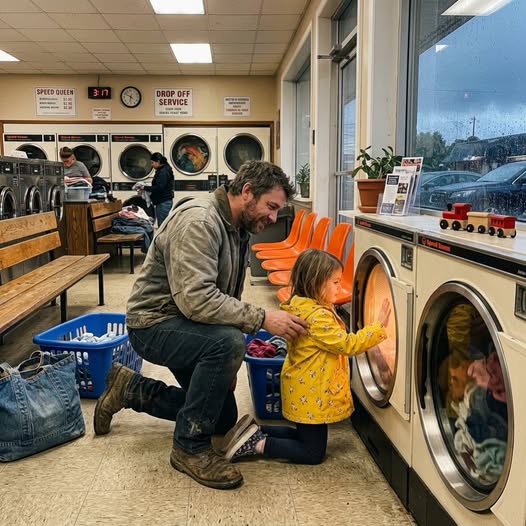
**PART 1: **
The man at the laundromat asked if the dryer could keep running even though his clothes were already dry.
I was wiping lint out of machine number twelve at Suds & Fold on the east side of Des Moines when he came to the counter with a handful of quarters and a look on his face like he was asking for something illegal.
“Can I get change for these?” he asked.
His clothes were clean. I knew because I had watched him fold them thirty minutes earlier.
Two pairs of jeans. Three work shirts with a plumbing company logo. White socks. One faded Iowa Hawkeyes sweatshirt with a paint stain on the sleeve.
All of it was already stacked neatly in a blue plastic basket by dryer seven.
But he kept feeding quarters into that dryer.
Every ten minutes, another quarter.
The drum kept turning.
Empty.
At first, I thought he had forgotten something inside. People do that all the time. Baby socks. Washcloths. One time, a woman left a whole phone in a dryer and blamed the dryer for being “too aggressive.”
But this man knew the dryer was empty.
He stood in front of it with both hands in his jacket pockets, watching it spin like there was something in there worth waiting for.
He was maybe forty-five. Work boots, tired eyes, beard coming in uneven. His name patch said RAY.
I gave him four quarters.
He thanked me, walked back, and dropped one into dryer seven.
The machine rumbled to life again.
Across the room, a college kid looked up from his laptop. A mother sorting toddler pajamas glanced over and then away. Rain tapped against the front windows, and the neon OPEN sign buzzed above the vending machine.
After the third empty cycle, I finally walked over.
“Sir,” I said gently, “that dryer’s empty.”
He nodded.
“I know.”
I waited.
He kept looking through the round glass door.
The orange light inside made his face look older than it was.
“My daughter has court at four,” he said.
I didn’t understand.
He gave a small embarrassed laugh, like he wished he hadn’t started talking.
“She’s six. Her foster mom is bringing her. I get one hour.”
He swallowed.
“I didn’t want to sit in the parking lot.”
I looked at the dryer.
Then at the basket of folded clothes.
Then back at him.
“She likes the dryer?”
He nodded, and for the first time, a real smile almost happened.
“When she was little, she wouldn’t sleep unless the dryer was running. My wife used to say we were raising the most expensive baby in Iowa because we had to dry towels every night whether they were wet or not.”
His fingers curled inside his pockets.
“After my wife passed, I’d bring Lily here. I was working double shifts, no washer at the apartment. She’d sit right there.”
He pointed to the orange plastic chair beside dryer seven.
“She’d put her hand on the door and say it sounded like a train.”
The dryer thumped softly.
“Last time I saw her before the state stepped in, we were here.”
He said it plain.
No drama.
That somehow made it harder.
“I got behind,” he said. “Bills. Rent. Everything. Then I started drinking too much. I’m not proud of it.”
The mother sorting pajamas had stopped pretending not to listen.
Ray looked down.
“I’m ninety-three days sober today. Got a room. Got steady work again. Got this visit. I just thought, if she remembers this sound, maybe she won’t be scared of me.”
I felt my throat tighten.
The dryer buzzed.
Ray flinched like a door had slammed shut.
He pulled another quarter from his palm.
I reached out before he could put it in.
“Don’t waste your money.”
His face closed.
“I’m not asking for—”
“I know,” I said. “I’m saying dryer seven sticks sometimes.”
It did not.
I walked behind the counter, took the little OUT OF ORDER sign from the drawer, and placed it on the top of the dryer.
Then I turned the machine on with the service key.
Thirty minutes.
No charge.
Ray stared at me.
“That allowed?”
“Nope.”
He gave one short laugh and then pressed the heel of his hand against his eye.
For half an hour, he stood beside dryer seven while it spun empty.
At 3:50, a silver minivan pulled up outside.
Ray saw it and went still.
A woman got out first. Then a little girl in a yellow raincoat stepped onto the sidewalk, clutching a stuffed rabbit by one ear.
She was small. Dark hair in two uneven braids. Pink sneakers lighting up with every step.
Ray took one breath.
Then another.
He wiped his hands on his jeans.
The foster mother came in carefully, the way people do when they are carrying someone else’s child through someone else’s pain.
“Hi, Ray,” she said.
“Hi, Ms. Denise.”
The little girl hid behind the woman’s coat.
Ray crouched down, not too close.
“Hi, Lilybug.”
The girl looked at him.
For a second, I thought she might cry.
Then dryer seven gave a soft, familiar thump.
Her eyes moved toward it.
The drum turned, orange light glowing behind the glass.
Lily stepped out from behind the coat.
“Train,” she whispered.
Ray covered his mouth.
She walked to the dryer and put one hand on the warm door.
Then she looked back at him.
“You remembered?”
He nodded.
“I remembered.”
That was when she ran to him.
Not all the way at first.
Just three quick steps, then a stop, then two more, then she was in his arms with her yellow raincoat bunched under his chin and her light-up sneakers blinking against his work boots.
Ray held her like a man trying not to hold too tight.
“I’m sorry,” he whispered.
“I know,” she said, because children hear more than we think and understand less than we fear.
**PART 2: THE WARM TRAIN THAT HELPED A FAMILY FIND THEIR WAY HOME**
They sat in the orange chairs beside dryer seven for the whole visit.
He showed her the sobriety chip from his pocket. Plain silver. Ninety days. She asked if it was treasure. He said yes.
She told him about kindergarten, about a boy named Mateo who ate glue, about how Ms. Denise had a cat that hated everyone except her.
Every few minutes, the dryer thumped.
Every few minutes, Lily smiled at it.
When the machine finally stopped, she looked worried.
Ray looked at me.
I looked at the service key in my hand.
Then I started it again.
No charge.
At 4:58, Ms. Denise stood.
“Time, sweetheart.”
Lily’s face folded.
Ray’s did too, but he forced his into something brave.
“I’ll see you next week,” he said.
“You promise?”
“I promise.”
She looked at the dryer.
“Will the train be here?”
Ray glanced at me.
I said, “Dryer seven isn’t going anywhere.”
Lily nodded like that settled the whole world.
After they left, Ray stood by the window until the minivan disappeared.
Then he walked to the counter and placed all his remaining quarters in the tip jar.
“Don’t,” I said.
He shook his head.
“For the train.”
He picked up his blue basket of folded clothes and went out into the rain.
For months after that, Ray came every Thursday at 3:30.
Sometimes Lily came. Sometimes court got delayed. Sometimes visits changed. Sometimes she was sick. But he came anyway.
He washed the same small load of clothes and sat beside dryer seven like a man practicing how to be dependable in public.
One day, he brought a little wooden train from the dollar shelf at Goodwill and set it on the windowsill above the dryer.
Then a month later, Lily added a sticker of a rainbow.
Then Ms. Denise added a pack of crayons for other kids.
Before long, the corner by dryer seven had two children’s books, three mismatched toy trains, and a hand-lettered sign Lily made in purple marker.
THE WARM TRAIN.
Nobody used that dryer without asking.
People in the laundromat somehow understood.
Two years later, Ray came in wearing a clean button-down shirt and shoes that had been polished badly but with effort.
Lily came in beside him holding a backpack.
No Ms. Denise.
Ray walked to the counter.
“Court signed this morning,” he said.
I looked at Lily.
She grinned.
“I live with Dad now.”
Then she ran to dryer seven and touched the glass like she was greeting an old friend.
Ray stood there with his hand on the counter, blinking hard.
“I kept thinking I had to prove I was a different man,” he said. “But maybe I just had to keep showing up as the same one every week.”
I nodded because sometimes people say the whole sermon themselves.
Before they left, Lily taped one more note to the wall above dryer seven.
It said:
THANK YOU FOR KEEPING THE TRAIN RUNNING.
I still have that note.
The ink is faded now. The tape has yellowed. Dryer seven has been repaired twice and still thumps like it has a secret.
But every Thursday around 3:30, I find myself looking at the door.
Because sometimes a laundromat is not just a laundromat.
Sometimes a dryer is not just a dryer.
And sometimes the sound that helps a child trust again is just an empty machine, spinning warm in the corner, because one father finally learned how to stay.