Aldrin’s Second Chance to Stand: The Boy Who Learned to Walk Without Pain
For most children, standing up is an ordinary part of everyday life. For Aldrin, an 11-year-old boy from the Philippines, simply standing could bring significant pain.
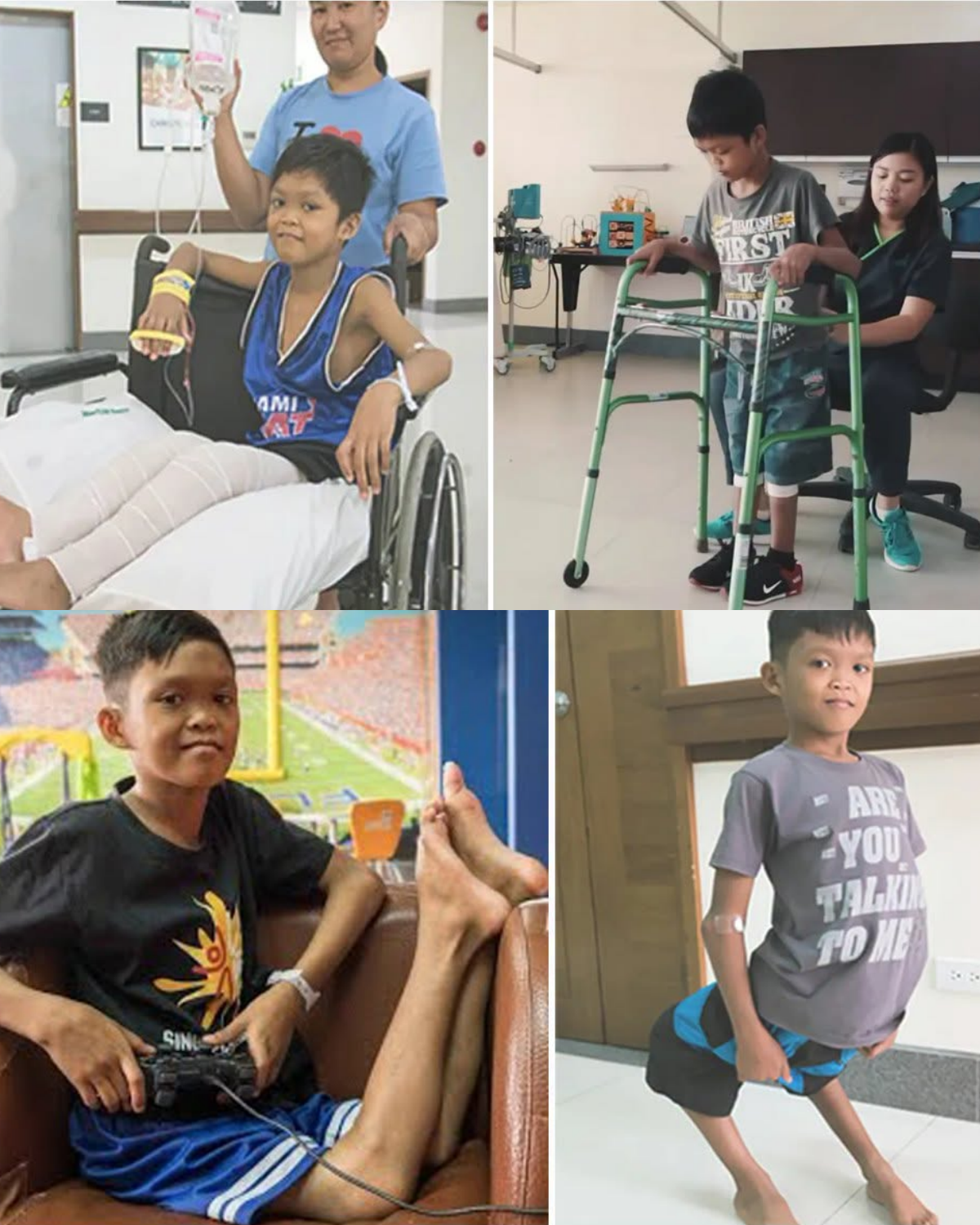
Born with congenital knee dislocation, Aldrin spent much of his childhood with his knees bent in the wrong direction. The condition made walking long distances extremely difficult and left him unable to stand comfortably for extended periods. His unusual gait also exposed him to bullying at school, adding an emotional burden to an already challenging physical condition.
His story changed when he arrived at Tebow CURE Hospital in Davao City, where a team of orthopedic specialists took on the difficult task of correcting a deformity that had been present for 11 years.
Knees That Bent “Like a Flamingo”
Aldrin’s condition was described by Dr. Tim Mead, who was medical director of CURE at the time and one of the surgeons involved in his treatment, as a knee deformity in which the knees bent backward “like a flamingo.” Mead was reportedly astonished that Aldrin had been able to move around at all with such severe deformity.
Congenital knee dislocation is a rare condition in which the knee joint is abnormally positioned from birth. Treatment can be more challenging when the deformity remains untreated for many years because bones, tendons, muscles and other soft tissues adapt to the abnormal position.
According to contemporary reports, doctors noted that correcting the problem earlier in childhood could have required less extensive surgery. By the time Aldrin reached adolescence, however, the procedure was considerably more complicated.
A Four-Hour Operation
Aldrin eventually underwent a complex corrective operation at Tebow CURE Hospital.
A team of three surgeons spent approximately four hours realigning his joints, tendons and femur bones. Once the correction was completed, both legs were placed in casts to protect the repaired soft tissues and tendons while they healed.
The operation was only the beginning of Aldrin’s recovery.
After years of adapting to an abnormal way of standing and walking, his body had to learn a completely different alignment. Physical therapy became an essential part of the process. He initially practiced standing with his newly straightened legs before progressing to walking exercises with braces and a walker.
For a child who had spent 11 years living with his knees in an abnormal position, even learning how to stand correctly again represented a major milestone.
More Than a Physical Transformation
Aldrin’s condition affected more than his mobility.
Reports from the time said that he experienced pain simply from standing and could not walk long distances. His appearance also made him a target for teasing and bullying by other children.
This aspect of his story is important because orthopedic conditions in childhood can affect confidence, education, social relationships and a child’s willingness to participate in ordinary activities.
After surgery and rehabilitation, the goal was not simply to straighten Aldrin’s legs. It was to give him greater freedom—to stand, walk, attend school and imagine a future without his physical condition constantly limiting him.
In a later account shared by Tim Tebow, Aldrin said that after treatment he could do things without his condition getting in the way and hoped to continue his studies without fear of bullying or discrimination. He also expressed an interest in eventually working in a computer-related field so that he could support his family.
The Hospital Behind His Treatment
Aldrin’s surgery took place at Tebow CURE Hospital, a pediatric surgical center in Davao City established through a partnership involving CURE International and the Tim Tebow Foundation.
The hospital opened its doors in 2014 and specializes in pediatric orthopedic and reconstructive surgery. It provides charitable treatment for children with treatable disabilities, including conditions such as bowed legs, clubfoot, cleft lip and palate, and other orthopedic deformities.
CURE describes the hospital as providing care that extends beyond the operating room. Children may receive diagnostic services, surgery, post-operative monitoring, physical therapy and assistive devices as part of their treatment journey.
The hospital was created in the Philippines partly because of Tim Tebow’s longstanding connection to the country. Tebow was born in the Philippines while his parents were serving as missionaries there, and the project became one of the major initiatives of the Tim Tebow Foundation.
From Surgery to Independence
A successful operation does not immediately restore normal movement. After a major orthopedic correction, muscles and soft tissues need time to heal, while the patient must gradually develop new movement patterns.
For Aldrin, rehabilitation therefore became a second test of determination.
Step by step, he practiced using his newly aligned legs. Braces and a walker provided support while his strength and coordination improved. The process required patience, repetition and encouragement.
Later reports offered an even more remarkable update: Tim Tebow said that CURE partners had visited Aldrin in his village and found him standing straight and walking without braces, something the medical team had not initially expected to be possible.
That transformation illustrates why rehabilitation is such an important part of pediatric orthopedic care. Surgery can correct anatomy, but children must then learn how to use their bodies in a new way.
A New Way of Looking at the Future
Aldrin entered the hospital with a body that had adapted to an abnormal position for most of his life.
He left with something far more significant than straighter legs.
He had the opportunity to experience movement differently—to stand without the same limitations, to walk farther and to imagine a future in which his physical condition no longer determined what he could do.
His story also highlights the importance of access to specialized pediatric surgery. For children living with treatable disabilities, the difference between receiving care and being unable to access it can profoundly affect the course of their lives.
Today, Tebow CURE continues to provide orthopedic and reconstructive services to children in the Philippines. The hospital says it has performed thousands of surgical procedures since opening in 2014 and continues to combine surgery with rehabilitation and comprehensive patient care.
The Meaning of Standing Tall
For most people, standing is something so ordinary that it happens without conscious thought.
For Aldrin, it once represented pain, difficulty and unwanted attention.
After surgery, rehabilitation and years of perseverance, standing became something entirely different: a symbol of possibility.
His story is a reminder that medical care can do more than correct a physical deformity. It can give a child the chance to participate more fully in school, family life and the world around him.
And perhaps the most powerful part of Aldrin’s journey is not the moment his legs were straightened in the operating room.
It is the moment afterward—when he stood up, took a step, and began discovering what his future could look like.
Sources
- Fox News — “Boy with deformed legs undergoes life-changing surgery at Tebow CURE Hospital”: contemporary report detailing Aldrin’s congenital knee dislocation, four-hour surgery, three-surgeon team and rehabilitation.
- FOX 5 Atlanta — “Tebow CURE Hospital corrects boy’s leg deformity”: report on Aldrin’s pain, bullying, surgery and recovery.
- NextShark — “Filipino Boy With Deformed Knees Gets Life-Changing Surgery at Tim Tebow’s Clinic”: additional reporting on the surgery and rehabilitation process.
- Tim Tebow — personal account of Aldrin’s later progress: describes his recovery and subsequent ability to stand and walk without braces.
- Tebow CURE Hospital — official hospital information: history, services, rehabilitation and current mission.
- CURE International — Tebow CURE Hospital: background on the hospital’s establishment in Davao City and its pediatric orthopedic mission.