The Remarkable Story of Bentley Yoder: The Baby Who Survived a Rare Brain Defect and a Groundbreaking Surgery
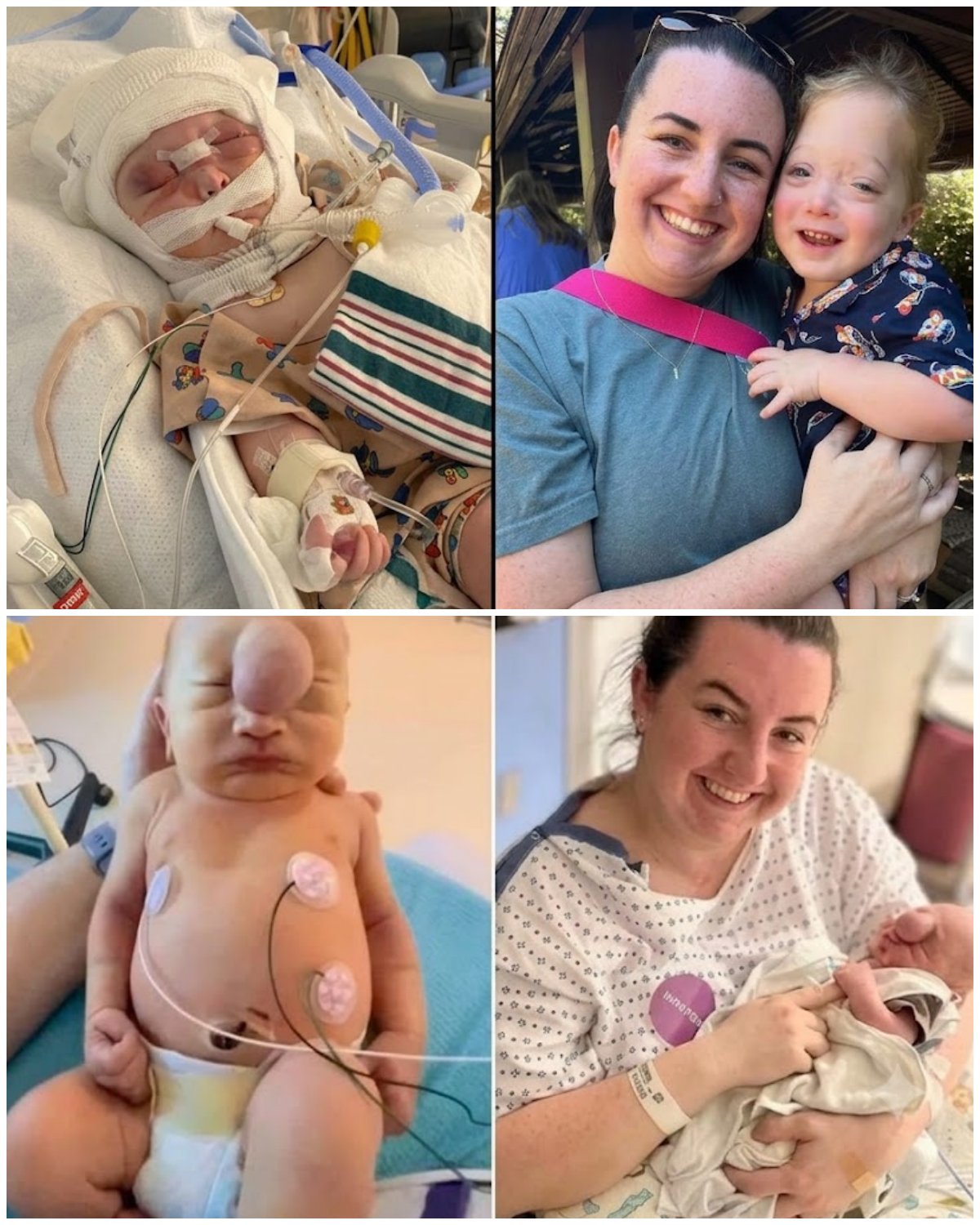
When Bentley Yoder was born in Ohio on October 31, 2015, his parents had been warned that their son might not survive. Before his birth, doctors had diagnosed him with encephalocele, a rare congenital defect in which part of the brain and its surrounding membranes protrude through an opening in the skull.
The condition was exceptionally severe in Bentley’s case. A significant portion of his brain had developed outside his skull, including tissue associated with motor function, problem-solving and vision. Because of the severity of the defect, his parents, Sierra and Dustin Yoder, were initially given an extremely poor prognosis.
Yet Bentley defied those expectations from the very beginning.
A newborn who refused to give up
When Bentley arrived, his family had prepared for the possibility that they would only have a short time with him. Instead, the newborn was breathing, crying and moving.
He continued to survive despite serious medical challenges during his first months. His family sought additional medical opinions as they realized that Bentley was showing signs of development and appeared to be using some of the brain tissue contained in the protruding sac.
Eventually, the family traveled to Boston Children’s Hospital, where a team led by neurosurgeon Mark Proctor and plastic surgeon John Meara evaluated the extraordinary case.
For the surgeons, the challenge was unlike a typical encephalocele operation. In many cases, tissue outside the skull may be severely damaged or nonfunctional and can sometimes be removed. Bentley’s situation was different: doctors believed that much of the tissue was functioning and therefore wanted to preserve it rather than simply remove it.
Using 3D technology to plan an unprecedented operation
The biggest obstacle was physical space.
Doctors estimated that roughly 100 cubic centimeters of Bentley’s brain tissue was outside his skull. Simply placing that tissue back inside would not work because his existing skull was too small to accommodate it.
To prepare, the Boston Children’s team created 3D-printed models based on Bentley’s medical scans. These models allowed the surgeons to study his unusual anatomy and rehearse the operation before performing it on the infant.
The surgical plan involved carefully expanding Bentley’s skull. Surgeons made multiple cuts in the skull so it could be spread outward, creating additional space. They then carefully moved the brain tissue back into the cranial cavity and used pieces of bone to help reconstruct the top of his skull.
A five-hour operation that changed his future
On May 24, 2016, when Bentley was about seven months old, the surgical team carried out the procedure.
The operation lasted approximately five hours. Doctors drained cerebrospinal fluid, opened the skull to create additional room and carefully returned the brain tissue that had been outside the skull to its intended position.
The outcome was encouraging.
When his parents were finally able to see him after surgery, Bentley was awake and looking around. In the weeks that followed, his mother reported that he was eating, smiling, making sounds and beginning to hold his head up.
His recovery did not mean that every medical challenge had disappeared. Doctors emphasized that Bentley’s neurological development remained uncertain because his brain anatomy was so unusual. But the operation gave him something his family had once been told was unlikely: a chance at a future.
A story of medicine, technology and determination
Bentley Yoder’s case became widely recognized because it demonstrated how highly specialized surgery, advanced imaging and 3D modeling could be combined to tackle an extraordinarily complex congenital condition.
His story is also a reminder that medical prognoses can sometimes change as doctors learn more about an individual patient. Bentley’s survival and the decision to preserve functional brain tissue required his family and medical team to take an enormous risk—but the result gave the child an opportunity to continue growing with his family.
One important correction: the child’s verified name is Bentley Yoder, not “Bentley Yanko” as stated in the supplied Spanish text. Contemporary reports from The Washington Post, ABC News, STAT and other outlets consistently identify him as Bentley Yoder