International Solidarity and Surgery: Encephalocele, Sierra Leone, and the Long Road to a Closed Skull
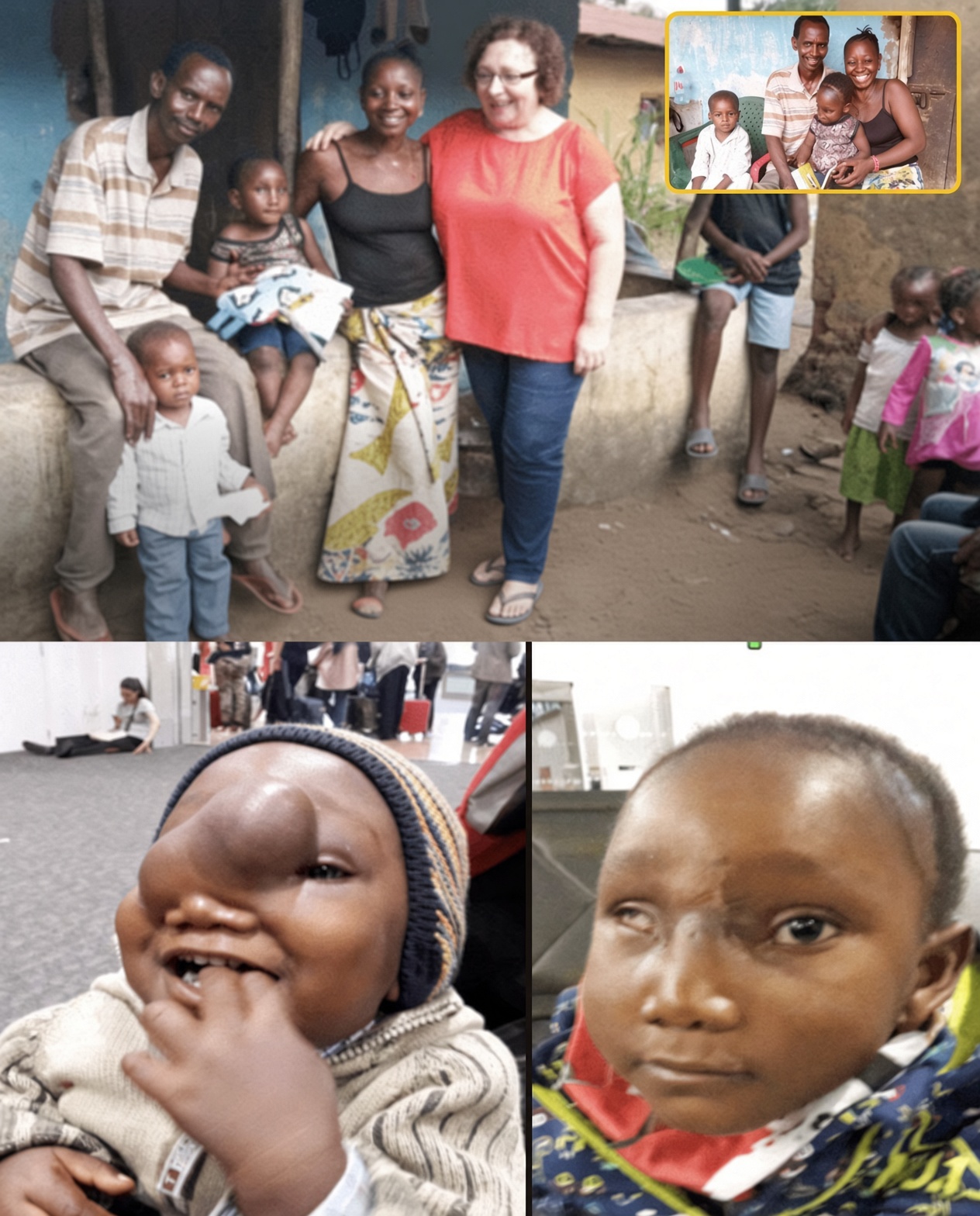
An encephalocele is a neural-tube defect: a gap in the skull through which meninges, cerebrospinal fluid, and sometimes brain tissue push outward. When the defect sits in the face — often the frontoethmoidal region, between the eyes and the nose — the child is born with a mass that looks like a second forehead or a swollen bridge of the nose. The sac can leak, dry, infect, or grow. Vision, breathing, and feeding are at risk. Without repair, the opening never closes on its own.
The Spanish caption attached to these photographs names a Sierra Leonean infant, Mohamed, said to have been evaluated at Choithram Memorial Hospital in Freetown and then sent to Germany at about two years of age. It lists four organizations — Bintumani D-SL, Lion for Lion, Pikinbizness, and the German charity Krankenhaus Friedensdorf International — as the chain that arranged visas, flights, and a free operation of several hours by neurosurgeons and maxillofacial surgeons. Friedensdorf International does, in fact, host children from low-income countries for complex care in Germany and return them home. Choithram Memorial Hospital is a real Freetown institution that has hosted visiting reconstructive teams. What could not be confirmed in major English- or German-language news archives is a single, fully reported case file under that exact combination of names. The photographs themselves are consistent with a large anterior encephalocele before and after reduction of the sac and reshaping of the midface.
That gap in the public record does not make the medicine imaginary. Sierra Leone had no resident neurosurgeon for years; the first began practicing only recently. Anterior encephaloceles are more common in parts of Africa and Southeast Asia than in Europe. Repair is a one-stage or staged operation: reduce herniated tissue if it is viable, close the dura, reconstruct the bony defect, and protect the brain from infection. Hydrocephalus sometimes appears afterward and needs a shunt. Families in Freetown cannot pay for that sequence. The usual path is a local clinic that names the diagnosis, an NGO that photographs the child and raises funds, a European or Indian hospital that operates for free, and a flight home with a flatter face and a scar. Four organizations working together is how those paths are built.
If Mohamed’s operation happened as the caption describes, the result in the after photograph — a child whose face no longer carries a sac of brain — is the point of that network. Encephalocele surgery does not restore every function that never developed. It does stop a wound that should never have been open to the air. That is what “recovered” means here: a skull that holds what belongs inside it, and a country that still cannot do that operation for every infant who needs it.
Sources: Clinical literature on frontoethmoidal meningoencephalocele repair; reporting on Sierra Leone’s neurosurgical capacity (NPR / Angels in Medicine, 2025); Choithram Memorial Hospital reconstructive camps; Friedensdorf International’s established model of treating children from abroad in Germany. The specific four-NGO itinerary named in the viral caption was not independently corroborated in major press archives.