Manar Maged: The Egyptian Girl Born With a Second Head
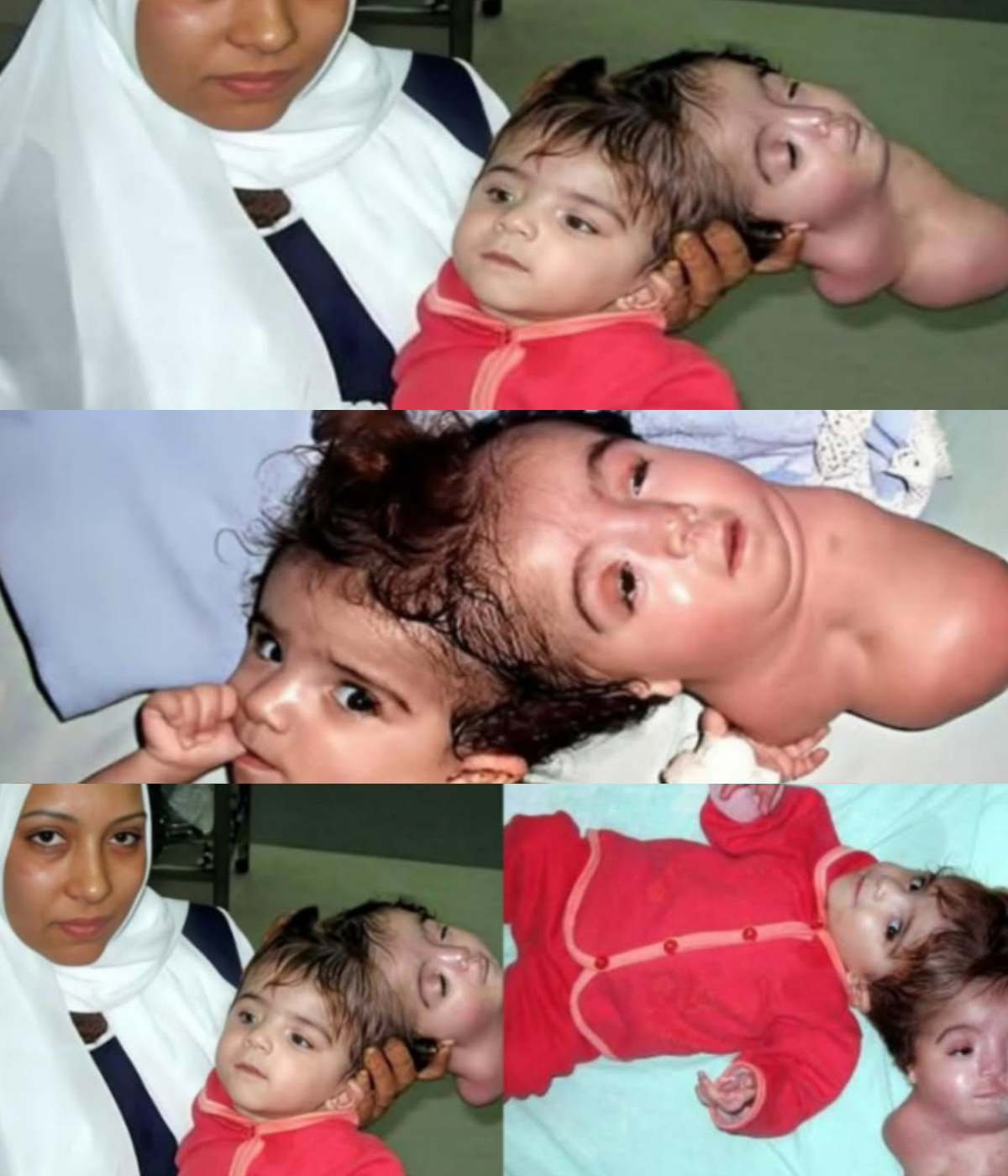
On 30 March 2004, in Egypt, Naglaa Maged delivered twins. The first girl, Noora, was healthy. The second, Manar, arrived by emergency caesarean with a second, incomplete head fused to the upper left side of her skull. The condition is craniopagus parasiticus: an embryo begins to split into identical twins and never finishes. One twin develops a body; the other is reduced to a head and a trace of torso, fed by the surviving child’s blood. Doctors later named the attached twin Islaam. She had a separate brain, a face that could blink, smile and suck, and no heart or lungs of her own. Incidence is estimated at a handful of cases per ten million births. Only a few infants have ever lived long enough for surgery to be attempted.
The extra head grew, shared a critical vein, and strained Manar’s heart. She could not sit or crawl. Egyptian doctors at Benha Children’s Hospital, north of Cairo — among them paediatric intensivist Abla el-Alfy and neurosurgeon Mohamed Lotfy — studied the scans and the failed Dominican attempt on Rebeca Martínez a year earlier. Religious authorities were consulted. The consensus was that Islaam could not live independently and that leaving her attached would kill Manar. On 19 February 2005, when Manar was about ten months old, a team of roughly thirteen surgeons operated for thirteen to sixteen hours. They divided brains and vessels and closed the skull. Islaam was buried with a Muslim funeral. Manar woke, moved her limbs, and was weaned toward breathing on her own. She and her mother later appeared on The Oprah Winfrey Show. It was called the first such survival in the Middle East.
Survival was not the end of the anatomy. Hydrocephalus followed. Shunts were placed. Infections returned. On 26 March 2006, days before her second birthday, Manar was admitted with fever. She had a severe brain infection, pneumonia and heart failure. She died that night. Thirteen months after a historic separation, the child who had been the only modern survivor of the operation was gone.
The photographs that still circulate — a toddler in pink, a second face resting against her hair, a mother in a white hijab — freeze the interval between birth and the operating theatre. They do not show the shunt, the fever, or the grave. Craniopagus parasiticus remains almost unsurvivable. Manar’s case proved that separation was technically possible. It also proved that possibility is not the same as a long life.
Sources
Al Jazeera, “Egyptian baby’s second head removed” (20 February 2005)
UPI / Associated Press reports on Manar’s death (27 March 2006)
New York Daily News / Oprah appearance coverage (May 2005)
Wikipedia and medical reviews of craniopagus parasiticus (Manar Maged; comparison with Rebeca Martínez)
Gulf News postoperative update from Benha Neonatal Hospital