Samuel Rodrigues: A Decade-Long Journey of Survival and Facial Reconstruction After a Fireworks Accident
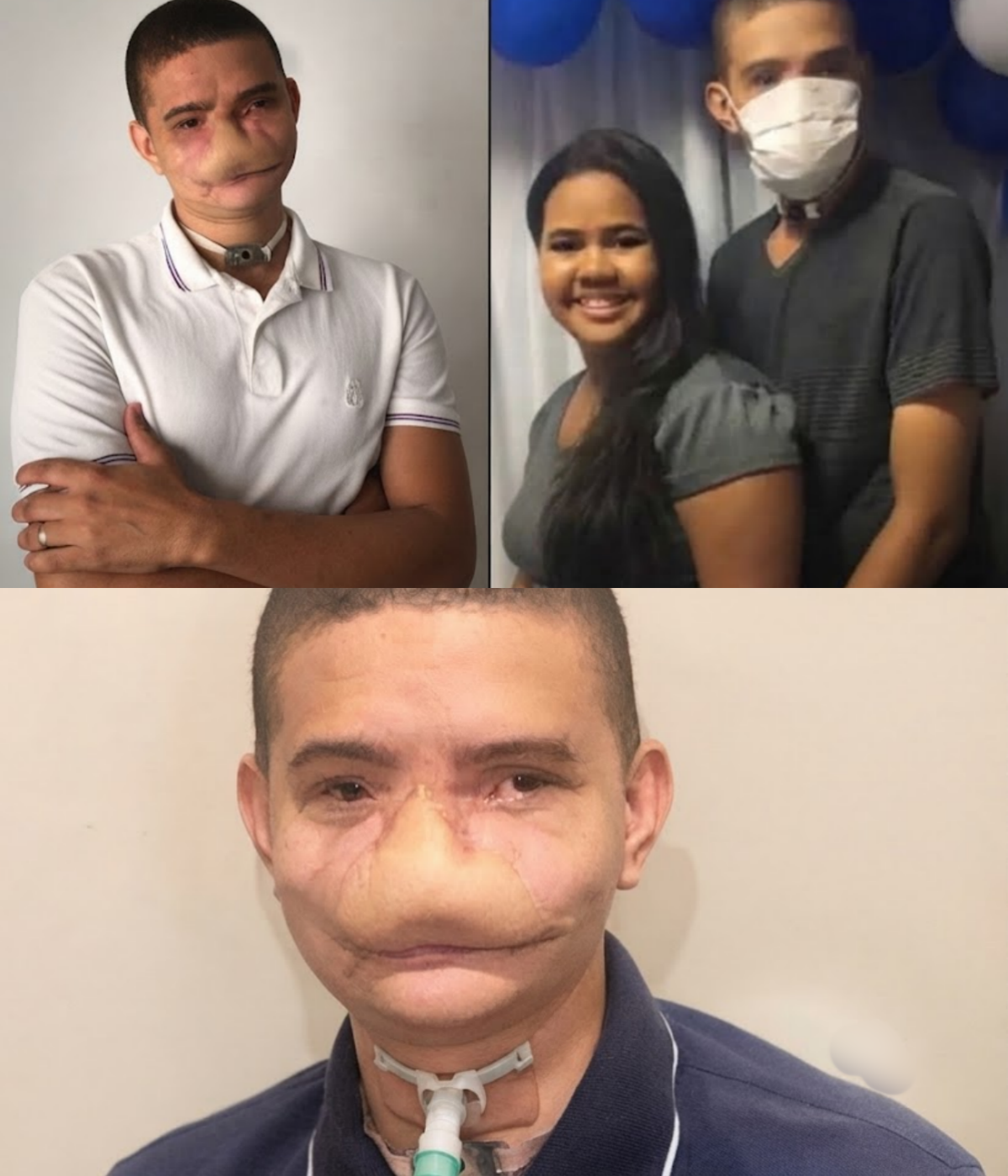
In November 2012, a fireworks accident in Goiás, Brazil, changed Samuel Rodrigues’ life forever. He was only 19 years old and working as a lighting technician at a music festival in Caldas Novas when a firework struck him directly in the face.
The impact caused devastating facial injuries, destroying much of the central structure of his face and leaving him with permanent physical consequences. Nearly a decade later, his story became known more widely after he began speaking publicly about the accident, his recovery and his decision to show his face without a mask.
A Devastating Accident
On the night of November 17, 2012, Samuel was working near the lighting structure of a concert stage. According to reports, fireworks were being launched near the stage when one struck him in the face.
The injury was catastrophic. Samuel lost his nose, much of the bone beneath his eyes, part of his upper teeth and extensive soft tissue. Reconstructive surgeon Carlos Gustavo Neves described the loss as involving the skin and muscle of the central face, the upper lip, portions of both sides of the maxilla, and the hard and soft palate. The damage also eliminated much of the normal separation between the mouth and nasal cavity.
His eyes were also severely affected. Reports stated that he became completely blind in his left eye and retained only about 20% vision in the right eye.
After being taken for emergency treatment, Samuel underwent a surgery that lasted nearly 24 hours. Plates and pins were used to stabilize parts of his damaged face, while additional material was placed to support the eye area.
He spent approximately two weeks in intensive care and another two weeks in a hospital ward. When he regained consciousness, he was unable to speak because he had a tracheostomy. He subsequently received support from speech, physical and psychological rehabilitation professionals.
Rebuilding What Had Been Lost
Almost a year after the accident, Samuel began a long process of facial reconstruction.
The procedures were designed primarily to restore function rather than simply change his appearance. Surgeons used tissue from his own body, including skin, tissue and muscle taken from his thigh, to reconstruct damaged areas of his face. Bone taken from his pelvis was also used as part of the reconstruction. A team of approximately 20 people was involved in the complex procedures.
Later, Samuel underwent nasal reconstruction and a procedure to reshape the transplanted tissue. Although the operations produced positive results, the recovery was extremely difficult. His mouth was immobilized for a period of time, making the postoperative experience particularly traumatic for him. As a result, he eventually stepped away from medical appointments for a period.
Living With the Physical Consequences
The accident affected far more than Samuel’s appearance. Eating, speaking and breathing became difficult, and he continued to depend on a tracheostomy for breathing.
Because much of the normal facial structure beneath his eyes had been destroyed, his mouth and nasal region no longer functioned in the usual way. Samuel later explained that any additional reconstruction he pursued would be intended primarily to improve these functions.
Doctors considered options including additional bone grafting or the use of a prosthetic structure to replace missing facial support.
Nearly Ten Years of Hiding His Face
For years, Samuel frequently covered his face in public and on social media. He had to adapt not only to the physical consequences of the accident but also to the reactions of other people.
Despite the trauma, he eventually married and became a father. By 2022, reports described him as living with his wife and young son in Trindade, in the metropolitan region of Goiânia.
His relationship with his appearance began to change when he started appearing publicly without a mask.
During an online video appearance, Samuel showed his face without the covering he had used for years. Instead of the negative reaction he feared, he received messages of support. That experience encouraged him to continue sharing his story online.
He later began using humor and openness when talking about his condition, turning his social-media presence into a way of discussing self-acceptance and life after a devastating injury.
Reconstruction With Function in Mind
Samuel’s goals eventually evolved. Rather than seeking reconstruction simply to look different, he emphasized the importance of restoring functions that had been lost after the accident.
Breathing became one of his major concerns. He wanted further procedures to reconstruct the nasal area and improve his ability to breathe normally, while doctors would determine whether bone grafts or prosthetic materials would be appropriate.
His story therefore goes beyond a dramatic physical transformation. It is also a story about surviving severe trauma, undergoing complex reconstructive procedures, adapting to permanent disabilities and gradually becoming comfortable with being seen by others.
More than a decade after the accident, Samuel’s journey continues to illustrate the long and complex nature of recovery from devastating facial trauma—and the distinction between reconstructing a face for appearance and reconstructing it to restore essential human functions.
Sources:
- BBC News Brasil, “Rapaz atingido por fogos de artifício sonha em reconstruir rosto”, reported by Vinícius Lemos, December 2021/January 2022.
- Folha de S.Paulo, “Rapaz atingido por fogos de artifício sonha em reconstruir rosto”, January 1, 2022.
- Mais Goiás, “‘Foi como um soco’, diz jovem que perdeu nariz ao ser atingido por fogos em Caldas Novas”, December 31, 2021.
- Correio da Amazônia, report on Samuel Rodrigues’ facial reconstruction and recovery.
- Globo/JA 1ª Edição, report on Samuel Rodrigues and his experience after the fireworks accident.