While New York Sleeps, Jim Maroon Quietly Cares for the 9/11 Memorial Pools
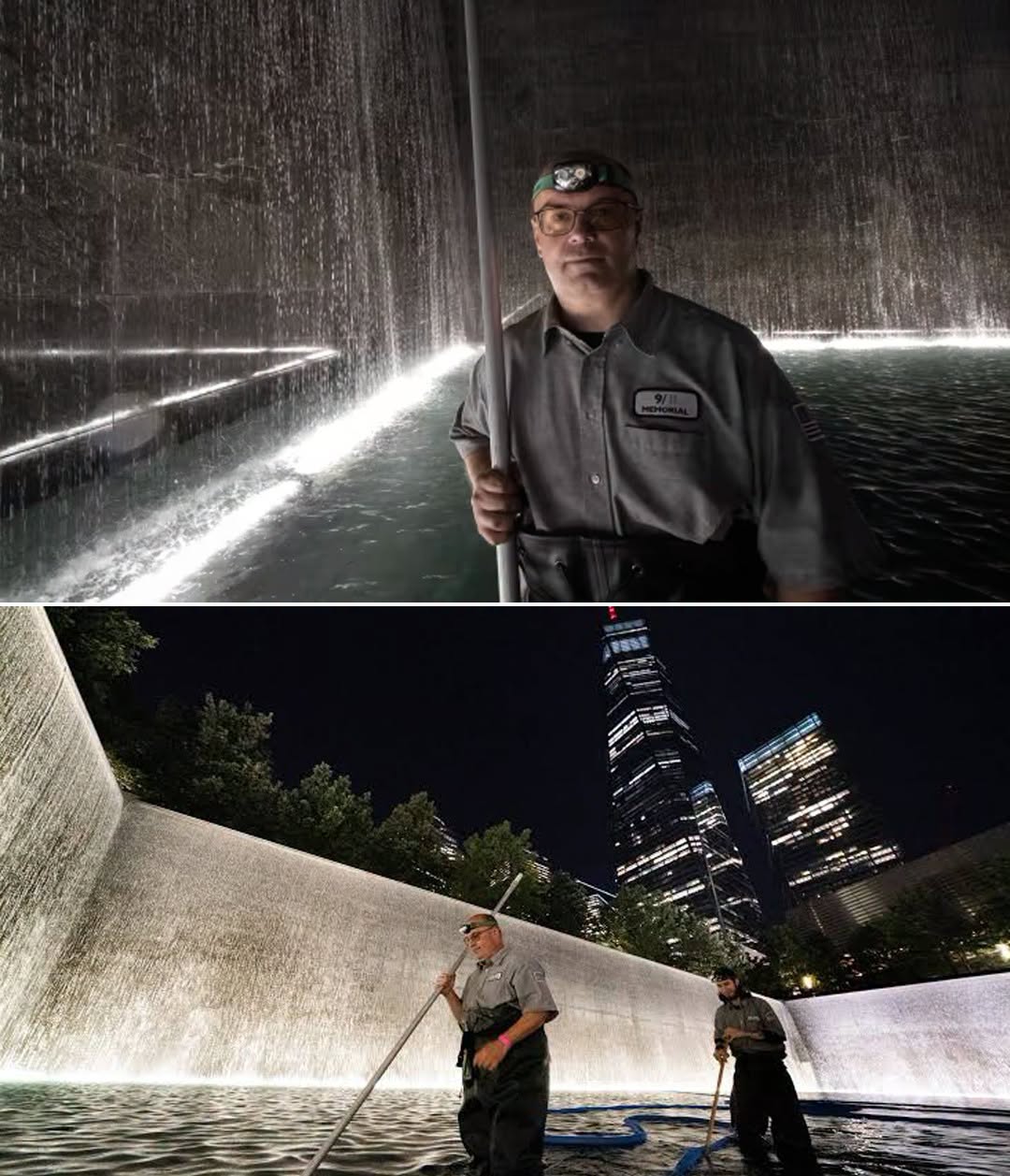
While New York Sleeps, Jim Maroon Quietly Cares for the 9/11 Memorial Pools
When the crowds disappear from the 9/11 Memorial at night, Jim Maroon steps into a place few visitors will ever see from this perspective.
He puts on a rubber wading suit and walks into the reflecting pools that occupy the footprints of the World Trade Center’s Twin Towers.
For Maroon, the work is more than routine maintenance.
It is personal.
On September 11, 2001, Maroon was 29 years old and working at the New York Mercantile Exchange, only a few hundred yards from the World Trade Center. He was on his way to work when the first plane struck.
He remembers hearing the impact and seeing the damage to the tower.
Later that morning, while trying to leave the area with a coworker, he looked back and witnessed one of the towers collapse.
The World Trade Center had already been part of Maroon’s life long before that morning. His father worked in the area for much of his adult life, and Maroon spent much of his childhood around the complex.
He also knew people who worked inside the towers.
Years later, Maroon returned to the site in an entirely different role.
Since 2012, he has been part of the overnight team responsible for maintaining the 9/11 Memorial’s reflecting pools. He works five nights a week, generally from around 11 p.m. until 6 a.m., while most of New York is asleep.
The two pools are enormous. Each covers roughly an acre and occupies the footprint of one of the former Twin Towers.
Maroon has calculated that cleaning a single pool requires 44 passes with the vacuum in one direction and another 44 on the way back.
Working alongside other members of the overnight crew, he helps remove debris from the water and keep the memorial in pristine condition.
Much of what he encounters is ordinary: leaves from the hundreds of trees surrounding the memorial, coins, soda cans and children’s toys. Occasionally, visitors accidentally drop other objects into the pools. Coins found in the water are kept for the memorial.
The work can be repetitive and physically demanding.
But Maroon says the responsibility matters because of what the site represents.
Families come to the memorial to remember people they lost.
He wants them to find a place that looks cared for and respected.
For Maroon, that responsibility carries particular weight.
He tries not to spend every night thinking about September 11. The memories are still painful, and he has said that constantly dwelling on them would leave him heartbroken.
But around the anniversary, the past becomes harder to avoid.
As he works near the pools, he can see the names of the people killed in the attacks engraved around the memorial.
Twenty-five years after September 11, the site has changed dramatically. Buildings have risen around it, millions of visitors have passed through, and a new generation has grown up without personal memories of the attacks.
Yet every night, while the city sleeps, Maroon returns to the water.
He vacuums.
He brushes.
He removes what does not belong there.
And before the crowds arrive in the morning, he leaves.
Most visitors will never know who cleaned the pool beneath them or how many hours went into preparing the memorial for another day.
For Maroon, that anonymity is not the point.
The point is that when families arrive to remember someone they loved, the place is ready for them.
What began as a job has become, in his own words, a responsibility to the people whose names surround the pools.
And so, night after night, Jim Maroon quietly takes care of a place that means something extraordinary to millions of people.
While New York sleeps, he helps make sure the memorial is ready to remember.
Sources / Further Information
The New York Times — “Who Cleans the 9/11 Memorial Pools?” — published September 6, 2026.
9/11 Memorial & Museum — 2025 Annual Report — information on the memorial pools and the overnight custodial team.
Business Times — “Keeping the 9/11 Memorial pools clean” — reporting on Jim Maroon’s work and his connection to the World Trade Center.