The Woman I Sent Away Came Back to Save My Ranch
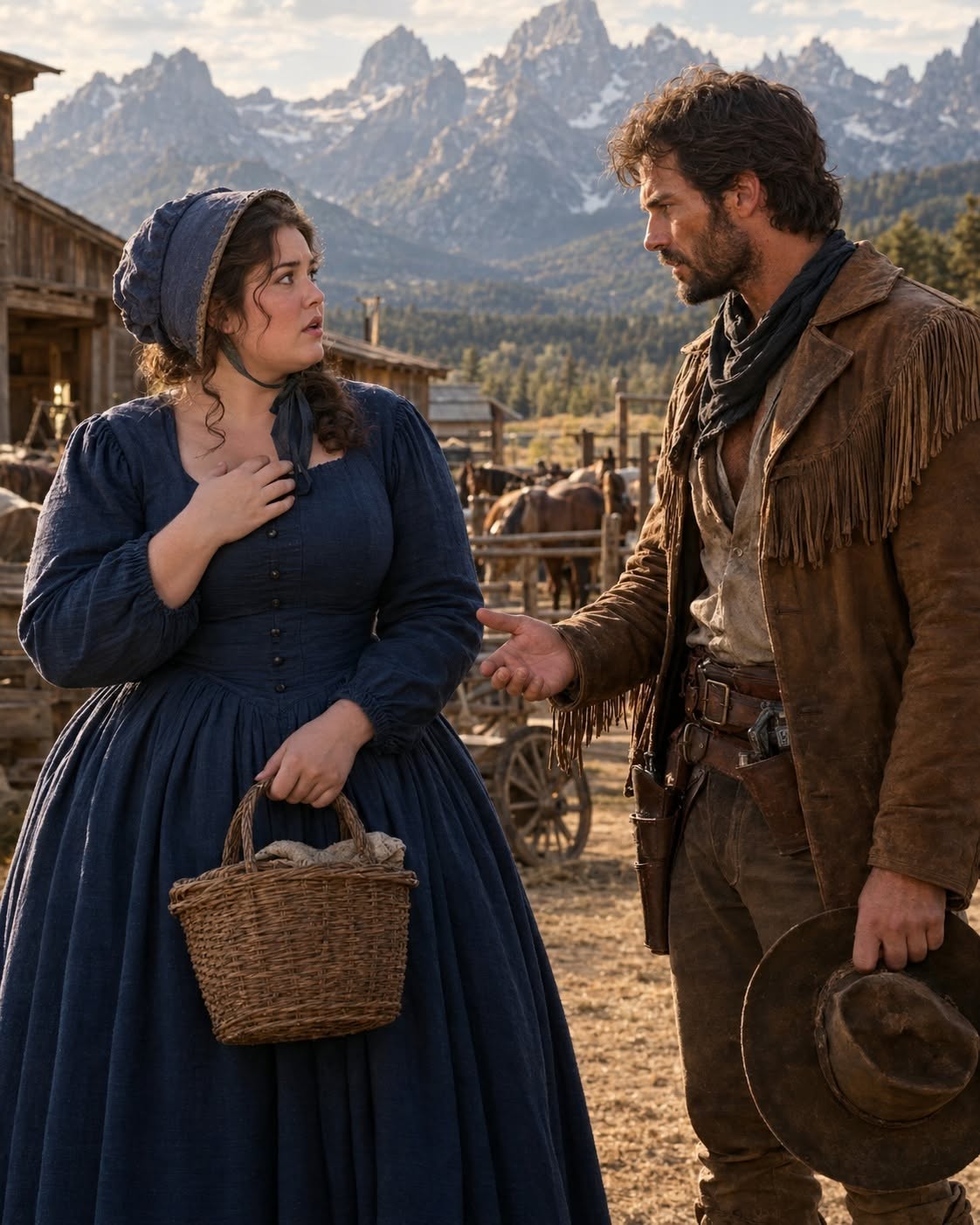
When Josephine stepped from the train at Cheyenne Depot, every cowboy laughed at her size, and I coldly sent her away—because I already knew someone had betrayed me.
I was standing beside the freight platform when she arrived, wrapped in a dark wool coat that could barely contain her broad, graceful frame.
She carried one battered suitcase and looked at me with eyes so steady that, for one foolish second, I forgot the ranch was dying.
Then I remembered the mortgage notice folded inside my coat, the empty grain bins, and the twenty-five hungry men waiting back at the Broken Spur.
“I ordered a wife who could work,” I said.
Her cheeks tightened.
“I was told you needed someone who could cook, clean, mend, and survive Wyoming.”
“You don’t look like you can survive a winter here.”
The cowboys behind me laughed.
Josephine looked at them, then at me, and something wounded passed through her eyes before she quietly picked up her suitcase.
“Then you should have read the letter more carefully, Mr. Wells.”
She walked away before I could answer, and I thought I had just saved myself another burden.
I was wrong.
By sunset, Josephine was standing in my kitchen because she had nowhere else to go, and I discovered the first thing I should have noticed about her.
She could cook.
Not ordinary cooking, either.
With nothing but potatoes, dried beans, three onions, flour, a little salt pork, and the last scraps of beef, she worked until the kitchen smelled like a feast.
The ranch hands crowded around the dining room when she finally carried out the meal.
Nobody spoke.
Forks moved slowly, almost reverently.
One of the older cowboys closed his eyes after the first bite.
“Lord above,” he whispered.
Josephine stood by the stove, watching them without smiling.
I tasted the stew and felt something inside me crack.
It was the finest meal I had eaten since my mother died.
“Where did you learn to cook like this?” I asked.
She wiped her hands on her apron.
“I cooked for a hotel kitchen in St. Louis, then for a boardinghouse, then for thirty-two railroad workers during the winter of ’89.”
The laughter in the room disappeared.
She had not been helpless.
She had been surviving people like us long before she ever saw Wyoming.
Over the next weeks, Josephine became the heartbeat of the Broken Spur.
She stretched flour twice as far, turned spoiled vegetables into soup, taught the boys how to preserve meat, and convinced me to plant a kitchen garden beside the creek.
Then she noticed something I had ignored.
Our cattle weren’t failing because the land was bad.
Someone was stealing from us.
At first, I refused to believe it.
Then Josephine showed me the account book.
“The numbers don’t match,” she said.
I stared at the missing cattle, the falsified feed orders, and the signatures that looked almost like mine.
“Who has access to these?”
She looked toward the bunkhouse.
“Your foreman.”
His name was Caleb Mercer, a hard-faced man who had worked beside my father and hated me for reasons I never understood.
When I confronted him, he admitted only one thing.
“I warned your father about the bank years ago,” Caleb said.
“What warning?”
His jaw tightened.
“They weren’t trying to lend him money.”
That night, Josephine found me sitting alone in the barn.
“The bank wanted the ranch,” I said.
She sat beside me without touching me.
“And now they want you desperate enough to sell.”
I looked at her.
“Why are you helping me?”
She was silent for a long moment.
“Because someone once looked at me and decided what I was worth before knowing my name.”
I understood then that my cruelty at the train station had hurt more deeply than I realized.
“I’m sorry,” I whispered.
She finally looked at me.
“I know.”
That was the night I fell in love with her.
Not because she was beautiful, though she was.
Not because she could feed twenty-five men from an almost empty pantry, though she could.
I loved her because she had every reason to hate me and somehow chose to stay.
Spring came, and so did our first profitable cattle shipment.
The Broken Spur began breathing again.
But the bank had one final move.
Just before dawn one October morning, Caleb rode into the yard shouting that armed men were cutting the east fence.
I grabbed my shotgun.
Josephine grabbed something else.
The ranch hands scattered toward the horses, but before we could reach the pasture, six riders appeared through the mist.
They carried rifles.
Their leader shouted, “This land belongs to the bank now.”
Josephine disappeared into the kitchen.
I thought she was afraid.
Then I heard the unmistakable slam of a shotgun being loaded.
She stepped onto the porch with a steaming iron cauldron in one hand and a shotgun in the other.
“What in God’s name are you doing?” I shouted.
“Making soap,” she answered.
Then she tipped the cauldron.
Boiling lye water crashed across the dirt in front of the riders, forcing their horses backward in panic.
The men cursed and raised their rifles.
Josephine fired once into the ground.
“Next one goes higher.”
Nobody moved.
Caleb and the ranch hands surrounded them within seconds.
The rustlers surrendered before another shot was fired.
Afterward, I found Josephine sitting on the porch, trembling so badly she could barely hold her coffee.
I knelt beside her.
“You saved us.”
She shook her head.
“No, Giannis.”
She looked toward the eastern horizon.
“I only protected what finally felt like mine.”
I took her hand.
For the first time, she didn’t pull away.
That evening, Caleb brought me one final envelope he had found among the rustlers’ supplies.
It contained a list of names.
The bank manager was on it.
The foreman was on it.
And at the bottom was the name of the man who had arranged Josephine’s journey to Wyoming.
My blood went cold when I saw it.
Because beneath the name was a single handwritten sentence: “She must never discover who her father really was.”
I looked toward the kitchen, where Josephine was laughing softly with the ranch hands.
For the first time, I wondered whether the woman I had almost sent away had not come to save my ranch by accident.
Maybe someone had sent her here for a reason.
And whatever that reason was, it had just found us.
THE ASHES OF CHEYENNE
The paper in my hand felt heavy, heavier than any mortgage deed or foreclosure notice. The wind sweeping off the Laramie Mountains rattled the weathered timber of the Broken Spur porch, carrying the scent of sage, dust, and the damp iron of the morning’s struggle. Down in the yard, the ranch hands were tying up the captured rustlers, their low murmurs punctuated by the jingle of spurs and the occasional sharp cough of a man nursing a bruised rib.
I looked back down at the list.
Caleb Mercer. Arthur Pendelton. Julian Vance.
And beneath them, written in a cramped, hurried script that looked as though it had been scrawled in the back of a bouncing carriage: She must never discover who her father really was.
My thumb brushed the edge of the parchment. Julian Vance was not just any name—he was the president of the Cheyenne Territorial Bank, the very man who had sat behind a polished mahogany desk three months ago, smiling with cold, predatory politeness as he told me that my father’s signature on the default papers was valid. Vance was the man who had orchestrated our slow, agonizing starvation.
Yet here, tied directly to Vance’s financial ledger, was Josephine. Or rather, the phantom of a past she had never known.
From the kitchen doorway came the soft clink of a ceramic mug. Josephine stepped back out onto the porch, wiping her hands on a fresh linen cloth. The golden morning light struck her face, illuminating the sharp, elegant lines of her cheekbones and the quiet resolve in her dark eyes. She had changed out of her travel-stained wool coat months ago, but even in her plain cotton dress and faded apron, she carried herself with a dignity that no amount of frontier dust could tarnish.
“The boys are hungry,” she said, her voice steady, though a slight tremor still lingered at the edge of her lips from the lye water and the gunfire. “Caleb says we have enough salt pork left for breakfast, but if we’re going to feed twenty-five men through the winter, we’ll need to butcher that three-year-old steer by Tuesday.”
She stopped, noticing the paper in my hand. Her dark eyes narrowed slightly, fixing on the seal of the Territorial Bank stamped into the corner of the envelope.
“What is that, Giannis?” she asked.
For a heartbeat, I considered lying. I could fold the paper, slip it into my pocket, and pretend it was just another threatening letter from the bank—the kind we had learned to burn in the stove without reading. I could protect her from whatever cruel geometry connected her orphaned past to the man who had tried to steal our home.
Instead, I held it out.
“It was in the rustler’s saddlebag,” I said, my voice tight. “Along with the ledger. It has names on it, Josephine. Names of the men who backed the raid.”
She walked over, her footsteps measured and unhurried. She didn’t grab the paper; she simply looked down at it, her gaze scanning the ink. When her eyes reached the bottom line—She must never discover who her father really was—the color drained completely from her face.
The silence between us stretched, longer and heavier than the Wyoming winter. The wind died down, leaving only the distant sound of a hawk crying out over the ridge.
“My mother died when I was four,” Josephine whispered, her voice barely louder than the rustle of dry grass. “In a railway camp outside St. Louis. She never spoke of him. The women who raised me said he was a gambler who took the eastbound train before I drew my first breath.” She looked up at me, her eyes wide, haunted by a realization she had spent a lifetime running from. “Why would Julian Vance care who my father was?”
“Because,” I said softly, stepping closer to her, “men like Vance don’t spend thousand of dollars hiring railway companies and boardinghouses to keep track of a young woman unless she holds something they want—or something they’re terrified she’ll find out.”
By noon, the prisoners were secured in the old root cellar, guarded by two of our most trusted hands. Caleb Mercer sat on an overturned bucket outside the heavy oak door, smoking a foul-smelling pipe and staring out toward the horizon with the grim expression of a man who knew his time was up.
I found him there when I walked down from the main house.
“You knew,” I said, stopping a few feet away.
Caleb didn’t look up immediately. He tapped the ash of his pipe against the heel of his boot, a slow, deliberate motion. When he finally raised his head, his weathered face looked older than the hills around us.
“I knew Julian Vance back when your old man was still buying cattle on credit,” Caleb rasped. “Vance didn’t start out as a banker. Twenty years ago, he was a land speculator in St. Louis. Smart, ruthless, and married into old money he didn’t deserve.” He paused, pointing the stem of his pipe toward the main house where Josephine was inside cleaning up the breakfast dishes. “And he had a mistress. A young woman from a respectable family who disappeared