PART 2 — The Mustang Would Not Leave the Snow Until I Saw What Was Under Her
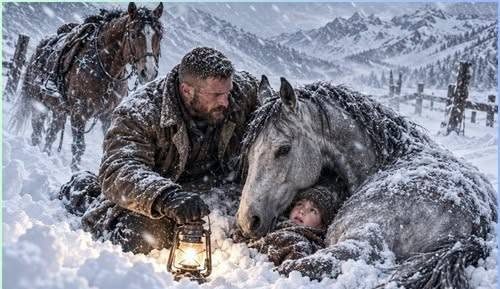
“What’s your name?”
The boy stared at me from beneath three wool blankets.
For a long moment, I thought he hadn’t heard.
Then his cracked lips moved.
“Caleb.”
His voice was barely louder than the fire.
“All right, Caleb. I’m Daniel Mercer. You’re safe now.”
He looked toward the barn door.
“Where’s Silver?”
“The gray mare?”
He nodded.
“She’s right over there. Warm and dry.”
His small fingers loosened their grip on the blanket.
Then he whispered something that made the hair rise on the back of my neck.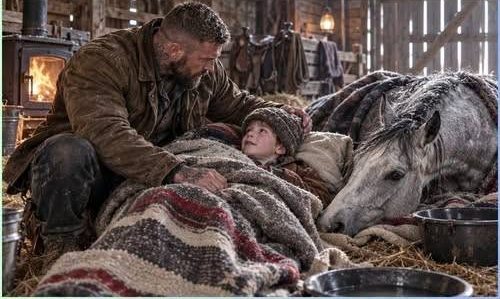
“She wouldn’t leave Mama.”
I stopped moving.
“What did you say?”
Caleb closed his eyes.
“Silver stayed with Mama until she stopped talking.”
Outside, the wind slammed against the barn walls.
I pulled a stool closer to the stove.
“Caleb, where is your mother?”
He didn’t answer.
I waited.
Finally, he opened his eyes and looked at me with an expression no six-year-old should ever have to wear.
“Under the snow.”
I had spent three winters trying not to remember the night I lost my wife and daughter.
Now a strange little boy was lying beside my stove, telling me his mother might be somewhere out in the same storm that had nearly killed him.
“Where?” I asked gently.
Caleb swallowed.
“By the broken wagon.”
“What wagon?”
“The one with the red wheels.”
His lower lip began trembling.
“Mama told me to stay with Silver. She said she’d come back after she found the road.”
I felt something cold settle inside my chest.
“How long ago?”
He shook his head.
“Was it daylight?”
Another nod.
“Caleb, did your mother get hurt?”
The boy stared at the flames.
“She fell.”
Then he started crying.
Not loudly.
That would have been easier.
He cried the way children do when they’ve been frightened too long to believe anyone will help them.
“I tried to wake her up,” he whispered. “But she wouldn’t open her eyes.”
I looked at the barn door.
The storm was still raging.
The temperature had dropped well below zero.
If his mother was lying out there, every passing minute mattered.
I reached for my coat.
Caleb grabbed my sleeve.
“Don’t go.”
His fingers were surprisingly strong.
“Please, mister. Everybody goes away.”
Those four words nearly brought me to my knees.
Because Emily had said something terribly similar the last morning I saw her.
Daddy, don’t go to work yet.
I had kissed her forehead and promised to be home before supper.
I never got the chance.
I crouched beside Caleb.
“Listen to me. I’m going to find your mama.”
He shook his head violently.
“No!”
“I have to try.”
“What if you don’t come back?”
I couldn’t answer immediately.
Then I reached into my pocket and took out a small silver pocket watch.
It had belonged to my father.
Emily used to wind it every Sunday.
I placed it in Caleb’s hand.
“Keep this for me.”
He looked down at it.
“Why?”
“Because it’s important. And I always come back for important things.”
It was a foolish promise to make in a Wyoming blizzard.
But I made it anyway.
I saddled Amos again.
Before leaving, I filled a bucket with warm water and placed fresh hay beside the gray mare.
She had been lying with her head resting on the straw.
The moment she saw me carrying the saddle, she lifted it.
“No,” I told her.
“You’ve done enough.”
She struggled onto her front knees.
“Stay down, girl.”
But Silver stood.
Her legs shook so badly I expected her to collapse.
She took one step toward the door.
Then another.
I stared at her.
“You know where she is, don’t you?”
The mare pressed her muzzle against my shoulder.
I had worked around horses for twenty-five years.
I knew how easily people imagined human thoughts behind animal behavior.
But I also knew when an animal was determined to go somewhere.
And this mare was determined.
I opened the door.
“Then show me.”
The wind nearly knocked us sideways.
Amos lowered his head and pushed into the storm while Silver followed beside us.
Every few hundred yards, she stopped.
Not because she was tired.
She would raise her head, test the wind, and turn slightly before moving again.
I had no idea whether she was following a remembered route, familiar smells, or something I couldn’t understand.
But I followed.
Forty minutes passed.
Then an hour.
My beard froze against my collar.
The lantern flame flickered inside its glass.
At one point, Silver disappeared into the blowing snow.
I called after her.
Nothing.
Then came a weak whinny.
I turned Amos toward the sound.
And saw it.
A wagon.
Half buried in a drift.
One red wheel stood crookedly above the snow.
The other had broken away from the axle.
I dismounted so quickly I nearly fell.
“Hello!”
The wind swallowed my voice.
“Anybody here?”
No answer.
I found a woman’s scarf caught beneath a wheel.
A small wooden crate lay overturned nearby.
Inside were a few potatoes, a broken jar, and a child’s blue mitten.
Then Silver began pawing at the snow.
Hard.
Frantic.
I hurried toward her.
There, beneath the drift, I saw the edge of a brown wool coat.
My heart began hammering.
I dropped to my knees and dug.
Snow filled my sleeves.
My fingers went numb.
Then I uncovered a hand.
A woman’s hand.
Pale.
Motionless.
I cleared the snow from her face.
She looked about thirty.
Dark hair frozen against her cheeks.
Blood had dried along her temple.
I pressed two fingers beneath her jaw.
Nothing.
I moved them.
Pressed harder.
Waited.
Then—
There.
A heartbeat.
Slow.
Weak.
But real.
“Oh, thank God.”
I pulled the snow away from her chest and found that her left leg was trapped beneath a broken section of the wagon.
The wood had pinned her below the knee.
I couldn’t lift it alone.
I tried anyway.
Once.
Twice.
The timber barely moved.
The woman made a faint sound.
Her eyes opened just enough to reveal their gray color.
The same gray as Caleb’s.
“Caleb?”
Her voice was a breath.
“He’s safe,” I told her.
Her lips trembled.
“Silver?”
“She’s here too.”
A tear slipped down her frozen cheek.
Then she whispered, “Don’t let him go back.”
I leaned closer.
“Back where?”
Her eyes widened.
Fear suddenly cut through the exhaustion.
“His uncle.”
Before I could ask another question, she lost consciousness.
It took nearly twenty minutes to free her leg.
I used a broken wagon spoke as a lever, bracing it against a stone buried beneath the snow.
When the timber finally shifted, I pulled her clear.
Her leg was badly swollen, but I couldn’t tell whether the bone was broken.
I wrapped it as firmly as I dared.
Then I carried her to Amos.
She weighed almost nothing.
I tied her securely against me, sheltered her beneath my coat, and began the long journey home.
Silver walked beside us.
Twice she stumbled.
Once she dropped to her knees.
Each time I thought she had reached the end of her strength.
But she rose again.
I had seen men surrender under far less suffering.
That mare never did.
By the time the barn came into view, the eastern sky had begun turning a pale, miserable gray.
I was so exhausted I could barely get down from the saddle.
But when I opened the barn door, I heard a small voice.
“Mister Daniel?”
Caleb was sitting up beside the stove.
He still held my pocket watch.
His eyes moved past me.
Then he saw the woman in my arms.
“MAMA!”
He tried to stand.
His legs gave way.
I lowered his mother onto the blankets beside him.
“Easy, son. She’s hurt, but she’s alive.”
Caleb crawled toward her.
He touched her cheek.
“Mama?”
No answer.
He pressed his little forehead against hers.
“I stayed with Silver, Mama. Just like you said.”
Then he began sobbing.
I turned away.
Not because I didn’t care.
Because for one terrible moment, I saw Emily kneeling beside Rachel’s hospital bed.
And I couldn’t bear the memory.
The woman’s name was Hannah Bennett.
I learned that later that afternoon, after she regained consciousness.
By then, I had cleaned the wound on her temple, warmed her slowly, splinted her injured leg, and given her a little broth.
The storm had finally weakened enough that I could see the fence posts again.
But the roads were still impassable.
Hannah lay beside the stove with Caleb sleeping against her shoulder.
Silver stood only a few feet away, separated from them by a low wooden rail.
The mare hadn’t touched much of her hay.
She simply watched.
Hannah followed my gaze.
“She isn’t mine,” she whispered.
I looked at her.
“What?”
“Silver. She isn’t our horse.”
That surprised me.
“Then whose is she?”
Hannah’s face changed.
“She belonged to the man who was chasing us.”
I set down the cup in my hand.
“What man?”
She looked toward Caleb to make certain he was asleep.
Then she spoke so softly I had to lean closer.
“My husband’s brother. Thomas Bennett.”
“Why was he chasing you?”
Hannah stared at the flames.
“My husband died last spring. Pneumonia. After the funeral, Thomas told me the farm belonged to him.”
“Did it?”
“No.”
Her voice grew steadier.
“My husband left it to Caleb.”
I frowned.
“How old is Caleb?”
“Seven next month.”
“And his uncle wanted the farm?”
“He wanted everything.”
Hannah looked down at her sleeping son.
“At first he said he’d help us. Then he started selling the cattle. He took my husband’s savings. When I questioned him, he told everyone I wasn’t fit to raise a child.”
My jaw tightened.
“What happened next?”
“He brought a lawyer to the house. They wanted me to sign papers giving Thomas control of Caleb’s inheritance.”
“Did you sign?”
She shook her head.
“He told me I’d regret refusing.”
Outside, Silver stamped one hoof.
Hannah looked toward the mare.
“Three nights ago, I heard Thomas talking to another man. They were planning to take Caleb away and send him to relatives in Nebraska.”
She swallowed.
“I packed what I could and left before dawn.”
“With a broken wagon?”
“It wasn’t broken when we started.”
Something in her voice made me look at her more carefully.
“What happened to it?”
Hannah hesitated.
Then she said, “Thomas found us yesterday morning.”
I felt the room grow very still.
“He was riding Silver. He caught us near the ridge and tried to pull Caleb from the wagon.”
My hands curled into fists.
“What did you do?”
“I struck him with the lantern.”
She looked ashamed.
“I didn’t know what else to do.”
“Then?”
“He fell. Silver broke away. I whipped the team and drove as fast as I could.”
Her eyes filled.
“But the wagon wheel came off on the mountain road. The horses broke loose. Caleb fell and hit his head. I tried to carry him, but my leg was trapped when the wagon shifted.”
I looked toward the mare.
“How did Silver find you?”
“I don’t know.”
Hannah’s voice broke.
“She just appeared through the snow. I thought Thomas had come back.”
She reached for Caleb’s hand.
“But she walked straight to my boy.”
For a moment, Hannah couldn’t continue.
“Caleb was shaking so badly he couldn’t stand. I pulled him beneath her neck while I tried to free my leg.”
“What happened then?”
“I got loose for a moment. I tried to find the road. But I fell, and I couldn’t get back.”
Her eyes met mine.
“I watched Silver lie down beside my son. She curled around him while the snow kept falling.”
A tear rolled down her cheek.
“I thought I was watching them both disappear.”
I sat silently.
Hannah took a trembling breath.
“Mr. Mercer, that horse saved my boy.”
I looked at the exhausted gray mare.
“Yes,” I said.
“She did.”
By evening, the storm had finally passed.
I went outside to split more wood.
The sky had cleared to a hard blue, and the mountains stood white and enormous against the horizon.
For the first time in three years, my barn wasn’t silent.
Inside, a little boy was asking his mother whether horses dreamed.
And a woman I had met only hours earlier was laughing softly at something he said.
I stood with the ax in my hands, listening.
The sound hurt.
Not because it was unpleasant.
Because it reminded me of everything I had lost.
I was still standing there when Amos raised his head from the corral.
His ears pointed toward the eastern road.
Then I heard it.
Hoofbeats.
One horse.
Moving fast.
A rider appeared between the snow-covered pines.
He wore a dark coat and a wide-brimmed hat.
As he approached, I noticed the rifle strapped across his saddle.
He stopped twenty yards from my barn.
“Evening,” he called.
I rested the ax against the chopping block.
“Evening.”
The stranger studied my house.
Then the barn.
Then the fresh tracks leading toward the door.
“Name’s Thomas Bennett.”
My blood went cold.
He smiled.
“I’m looking for my sister-in-law and her little boy.”
I said nothing.
Thomas shifted in his saddle.
“They’ve been missing since yesterday. Woman’s not right in the head, I’m afraid. Took the boy out in the storm.”
He shook his head sadly.
“Terrible business.”
I watched him.
He was a good liar.
Smooth.
Practiced.
The kind of man who had learned that a concerned expression could open doors faster than a gun.
“Can’t help you,” I said.
His smile thinned.
Then Silver whinnied from inside the barn.
Thomas turned his head sharply.
He knew that sound.
I saw recognition flash across his face.
“Well now,” he said.
“That sounds like my mare.”
I didn’t move.
He looked back at me.
“Mind if I take a look?”
“Yes,” I answered.
“I do.”
The smile disappeared completely.
Thomas’s hand settled near the rifle.
“You hiding something, Mercer?”
Before I could answer, the barn door creaked behind me.
Caleb stood in the opening.
Wrapped in my old coat.
Holding my father’s pocket watch.
His face went white when he saw the rider.
“Uncle Thomas.”
The man smiled again.
“There you are, boy.”
He swung down from his horse.
“Come along now. Your uncle’s taking you home.”
Caleb backed away.
Then he said something so quietly I almost missed it.
“You said Mama wouldn’t wake up if I told anybody.”
Thomas stopped walking.
For the first time, he looked genuinely frightened.
I stepped between him and the child.
“What exactly did you do to that woman?”
Thomas’s eyes moved from me to the barn.
Then to the ax leaning against the chopping block.
His hand closed around the rifle.
“Move aside, Mercer.”
I didn’t.
Behind me, Silver began kicking against the stall door.
Once.
Twice.
Hard enough to shake the whole building.
And Thomas Bennett made the worst mistake of his life.
He raised his rifle toward the barn.
Where Caleb was standing.
END OF PART 2 — TO BE CONTINUED IN PART 3