THE TOWN LAUGHED WHEN A LONELY WIDOW MOVED INSIDE A MOUNTAIN — PART 2: FULL ENDING — THE SECRET THAT SAVED AN ENTIRE TOWN
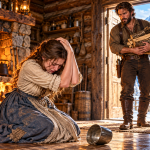
“Who’s there?”
Merritt Ainsworth held her rifle steady, its barrel pointed toward the narrow passage leading into her mountain home.
For seven days, the blizzard had swallowed every familiar sound. Now, somewhere beyond the curtain of hanging roots and snow-covered stones, a man was struggling to breathe.
“Please,” a weak voice answered. “Don’t shoot.”
Merritt recognized that voice.
And of all the people she had imagined finding outside her hidden shelter, this was the last one she expected.
“Caleb Thorne?”
A figure stumbled into the dim light.
Barnaby Thorne’s twenty-six-year-old son stood before her, his coat frozen stiff, one sleeve dark with blood. Ice clung to his eyebrows. His lips had turned a frightening shade of blue.
He took another step.
Then his knees buckled.
Merritt caught him before his head struck the stone.
“Good Lord, Caleb. What happened?”
He tried to answer, but his teeth chattered so violently that no words came.
She dragged him toward the stove, pulled a blanket from her bed, and wrapped it around his shoulders.
His left hand was swollen and pale. Two fingers looked nearly white.
Merritt had seen frostbite before.
She knew what could happen if she warmed him too quickly.
She removed his frozen outer clothing, wrapped him in dry wool, and gave him a few careful spoonfuls of warm broth.
For nearly an hour, he could do nothing but shiver.
Then he opened his eyes and stared at the stone ceiling.
“You really did it,” he whispered.
“Did what?”
“Built a house inside a mountain.”
Merritt gave him a tired look.
“According to your father, I built myself a coffin.”
Caleb closed his eyes.
“My father was wrong about more than that.”
Something in his voice made Merritt stop.
“What do you mean?”
But Caleb turned toward her with an expression she would remember for the rest of her life.
“Mrs. Ainsworth, I didn’t come here because I was lost.”
Merritt slowly set down the bowl.
“Then why did you come?”
Caleb swallowed.
“Because there are forty-three people trapped in Copperline Hollow. The church roof is failing. The schoolhouse chimney collapsed. We lost two children to the cold yesterday.”
Merritt felt the blood drain from her face.
“Two children?”
He nodded.
“And my father knows something about this mountain that he’s been hiding from everyone.”
Outside, the wind gave a low, mournful howl.
Merritt stared at him.
“What secret?”
Caleb looked toward the darkness beyond her stove.
“Your husband found something before he died.”
And suddenly, four years of unanswered questions came rushing back.
PART 2 — THE MAP JONAS LEFT BEHIND
Jonas Ainsworth had been a careful man.
He was not wealthy, educated, or particularly important in the eyes of Copperline Hollow.
But he understood stone.
He could look at a cliff and tell whether it would hold. He could strike a rock with his hammer and hear weaknesses other men missed.
Before the mine collapse, Jonas had worked as a surveyor and timberman for Barnaby Thorne.
Three weeks before his death, he came home carrying a small leather notebook.
Merritt remembered that evening clearly.
Jonas had spread several rough drawings across their kitchen table.
“There’s something strange beneath our ridge,” he told her.
“What kind of strange?”
“Old passages. Natural ones. Some may have been opened by water long before anyone settled here.”
Merritt had laughed.
“Are you telling me our mountain is hollow?”
“Not hollow,” Jonas answered. “But it has rooms.”
He had looked unusually excited.
Then he said something she never forgot.
“If I’m right, Merritt, this land is worth more than anyone knows. Not because of what can be dug out of it, but because of what it can hold.”
Three weeks later, Jonas was dead.
The mine company reported an unexpected cave-in.
Barnaby Thorne personally delivered the news.
He also brought Jonas’s belongings.
A watch.
A broken pencil.
A wedding ring.
But no notebook.
When Merritt asked about it, Barnaby claimed he had never seen one.
She had believed him.
Until now.
“Your father took Jonas’s notebook,” Merritt said.
Caleb stared into the fire.
“Yes.”
The word seemed to strike the stone walls.
Merritt gripped the edge of the table.
“How do you know?”
“Because I found it in his locked office six weeks ago.”
“Why would he keep it?”
Caleb hesitated.
“Because Jonas discovered a system of natural caverns beneath this mountain. Dry chambers. Underground springs. A second entrance on the northern slope.”
Merritt looked around her little home.
She had discovered only one chamber and a narrow passage.
She had no idea what lay beyond the dark wall at the back.
Caleb continued.
“Your husband believed the largest cavern could shelter hundreds of people. He even drew plans for a protected settlement.”
Merritt felt her throat tighten.
Jonas had always talked about building something that would last.
A home.
A place where no one could force them out.
She had thought he meant a cabin.
But perhaps he had dreamed of something much larger.
“Why did Barnaby want my land?” she asked.
Caleb lowered his head.
“Because he knew about the caverns. He wanted the northern spring and the mineral rights beneath the ridge. If he owned the land, he could control both.”
“And the mine collapse?”
Caleb looked at her sharply.
“I don’t know everything about that.”
“Tell me what you do know.”
For a long moment, he said nothing.
Then he reached inside his coat.
From beneath his shirt, he pulled a folded packet wrapped in oilcloth.
Inside were several yellowed pages.
On the first was Jonas’s unmistakable handwriting.
Merritt recognized the crooked capital J immediately.
Her hands began to tremble.
At the top of the page, Jonas had written:
NORTH RIDGE CAVERN SURVEY — SEPTEMBER 1879
Beneath it was a drawing of the mountain.
A series of passages wound through the stone like veins.
And at the center was a large chamber marked with three words.
THE GREAT HALL.
Merritt pressed the paper against her chest.
For four years, she had possessed nothing written by her husband.
Now his handwriting had returned to her from the dead.
Caleb spoke softly.
“My father didn’t want anyone to know about this place.”
“Why?”
“Because if the town discovered it could survive without depending on his coal shipments, his company store, and his buildings, he would lose much of his control.”
Merritt looked at the drawing again.
“Where is this Great Hall?”
Caleb pointed toward the rear of her chamber.
“According to Jonas, behind that wall.”
Merritt turned.
The stone wall had been there since the day she found the cave.
Solid.
Cold.
Unremarkable.
She had stacked firewood against it.
“There’s no opening.”
Caleb gave a faint, exhausted smile.
“Your husband thought there was.”
PART 3 — THE WALL THAT WASN’T A WALL
By morning, Caleb could stand with assistance.
His hand remained painful, but his breathing had steadied.
Merritt fed him the last of her dried venison and half a biscuit.
Then she examined Jonas’s drawings beside the stove.
The map showed a narrow passage behind a formation shaped like a crooked tooth.
Merritt knew that stone.
It stood near the back wall, partly hidden behind her winter firewood.
She moved the logs aside.
Caleb held a lantern while she examined the rock.
At first, she found nothing.
Then her fingers brushed a thin gap.
Cold air moved through it.
Not enough to extinguish a flame.
Just enough to tell her that somewhere beyond the stone was empty space.
Merritt fetched her iron pry bar.
She pushed it into the crack.
Nothing happened.
She tried again.
A small stone shifted.
Then another.
For two hours, she and Caleb worked carefully, loosening stones that had fallen across an old natural opening.
Finally, a gap wide enough for a person appeared.
Merritt raised the lantern.
Beyond the opening lay a passage descending into darkness.
The air smelled of stone, minerals, and something unexpectedly fresh.
Water.
Merritt turned to Caleb.
“Stay here.”
“Mrs. Ainsworth—”
“You can barely walk.”
She took Jonas’s map, tied a length of rope around her waist, and secured the other end to a heavy timber.
Then she entered the passage.
The tunnel narrowed after twenty feet.
At forty feet, she had to turn sideways.
Then it widened.
Her lantern flame flickered.
And the darkness opened.
Merritt stepped forward.
She stopped breathing.
Before her stretched a cavern so immense that her lantern could not illuminate its farthest wall.
Stone columns rose like the pillars of a cathedral.
The ceiling arched high overhead.
A shallow stream ran through a channel along one side.
And near the center stood a broad shelf of dry, level stone.
Enough space for dozens of beds.
Perhaps hundreds.
Merritt walked slowly, overwhelmed by the scale of it.
Then she noticed something else.
The air was not freezing.
It was cool, but steady.
Protected from the terrible wind outside.
Near the stream, a narrow crack released a faint breath of warmer air.
She crouched and touched the water.
Cold, but flowing.
Not frozen.
Jonas had been right.
Everything he had written was true.
Then her lantern illuminated something carved into a flat stone near the entrance.
Two initials.
J.A.
And beneath them, four words.
FOR MERRITT. FOR HOME.
Her knees nearly gave way.
She pressed one hand against the carving.
“Jonas,” she whispered.
For four years, she had grieved the little cabin they never finished.
All along, he had been searching for a way to give her something greater.
A home that storms could not tear apart.
A refuge that no wealthy man could easily take away.
And now, with an entire town freezing below the ridge, Merritt understood what her husband had meant.
The mountain was not a coffin.
It was a shelter.
And its doors had to be opened.
PART 4 — THE WOMAN THEY HAD MOCKED
When Merritt returned to the smaller chamber, Caleb was waiting beside the stove.
“Well?”
She placed Jonas’s map on the table.
“Your father wanted this mountain because it has enough shelter for the whole town.”
Caleb looked at her.
“Then you found it?”
“I found it.”
For the first time since he arrived, hope appeared on his face.
“We have to tell them.”
Merritt looked toward the entrance.
Outside, the snow lay deep enough to bury a horse.
The road into Copperline Hollow had disappeared.
The wind was weakening, but the temperature remained deadly.
“How far is the church?”
“Nearly six miles by the lower road.”
“We can’t take the lower road.”
Caleb nodded.
“There’s an old miners’ trail across the ridge.”
Merritt studied the map.
Jonas had marked a second opening on the northern slope.
A narrow path led from it toward the abandoned upper mine road.
If that passage remained open, it might shorten the journey.
But they needed to find it.
They needed to make sure the cavern was safe.
And they needed to move people before another storm arrived.
Merritt glanced at the provisions lining her shelves.
Twenty jars of preserved vegetables.
Three sacks of potatoes.
A barrel of dried beans.
Two small bags of flour.
Not enough for a town.
But enough to keep the weakest alive while help was organized.
She had also collected wood, coal, and lamp oil for months.
Every time someone laughed at her strange mountain home, she had kept working.
Every time Barnaby offered money, she had refused.
Every time loneliness whispered that she was wasting her life, she had carried another stone, split another log, or sealed another crack.
Now those ordinary acts of stubbornness might matter more than anything she had ever done.
She turned to Caleb.
“Can you ride?”
“Not well with this hand.”
“Can you stay in a saddle?”
“Yes.”
“Then we’ll go together.”
Caleb stared at her.
“After what my father did?”
Merritt pulled on her heavy coat.
“The children down there didn’t do anything to me.”
She took her rifle from the wall.
“And neither did most of their parents.”
PART 5 — THE JOURNEY THROUGH THE SNOW
Merritt’s mule, Deacon, had survived the storm in a sheltered stone recess near the cave entrance.
He greeted her with an indignant bray, as if blaming her personally for the weather.
Merritt brushed snow from his thick coat.
“Don’t start with me, old boy. We’ve got work.”
She loaded blankets, food, lanterns, rope, and two shovels onto his pack saddle.
Caleb rode the mule for the steepest part of the trail while Merritt walked ahead, testing the snow with a long pole.
The journey was brutal.
Snowdrifts reached Merritt’s waist.
Twice, she sank into hidden hollows.
Once, a slab of snow broke loose above them and slid across the trail.
They waited, trembling, until the mountain settled.
By late afternoon, the church steeple appeared through the trees.
Copperline Hollow looked abandoned.
Smoke rose from only a few chimneys.
The general store’s windows were boarded.
A wagon lay overturned in the street.
And outside the church, several men were chopping apart wooden benches for firewood.
Merritt stopped.
The sight struck her harder than the cold.
Those same men had laughed at her six weeks earlier.
They had called her foolish.
Crazy.
A widow who had finally lost her senses.
Now they were burning the very furniture on which their families sat each Sunday.
A man looked up.
“Is that Merritt Ainsworth?”
Another dropped his ax.
“Good heavens. We thought you were dead.”
Merritt walked straight toward the church.
“How many people are inside?”
“Forty-three,” the man answered. “Maybe forty-four. Mrs. Ellison had her baby yesterday.”
Merritt felt her heart twist.
“A newborn?”
He nodded.
“Mother’s weak. Baby’s worse.”
Merritt pushed through the doors.
The church smelled of smoke, damp wool, and sickness.
Families huddled beneath blankets.
Children slept against their mothers.
A man lay coughing near the altar.
And beside the stove sat Barnaby Thorne.
The richest man in Copperline Hollow looked twenty years older than he had a month earlier.
His expensive coat was torn.
His cheeks were hollow.
He looked up as Merritt entered.
For several seconds, he said nothing.
Then his eyes moved to Caleb.
“Son?”
Caleb stepped forward.
“Father.”
Barnaby struggled to his feet.
“I thought I’d lost you.”
“You nearly did.”
The two men embraced awkwardly.
Then Barnaby noticed Merritt watching.
His face hardened.
“What are you doing here?”
Merritt looked around the church.
“I came to take these people somewhere warm.”
A bitter laugh escaped him.
“Where? Your cave?”
“Yes.”
The church fell silent.
Barnaby stared at her.
“You expect forty-three people to crawl into a hole in the mountain?”
Merritt held his gaze.
“No, Mr. Thorne.”
She unfolded Jonas’s map.
“I expect them to walk into the shelter my husband discovered before he died.”
Barnaby’s expression changed.
Not much.
But enough.
And Merritt saw it.
Fear.
PART 6 — THE TRUTH BARNABY COULDN’T BURY
Caleb stepped beside Merritt.
“Tell them, Father.”
Barnaby looked at his son.
“Tell them what?”
“About Jonas Ainsworth’s survey.”
Several townspeople lifted their heads.
Merritt spread the yellowed pages across a pew.
“Four years ago, my husband found a natural cavern system beneath our ridge. One chamber is large enough to shelter every family here.”
The schoolteacher, Miss Lydia Bell, approached.
“Are you certain?”
“I stood inside it yesterday.”
A murmur passed through the room.
Merritt continued.
“It has a flowing spring, dry ground, and enough space to build sleeping areas. The temperature stays above the freezing conditions outside.”
An elderly miner named Silas Boone leaned forward.
“Jonas always said that mountain had a warm heart.”
Merritt turned to him.
“You knew?”
Silas nodded slowly.
“He told me once that the ridge breathed. Said there were passages through the stone.”
Barnaby suddenly rose.
“This is nonsense. Even if such a cavern exists, moving sick people through deep snow would be madness.”
Merritt faced him.
“Leaving them here to freeze isn’t?”
Barnaby opened his mouth.
No words came.
Then Caleb spoke.
“My father knew about the caverns. He kept Jonas’s survey hidden.”
The silence that followed was complete.
Barnaby turned pale.
“Caleb.”
“No, Father. Not this time.”
Caleb placed the oilcloth packet on the pew.
“I found the survey in your office. I also found correspondence about acquiring the Ainsworth property and diverting the northern spring.”
Silas Boone stood.
“That spring feeds the upper creek.”
Caleb nodded.
“And the company wanted control of it.”
Merritt stared at Barnaby.
“That’s why you offered me fifteen hundred dollars.”
Barnaby looked away.
“You had no use for that land.”
“It was mine.”
“You couldn’t afford to develop it.”
“That didn’t make it yours.”
For the first time, the powerful mine owner had no answer.
But Merritt wasn’t finished.
“Did Jonas die because he found the caverns?”
Barnaby flinched.
The question hung in the church like a tolling bell.
Finally, he spoke.
“The mine collapse was an accident.”
“Then why did you hide his notebook?”
Barnaby looked toward the stove.
“Because after he died, I realized what his discovery could mean for my business.”
Merritt’s voice grew quiet.
“Did you know the mine was unsafe?”
Barnaby closed his eyes.
“I knew Jonas had raised concerns about the eastern supports.”
Silas Boone took a step forward.
“What concerns?”
Barnaby’s shoulders sagged.
“He wanted that section closed until the timbers were replaced.”
Merritt felt as though the floor had shifted beneath her.
“And you refused?”
Barnaby said nothing.
Caleb looked at his father in disbelief.
“Tell her.”
At last, Barnaby whispered, “I delayed the repairs.”
Merritt gripped the pew.
The church seemed very far away.
For four years, she had imagined the collapse as a terrible act of fate.
A mountain taking the man she loved.
Now she understood that someone had been warned.
Someone had decided the cost of stopping work was too high.
And Jonas had paid for that decision.
Barnaby lowered his head.
“I never intended for anyone to die.”
Merritt’s eyes filled with tears.
“Neither did Jonas.”
No one spoke.
Then, from the back of the church, a baby began to cry.
A thin, weak sound.
Merritt turned toward it.
There would be time for anger.
There would be time for the truth.
But not while people were freezing.
She wiped her eyes.
“Anyone who can walk, help carry someone who can’t. We leave at first light.”
PART 7 — THE LONGEST NIGHT
That evening, Merritt organized the town.
Silas Boone and three miners gathered tools.
Lydia Bell counted the children.
The blacksmith, Aaron Pike, repaired two sled runners.
Women divided the remaining food into small portions.
Barnaby stood apart, watching.
No one asked him for instructions.
For the first time in years, Copperline Hollow was making decisions without him.
Merritt moved from family to family, checking boots, blankets, and coats.
She found Mrs. Ellison near the altar.
The young mother was pale and exhausted.
Her newborn daughter lay against her chest, barely moving.
Merritt knelt beside her.
“What’s her name?”
“Hope,” the woman whispered.
Merritt looked at the tiny face.
“That’s a fine name.”
“Will she live?”
Merritt could not promise what she did not know.
But she placed her hand gently over the mother’s.
“We’re going to give her every chance.”
That night, the church roof groaned beneath the snow.
At midnight, a beam cracked.
The sound sent everyone scrambling.
Silas examined the ceiling and returned with a grim expression.
“We can’t wait until morning.”
Merritt looked outside.
The moon had appeared between racing clouds.
The wind was quieter.
But the temperature had fallen again.
She made her decision.
“We leave now.”
Within an hour, the townspeople were gathered in the street.
Children were wrapped in quilts.
The sick lay on sleds.
Lanterns swung from poles.
Deacon stood at the front, his ears flattened against the cold.
Merritt counted everyone twice.
Forty-three people.
Then forty-four.
Little Hope made the number complete.
Barnaby approached her.
“I have three horses in my stable,” he said. “They’re weak, but they can pull.”
Merritt looked at him.
“Then bring them.”
He hesitated.
“Mrs. Ainsworth, I—”
“Not now.”
She turned toward the mountain.
“Help me get them there.”
And so, beneath a pale winter moon, the people of Copperline Hollow began the hardest journey of their lives.
PART 8 — THE MOUNTAIN OPENS ITS DOORS
The first mile took nearly two hours.
Snow swallowed their boots.
Sled runners caught on buried branches.
The youngest children cried from exhaustion.
Several times, Merritt feared they would have to turn back.
But there was nowhere safe to return to.
At the old mining road, Silas found a buried marker Jonas had placed years earlier.
Merritt held the lantern close.
A small J had been carved into the wood.
Beside it was an arrow.
She smiled through frozen tears.
“He’s still showing us the way.”
The trail climbed through thick pines.
At one point, a sled overturned.
Barnaby rushed forward and helped lift the elderly woman riding on it.
He carried her across the drift himself.
No one thanked him.
He did not ask them to.
Near dawn, the mountain entrance finally appeared.
The great stone arch rose above the snow, almost invisible beneath the cliff.
Merritt hurried ahead.
She pushed aside the hanging branches.
Then she turned and called into the darkness.
“Deacon, home!”
The mule brayed.
Several exhausted children laughed.
It was the first laughter Merritt had heard in days.
One by one, the townspeople entered the sheltered chamber.
They stopped in astonishment.
A wooden cabin stood against the rock wall.
Lanterns glowed on shelves.
Barrels of food lined the lower ledge.
A stove radiated warmth.
Above them, stone curved into a ceiling untouched by snow or wind.
Lydia Bell covered her mouth.
“You built all this?”
Merritt nodded.
“One board at a time.”
Silas Boone looked around.
“Good Lord. We called you mad.”
Merritt gave him a weary smile.
“You weren’t the only one.”
Then she led them through the passage into the Great Hall.
The reaction was something she would never forget.
Forty-four people stood beneath the vast stone ceiling.
Lantern light danced across pillars that had waited in darkness for centuries.
The underground stream murmured beside them.
A child whispered, “Are we inside a castle?”
“No,” Merritt answered softly.
“You’re inside a mountain.”
The boy considered this.
Then he smiled.
“I like it better.”
PART 9 — THE WINTER COMMUNITY
The next three days transformed the cavern.
Silas and the miners checked the rock overhead, marked safe walking areas, and closed off unstable side passages.
Aaron Pike built a second stove from iron pieces Merritt had salvaged from her ruined cabin.
Barnaby and Caleb organized trips to the abandoned upper storehouse, bringing back flour, coal, and blankets.
The women arranged sleeping spaces.
Lydia Bell established a small classroom near the warmest wall.
Children gathered around her with slate boards and pieces of chalk.
For the first time since the blizzard began, the town had a routine.
Morning brought warm porridge.
Afternoon brought work.
Evening brought stories, prayers, and quiet conversations beside the stoves.
Merritt’s jars of preserved vegetables became precious.
Her potatoes were divided carefully.
The underground spring supplied water.
The dry stone shelves kept food protected.
And the mountain itself shielded them from the storms outside.
But survival was not easy.
Food remained scarce.
Several people were sick.
Little Hope struggled through her first week.
One evening, Merritt found Mrs. Ellison crying beside the stream.
“She’s so small,” the young mother whispered.
Merritt sat beside her.
“She is.”
“I’m afraid to sleep.”
Merritt looked at the baby wrapped against her mother’s chest.
“Then I’ll sit with you awhile.”
And she did.
For three nights, Merritt took turns with the other women, helping the exhausted mother rest and keeping the infant warm.
On the fourth morning, Hope began to cry loudly.
A strong, indignant cry.
Mrs. Ellison laughed and wept at the same time.
Merritt looked up from the stove.
“Now that’s a sound I like.”
The whole cavern seemed to breathe easier.
PART 10 — THE LETTER THAT CHANGED EVERYTHING
Two weeks after the evacuation, Caleb approached Merritt with another document.
He found her repairing a blanket near the stove.
“There’s something else you should see.”
Merritt looked up.
“What is it?”
Caleb sat across from her.
“My father gave me this yesterday.”
He handed her an envelope.
The paper was old and stained.
On the front, in Jonas’s handwriting, were two words.
For Merritt.
She stared at it.
“Where did he get this?”
“It was among Jonas’s papers. Father says he kept it because he feared it might reveal the survey.”
Merritt opened the envelope with trembling fingers.
Inside was a letter.
My dearest Merritt,
If you are reading this, then perhaps I have been delayed longer than I intended.
I have found something remarkable beneath our ridge.
The mountain holds a great chamber where the wind cannot reach, and water flows even when the valley freezes.
I know you laugh when I speak of building a home that will outlast us both.
But I believe this place could become more than a home.
Someday, if winter comes cruelly enough, people may need shelter here.
Not just us.
Others.
Families with nowhere else to go.
I want our land to be a place where a person is never turned away simply because they have nothing to offer.
I know what it means to be poor.
I know what it means to be told you do not belong.
And I know what it means to find a woman who makes even the hardest country feel like home.
That woman is you.
If I never finish what I started, promise me one thing.
Do not let anyone convince you that what we dreamed was foolish.
A good home is not measured by the money spent building it.
It is measured by the lives made safer inside it.
All my love,
Jonas
Merritt read the letter once.
Then again.
By the third reading, the words had blurred beneath her tears.
Caleb sat quietly.
Finally, Merritt folded the paper and pressed it against her heart.
“He knew,” she whispered.
Caleb looked at her.
“Knew what?”
“That someday someone would need this place.”
She glanced toward the Great Hall.
Children were playing beside the stone pillars.
Women were preparing supper.
Silas was helping an elderly man repair his boots.
Little Hope slept in her mother’s arms.
Merritt smiled through her tears.
“And he was right.”
PART 11 — THE PRICE OF A SECRET
As the weather improved, word of the cavern reached neighboring settlements.
A rescue party arrived from the south carrying medicine, flour, and news.
The winter had devastated much of the region.
Barns had collapsed.
Livestock had frozen.
Roads remained blocked.
Several remote homesteads had been abandoned.
But every person who had entered Merritt’s mountain refuge was still alive.
The story spread quickly.
The widow who had been mocked for living in a cave had saved the people who mocked her.
Yet Merritt did not feel triumphant.
She was too busy.
There were meals to prepare.
Children to comfort.
Repairs to finish.
And there was still the matter of Barnaby Thorne.
One morning, he asked to speak with her privately.
They met beside the underground stream.
He looked smaller without his fine clothes and polished boots.
For a while, he simply watched the water move over the stones.
Then he said, “I owe you an apology.”
Merritt waited.
“I was greedy,” he continued. “I believed everything could be bought if I offered enough money.”
“You tried to buy the only thing Jonas left me.”
“I know.”
“And you hid his work.”
“Yes.”
Merritt looked at him.
“You also ignored his warning about the mine.”
Barnaby’s face tightened.
“Yes.”
The admission came without excuses.
He reached into his coat and withdrew a packet of documents.
“I’ve written a full account of what happened. The mine inspection, Jonas’s objections, my decision to delay the repairs, and the records I kept afterward.”
Merritt took the packet.
“What do you expect me to do with this?”
“Whatever you believe is right.”
She studied him.
“Why now?”
Barnaby looked toward the Great Hall.
“Because my son nearly died trying to correct what I had done. And because the people I thought depended on me survived only after you opened your door.”
He paused.
“I have spent my life building things with my name on them. But when the storm came, none of them protected anyone.”
Merritt did not forgive him that morning.
Some wounds were too deep for a single conversation.
But she accepted the documents.
When the county authorities could finally reach Copperline Hollow, she delivered them for investigation.
The records confirmed that Jonas had warned about unsafe supports before the collapse.
Barnaby faced legal and financial consequences for his decisions.
The truth could not bring Jonas home.
But it gave Merritt something she had been denied for four years.
An answer.
And the knowledge that her husband had tried to protect others until the end.
PART 12 — SPRING RETURNS TO COPPERLINE HOLLOW
By April, snowmelt ran down the slopes.
The roads reopened.
Families began returning to their damaged homes.
Some found roofs missing.
Others found frozen wells and broken fences.
Several had nothing left worth repairing.
Merritt expected the cavern to become quiet again.
She imagined returning to her small wooden room, tending her garden, and listening to the underground stream.
But one afternoon, Lydia Bell arrived carrying a bundle of papers.
Behind her stood Silas Boone, Aaron Pike, Mrs. Ellison, and several other townspeople.
Merritt looked up from planting seeds in wooden boxes near the cave entrance.
“What’s all this?”
Lydia smiled.
“We have a proposal.”
Merritt raised an eyebrow.
“That sounds expensive.”
Silas chuckled.
“Not nearly as expensive as freezing to death.”
Lydia unfolded the papers.
The townspeople wanted to establish a permanent emergency shelter inside the mountain.
They proposed building proper sleeping rooms, food storage areas, a protected kitchen, and a medical station.
They also wanted to repair the upper trail and mark the safe entrances.
And they wanted Merritt to oversee it.
She stared at them.
“Me?”
“Who else?” Lydia asked.
Merritt shook her head.
“I’m not a builder.”
Silas pointed toward the wooden cabin.
“You built that.”
“I’m not an engineer.”
“You found the Great Hall.”
“I’m not wealthy.”
Aaron Pike smiled.
“Neither are we.”
Merritt looked at the faces surrounding her.
These were the people who had once laughed at her.
Some had called her a fool.
Others had predicted she would die alone inside the mountain.
Now they stood before her asking to help complete Jonas’s dream.
Mrs. Ellison stepped forward, carrying Hope.
The baby was plump and healthy now, her cheeks rosy.
“We want this place to be here for our children,” she said.
“And their children.”
Merritt looked down at the papers.
At the top was a proposed name.
AINSWORTH HAVEN.
Her eyes filled.
“Why that?”
Lydia answered gently.
“Because your husband discovered it. And you had the courage to open it.”
Merritt looked toward the mountain.
Then back at the townspeople.
“One condition.”
Silas folded his arms.
“Let’s hear it.”
“No one is ever turned away because they can’t pay.”
Lydia smiled.
“That was already the first rule.”
PART 13 — THE MAN WHO CAME BACK
That summer, Caleb Thorne returned to the mountain carrying a wooden crate.
Merritt was working beside the garden when he arrived.
His frostbitten hand had healed, though two fingers remained stiff.
He had left his father’s mining company and taken work helping rebuild the damaged roads.
“Afternoon, Mrs. Ainsworth.”
“Afternoon, Caleb.”
He placed the crate on a stone ledge.
“I brought something.”
Inside were books.
A dozen of them.
Some were about stonework and construction.
Others contained medical advice, gardening instructions, and maps.
Merritt picked up a worn volume.
“Where did you find these?”
“Denver. I thought they might be useful.”
“They will.”
Caleb hesitated.
“There’s something else.”
Merritt looked up.
“I’ve been offered work surveying land near Leadville.”
“That’s good news.”
“It is.”
He glanced toward the cavern.
“But I was hoping I could stay here until autumn. Help with the new shelter.”
Merritt smiled.
“We could use another pair of hands.”
Caleb looked relieved.
Then he added, “My father is selling most of his property to settle what he owes.”
Merritt said nothing.
“He asked me to tell you he’s sorry.”
She looked toward the valley.
“I believe he is.”
“Do you forgive him?”
Merritt considered the question carefully.
“Forgiveness isn’t the same as pretending something never happened.”
Caleb nodded.
“No.”
“Maybe someday I can let go of all the anger. But Jonas deserved better. And your father has to live with what he chose.”
Caleb lowered his eyes.
“That’s fair.”
Merritt picked up the crate.
“Now, if you’re staying, you can start by helping me carry these books inside.”
He laughed.
“Yes, ma’am.”
And together, they walked toward the mountain.
PART 14 — THE WINTER THAT CAME AGAIN
The following December, another storm swept across the Colorado mountains.
It was not as fierce as the previous winter.
But it was strong enough to close the roads for five days.
This time, Copperline Hollow was ready.
Ainsworth Haven held sacks of flour, dried meat, preserved vegetables, coal, firewood, and blankets.
The entrance had been reinforced.
The passage to the Great Hall had been widened and fitted with sturdy wooden supports where needed.
The underground stream was protected from contamination.
Several small cabins stood on the sheltered ledge near the entrance.
And a bell had been mounted beside the main doorway.
When the storm warning came, families did not panic.
They packed what they needed and climbed the marked trail.
By evening, seventy-two people had gathered inside the mountain.
Children played beneath the stone pillars.
Women prepared soup in enormous iron pots.
Men checked the stoves and carried supplies.
Lydia Bell read aloud from a book while the youngest children gathered around her.
Merritt stood near the entrance, watching snow fall beyond the great arch.
Deacon stood beside her, older and grayer, chewing contentedly on a mouthful of hay.
She scratched his neck.
“You found us a good place, old boy.”
The mule flicked one ear.
“Don’t act so proud.”
Behind her, a small voice called, “Miss Merritt!”
She turned.
A little girl was running toward her.
Hope Ellison, now nearly a year old, toddled across the stone floor with her mother following close behind.
The child reached for Merritt’s skirt.
Merritt lifted her into her arms.
“Well, hello there, little one.”
Hope laughed.
Merritt carried her toward the entrance.
Outside, snow swept across the valley.
Inside, seventy-two people were warm.
And for the first time in many years, Merritt no longer felt alone.
PART 15 — WHAT THE MOUNTAIN REMEMBERED
Years passed.
Copperline Hollow changed.
The mining industry rose and fell.
Families came and went.
Children grew into adults.
Some moved away.
Others returned.
But Ainsworth Haven remained.
Each autumn, volunteers inspected the trails, cleaned the storage rooms, checked the stoves, and replenished the food supplies.
Each winter, the shelter stood ready.
Travelers caught in sudden storms found refuge there.
Families whose homes burned found temporary rooms.
Hungry strangers received meals.
And no one was asked how much money they carried before being offered a place beside the fire.
Merritt grew older.
Her hair turned silver.
Her hands became rough and stiff from years of work.
But every morning, she still walked to the mountain entrance and watched the sun rise over the snowy peaks.
Sometimes she remembered the general store.
The laughter.
The cruel jokes.
The men who said she was digging her own grave.
She remembered the first night she slept inside the cave, wrapped in two blankets, frightened that she had made a terrible mistake.
She remembered the sound of footsteps on the seventh day of the blizzard.
And she remembered Jonas’s words.
A good home is not measured by the money spent building it.
It is measured by the lives made safer inside it.
One spring morning, many years after the great storm, Merritt sat outside the entrance with Lydia Bell, now an elderly woman herself.
Children were playing near the garden.
The underground stream could be heard through the open doorway.
Lydia looked at the stone arch.
“Do you ever think about what would have happened if you’d sold the land?”
Merritt smiled faintly.
“Sometimes.”
“Barnaby would have owned the whole mountain.”
“Yes.”
“And none of us would have known about the cavern when the blizzard came.”
Merritt looked toward the valley.
“Maybe.”
Lydia shook her head.
“You always refuse to take credit.”
Merritt laughed softly.
“I didn’t make the mountain.”
“No,” Lydia said. “But you opened the door.”
For a long time, neither woman spoke.
Then Lydia asked, “Do you miss your old cabin?”
Merritt thought about the crooked walls, the leaking roof, and the cold nights when she had tried so desperately to make it livable.
She remembered how ashamed she had felt when it failed.
How she had believed that losing the cabin meant losing the last part of Jonas.
Then she looked at the great stone entrance.
At the children.
At the gardens.
At the warm windows glowing inside the mountain.
“No,” she answered.
“I think I finally understand what Jonas was trying to build.”
THE FINAL ENDING — THE HOUSE THAT OUTLIVED THEM ALL
When Merritt Ainsworth passed away at the age of seventy-eight, the people of Copperline Hollow carried her to a small cemetery overlooking the ridge.
There was no grand funeral procession.
No expensive marble monument.
No speeches about wealth or power.
Instead, families came from every settlement within a day’s journey.
Old miners.
Teachers.
Farmers.
Travelers.
Children who had once slept safely inside the mountain during terrible storms.
And among them stood a middle-aged woman named Hope Ellison, holding the hand of her own daughter.
Hope had been the newborn carried through the snow on the night Merritt opened the mountain.
She had grown up hearing the story.
Now she told it to her child.
“That woman saved my life before I was old enough to know what life was.”
The little girl looked toward the mountain.
“Did she live in there?”
Hope smiled.
“Yes.”
“Wasn’t she scared?”
“Sometimes.”
“Then why did she stay?”
Hope looked at the stone arch rising above the pines.
“Because she knew that being afraid didn’t mean she was wrong.”
After the funeral, the townspeople gathered inside Ainsworth Haven.
Above the entrance, they placed a wooden sign.
It carried Merritt’s name.
And beneath it, a sentence copied from Jonas’s final letter.
A HOME IS MEASURED BY THE LIVES MADE SAFER INSIDE IT.
For generations afterward, the mountain shelter remained a place of refuge.
Storms came.
Roads vanished.
Hard winters returned.
But whenever travelers reached the stone arch, they found a lantern burning and a door waiting to be opened.
The people of Copperline Hollow never forgot the winter of 1883.
They never forgot how close they had come to losing everything.
And they never forgot the lonely widow they had once mocked.
Because the woman they thought was building herself a coffin had actually been building a future.
The wealthy mine owner had offered her fifteen hundred dollars for the land.
She refused.
The townspeople called her foolish.
She kept working.
The winter tried to bury her.
She survived.
And when the people who had laughed at her came freezing to her door, she did not ask who had been kind to her.
She simply let them in.
That was the secret of Merritt Ainsworth’s mountain.
Not the hidden spring.
Not the enormous cavern.
Not even the stone walls that could withstand the fiercest blizzard.
The greatest secret was something no surveyor could draw on a map and no wealthy man could purchase.
It was the belief that a home became truly valuable only when there was room for someone else.
And long after Merritt’s footprints had disappeared from the mountain trail, the lantern at Ainsworth Haven continued to burn.
Not because the world had become less cruel.
But because one woman had decided that cruelty would stop at her door.
THE END.