PART 5 — THE WOMAN WHO BUILT A LEGEND (FINAL)
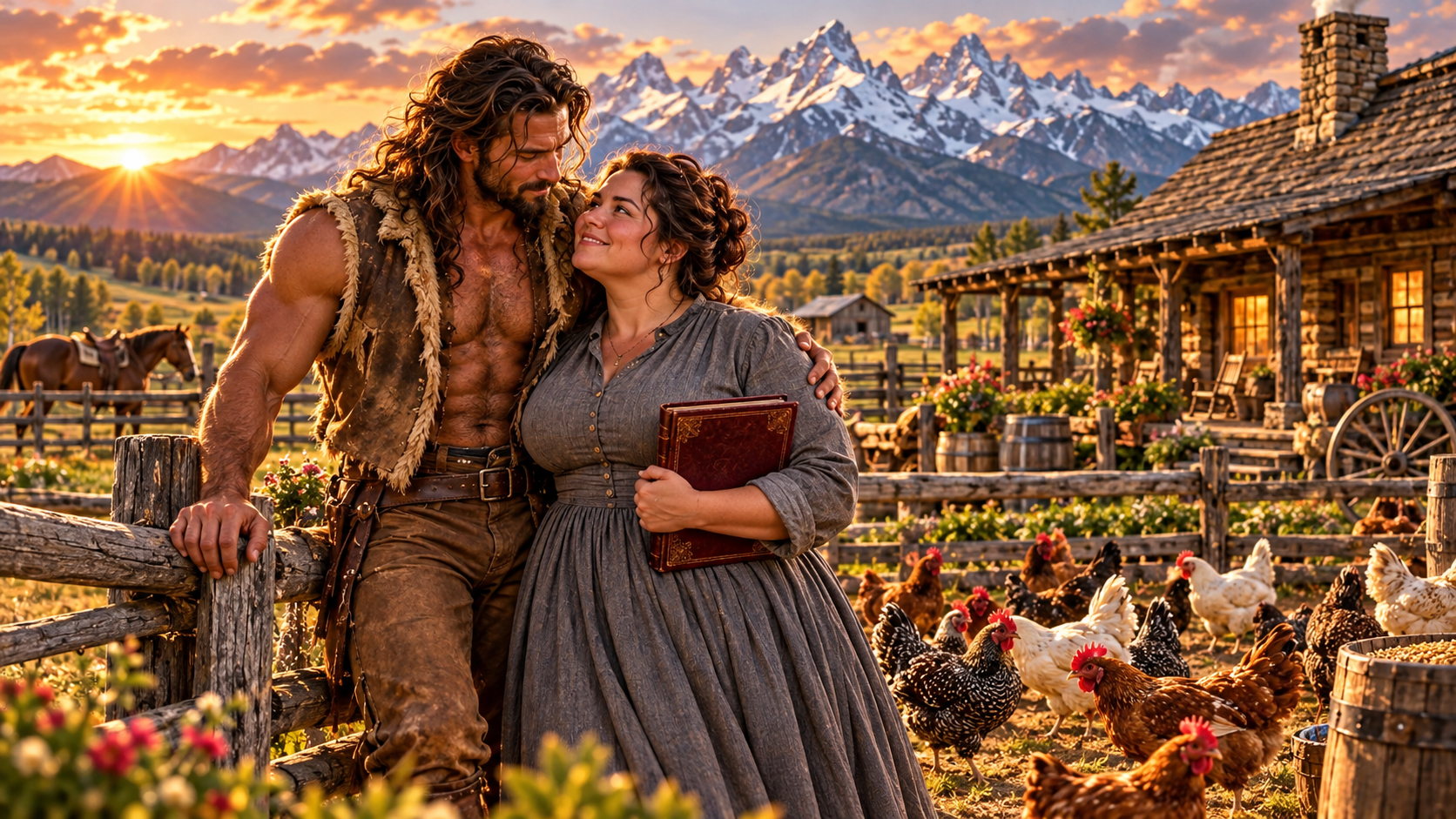
He Wanted a Wife to Tend the Chickens—She Turned His Bankrupt Homestead Into a Frontier Legend
The gunshot shattered the silence inside Harrison Caldwell’s bank.
Glass rained from the ceiling.
The hanging oil lamp crashed against the floor, spilling burning fuel across the polished boards.
Then darkness swallowed the room.
“GRIFFIN!”
Mattie Tucker heard her husband’s voice somewhere beside her.
A body struck the desk.
Someone screamed.
Another gunshot exploded.
And Silas Rourke shouted, “KILL THEM!”
Mattie had already made her move.
She seized the heavy iron cash drawer with both hands and swung it into the nearest gunman’s stomach.
The man doubled over.
She struck him again across the shoulder.
His revolver clattered to the floor.
Griffin caught the second attacker by the collar and drove him backward into the bookcase.
The man’s head struck the wooden frame.
Ledgers tumbled from the shelves.
Sheriff Briggs fired toward the ceiling.
“EVERYBODY DOWN!”
For one terrible moment, the room filled with smoke, shouting, and the smell of burning oil.
Then Thomas Reed grabbed the water pitcher from Caldwell’s desk and threw its contents across the spreading flames.
The fire hissed.
Mattie dropped behind the desk.
A bullet tore through the wood above her head.
Splinters scattered across her shoulders.
She pressed herself against the floor.
Her heart pounded so violently she could barely hear.
Then she saw it.
The velvet ledger.
It had slid beneath the open cash drawer.
One brass corner caught the dim morning light.
Mattie reached for it.
A boot slammed onto the floor inches from her fingers.
Silas Rourke stood over her.
His revolver pointed directly at her face.
“Enough, Mrs. Tucker.”
She froze.
The gunman’s expression was no longer amused.
He looked furious.
Desperate.
And more dangerous than ever.
“You’ve cost me a fortune.”
Mattie looked slowly toward Griffin.
He stood near the shattered bookcase, struggling to keep one of Rourke’s men pinned against the wall.
His injured shoulder had begun bleeding again.
Sheriff Briggs was wrestling with the other attacker.
Thomas Reed crouched beside the unconscious judge.
No one could reach her in time.
Rourke cocked his pistol.
“Hand me the ledger.”
Mattie looked up.
“You won’t get away with this.”
He smiled.
“People have been saying that for fifteen years.”
“Not anymore.”
Rourke leaned closer.
“You think these farmers will stand against me? Half of them can barely read their own contracts.”
Mattie’s expression changed.
“You underestimate them.”
He laughed.
“The same way Tucker underestimated you?”
She said nothing.
Rourke’s smile widened.
“That’s right. I heard about the advertisement.”
He glanced toward Griffin.
“A desperate rancher looking for a woman to feed chickens and scrub floors.”
Mattie’s jaw tightened.
“And instead he got a woman who thinks she can destroy powerful men.”
Rourke lowered the pistol slightly.
“Tell me, Martha. Did you really believe a man like Griffin Tucker would ever love a woman like you?”
The insult hung in the smoky air.
Once, those words might have broken her.
She remembered the men who had laughed when she entered a room.
The women who whispered about her size.
The marriage proposals that never came.
The way Griffin had stared when she first stepped off the train.
She remembered feeling too large for the world and too small to matter.
But she also remembered the man who held her beside the burning barn.
The man who kissed her forehead.
The man who told her that she was wanted.
And the man now fighting through a room full of armed criminals to reach her.
Mattie looked Rourke directly in the eyes.
“Yes.”
He blinked.
She smiled.
“I believe he loves me.”
Then she grabbed the metal cash drawer and shoved it against his knees.
Rourke staggered.
His pistol fired.
The bullet struck the ceiling.
Griffin turned at the sound.
“MATTIE!”
She rolled aside as Rourke fell against the desk.
The gunman’s revolver skidded across the floor.
Griffin lunged.
Despite his injured shoulder, he caught Rourke by the coat and slammed him against the wall.
The impact shook the shelves.
“You threatened my wife.”
Rourke struggled.
Griffin struck him.
“You burned my home.”
Another blow.
“You stole from my father.”
Rourke collapsed against the desk.
Griffin raised his fist again.
Then Mattie’s voice stopped him.
“Griffin.”
He froze.
She stood beside him, breathing hard.
Her face was pale.
Her dark dress was stained with soot.
But her eyes were steady.
“Don’t.”
Griffin stared at Rourke.
Every instinct urged him to finish what had begun eleven years earlier.
For his father.
For Mattie’s father.
For every family that had lost its land.
But Mattie stepped closer.
“If you kill him, he becomes another dead man whose secrets are buried.”
Griffin’s hand trembled.
She touched his arm.
“We need him alive.”
Rourke laughed weakly.
“You think a courtroom will stop me?”
Mattie looked down at him.
“No.”
She picked up the black private ledger from the floor.
“The truth will.”
At that moment, Sheriff Briggs seized Rourke’s wrists and locked them in iron handcuffs.
“Silas Rourke,” he said, “you’re under arrest for attempted murder, arson, conspiracy, and fraud.”
Rourke spat blood onto the floor.
“You don’t have the authority.”
Briggs tightened the cuffs.
“Then I’ll find someone who does.”
He hauled the man upright.
Outside, the first rays of sunlight touched the streets of Laramie.
And for the first time in years, Silas Rourke walked into town without a gun at his hip.
He walked in chains.
But the battle was not over.
Caldwell’s alleged death had left the bank in chaos.
Judge Whitcomb had been taken into custody for questioning.
The development syndicate was already claiming that its contracts remained valid.
And the Broken Spur still faced a foreclosure order.
Mattie understood something Griffin did not.
Winning a gunfight was not the same as winning a legal battle.
Their enemies still had money.
Lawyers.
Political influence.
And documents designed to make theft look respectable.
But now Mattie had something stronger.
Evidence.
Witnesses.
And an entire valley beginning to understand that its suffering had not been accidental.
Three days later, a federal investigator arrived in Laramie.
His name was Edward Whitaker.
He was a thin, serious man with gray hair, wire-rimmed spectacles, and a habit of asking questions twice.
He had been summoned after Sheriff Briggs forwarded copies of the fraudulent account records and land agreements.
Whitaker spent two days examining the books.
On the third morning, he requested a meeting with Mattie and Griffin.
They entered the sheriff’s office together.
Griffin wore his arm in a sling.
Mattie carried her velvet ledger.
Whitaker motioned them toward two chairs.
“Mrs. Tucker, I’ve been reviewing your work.”
Mattie sat.
“I hope you found it useful.”
He looked at her for a long moment.
“Useful?”
He lifted a thick folder.
“Madam, you have documented a financial conspiracy involving fraudulent mortgages, bribery, unlawful transfers, and manipulation of property rights across several counties.”
Griffin looked at his wife.
Mattie merely folded her hands.
“I was taught to keep careful records.”
Whitaker almost smiled.
“So I can see.”
He turned toward Griffin.
“Mr. Tucker, the bank’s own books show that your father’s payments were received and deliberately concealed.”
Griffin swallowed.
“Then the debt…”
“Was manufactured.”
The words seemed to empty the air from his lungs.
Whitaker continued.
“Your family appears to have been entitled to clear ownership long before Caldwell began foreclosure proceedings.”
Griffin looked down at his hands.
For years, he had carried shame like a stone inside his chest.
Every failing crop.
Every unpaid bill.
Every winter spent wondering whether he had disappointed his dead father.
He had believed the Broken Spur was dying because he was not strong enough to save it.
Now a stranger sat before him and said the ruin had been engineered.
His father had not failed.
He had not failed.
They had been robbed.
Griffin bent forward.
His shoulders began to shake.
Mattie immediately reached for him.
He covered his face.
“I’m sorry,” he whispered.
Whitaker looked away respectfully.
Mattie rested her hand against Griffin’s back.
“There’s nothing to apologize for.”
He shook his head.
“I thought he left me debts.”
His voice broke.
“I spent years angry with him.”
Mattie’s eyes filled.
“He left you a home.”
Griffin looked at her.
“And he tried to protect it.”
For a long moment, neither spoke.
Then Whitaker continued.
“The foreclosure order has been suspended pending a full review. The evidence also supports action against the false liens.”
Griffin slowly straightened.
“The ranch is ours?”
Whitaker nodded.
“Subject to the court’s final determination, your family’s claim appears sound.”
Mattie squeezed Griffin’s hand.
But the investigator was not finished.
“There’s another matter.”
He opened a second folder.
“Mrs. Tucker, you told Sheriff Briggs that your father died after being falsely accused of embezzlement.”
Mattie’s expression changed.
“Yes.”
Whitaker removed a yellowed document.
“We found this in a sealed packet hidden among Caldwell’s private correspondence.”
Mattie stared at the handwriting.
Her breath caught.
Samuel Cole.
Her father.
She recognized it immediately.
Whitaker placed the letter before her.
“It appears your father prepared a sworn statement before his death.”
Mattie’s hands began trembling.
She opened it.
My dearest Martha,
If these words ever reach you, I hope they find you safe and living a life far kinder than the one I have been able to provide.
I know what people will say about me.
They will call me dishonest.
They will tell you I stole money.
They will say I brought disgrace upon our family.
But I want you to understand one thing.
I did not steal.
I did not betray the people who trusted me.
And I never stopped trying to protect you.
Mattie’s vision blurred.
She pressed a hand over her mouth.
Griffin leaned closer.
The letter continued.
Nathaniel Tucker is an honorable man.
He risked his livelihood to stand beside me when others turned away.
If the truth is ever known, remember that the Tucker family showed us kindness when we had little left to offer.
And Martha, my darling girl, never allow this world to convince you that you are worth less because you do not resemble the women it chooses to admire.
You were born with a mind stronger than many men twice your age.
You have a heart that refuses cruelty.
And you possess a courage I hope you will never need to prove.
If I cannot give you wealth, let me leave you the truth.
You are enough.
You have always been enough.
With all my love,
Father.
Mattie could not finish speaking.
She lowered the letter.
Then she began to cry.
Not quietly.
Not politely.
The grief she had carried for more than a decade finally broke open.
Griffin pulled her into his arms.
She clung to him.
“My father…”
“I know.”
“He knew…”
Griffin kissed her hair.
“He knew exactly who you were.”
Mattie buried her face against his shoulder.
For years, she had worked to prove she was useful.
Capable.
Intelligent.
Worthy.
Now, in the middle of a small sheriff’s office, she realized the man who had loved her first had never needed her to prove anything.
He had already seen her.
And somehow, after all the heartbreak, she had found another man who did too.
Whitaker quietly gathered the remaining papers.
He allowed them their moment.
Then he offered one final piece of news.
“Mrs. Tucker, your father’s statement corroborates several of the financial records. It also identifies the men who threatened him.”
Mattie looked up.
“Rourke?”
Whitaker nodded.
“And Caldwell.”
Griffin’s face hardened.
“What happens now?”
“The matter will go before the appropriate court. We have sufficient grounds to continue the criminal investigation and challenge the fraudulent property transfers.”
Mattie looked down at the letter.
“Then my father’s name can be cleared?”
Whitaker met her eyes.
“That is what we intend to establish.”
The following weeks transformed Bitter Creek.
Word spread quickly.
Caldwell’s bank had been placed under temporary supervision.
The accounts were examined.
Families who had long believed their land was lost began bringing old receipts, letters, and records to the investigators.
Mrs. Harlow produced her husband’s payment receipt.
Amos Bell brought years of cattle-sale records.
The Henderson brothers provided copies of disputed loan statements.
One by one, the pieces of Caldwell’s operation came together.
Judge Whitcomb eventually admitted that he had received improper payments through an intermediary in connection with several property cases.
His testimony helped investigators reconstruct the scheme.
Silas Rourke was charged with the attack at the timber mill, the barn fire, the destruction at the Broken Spur, and the attempts on Griffin and Mattie’s lives.
The investigation also uncovered evidence linking him to the assault on Nathaniel Tucker years earlier.
The circumstances of Harrison Caldwell’s death were examined separately.
What was certain was that his fall had not ended the conspiracy.
His records and partners had allowed it to continue long after the wagon was found in Miller’s Ravine.
But now the system Caldwell had built was unraveling.
And the people he had counted on frightening into silence were speaking.
At a later court hearing, Mattie was called to testify.
She stood before the room wearing a dark blue dress Mrs. Harlow had helped her sew.
Her hair was pinned neatly.
Her velvet ledger rested on the witness table.
The courtroom was crowded.
Ranchers filled the benches.
Merchants stood near the back.
Reporters from Cheyenne and Laramie waited with notebooks.
Griffin sat in the front row.
He had never seen his wife look more beautiful.
Not because of her dress.
Not because of the way sunlight touched her face.
But because she stood in a room filled with powerful men and did not lower her eyes.
The prosecutor asked her to explain how she identified the fraudulent charges.
Mattie opened her ledger.
She described the discrepancies.
The false cattle weights.
The payments that had disappeared.
The interest calculations that did not match the contracts.
And the hidden water-rights agreement that gave Caldwell and Rourke a financial reason to seize the land.
She spoke clearly.
Patiently.
Precisely.
When the defense attorney attempted to challenge her qualifications, Mattie did not become angry.
“Mrs. Tucker,” he asked, “are you a licensed banker?”
“No, sir.”
“An attorney?”
“No.”
“A professional surveyor?”
“No.”
He smiled toward the jury.
“Then perhaps your conclusions are based on little more than personal suspicion.”
Mattie looked at him.
“May I ask you a question, sir?”
The attorney frowned.
“I suppose.”
“If a farmer sells ten cattle and receives payment for eight, does he need to be a banker to know two are missing?”
A few spectators chuckled.
The attorney stiffened.
“That isn’t the issue.”
“If a woman pays a debt and keeps the receipt, does she need to be an attorney to know the payment occurred?”
The room grew quiet.
“And if the same missing payments appear across dozens of families, all handled by the same bank, does she need a special title to recognize a pattern?”
The attorney’s smile disappeared.
Mattie leaned forward.
“I do not claim to know every law in Wyoming Territory.”
Her voice strengthened.
“But I know how to add.”
A murmur swept through the courtroom.
“And I know the difference between a mistake and a deliberate lie.”
Griffin watched her.
Pride rose in his chest so fiercely that it almost hurt.
He remembered the woman who stepped off the train carrying that ridiculous-looking velvet ledger.
He remembered assuming she would be a burden.
Now the same woman was explaining financial crimes to a courtroom full of men who had spent years pretending those crimes did not exist.
When Mattie finished, the prosecutor thanked her.
She gathered her papers.
Then she stepped down.
Griffin stood.
He was the first.
Amos Bell followed.
Then Mrs. Harlow.
Then the Henderson brothers.
Within seconds, nearly every rancher in the room was standing.
Not because the law required it.
Because they wanted her to know what she had done.
Mattie stopped in the aisle.
She looked around.
Men removed their hats.
Women smiled through tears.
And Griffin Tucker, the stubborn rancher who once wanted only a wife to feed his chickens, looked at her with tears in his own eyes.
She walked toward him.
He took her hand.
“I’m proud of you,” he whispered.
Mattie smiled.
“Even though I talked too much?”
He laughed.
“Especially because you talked too much.”
Months passed.
The criminal proceedings and civil claims continued, but the fraudulent foreclosure against the Broken Spur was set aside, and the Tuckers’ title was confirmed.
Several neighboring families recovered property or received compensation after the disputed accounts were corrected.
Caldwell’s elaborate scheme had finally been exposed.
But life did not immediately become easy.
The Broken Spur was still badly damaged.
The barn needed rebuilding.
The chicken house was gone.
The fences were broken.
The cabin required a new roof.
And Griffin had spent most of the autumn recovering from his wounds.
One cold morning, he stood beside the ruined barn and stared at the empty foundation.
Mattie approached carrying two mugs of coffee.
“You look troubled.”
He accepted one.
“I’m thinking.”
“That can be dangerous.”
He smiled.
She stood beside him.
Together, they looked across the battered ranch.
For the first time, the land felt peaceful.
The creek flowed again.
Green grass had returned along the lower pasture.
A few surviving hens scratched beneath the cottonwoods.
And the cattle were growing stronger.
Griffin drew a deep breath.
“We can rebuild the barn.”
Mattie nodded.
“Yes.”
“The cabin too.”
“Certainly.”
He looked toward the empty chicken-house foundation.
“And I suppose you’ll want a new henhouse.”
Mattie’s eyes brightened.
“Actually…”
Griffin groaned.
“Oh, Lord.”
She reached into her apron pocket.
Then she unfolded a sheet of paper.
A drawing.
Not of a small chicken coop.
But of a large building with separate nesting rooms, storage space, ventilation openings, and an attached feed shed.
Griffin stared.
“What in heaven’s name is that?”
Mattie smiled proudly.
“Our new poultry house.”
He looked at the dimensions.
“Mattie, that thing is bigger than our cabin.”
“Precisely.”
He studied her.
“How many chickens are you planning to keep?”
She hesitated.
“Well…”
“Mattie.”
“Eventually?”
He narrowed his eyes.
“How many?”
She smiled.
“Five hundred.”
Griffin nearly dropped his coffee.
“FIVE HUNDRED?”
Mattie laughed.
“Perhaps six hundred if things go well.”
He stared at the drawing.
Then at her.
Then back at the drawing.
Finally, he shook his head.
“Why do I have the feeling I married the most dangerous woman in Wyoming?”
Mattie kissed his cheek.
“Because you did.”
But the plan was more than a dream.
Mattie had been studying market prices in Laramie and Cheyenne.
Eggs were in constant demand.
Railroad workers needed food.
Hotels required dependable suppliers.
Families moving west needed flour, vegetables, meat, and fresh produce.
The Broken Spur could provide more than cattle.
It could become a working agricultural enterprise.
And this time, Griffin listened.
Not because he understood every detail.
But because he trusted the woman who had already proven that imagination could be as valuable as muscle.
Together, they planned.
A larger poultry house.
A vegetable garden irrigated by the restored spring.
A small dairy.
A smokehouse.
A roadside market where neighboring families could sell their goods.
Mattie suggested they invite struggling ranchers to join them rather than compete.
Griffin frowned.
“You want to share our customers?”
“I want everyone to have customers.”
She pointed toward the valley.
“A single ranch can fail during a hard winter.”
She smiled.
“But a community that trades, shares resources, and helps one another has a better chance of surviving.”
Griffin stared at her.
He had spent most of his life believing independence meant needing nobody.
Now he understood that the strongest people were sometimes those willing to reach for another hand.
He took hers.
“Then that’s what we’ll build.”
The following spring, the first new buildings rose at the Broken Spur.
Neighbors arrived with wagons.
The Henderson brothers brought lumber.
Amos Bell supplied nails.
Mrs. Harlow organized meals for the workers.
Thomas Reed, fully recovered from his injuries, came to help Mattie establish proper accounting records.
He no longer wanted to work for a dishonest bank.
Mattie hired him.
At first, Griffin objected.
“We can’t afford a bookkeeper.”
Mattie gave him a look.
“Griffin, if there’s one thing you should have learned by now, it’s that a good bookkeeper can save a ranch.”
He considered that.
Then smiled.
“Fair point.”
By summer, the poultry house was complete.
The new barn stood beside it.
The vegetable gardens stretched toward the creek.
Fresh water flowed through carefully dug channels.
And a sign appeared beside the main road.
BROKEN SPUR FARM & MARKET
Fresh Eggs — Produce — Dairy — Supplies
Visitors Welcome
Griffin stood beneath the sign with his hat in his hands.
Mattie approached.
“What do you think?”
He looked at the busy yard.
Wagons came and went.
Children carried baskets.
Women traded produce.
Cowboys watered their horses.
The sound of hammering drifted from a new storage shed.
He shook his head slowly.
“I think my father would be astonished.”
Mattie slipped her hand into his.
“Would he be proud?”
Griffin looked toward the house.
The same cabin that had once seemed ready to collapse now stood freshly repaired, its windows shining in the afternoon sun.
He smiled.
“Yes.”
Then he turned toward her.
“Of both of us.”
One year after the fire, Bitter Creek held its first annual harvest celebration at the Broken Spur.
What began as Mattie’s small roadside market had grown into a gathering that drew families from miles around.
There were tables covered with bread, pies, preserves, butter, cheese, and vegetables.
Children played beneath colorful ribbons.
Musicians performed near the barn.
The air smelled of roasted meat, fresh biscuits, and autumn apples.
And the poultry house held more than four hundred healthy birds.
Griffin still couldn’t believe it.
He stood beside the fence watching Mattie direct the day’s activities.
Her dark hair was pinned beneath a simple bonnet.
She wore a blue-gray dress made from sturdy cloth.
Her cheeks were flushed with happiness.
And her voice carried across the yard.
“Amos, those barrels belong beside the dairy tent!”
“Mrs. Harlow, the pies go on the center table!”
“Thomas, have you counted the cheese orders?”
Griffin shook his head affectionately.
The woman never stopped working.
But now she worked with joy.
She had built something larger than a ranch.
She had built a place where people helped one another.
Where widows could earn honest money.
Where small farmers had customers.
Where struggling families could trade without being cheated.
And where no one was made to feel worthless because of their appearance, their poverty, or the failures others had forced upon them.
Amos Bell approached Griffin.
“Remember that day you sent for a wife?”
Griffin chuckled.
“Unfortunately.”
“You told me you didn’t want a pretty woman. Didn’t want romance. Just somebody sturdy enough to tend the chickens.”
Griffin looked toward Mattie.
“That I did.”
Amos laughed.
“And now?”
Griffin smiled.
“Now I wish I’d met her twenty years sooner.”
Amos slapped his shoulder.
“Well, son, there’s something I’ve been meaning to ask.”
“What’s that?”
“Have you ever properly asked that woman to marry you?”
Griffin frowned.
“We’re already married.”
Amos raised an eyebrow.
“You sent her a business arrangement by post.”
Griffin looked down.
“I suppose I did.”
“Then maybe it’s time you gave her something better.”
The words stayed with Griffin for the rest of the afternoon.
He watched Mattie laughing with the children.
Helping Mrs. Harlow.
Checking the accounts.
Greeting travelers.
She had never asked for jewelry.
Never demanded fine dresses.
Never complained about the years of struggle waiting ahead.
All she had ever wanted was a place where she belonged.
And Griffin realized that he had one more thing he needed to give her.
A choice.
A true one.
That evening, as the sun began setting behind the mountains, Griffin climbed onto the small wooden platform used for announcements.
The musicians stopped playing.
Conversations faded.
Someone called out.
“Speech!”
Griffin cleared his throat.
Public speaking had never been his talent.
He would rather face an angry bull than address a crowd.
But Mattie stood near the front, looking up at him with puzzled amusement.
And somehow that gave him courage.
“Folks,” he began.
“I’ve never been much of a talker.”
Amos Bell shouted, “We noticed!”
Laughter swept through the gathering.
Griffin smiled nervously.
“A year and a half ago, this ranch was dying.”
The laughter faded.
“The creek was dry. The cattle were starving. My debts were bigger than my courage.”
He looked toward the cabin.
“I’d spent years trying to hold together what my father left me. And I thought the only thing I needed was another pair of hands.”
Mattie began to understand.
Her smile faded into surprise.
Griffin took a breath.
“So I put an advertisement in a newspaper.”
A few people chuckled.
“I asked for a wife of sturdy habits. A quiet woman willing to cook, clean, and tend the chickens.”
Mrs. Harlow covered her mouth to hide a smile.
Griffin shook his head.
“Then Martha Cole stepped off the train.”
He looked directly at Mattie.
“And God help me, I didn’t know what to make of her.”
The crowd laughed warmly.
“She wasn’t quiet.”
More laughter.
“She certainly wasn’t willing to stay out of my way.”
Mattie folded her arms.
“Still not willing!”
The crowd roared.
Griffin laughed too.
“No, ma’am. And I thank the Lord for it.”
Then his expression softened.
“Because that woman found water where I saw dust.”
The crowd grew quiet.
“She found profit where I saw failure.”
He looked around the gathering.
“She found dishonesty where the rest of us had been taught to accept shame.”
His voice thickened.
“And she found something worth saving in a man who had stopped believing he was worth much of anything.”
Mattie’s eyes filled with tears.
Griffin removed his hat.
“I used to believe strength meant lifting the heaviest load, riding the longest trail, or standing alone when trouble came.”
He shook his head.
“But my wife taught me something different.”
He paused.
“Strength is getting up after someone has knocked you down. It’s telling the truth when powerful people want you silent. It’s helping others even when you’ve got little left yourself.”
His gaze never left Mattie.
“And sometimes strength looks like a woman standing in front of a burning chicken house, refusing to let one more living thing be lost.”
A few people laughed through their tears.
Griffin stepped down from the platform.
He walked slowly toward Mattie.
The crowd parted.
She stared at him.
“Griffin, what are you doing?”
He stopped before her.
Then, to everyone’s astonishment, the stubborn rancher dropped to one knee.
Mattie gasped.
“Griffin!”
He reached into his pocket.
Inside was a small wooden box.
He opened it.
A simple gold ring rested on dark blue velvet.
Nothing extravagant.
Nothing fashionable.
Just a plain band engraved with two tiny words.
My Home.
Mattie covered her mouth.
Griffin looked up at her.
“When I first asked you to come here, I offered you a roof and a list of chores.”
His voice trembled.
“I never asked whether you wanted me.”
Tears spilled down Mattie’s cheeks.
“I was frightened, proud, and too foolish to recognize the best thing that ever happened to me.”
He swallowed.
“So I’m asking now.”
The entire gathering stood silent.
“Martha Cole Tucker…”
His eyes shone.
“Would you choose me again?”
Mattie stared at him.
Her lips trembled.
“Griffin…”
He smiled through his own tears.
“Not because you need a home.”
He gently took her hand.
“Not because I need somebody to tend the chickens.”
His voice broke.
“But because I love you.”
Mattie began crying harder.
Griffin squeezed her fingers.
“And because every morning I wake up beside you, I thank God that you answered the advertisement of a foolish man who didn’t know what he was looking for.”
For a moment, Mattie could not speak.
Then she laughed through her tears.
“You ridiculous man.”
The crowd chuckled.
Griffin smiled.
“That’s fair.”
Mattie dropped to her knees in front of him, ignoring the dirt beneath her dress.
She cupped his face in her hands.
“You already have my heart.”
His eyes filled.
“But since you’ve gone to all this trouble…”
She kissed him.
The crowd erupted in cheers.
Amos Bell threw his hat into the air.
Mrs. Harlow openly wept.
The Henderson brothers began clapping so loudly that the chickens scattered beneath the tables.
And Griffin Tucker, who once believed marriage was little more than an agreement between two desperate strangers, held his wife as though she were the greatest treasure on earth.
That night, the celebration continued beneath a sky filled with stars.
Music drifted across the yard.
Lanterns glowed along the fences.
Children fell asleep in wagons.
And the Broken Spur stood strong beneath the Wyoming mountains.
Later, when the guests had gone and the final lantern was extinguished, Griffin found Mattie sitting on the porch.
She held her father’s letter in her lap.
He sat beside her.
“Thinking about him?”
She nodded.
“I wish he could have seen this.”
Griffin looked toward the fields.
“Maybe he would have liked it.”
Mattie smiled sadly.
“He would have liked you.”
Griffin laughed softly.
“Even after hearing how I treated you when you first arrived?”
She tilted her head.
“Perhaps not immediately.”
He chuckled.
Then she grew quiet.
“Do you think your father would have approved of me?”
Griffin took her hand.
He looked at the repaired barn.
The flowing creek.
The warm light in the kitchen window.
And the long rows of healthy crops stretching toward the hills.
“My father spent his life fighting men who thought money gave them the right to destroy other people.”
He turned toward her.
“You finished what he started.”
Mattie’s eyes shone.
“He would have loved you, Martha.”
She leaned against him.
For a while, they listened to the night.
The creek murmured.
The horses shifted in the pasture.
Somewhere near the poultry house, a rooster crowed at an entirely unreasonable hour.
Griffin sighed.
Mattie began laughing.
“What?”
He looked toward the chicken house.
“I’ve got four hundred chickens, a wife who terrifies bankers, and a market that brings half the county into my yard.”
She smiled.
“And?”
He shook his head.
“All I ever wanted was somebody to feed the hens.”
Mattie laughed so hard she had to wipe her eyes.
Griffin wrapped his arm around her.
Then he kissed the top of her head.
“Best mistake I ever made.”
Mattie lifted her face.
“No, Griffin.”
Her voice was soft.
“You didn’t make a mistake.”
He looked at her.
She smiled.
“You finally found what you needed.”
He kissed her again.
And for the first time in his life, Griffin Tucker understood that a home was not something a man inherited.
It was something people built together.
Sometimes from timber.
Sometimes from sacrifice.
Sometimes from forgiveness.
And sometimes from the stubborn courage of a woman the world had taught him to underestimate.
Years later, travelers passing through Bitter Creek would still tell the story of the Broken Spur.
They spoke of the ranch that survived drought, debt, fire, and corruption.
They spoke of the underground spring that turned barren land green.
They spoke of a woman who exposed dishonest bankers with nothing more than a velvet ledger, careful arithmetic, and the courage to speak.
They spoke of the thriving farm that helped an entire valley prosper.
But those who knew the story best always remembered one particular detail.
Griffin Tucker had sent away for a wife because he could not afford a hired hand.
He wanted a woman to tend the chickens.
Instead, he received a partner who saved his father’s land, restored his family’s honor, and changed the future of Bitter Creek.
And whenever someone asked old Griffin how he had managed to build such a remarkable place, he would smile, glance toward the strong, dark-haired woman working beside him, and give the same answer.
“I didn’t build it.”
Then he would take off his hat.
Look at his wife.
And say with all the love and pride in his heart:
“She did.”
THE END