PART 2 — FULL ENDING: “I Promised Your Father I’d Find You,” the Mountain Man Whispered — Then He Revealed the Secret Her Husband Had Buried for Six Years
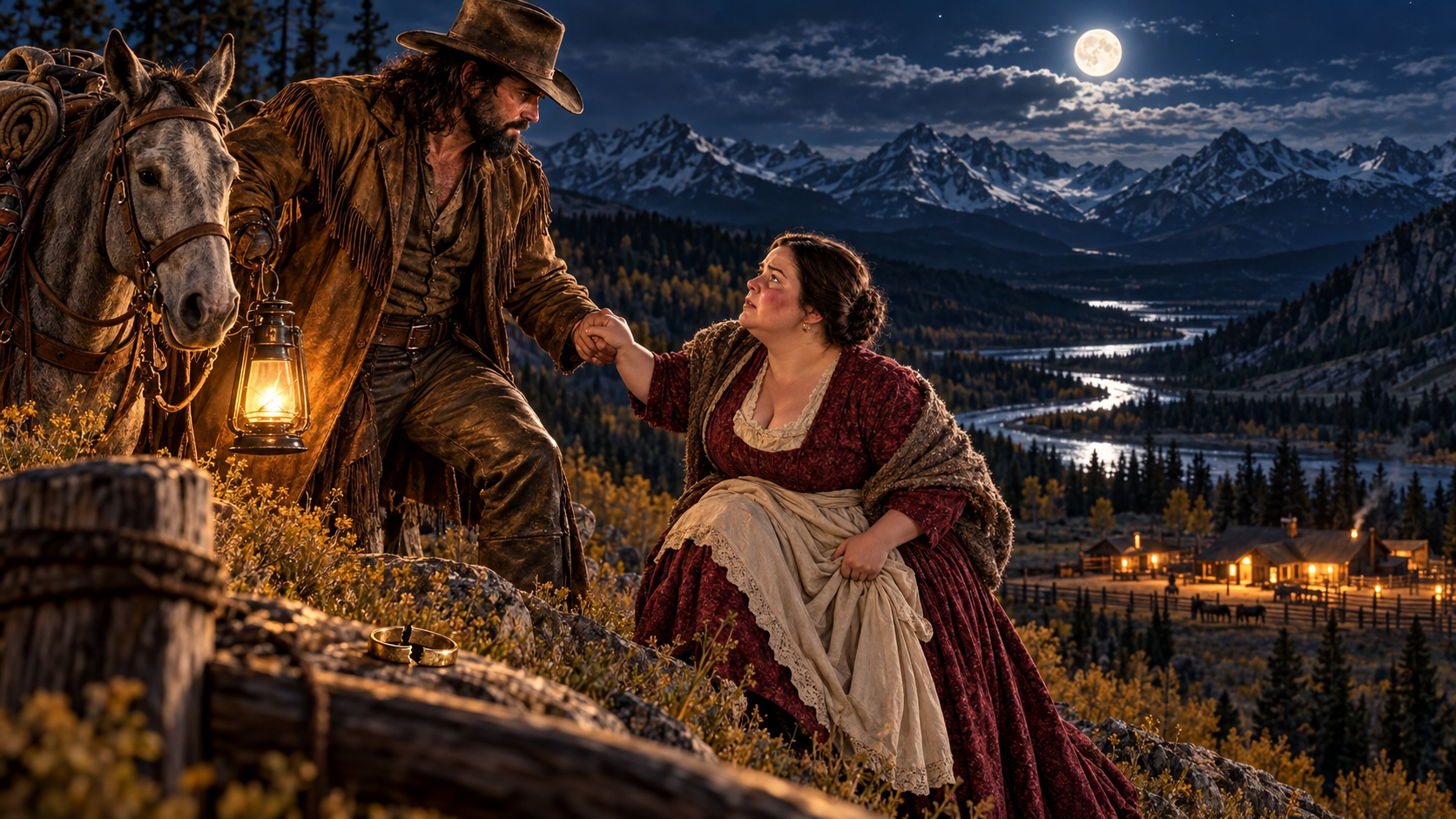
“My father has been dead for six years,” I whispered.
Jackson Boone tightened his grip on the reins.
“I know.”
“Then how could you have made him a promise three years ago?”
The mountain man looked at me beneath the pale moonlight, and for the first time since I had met him, I saw uncertainty in his face.
“Because your father didn’t die six years ago, Eleanor.”
The world seemed to tilt beneath me.
I stared at him, waiting for a smile, an explanation, anything that would make his words less impossible.
But Jackson Boone was not smiling.
The gray mule shifted beneath me, its hooves crunching over the frozen mountain trail.
Behind us, the Double Bar Ranch had disappeared into darkness.
Ahead lay miles of wilderness.
And somewhere between those two places, the story of my life had just begun to unravel.
“You’re lying,” I said.
Jackson nodded slowly.
“If I were you, I’d think the same.”
“My father was buried in the family cemetery. Charles took me to his grave.”
“Did you see the body?”
I opened my mouth.
Then closed it.
I remembered the funeral.
The black dress Charles had chosen for me.
The rain falling against the church windows.
The closed coffin.
Charles standing beside me, his hand pressed firmly against my back as the minister spoke.
I remembered asking why I couldn’t say goodbye.
Charles had told me the accident had left my father unrecognizable.
I had believed him.
Because back then, I still believed husbands were supposed to protect their wives.
Jackson reached inside his coat.
He withdrew a small leather packet, worn smooth at the corners, and handed it to me.
Inside was a folded letter.
The handwriting struck me before I read a single word.
My father’s handwriting.
I recognized the peculiar way he curved the letter E, the heavy pressure of his pen, the little dash he always placed beneath his signature.
My hands began to shake.
I unfolded the paper.
My dearest Eleanor,
If this letter reaches you, it means I have failed to protect you in the way a father should.
But please understand one thing.
I never abandoned you.
I never stopped looking for a way home.
And whatever Charles Roberts has told you, do not believe that I willingly gave him our land.
I pressed the letter against my chest.
The mountains blurred.
“My father wrote this?”
“Yes.”
“Where is he?”
Jackson looked toward the northern ridge.
“Alive when I last saw him.”
My breath caught.
“When?”
“Three years ago.”
The words struck harder than any blow Charles had ever delivered.
Three years.
For three years, my father had been alive somewhere in the world while I endured a marriage built on fear.
For three years, someone had known.
“Why didn’t you come sooner?” I demanded.
Jackson accepted the anger without flinching.
“Because I spent those years trying to find you without getting you killed.”
I shook my head.
“You knew where I lived.”
“I knew where Charles kept you. That wasn’t the same as knowing how to get you out alive.”
I wanted to hate him.
It would have been easier.
But there was something in his expression that stopped me.
Not guilt alone.
Grief.
The kind that settled into a man’s bones and stayed there.
Jackson dismounted beside a narrow stream.
“We should stop here.”
“No.”
“Eleanor—”
“Tell me everything.”
He looked at me for a long moment.
Then he nodded.
“All right.”
We made camp beneath a stand of pines.
Jackson built a small fire hidden between rocks, then handed me his spare coat.
I sat beside the flames with my father’s letter resting in my lap.
And Jackson Boone told me how my husband had stolen my life.
Six years earlier, my father, Thomas Whitcomb, had owned nearly eight thousand acres of grazing land bordering the northern mountains.
The land was valuable.
But not because of cattle.
A railroad survey had identified a possible route through the valley, and the company intended to purchase right-of-way across several properties.
My father’s land sat directly in the middle of the proposed passage.
Charles Roberts wanted it.
My father refused to sell.
So Charles found another way.
He bribed a county clerk, forged debt papers, and arranged for a false claim against the property.
When my father discovered the scheme, he rode to the county seat carrying evidence that could have sent Charles to prison.
He never arrived.
His horse was found beside a ravine.
A bloodstained coat lay nearby.
And Charles announced that Thomas Whitcomb had died in a terrible accident.
But my father hadn’t fallen into that ravine.
He had been taken.
Charles’s men held him in an abandoned mining settlement deep in the mountains.
For three years, my father remained a prisoner, forced to sign documents and threatened whenever he refused.
Then one winter night, a mountain trapper stumbled upon the settlement.
Jackson Boone.
“I found him chained inside an old ore shed,” Jackson said quietly.
“He was thin enough that I could see his ribs through his shirt. But he still had the strength to tell me his daughter’s name.”
I covered my mouth.
Jackson stared into the fire.
“We got him out. Barely.”
“Then where did you take him?”
“To a doctor in a mining town north of the border.”
“Why didn’t he come for me?”
Jackson’s jaw tightened.
“Because he couldn’t walk without help. Because Charles still had men searching for him. And because your father knew Charles would hurt you if he discovered you knew the truth.”
I stared at the flames.
For years, Charles had told me my father had left behind nothing but debts.
He had told me I should be grateful he married me.
He had told me nobody else would want a woman of my size, with no family and no fortune.
And I had believed every cruel word.
Jackson reached into his saddlebag again.
This time he produced a second document.
A property deed.
My father’s name appeared at the top.
Below it, in carefully written legal language, was the transfer of the entire Whitcomb estate.
Not to Charles Roberts.
To me.
Eleanor Whitcomb.
The deed was dated six years earlier.
Two weeks before my father’s supposed death.
I stared at it.
“I own the land?”
Jackson nodded.
“Your father placed it in your name when he realized Charles was trying to steal it.”
“But Charles owns the Double Bar.”
“He owns the buildings and some adjoining parcels. Most of the valley beneath them belongs to you.”
My throat tightened.
All those years.
Charles had beaten me inside a house built on land that was legally mine.
He had called me worthless while living from property he had stolen from me.
I looked at Jackson.
“Does Charles know?”
“Yes.”
“Then why did he marry me?”
Jackson didn’t answer immediately.
He didn’t need to.
I understood.
Charles couldn’t legally control my inheritance without gaining authority over me.
So he married me.
Then he made certain I never knew what I possessed.
I looked down at my hands.
The ring was gone.
For the first time, its absence felt like freedom.
But the relief lasted only a moment.
A branch cracked somewhere beyond the firelight.
Jackson’s head turned.
His hand moved toward his rifle.
“Get behind that rock,” he whispered.
I froze.
Another sound followed.
A horse snorting.
Then a man’s voice carried through the trees.
“Boone!”
Charles.
My blood went cold.
“Come out, you mountain rat!”
Jackson extinguished the fire with a shovel of snow.
Three riders appeared through the pines.
Charles sat on a black horse, his injured wrist wrapped against his chest.
Beside him rode two ranch hands I recognized.
Men who had watched him hurt me and never once intervened.
Charles spotted me.
His expression twisted.
“There you are, Eleanor.”
Jackson stepped between us.
“Turn around, Roberts.”
Charles laughed.
“You think you can steal another man’s wife?”
I stood slowly.
“No one stole me.”
Charles looked past Jackson.
“What did you say?”
I swallowed.
Then repeated it.
“No one stole me. I left.”
For a moment, the woods were silent.
Charles’s face darkened.
“You get on my horse right now.”
“No.”
He stared as if the word belonged to a language he had never heard.
Then his gaze dropped to the papers in my hand.
Something changed.
The anger vanished.
In its place came calculation.
“What has he told you?”
I held up the deed.
“Enough.”
Charles went pale.
Jackson raised his rifle slightly.
“Ride away.”
But Charles was staring at me now.
“You don’t understand what you’re holding.”
“I understand perfectly.”
“That land is worthless without the ranch.”
“Then you shouldn’t have stolen it.”
One of the ranch hands shifted uneasily in his saddle.
Charles noticed.
“Don’t listen to her,” he snapped. “She’s confused.”
I looked at the two men.
“My father didn’t die in that ravine. Charles kept him prisoner. He forged the debts, stole the property, and married me to hide it.”
The younger ranch hand, Daniel Mercer, stared at Charles.
“Boss?”
“Shut your mouth.”
Daniel looked at the deed.
Then at me.
“My brother worked the old silver camp,” he said slowly. “He told me there was a prisoner up there. A man named Whitcomb.”
Charles wheeled toward him.
“Not another word!”
Daniel’s face drained of color.
And suddenly I understood something important.
Charles’s power had never come from being stronger than everyone else.
It came from convincing people they had no choice.
Jackson’s voice remained steady.
“Your men know enough now, Roberts.”
Charles reached toward the revolver at his hip.
Jackson moved first.
A rifle shot cracked through the trees.
The bullet struck the trunk beside Charles’s shoulder, spraying bark across his coat.
“Don’t,” Jackson said.
Charles froze.
His two men immediately backed their horses away.
For several seconds, nobody moved.
Then Daniel dismounted.
He removed his revolver and placed it on the ground.
“I won’t die for you,” he told Charles.
The second ranch hand followed.
Charles stared at them in disbelief.
“You ungrateful cowards!”
Daniel shook his head.
“We’ve been cowards long enough.”
Jackson kept his rifle trained on Charles.
“Get down.”
Charles obeyed.
For the first time in three years, I watched my husband follow an order he didn’t like.
Jackson bound his good hand to the saddle horn and secured the reins.
“We’re taking him to the sheriff.”
Charles laughed bitterly.
“Sheriff Harlan eats at my table.”
Jackson nodded.
“I know.”
“Then you’re wasting your time.”
“That’s why we’re not going to Harlan.”
He glanced at me.
“We’re going to the territorial marshal.”
The journey took two days.
Two days of cold wind, steep trails, and sleepless nights.
Charles spent most of the ride threatening everyone.
He promised to ruin Daniel.
He promised to burn Jackson’s cabin.
He promised that I would come crawling back when I realized how difficult the world was for a woman alone.
On the second morning, I finally turned toward him.
“Charles.”
He stopped talking.
I looked directly into his eyes.
“I survived you for three years. I think I can survive the rest of the world.”
Jackson said nothing.
But I saw the faintest smile beneath his beard.
We reached the territorial office just before dusk.
Marshal Nathaniel Briggs was an older man with silver hair and the weary eyes of someone who had spent his life listening to lies.
Jackson laid the documents across his desk.
The deed.
My father’s letter.
Copies of the forged debts.
And a small notebook containing names, dates, and payments made to Charles’s hired men.
The marshal studied everything.
Then he looked at Charles.
“Where is Thomas Whitcomb?”
Charles said nothing.
Briggs leaned back.
“I asked you a question.”
“He’s dead.”
Jackson placed one final paper on the desk.
A physician’s sworn statement.
Dated three months earlier.
It confirmed that Thomas Whitcomb was alive and recovering under medical care.
Charles’s face went gray.
The marshal stood.
“Charles Roberts, you’re under arrest pending investigation into kidnapping, fraud, conspiracy, and unlawful imprisonment.”
For the first time, Charles had nothing to say.
As the deputies led him away, he turned toward me.
“You’ll regret this.”
I looked at the man who had controlled every hour of my life.
“No,” I said.
“I regret that I ever believed you.”
He disappeared behind the iron door.
And just like that, the man I had feared for three years became someone else’s responsibility.
But my story wasn’t finished.
Not even close.
The following morning, Jackson brought me to a small boardinghouse on the edge of town.
He stopped outside the front door.
“There’s someone waiting inside.”
My heart began to pound.
I looked at him.
“Jackson?”
He nodded.
“He came south as soon as he heard Charles had been arrested.”
I could barely move.
Jackson opened the door.
Inside, beside a window filled with morning sunlight, sat an elderly man in a wooden chair.
His hair had turned almost completely white.
His shoulders were narrow.
One leg rested stiffly on a cushioned stool.
But when he lifted his face, I recognized his eyes.
My father’s eyes.
“Ellie?”
The nickname broke something inside me.
Nobody had called me Ellie since I was a girl.
I crossed the room before I knew I was moving.
“Papa?”
He tried to stand.
His weakened leg gave way.
I caught him.
And suddenly I was kneeling on the floor, holding the father I had buried six years ago.
He smelled of soap, wool, and the faint tobacco scent I remembered from childhood.
His hands trembled against my cheeks.
“My little girl,” he whispered.
I began to cry.
Not the quiet tears I had learned to hide from Charles.
Not the tears I swallowed behind locked doors.
I cried with my whole body.
My father held me as tightly as his weakened arms allowed.
“I tried,” he whispered. “God help me, Ellie, I tried to come home.”
“I know.”
“I thought he might have killed you.”
“I know, Papa.”
He pulled back and looked at my face.
His eyes settled on the fading bruise near my cheek.
Then on the marks around my wrist.
His expression crumpled.
“What did he do to you?”
I shook my head.
“It doesn’t matter now.”
My father began to weep.
“It matters to me.”
I held his hands.
“Then let it matter tomorrow. Today, I just want my father back.”
We stayed that way for a long time.
Jackson waited outside.
He never once interrupted.
Over the following weeks, the truth spread across the territory.
The county clerk who had forged the debt records was arrested.
Two former employees came forward with testimony about my father’s imprisonment.
Daniel Mercer told investigators what he knew about the old mining camp.
The territorial court ordered the disputed property placed under protection while the claims were reviewed.
And Charles Roberts, who had once believed every man in the valley belonged to him, found himself sitting in a jail cell while his former friends hurried to deny knowing him.
The legal proceedings took months.
There were hearings.
Witnesses.
Documents that had to be examined.
Arguments over signatures and boundaries.
But eventually the forged claims were set aside, my ownership was recognized, and the Double Bar’s use of my land was brought to an end.
Charles was convicted of several crimes connected to the kidnapping and property scheme.
His influence could no longer shield him.
I also obtained a divorce.
When the judge asked whether I wished to resume my maiden name, I answered without hesitation.
“Yes.”
Eleanor Whitcomb.
Hearing it spoken aloud felt like meeting myself again.
But freedom, I discovered, was not something that arrived all at once.
For months, I still startled when doors slammed.
I apologized for taking up too much room.
I caught myself hiding food, even when the cupboards were full.
Sometimes I woke in the middle of the night convinced Charles was standing beside my bed.
And sometimes, when I looked in the mirror, I still heard his voice.
Too big.
Too plain.
Too difficult to love.
Healing was slower than escape.
But it came.
A little at a time.
My father and I moved into a small house overlooking the valley.
I hired honest workers to restore the ranch buildings.
I sold part of the railroad right-of-way for a fair price and used the money to pay the ranch hands what Charles had withheld from them.
Then I did something nobody expected.
I turned the old Double Bar dining hall into a boardinghouse for travelers, widows, and women who needed somewhere safe to begin again.
I called it Whitcomb House.
No one was turned away for being poor.
No one was mocked for the way they looked.
And no man was allowed to raise a hand against anyone beneath its roof.
The first woman who arrived was named Margaret.
She had two children, a broken suitcase, and a frightened expression I recognized immediately.
When she told me she had nowhere else to go, I remembered Jackson’s words.
Everybody has somewhere else to go.
I opened the door wider.
“You do now.”
By the following spring, Whitcomb House was full.
There were children running through the hallways.
Fresh bread cooling on the kitchen counter.
Women laughing over sewing baskets.
And evenings when the old building rang with music instead of shouting.
My father spent his afternoons on the porch, watching the valley he had nearly lost.
Sometimes he would reach for my hand and squeeze it.
Neither of us needed to speak.
As for Jackson Boone, he returned to the mountains.
At first, I thought he had simply gone back to the life he preferred.
He had never asked for payment.
Never suggested I owed him affection.
Never used what he had done as a reason to claim anything from me.
Before leaving, he had stood beside his horse and tipped his hat.
“You’ll be all right, Eleanor.”
I tried to smile.
“Will I see you again?”
He looked toward the mountains.
“If you want to.”
“I do.”
His expression softened.
“Then you will.”
Three weeks later, a bundle appeared on my porch.
Inside was a beautifully carved wooden comb.
A note rested beneath it.
For the woman who deserves to look in the mirror without hearing anyone else’s voice.
— Jackson
I held that comb for a long time.
Then I went upstairs.
I brushed my hair.
And for the first time in years, I looked at my reflection without turning away.
Jackson returned in early summer.
He arrived at sunset carrying a sack of wild apples and a wounded dog he had found caught in an abandoned trap.
He claimed he had only come to ask whether I had room for the animal.
I looked at the dog.
Then at him.
“There’s always room for one more.”
Jackson smiled.
The dog stayed.
And so did Jackson, at least for supper.
After that, he began visiting more often.
Sometimes he brought game for the kitchen.
Sometimes he repaired fences.
Sometimes he simply sat on the porch with my father, listening to stories about the old days.
He never rushed me.
He never touched me without invitation.
When I spoke, he listened.
When I was quiet, he allowed the silence.
And when I laughed, he looked at me as though the sound was something precious.
One evening in September, we walked beside the creek behind the house.
The cottonwood leaves had begun turning gold.
Jackson carried his hat in one hand.
I carried a basket of late blackberries.
We stopped where the water widened beneath a fallen tree.
“Eleanor,” he said.
I looked at him.
“There’s something I ought to tell you.”
I laughed softly.
“The last time you said something like that, my entire life changed.”
He smiled.
“I hope this changes it differently.”
Then his expression grew serious.
“I came to the Double Bar because of a promise to your father.”
“I know.”
“But I didn’t stay because of that promise.”
My heart began to beat faster.
Jackson looked down at his hands.
“I’ve spent most of my life alone. The mountains never asked me to explain myself. They never needed anything I couldn’t give.”
He paused.
“Then I met a woman carrying a basket of laundry, and I realized there were things in this world worth coming down from the mountains for.”
My eyes filled.
“Jackson—”
He shook his head gently.
“Let me finish.”
I waited.
“I don’t want your land. I don’t want your money. And I don’t want you to think that because I helped you leave Charles, you owe me a place in your life.”
He stepped closer.
“I just want to know whether I might earn one.”
For a moment, I couldn’t speak.
Then I asked the question I had been carrying since the day we met.
“Does it bother you that I’m not a small woman?”
Jackson frowned.
“Bother me?”
I looked away.
“Charles always said—”
“Charles said a great many things that weren’t true.”
I swallowed.
“I’m broad. I’m heavy. I’m not the kind of woman men usually turn their heads for.”
Jackson was quiet for a moment.
Then he took my basket and set it gently on the grass.
“Eleanor, look at me.”
I did.
“I’ve crossed rivers in flood. I’ve slept through blizzards. I’ve carried injured men down mountains when my own legs were ready to give out.”
His voice softened.
“But I’ve never met anyone stronger than the woman standing in front of me.”
A tear slipped down my cheek.
He reached for my hand, then stopped.
Waiting.
I placed my fingers in his.
He smiled.
“And for the record,” he added, “I think you’re beautiful.”
I laughed through my tears.
“You don’t have to say that.”
“I know.”
He lifted my hand.
“That’s why I mean it.”
That evening, Jackson kissed me beside the creek.
It was a gentle kiss.
Unhurried.
A question rather than a demand.
And when I kissed him back, I realized something that made me cry all over again.
For the first time in my life, love did not feel like something I had to survive.
It felt like somewhere I could rest.
We married the following spring.
There was no grand ceremony.
No wealthy guests.
No expensive dress.
Just a small gathering beneath the cottonwoods, with my father sitting proudly in the front row.
Margaret’s children scattered flower petals along the path.
Daniel Mercer, now working honestly as the ranch foreman, stood beside Jackson.
And I wore a simple blue dress that I had chosen myself.
When the minister asked Jackson whether he would love and honor me, he answered clearly.
“I will.”
Then he turned toward me.
“And I’ll spend every day proving it.”
My father wiped his eyes.
I squeezed Jackson’s hand.
When the minister pronounced us husband and wife, the people of Whitcomb House cheered so loudly that the horses in the nearby pasture lifted their heads.
Jackson laughed.
I laughed with him.
And beneath the wide Montana sky, I finally understood what happiness could sound like.
Years passed.
My father lived long enough to see the boardinghouse become one of the most respected places in the valley.
He taught the children to fish.
He told stories beside the fireplace.
And every Sunday, he insisted on sitting at the head of the table, where he could see his daughter surrounded by people who loved her.
When he died peacefully one autumn morning, I buried him beneath the cottonwoods overlooking the land he had fought so hard to protect.
This time, there was no closed coffin hiding a lie.
No husband standing beside me with a controlling hand against my back.
There was only grief.
Real grief.
And the comfort of knowing my father had spent his final years free.
Jackson stood beside me at the graveside.
He held my hand until the last visitor had gone.
Then he placed a small pine branch on the grave.
“Promise kept, Thomas,” he whispered.
I leaned against him.
And together, we walked home.
One winter evening, many years after Charles Roberts had disappeared behind prison walls, a young woman arrived at Whitcomb House.
She was large and broad-shouldered, with a frightened face and a bruise she tried to hide beneath her scarf.
She stood in the doorway clutching a small bag.
“Ma’am,” she whispered, “they told me you help women who have nowhere to go.”
I looked at her.
For a moment, I saw myself.
The laundry basket.
The pantry wall.
The wedding ring pressing against my finger.
The years I had spent believing I was too much and worth too little.
Then I stepped aside.
“Come in, sweetheart.”
She hesitated.
“I don’t have any money.”
I smiled.
“Neither did I, once.”
Her eyes filled.
“Why would you help me?”
I thought of a mountain man standing beside a kitchen table, placing a leather pouch before a frightened woman.
Because somebody should have offered you a door years ago.
I reached for the girl’s hand.
“Because somebody should have offered you a door.”
Behind me, Jackson appeared carrying an armful of firewood.
His beard had gone gray.
There were new lines around his eyes.
But his smile was the same.
“Another guest?” he asked.
I nodded.
“Another beginning.”
He set down the wood and opened the door wider.
“Then she’d better come in before the supper gets cold.”
The young woman began to cry.
I wrapped my arms around her.
And this time, when I felt the strength of my broad shoulders and heavy arms, I did not think of the blows they had endured.
I thought of all the people they had held.
All the children they had comforted.
All the frightened women they had welcomed.
My body had once been the armor that helped me survive.
Now it was part of the home I had built.
That night, after everyone had gone to bed, Jackson and I sat together beside the fireplace.
He took my hand.
“Are you happy, Ellie?”
I looked around the room.
At the warm fire.
The handmade furniture.
The photographs of my father.
The sounds of people sleeping safely beneath our roof.
Then I looked at the man who had once ridden into my life wearing a weathered brown coat and carrying a rifle across his saddle.
“Yes,” I whispered.
“I truly am.”
Jackson kissed my forehead.
And I rested my head against his shoulder.
For years, Charles Roberts had told me I was too large to be loved, too weak to leave, and too worthless to deserve happiness.
He had been wrong about every single thing.
I had not been rescued because I was helpless.
I had been given a chance to discover the strength I already possessed.
And the greatest gift Jackson Boone ever gave me was not the money, the escape, or even the truth about my father.
It was the simple belief that my life belonged to me.
I had spent three years learning how to make myself smaller.
I spent the rest of my life learning that I never needed to.
And when the mountain wind whispered through the cottonwoods outside our window, I no longer heard the voice of the man who had tried to break me.
I heard laughter.
I heard home.
I heard freedom.
And beside me sat the man who had never once asked me to be anything less than exactly who I was.
THE END.