PART 3 — The Mustang Would Not Leave the Snow Until I Saw What Was Under Her
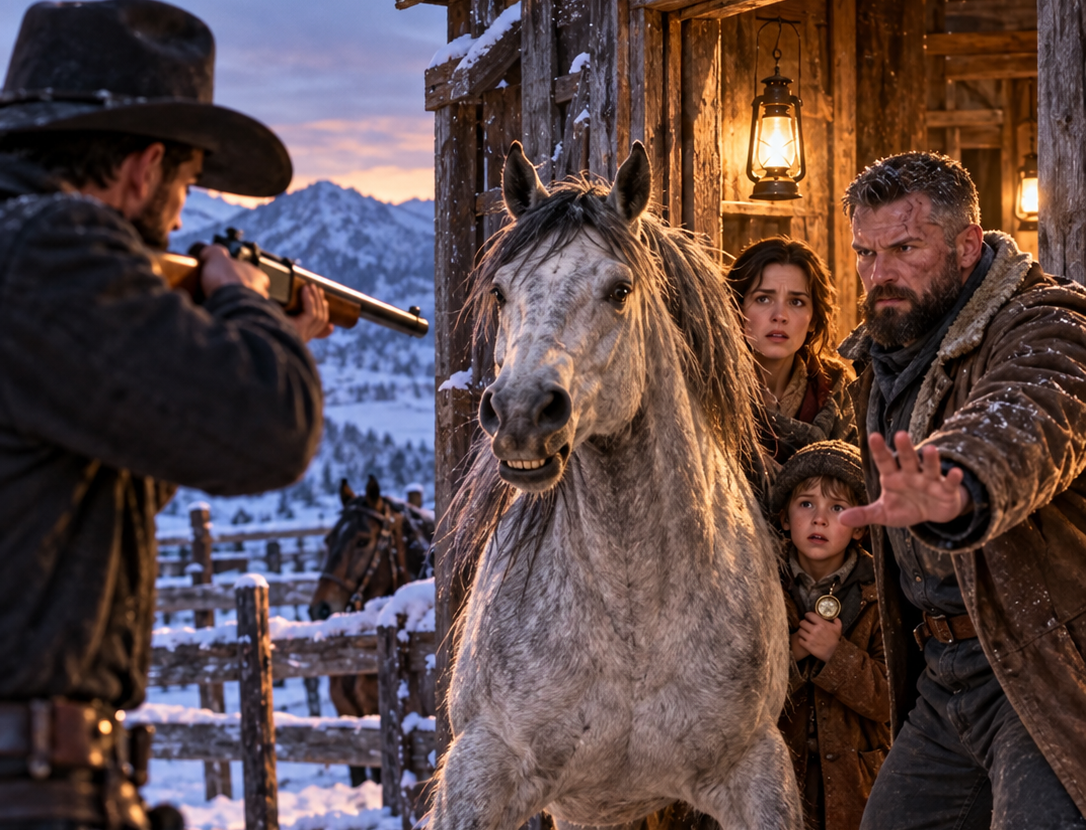
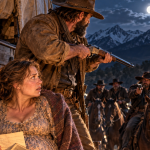
Thomas Bennett raised his rifle toward the barn.
Toward the seven-year-old boy standing in the doorway.
And something inside me that had been dead for three years suddenly came back to life.
“Lower it.”
My voice was so quiet I barely recognized it.
Thomas glanced at me.
“Stay out of family business, Mercer.”
“That boy is standing behind you.”
“Then tell him to move.”
I took one step forward.
“Lower the rifle.”
For several seconds, neither of us moved.
The only sounds were the wind brushing snow from the roof and Silver’s frantic hooves striking the wooden stall.
Then Thomas smiled.
“You don’t understand what you’re getting involved in.”
“You’re right,” I said. “I don’t.”
I took another step.
“But I understand enough.”
His smile disappeared.
“That woman stole property from me.”
“Your brother’s property?”
His eyes narrowed.
“Hannah’s been filling your head with stories.”
“She’s barely conscious.”
“Then she shouldn’t have dragged her boy into a blizzard.”
I looked past him.
Caleb had retreated into the barn, but his small face remained visible beside the doorframe.
He was holding my father’s pocket watch against his chest.
His hands were shaking.
And suddenly I wasn’t standing outside my barn anymore.
I was standing in a hospital corridor three winters earlier.
A doctor was telling me my daughter had survived the first impact.
That she’d been conscious when the ambulance arrived.
That she had asked for her father.
And that by the time I reached the hospital, there was nothing anyone could do.
I had spent three years wishing I could go back to that moment.
Three years imagining what I might have done differently.
Now another frightened child was looking at me.
And this time, I was there.
***
“Thomas,” I said, “you can ride away right now.”
He laughed.
“You’re ordering me off my own business?”
“That’s exactly what I’m doing.”
He shifted the rifle.
“You’re making a mistake.”
“Maybe.”
I kept my eyes on his hands.
“But I won’t make the mistake of letting you take that child.”
Then Silver screamed.
It wasn’t an ordinary whinny.
It was a harsh, furious sound that seemed to tear through the entire barn.
Thomas turned instinctively.
The mare struck the stall door with both front hooves.
The old wooden latch split.
Before I could move, Silver burst into the yard.
She was still weak from the storm.
Her gray coat was rough.
One hind leg trembled beneath her.
But she came forward with her ears pinned flat and her teeth bared.
Thomas stumbled backward.
“Get that damned horse away from me!”
Silver stopped between him and the barn.
Her body blocked the doorway.
Caleb disappeared behind her.
Thomas lifted his rifle again.
I moved.
I caught the barrel and shoved it upward just as the gun discharged.
The shot cracked across the frozen yard.
Snow fell from the barn roof.
Amos reared in the corral.
Thomas slammed his shoulder into me, and we went down together.
The rifle skidded across the ice.
He was younger than I was.
Faster.
But I had spent half my life hauling timber and wrestling stubborn cattle.
I caught his coat, rolled him onto his back, and drove my forearm across his chest.
“Stay down!”
He swung a fist into my cheek.
White sparks flashed across my vision.
I struck him once.
Hard enough to stop him.
Then I pinned both his wrists in the snow.
“You’re finished.”
He spat blood onto the ice.
“You think they’ll believe you?”
I leaned closer.
“They won’t have to.”
Behind me, a small voice answered.
“I heard him, Mr. Daniel.”
Caleb stood beside Silver.
His face was wet with tears.
“He told Mama he was going to take me away.”
Thomas stopped struggling.
The boy swallowed.
“And when Mama said no, he pushed her.”
My grip tightened.
Caleb looked at his uncle.
“You said nobody would believe me because I’m little.”
For the first time, Thomas Bennett had nothing to say.
***
I tied Thomas’s wrists with a length of rawhide and locked him inside the empty tack room.
Then I went to Hannah.
She had heard the gunshot.
I found her sitting halfway upright, her injured leg stretched beneath the blankets.
Her eyes went straight to Caleb.
“Baby?”
He ran to her.
She caught him so tightly I thought she might never let go.
“Mama, he came back.”
“I know.”
“I didn’t go with him.”
“I know, sweetheart.”
He buried his face against her shoulder.
“I stayed with Mr. Daniel.”
Hannah looked at me over the boy’s head.
There was gratitude in her face.
But something else too.
A terrible exhaustion.
The kind that comes from surviving when you have spent too long expecting the worst.
“Is he gone?” she whispered.
“He’s locked up.”
She closed her eyes.
“Thank you.”
I pulled another blanket over Caleb’s shoulders.
“Don’t thank me yet. We still have to get you both to town.”
Hannah nodded.
Then she reached beneath her pillow.
“I have something.”
She withdrew a small oilcloth packet, damp but intact.
Inside were folded papers.
A deed.
A handwritten letter.
And a legal document bearing her late husband’s signature.
I recognized the name.
Samuel Bennett.
He had bought lumber from me years earlier.
A quiet man with a gentle voice.
I remembered him talking about his little boy, who had only recently learned to walk.
“He was your husband?”
Hannah nodded.
“You knew him?”
“A little.”
Her eyes softened.
“Sam always said the people out here were kinder than the winters.”
She handed me the letter.
“Thomas wanted me to burn that.”
I unfolded it.
Samuel had written it shortly before his illness became serious.
He had left the farm and its income to his son, with Hannah managing the property until Caleb reached adulthood.
There was no mention of Thomas having any right to it.
But one paragraph caught my attention.
Samuel had written that if anything happened to Hannah, the boy was to remain with a guardian chosen by the county court, not automatically with his uncle.
I looked up.
“Thomas knew about this?”
“He helped Sam arrange the papers. Then after the funeral, he claimed Sam had changed his mind.”
“Do you have witnesses?”
“Our neighbor, Mrs. Whitcomb, heard Sam explain what he wanted.”
I folded the letter carefully.
“Then we have somewhere to start.”
Hannah began crying again.
This time she didn’t try to hide it.
***
The next morning, I rode into Lander.
The storm had left the roads nearly impassable, but the county road crews had begun clearing the worst drifts.
I brought Thomas with me, secured in the back of my wagon.
He spent the first hour threatening me.
Then he tried offering money.
Then he became strangely quiet.
At the sheriff’s office, I told everything I knew.
Sheriff Walter Briggs listened without interrupting.
He was a hard-faced man with a gray mustache and little patience for nonsense.
When I finished, he leaned back.
“You’re telling me this man pursued a widow and her child through a blizzard, and now he’s claiming she stole his property?”
“That’s what I’m telling you.”
The sheriff looked at Thomas.
“You want to explain yourself?”
Thomas smiled weakly.
“Family misunderstanding.”
Briggs glanced at the bruise on my cheek.
“Must be one hell of a misunderstanding.”
I gave him Samuel’s letter.
He read it twice.
Then he called for his deputy.
“Put Bennett in a cell until we sort this out.”
Thomas stood abruptly.
“You can’t do that!”
Briggs didn’t raise his voice.
“I can hold you while we investigate the assault and threats Mr. Mercer reported.”
Thomas pointed at me.
“He attacked me!”
The sheriff studied us both.
“Interesting.”
He turned to me.
“You bring the rifle?”
I placed it on his desk.
“Unloaded it before we left.”
Briggs examined it.
Then he looked at Thomas again.
“Seems you’ve got a great deal to explain.”
***
I returned home that evening with a doctor.
Dr. Eleanor Whitcomb was nearly sixty, with silver hair tucked beneath a black hat and a medical bag that looked older than I was.
She examined Hannah carefully.
The good news was that her leg wasn’t broken.
The bad news was that the injury was serious enough to require weeks of rest.
Caleb’s condition worried her too.
He had survived dangerous exposure to the cold, and the doctor insisted he remain warm, dry, and closely watched.
Silver received her own examination from a local veterinarian two days later.
The mare was severely exhausted and had frost damage along the edges of her ears.
But she was recovering.
The veterinarian shook his head when I explained how I’d found her.
“That horse should have walked away,” he said.
“I know.”
“She could’ve saved herself.”
“I know that too.”
He ran a hand along her neck.
“Some horses are just different.”
I watched Silver lower her nose toward Caleb, who was sitting nearby with a wool blanket around his shoulders.
The boy scratched the mare between her ears.
She closed her eyes.
“Yes,” I said.
“Some are.”
***
The days became weeks.
And slowly, my house began changing.
At first, I told myself Hannah and Caleb were only staying until she could walk properly.
That was the sensible explanation.
The practical one.
But practical explanations didn’t account for everything.
They didn’t explain why I found myself buying extra flour, sugar, and apples whenever I went to town.
They didn’t explain why I stopped eating supper alone.
Or why I began leaving the stove burning a little later because Caleb liked sitting beside it while Hannah read stories aloud.
Most of all, they didn’t explain why I started opening the curtains in the morning.
I hadn’t done that in three years.
One afternoon, I came inside and found Caleb sitting at the kitchen table.
He had spread several sheets of paper in front of him.
“What are you doing?”
“Drawing.”
“What are you drawing?”
He held up the page.
Three people stood in front of a house.
A large gray horse waited beside a fence.
Above them, a yellow sun shone in a bright blue sky.
I studied it.
“Who’s that?”
“That’s Mama.”
“And this?”
“Me.”
I pointed to the tallest figure.
“And who’s that?”
Caleb looked at me as though the answer should have been obvious.
“That’s you.”
Something tightened in my throat.
I stared at the drawing.
“Why’d you put me there?”
He shrugged.
“Because you live here.”
I almost laughed.
Instead, I sat down beside him.
“Suppose I do.”
He examined my face.
“Mr. Daniel?”
“Yeah?”
“Why don’t you have any pictures on the walls?”
My heart stopped for a moment.
There had once been pictures.
Rachel smiling beside the Christmas tree.
Emily holding a newborn lamb.
Our wedding photograph above the fireplace.
After the accident, I had put them all away.
I couldn’t stand looking at the happiness I’d lost.
“They’re in a box,” I said.
Caleb considered that.
“Why?”
“Because sometimes pictures make people sad.”
He nodded thoughtfully.
Then he said something I would remember for the rest of my life.
“Maybe they get sad because the people in the pictures were really loved.”
I looked at him.
He continued coloring his sun.
“And if you put the pictures away, you can’t remember the happy parts.”
I turned toward the window.
Outside, Silver was standing beside Amos in the pale afternoon sunshine.
For a long time, I couldn’t speak.
***
That night, after Caleb went to bed, I opened the cedar chest in my bedroom.
Rachel’s blue shawl lay folded on top.
Beneath it were Emily’s schoolbooks.
A ribbon.
A pair of small mittens.
And the photographs.
I sat on the floor holding one of Emily.
She was missing a front tooth.
Her hair was tangled.
She was smiling so hard her eyes had nearly disappeared.
I remembered the day the photograph was taken.
She had insisted on wearing her mother’s hat while helping me feed the horses.
I had told her it was too big.
She had declared that growing girls needed practice wearing grown-up things.
I began laughing.
Then crying.
Then both.
When I finally looked up, Hannah was standing in the doorway.
She didn’t ask what was wrong.
She simply lowered herself carefully onto the floor beside me.
For several minutes, we sat in silence.
Then she asked, “Is that your daughter?”
I nodded.
“Emily.”
“She’s beautiful.”
“She was.”
Hannah waited.
I told her everything.
About the black ice.
The truck.
The hospital.
The way I’d buried two people on a frozen January morning and somehow kept breathing afterward.
When I finished, Hannah wiped her cheeks.
“I’m sorry, Daniel.”
I looked at the photograph.
“People always say time heals.”
She shook her head.
“I don’t think it does.”
I turned toward her.
She spoke gently.
“I think sometimes we just learn how to carry what happened.”
I stared at the little girl in the photograph.
“For three years, I’ve been afraid that if I ever felt happy again, it would mean I loved them less.”
Hannah reached over and touched my hand.
“Love doesn’t work that way.”
I looked at her.
She held my gaze.
“Your heart doesn’t have to stop loving the people you lost to make room for the people who are still here.”
I had no answer.
But that night, for the first time since Rachel and Emily died, I placed their photograph back on the mantel.
And I left it there.
***
By early spring, Hannah was walking without a crutch.
The county investigation had finally uncovered what Thomas had tried to hide.
A local attorney confirmed Samuel’s will was valid.
Mrs. Whitcomb gave a statement supporting Hannah’s account.
A ranch hand who had worked for Thomas admitted that his employer had been trying to force Hannah to surrender control of the farm.
And Caleb, with Hannah beside him, told the sheriff what he remembered from the day of the storm.
Thomas faced criminal charges arising from the confrontation and his treatment of Hannah.
His claim to Samuel’s property failed.
For the first time in months, Hannah and Caleb had a future that belonged to them.
One April morning, a letter arrived from the attorney.
The legal dispute over the farm had been settled.
Hannah read the letter at the kitchen table.
Then she smiled.
A real smile.
Not the tired, careful one she’d worn since the storm.
“We can go home,” she whispered.
Caleb looked up from his breakfast.
“Home?”
She nodded.
“To our farm.”
He was quiet.
Then he looked at me.
“Does Silver get to come?”
Hannah hesitated.
Silver’s ownership had been part of Thomas’s property, and the legal question remained unresolved.
But the attorney had arranged for the mare to remain in my care while the necessary paperwork was completed.
I had already offered to purchase her lawfully if that became necessary.
“I think we can work something out,” I said.
Caleb didn’t smile.
He looked down at his plate.
“Will you come too?”
The room went silent.
Hannah looked at me.
I looked toward the window.
For weeks, I had known this moment was coming.
I had told myself I was prepared.
After all, Hannah had a home.
A farm.
A life she was entitled to reclaim.
And I had my own.
But the thought of returning to empty rooms made something inside me ache.
“I can’t just leave my ranch,” I said.
Caleb nodded slowly.
“Okay.”
He pushed his breakfast away.
Then he climbed down from his chair and went outside.
Hannah watched him leave.
“He loves you, Daniel.”
I swallowed.
“He’s a good boy.”
“That’s not what I said.”
I looked at her.
Her eyes were bright.
“You gave him somewhere to feel safe again.”
I shook my head.
“Silver did that.”
“Silver kept him alive through one night.”
Hannah reached across the table.
“You helped him believe he could have a life after it.”
For a long moment, I couldn’t look at her.
Then she spoke again.
“And you’ve done that for me too.”
***
They were supposed to leave on Saturday.
I spent Friday repairing the wagon, checking the harness, and packing supplies for the journey.
I had arranged for a neighbor to help them settle back onto their property.
Everything was ready.
Everything except me.
That evening, I found Caleb sitting beside Silver in the barn.
He had his arms wrapped around her neck.
“Hey, partner.”
He didn’t answer.
I sat on an overturned bucket beside him.
“Something bothering you?”
He nodded.
“What is it?”
He rubbed his cheek against Silver’s mane.
“Do you think she remembers the snow?”
I looked at the mare.
“Maybe.”
“Do horses remember being scared?”
“I reckon they remember some things.”
Caleb nodded.
Then he asked, “Do you remember being happy before?”
The question struck harder than I expected.
“Yes.”
“Do you remember how?”
I stared at him.
He looked at me with those enormous gray eyes.
“I think you forgot.”
I swallowed.
“Maybe I did.”
Caleb took my hand.
“Then you can practice with us.”
I couldn’t speak.
He continued with the complete confidence only a child can possess.
“Mama says people get better when somebody loves them.”
I looked away.
Caleb squeezed my fingers.
“I love you, Mr. Daniel.”
I had heard those words before.
From a little girl with tangled hair.
From a woman who kissed my cheek every morning before I went to work.
I had believed I would never hear them again.
My eyes burned.
I pulled Caleb into my arms.
And for the first time in three years, I let myself hold a child without being afraid of remembering the one I’d lost.
“I love you too, son.”
He hugged me tighter.
Silver lowered her head over both of us.
Her warm breath stirred Caleb’s hair.
And there, in an old Wyoming barn, I finally understood something that had taken me three winters to learn.
Saving a life doesn’t always happen in one heroic moment.
Sometimes it happens slowly.
With breakfast at a kitchen table.
A drawing left beside the stove.
A frightened child learning to sleep through the night.
And a lonely man discovering he still has something worth giving.
***
Saturday morning arrived bright and clear.
The snow had retreated from the lower pastures.
Water ran in narrow streams beneath the fence posts.
Birds had returned to the cottonwoods.
I stood beside the wagon while Hannah adjusted the blankets around Caleb.
Silver waited nearby, her coat brushed clean and shining in the morning sun.
Hannah turned toward me.
“We’ll never be able to repay you.”
I shook my head.
“Don’t need repaying.”
She smiled sadly.
“Then at least promise you’ll visit.”
I nodded.
“Of course.”
She stepped closer.
For a moment, neither of us spoke.
Then she kissed my cheek.
“Thank you for finding us.”
I looked at her.
“Wasn’t me.”
She frowned slightly.
I turned toward Silver.
“It was her.”
Hannah followed my gaze.
The gray mare stood quietly beside the wagon.
The same animal I had almost abandoned in the snow.
The same animal that had refused to leave a dying child.
And the same animal that had somehow led me to a woman who was still alive beneath a broken wagon.
Hannah wiped her eyes.
“Then I suppose we owe her everything.”
I smiled.
“Reckon we do.”
Caleb leaned over the side of the wagon.
“Mr. Daniel?”
“Yeah?”
He held out my father’s pocket watch.
“You forgot this.”
I looked at it.
The silver case had been polished with the edge of his shirt.
He had kept it safe through the storm.
Through the fear.
Through everything that followed.
I took it.
Then stopped.
“No.”
I placed it back in his palm.
“You keep it.”
His eyes widened.
“But it’s important.”
“I know.”
“Your daddy gave it to you.”
I nodded.
“And now I’m giving it to you.”
He stared at the watch.
Then at me.
“Why?”
I reached up and touched his shoulder.
“Because some things are worth passing on.”
He smiled.
Then his face grew serious.
“Will you miss us?”
I looked at Hannah.
At Silver.
At the boy holding my father’s watch.
“More than you know.”
Caleb thought for a moment.
Then he said, “Well, that’s silly.”
I blinked.
“What is?”
He looked at his mother.
Then back at me.
“Why don’t you just come with us?”
Hannah laughed softly.
But there were tears in her eyes.
I looked toward my house.
The old wooden building stood beneath the cottonwoods.
Inside were Rachel’s photographs.
Emily’s schoolbooks.
A lifetime of memories.
For three years, I had mistaken loneliness for loyalty.
I had believed that staying alone was somehow the only way to honor the people I’d loved.
But I knew now that Rachel would never have wanted that for me.
And Emily?
Emily would have adored Caleb.
She would have followed Silver everywhere.
She would have filled the house with laughter.
I looked at Hannah again.
“Your farm needs fixing?”
She smiled.
“More than you can imagine.”
“Fence posts?”
“Dozens.”
“Barn roof?”
“Leaks like a sieve.”
“Stubborn horses?”
She glanced at Silver.
“Apparently.”
I nodded thoughtfully.
“Sounds like you could use a rancher.”
Caleb’s mouth fell open.
“Really?”
I reached for the wagon reins.
“Really.”
Hannah stared at me.
“Daniel, what about your home?”
I looked back at the house.
Then at the people standing in front of me.
“My home isn’t going anywhere.”
I paused.
“And maybe it’s time I stopped standing still too.”
***
I didn’t sell my ranch.
Not that year.
Not the next.
Instead, I began dividing my time between the two properties.
The distance wasn’t great, and the work gave me reason to travel.
In the spring, I repaired Hannah’s barn roof.
In summer, we rebuilt her fences.
By autumn, the neglected farm was producing enough to stand on its own again.
Caleb followed me everywhere.
He learned how to saddle Amos.
How to repair a gate.
How to recognize a coming storm from the way cattle gathered along the tree line.
He talked constantly.
Asked a thousand questions.
And laughed more loudly than any child I had ever known.
Sometimes, when he laughed, I remembered Emily.
At first it hurt.
Then, gradually, it began to feel like a gift.
Hannah and I grew close in ways neither of us had expected.
There was no sudden declaration.
No grand romantic gesture.
Just countless ordinary moments.
Coffee before sunrise.
Long conversations after Caleb went to sleep.
Her hand finding mine when we walked across the pasture.
The quiet understanding of two people who had both learned that love could disappear without warning.
And yet had chosen to risk loving again.
***
The following winter, the first heavy snow arrived in November.
I stood outside Hannah’s barn, watching white flakes settle across the roof.
Silver was inside, warm and well fed.
Caleb had insisted on giving her the largest stall.
He had hung a little wooden sign above it.
SILVER — THE BRAVEST HORSE IN WYOMING.
His handwriting was crooked.
Some letters leaned sideways.
I thought it was the finest sign I’d ever seen.
Hannah came outside carrying two cups of coffee.
She handed me one.
“Thinking about last winter?”
I nodded.
“Hard not to.”
She stood beside me.
“I still dream about it sometimes.”
“So do I.”
She leaned her shoulder against mine.
“Do you ever wonder what would’ve happened if you hadn’t stopped?”
I stared across the snowy pasture.
The answer was too terrible to speak.
Instead, I said, “Amos stopped first.”
Hannah smiled.
“Then perhaps we owe him something too.”
“Already gave him an extra scoop of oats.”
She laughed.
I loved that laugh.
I wasn’t ready to say it aloud.
Not yet.
But I knew.
Behind us, the barn door opened.
Caleb came running outside.
“Mr. Daniel!”
I turned.
“What is it?”
“Silver’s doing something funny!”
Hannah and I hurried into the barn.
Silver stood in the center of her stall.
At her feet, nestled in the clean straw, was a tiny newborn foal.
Gray.
Shivering.
With long legs and a white star on its forehead.
I stared.
The veterinarian had suspected Silver might have been pregnant, but her exhaustion after the storm had made everything uncertain.
Now there was no doubt.
The little foal lifted its head.
Caleb gasped.
“She had a baby!”
Hannah covered her mouth.
Silver turned toward us.
For a moment, I remembered the first night I had seen her.
Lying in the Wyoming snow.
Her body curved protectively around a child who wasn’t hers.
Now she stood above a child of her own.
Warm.
Safe.
Alive.
Caleb dropped to his knees outside the stall.
“Can we name her?”
I smiled.
“Suppose we can.”
He thought very hard.
Then he said, “Hope.”
Hannah looked at me.
I looked at the tiny foal struggling to stand.
“Hope,” I repeated.
“That’s a mighty fine name.”
***
Three months later, on a clear February morning, I asked Hannah to marry me.
It wasn’t fancy.
There were no flowers.
No candles.
No audience.
I was standing in her kitchen, covered in sawdust from repairing a cupboard.
She was making bread.
Caleb was outside playing with the dogs.
I simply looked at her and said, “I think I’d like to spend the rest of my life coming home to you.”
She stopped kneading the dough.
“Daniel?”
“I know you’ve already had a husband you loved. And I’ve had a wife I still love.”
Her eyes filled.
I stepped closer.
“I’m not asking you to forget Samuel. And I can’t forget Rachel.”
I took her flour-covered hand.
“But I think we could build something good with whatever years we’ve got left.”
A tear slid down her cheek.
“Are you asking me to marry you?”
I nodded.
“Unless you’ve got a better idea.”
She laughed through her tears.
Then she kissed me.
“Yes, Daniel Mercer.”
She rested her forehead against mine.
“Yes.”
From outside came a furious pounding on the kitchen door.
Caleb burst inside.
“Did she say yes?”
We both stared at him.
Hannah laughed.
“You knew?”
He grinned.
“Mr. Daniel told Amos yesterday.”
I closed my eyes.
That boy had ears like a fox.
Caleb threw both arms around us.
Then he looked up at me.
“Does this mean I can call you Dad?”
Everything inside me went still.
I had not expected that question.
Not then.
Not so simply.
I knelt in front of him.
“Caleb, you had a father who loved you very much.”
He nodded.
“Mama says he did.”
“And nothing changes that.”
“I know.”
I swallowed.
“But if you want to call me Dad, I’d be honored.”
His face broke into the biggest smile I’d ever seen.
“Okay, Dad.”
Then he hugged me.
And I held him.
Not as a replacement for Emily.
Not as a way to erase the grief.
But as a boy I had come to love with my whole heart.
***
We married the following spring.
It was a small ceremony.
The sheriff came.
Dr. Whitcomb came.
Several neighbors brought food and flowers.
Caleb stood beside me wearing a jacket that was slightly too large.
He insisted on carrying the rings.
Silver watched from the pasture fence with her growing foal beside her.
When the ceremony ended, Caleb ran toward the mare.
“We did it, Silver!”
He wrapped his arms around her neck.
“We’re all a family now!”
The old mare lowered her head against his shoulder.
And I found myself crying.
Not the desperate tears I’d shed in the cedar chest.
Not the helpless tears from the hospital.
These were different.
They came from a place I thought grief had destroyed forever.
Happiness.
Real happiness.
The kind that doesn’t ask permission from the past.
***
Years later, Caleb asked me a question while we were repairing the north fence.
He was sixteen by then.
Tall.
Strong.
With his mother’s gray eyes and the same stubborn determination he’d shown as a little boy.
Silver was getting old.
Her muzzle had turned almost white.
She moved more slowly now.
But she still followed Caleb whenever he crossed the pasture.
“Dad?”
“Yeah?”
“Do you think Silver knew what she was doing that night?”
I leaned against the fence.
“What do you mean?”
“When she stayed with me in the snow.”
He looked toward the mare.
“She could’ve walked away.”
I nodded.
“She could have.”
“Why didn’t she?”
I watched Silver grazing in the sunlight.
For a long time, I thought about the question.
Then I answered.
“Maybe she’d already learned something it took me forty-three years to understand.”
Caleb looked at me.
“What’s that?”
I smiled.
“Sometimes the most important thing you can do is refuse to leave somebody alone.”
He grew quiet.
Then he looked across the pasture.
“She saved my life.”
“Yes, son.”
He turned back toward me.
“And you saved hers.”
I thought about the mare lying in the blizzard.
About my first instinct to ride past.
About the cold, hard man I had become after losing my family.
Then I shook my head.
“No, Caleb.”
He frowned.
“What?”
I looked toward the house.
Hannah was standing on the porch, waving for us to come inside.
Behind her, supper was waiting.
Photographs lined the mantel.
Rachel.
Emily.
Samuel.
Our wedding day.
Caleb as a little boy.
And Silver standing beside Hope in a field of wildflowers.
I looked back at my son.
“That horse saved more than one life that night.”
***
Silver lived to be twenty-eight years old.
When her time finally came, she passed peacefully in a sunny pasture with Caleb sitting beside her.
He was a grown man by then.
Married.
With a little daughter of his own.
He buried Silver beneath the cottonwood tree where she liked to stand during summer afternoons.
I helped him place a flat stone over the grave.
He carved the words himself.
SILVER
SHE STAYED WHEN EVERYONE ELSE WAS GONE.
We stood together for a long time.
Then Caleb reached into his pocket.
He took out the old silver watch I’d given him on that first terrible night.
The glass was scratched.
The chain was worn.
But it still worked.
He opened it.
Listened to the steady ticking.
Then he looked at me.
“You know, Dad, I used to think you gave me this watch because you wanted me to remember to be brave.”
I smiled.
“Did you?”
He nodded.
“But now I think I understand.”
I waited.
His eyes filled with tears.
“You gave it to me because you were promising there would be more time.”
I couldn’t speak.
He closed the watch.
“More mornings.”
“More birthdays.”
“More chances to be happy.”
I reached over and rested my hand on his shoulder.
He looked toward Silver’s grave.
“She gave us all of that.”
I nodded.
“She did.”
***
I’m an old man now.
My hands aren’t as steady as they once were.
My knees ache when winter comes.
And sometimes I forget why I walked into a room.
But there is one night I will never forget.
A Wyoming blizzard.
A dying gray mare.
A child’s boot sticking out from beneath the snow.
And the moment I nearly decided to keep riding.
People sometimes ask me whether I believe animals can understand love.
I tell them I don’t know how much they understand.
But I know what I saw.
I saw a horse lie down in a deadly storm to shelter a child who didn’t belong to her.
I saw that same horse struggle through miles of snow when she barely had the strength to stand.
I saw her lead me to a mother who might otherwise have disappeared beneath the drifts.
And I watched her spend the rest of her life surrounded by the family she helped bring together.
I lost my first wife and daughter.
Nothing changed that.
Nothing ever could.
But Hannah gave me another chance to love.
Caleb gave me another chance to be a father.
And Silver gave me something I had stopped believing existed.
A reason to keep going.
Sometimes I sit on the porch at sunset and look toward the pasture.
Caleb’s children run beneath the cottonwoods.
Hannah sits beside me with her hand in mine.
The house is filled with laughter, muddy boots, family photographs, and the ordinary noise of a life I once believed was finished.
And whenever the first snow begins to fall, I remember a gray mare curled around a little boy.
I remember how close I came to walking away.
Then I remember what happened because I stopped.
That night, I thought I was rescuing a dying horse.
But the truth is, she was rescuing me.
And if I’ve learned anything worth telling after all these years, it’s this:
Never mistake a creature’s refusal to leave for stubbornness.
Sometimes it’s loyalty.
Sometimes it’s courage.
And sometimes, beneath the very thing the world has given up on, there’s a life waiting to be saved.
THE END.