PART 2 — THE FINAL ENDING: THE MACHINE THEY TRIED TO BURN, THE SECRET THAT KILLED HER HUSBAND, AND THE WOMAN WHO SAVED AN ENTIRE VALLEY
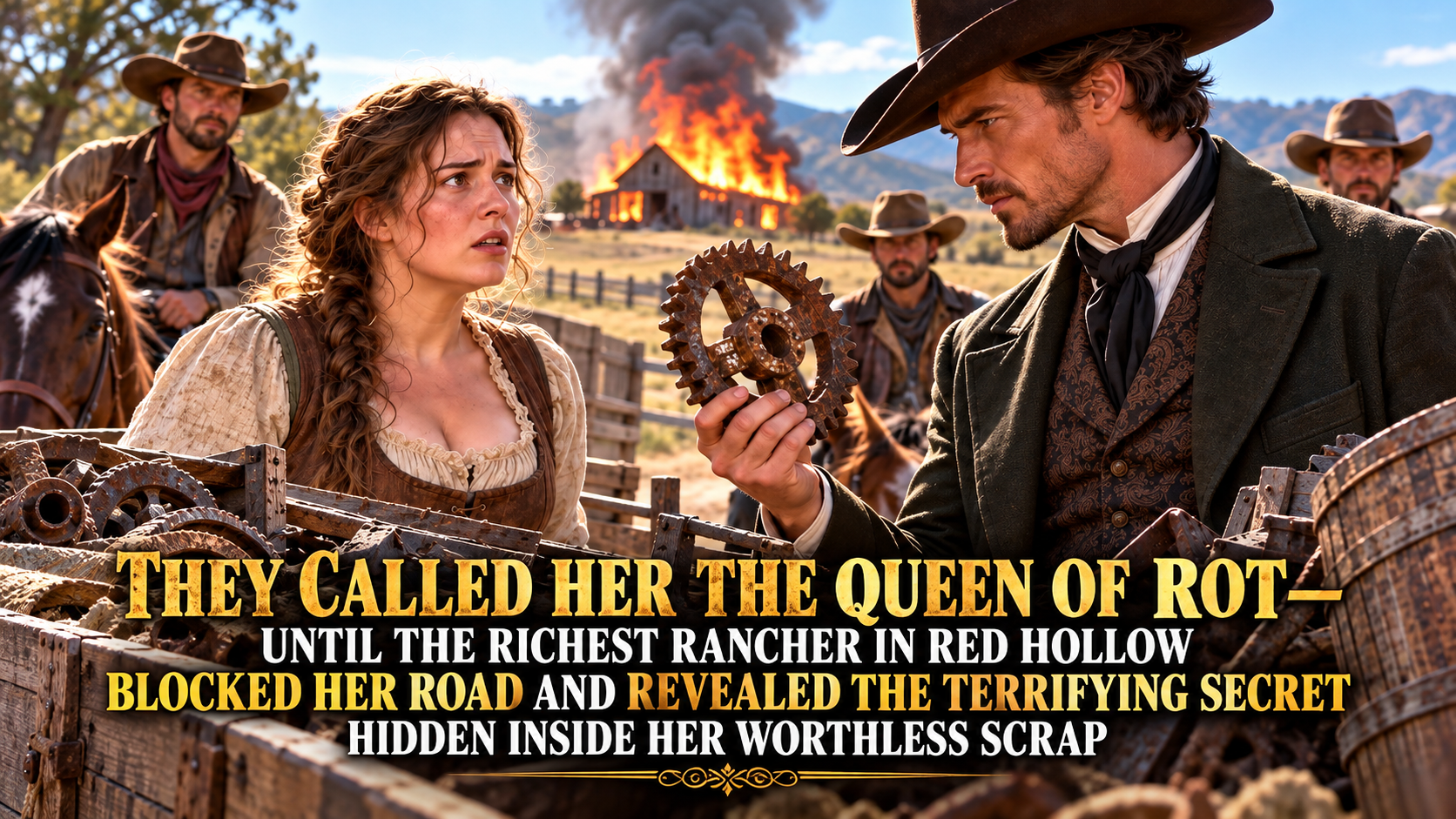
THEY CALLED HER THE QUEEN OF ROT—UNTIL THE RICHEST RANCHER IN RED HOLLOW BLOCKED HER ROAD AND REVEALED THE TERRIFYING SECRET HIDDEN INSIDE HER WORTHLESS SCRAP
“THEY KNOW YOU FOUND THE GEARS.”
Those six words were still ringing in my ears when I saw the flames rising above my farmhouse.
For eighteen months, I had mourned a husband I believed had died from a terrible fever.
For six months, I had endured an entire town laughing at me for collecting garbage.
And for the past three hours, I had believed I was finally close to finishing the machine Thomas had dreamed of building.
Now my workshop was burning.
The richest man in Red Hollow was holding one of my husband’s gears.
And two armed cowboys were blocking the only road home.
I pulled my arm away from Silas Crowe.
“Who knows?” I demanded.
Silas looked toward the smoke.
“Get on my horse.”
“Answer me!”
“Eleanor, there isn’t time.”
“WHO KNOWS?”
One of the cowboys suddenly turned his horse toward the ridge.
“Mr. Crowe!”
Silas looked up.
A fourth rider had appeared on the distant hill.
The man wore a pale coat and carried a rifle across his saddle.
He stopped beneath a crooked cottonwood tree.
Then he raised one arm.
Silas went white.
“Get down!”
The rifle cracked.
A bullet struck the wooden side of my cart, sending splinters across my dress.
My knees buckled.
Before I could scream, Silas grabbed me around the waist and pulled me behind the wagon.
Another shot rang out.
One of his cowboys shouted.
“That’s Mercer!”
Silas drew his revolver.
“Keep him away from the woman!”
I crouched beside the wheel, shaking so badly I could barely hold myself upright.
The smell of gunpowder mixed with dry grass.
Another bullet struck the road.
Then horses thundered past us.
Silas’s men charged toward the ridge, firing warning shots as the stranger turned and disappeared behind the hill.
Silas seized my wrist.
“Now do you understand?”
I stared at him.
“Understand what?”
“That somebody wants those gears badly enough to kill for them.”
My eyes filled with tears.
“Then tell me who!”
He hesitated.
And in that hesitation, I saw something I had never noticed before.
Silas Crowe was not simply frightened.
He was ashamed.
“His name is Gideon Mercer,” Silas said. “And eighteen months ago, I helped him destroy your husband’s future.”
***
I wanted to strike him.
For a moment, I truly did.
Instead, I looked toward the black smoke curling into the sky.
“Thomas trusted you?”
Silas lowered his eyes.
“Once.”
The word felt like a knife.
“Tell me everything.”
He glanced toward the ridge.
“Not here.”
“Then you can explain while we ride.”
I climbed onto the wagon seat.
Silas stared at me.
“Eleanor—”
“I’m not leaving my husband’s work behind.”
He looked at the cart.
The cracked barrels.
The rusted iron.
The gears.
The broken pulleys.
For the first time, he seemed to understand that the wagon contained more than discarded objects.
He climbed onto his horse.
“Then I’ll ride beside you.”
We started toward my farmhouse.
And as the wheels rattled over the uneven road, Silas began telling me a story that changed everything I thought I knew about Red Hollow.
***
Three years earlier, the valley had suffered its worst drought in a generation.
The river still ran through the northern gorge, but most small farms sat too high above its banks to use the water.
Wealthy ranchers could afford teams of horses, expensive pumps, and private irrigation channels.
Poor farmers could not.
They watched their crops wither.
They sold their livestock.
Some abandoned land their families had worked for decades.
Thomas had believed there was another way.
A machine that could lift water from the river using its own current.
No steam engine.
No expensive fuel.
No teams of horses.
Just carefully balanced gears, a series of lifting chambers, and a mechanism that transformed the river’s movement into mechanical power.
It would not create energy from nothing. Thomas had designed it to borrow a small portion of the river’s force and use that power to raise water through a pipe.
He called it the Whitcomb Current-Lift.
I remembered the name.
Thomas had whispered it to me one evening while drawing circles on the back of an old flour sack.
“Imagine, Ellie,” he had said, “a farmer watering his fields without paying a rich man for every bucket.”
I had kissed his forehead.
“And imagine the rich men when they hear about it.”
He had laughed.
Now I understood why that laughter had disappeared from his face during the final months of his life.
Silas continued.
“Thomas showed his plans to me first.”
“Why?”
“Because I owned the river crossing where he wanted to test the machine.”
I looked at him sharply.
“And what did you do?”
“I offered to finance it.”
For one foolish moment, I felt relief.
Then he added, “And I showed the drawings to Gideon Mercer.”
The relief vanished.
Mercer.
I knew that name.
Every struggling farmer in Red Hollow knew it.
Gideon Mercer owned the valley’s largest private water company.
His channels supplied several ranches and orchards.
His contracts were expensive.
His penalties were worse.
And whenever the summer drought came, his prices rose.
“Thomas’s machine would have threatened Mercer’s business,” I said.
Silas nodded.
“Mercer offered me twenty thousand dollars to convince Thomas to sell the design.”
I almost stopped walking.
Twenty thousand dollars.
More money than Thomas and I could have earned in a lifetime.
“Did Thomas agree?”
“No.”
“Of course he didn’t.”
Silas looked at me.
“He said water should not become a chain around a poor man’s neck.”
My throat tightened.
That sounded exactly like Thomas.
“What happened next?”
Silas took a long breath.
“Mercer tried to buy the drawings directly. Thomas refused again. Then Mercer threatened to ruin anyone who helped him.”
“And you?”
“I withdrew my investment.”
I stared ahead.
“Thomas came home that night.”
Silas said nothing.
“He sat at our kitchen table until sunrise. I asked him what had happened, and he told me a man had offered to make him rich if he agreed to keep the machine from ordinary farmers.”
My voice trembled.
“He said he would rather die poor.”
Silas closed his eyes.
“I remember.”
I turned toward him.
“And eighteen months later, he did.”
Neither of us spoke again until we reached the farmhouse.
By then, the smoke was so thick I could barely see the roof.
***
My workshop was burning from the inside.
Flames burst through the windows.
The western wall had collapsed.
A beam cracked overhead.
I jumped down from the cart and ran.
“THOMAS!”
The name escaped before I could stop it.
For one terrible instant, I was back in the bedroom where he had died, calling his name while he lay motionless beneath the quilt.
Then I remembered.
He was gone.
And the last thing he had left me was disappearing in front of my eyes.
I reached the workshop door.
Heat struck my face.
I tried to pull it open.
Silas caught me from behind.
“Don’t!”
“My drawings are inside!”
“The roof is coming down!”
“My husband’s drawings!”
I struggled against him.
Then I heard something.
A faint voice.
Not from the workshop.
From behind the chicken shed.
“Mrs. Whitcomb!”
I turned.
A boy emerged from the shadows.
He couldn’t have been more than fourteen.
His face was black with soot.
One sleeve had been torn.
And he was dragging a heavy wooden box.
“Samuel?”
Samuel Bell was the blacksmith’s apprentice.
He had delivered spare nails to my farm several times.
I ran toward him.
“What happened?”
He dropped the box and collapsed onto his knees.
“Two men came before noon. They broke the lock. I saw them from the road.”
“Who?”
“One wore a pale coat. The other had a red scarf.”
Mercer.
My stomach twisted.
“I tried to stop them,” Samuel continued. “They shoved me into the feed shed and locked the door.”
“How did you escape?”
“The latch was rotten.”
He gave a weak smile.
“I kicked it until it broke.”
I knelt beside him.
“Are you hurt?”
“Just bruised.”
Then he pointed toward the box.
“I couldn’t save everything. But I remembered you always kept that chest beneath the workbench.”
I looked down.
It was Thomas’s old tool chest.
The one with the brass corners.
The one he had built during our first winter together.
I opened it.
Inside were his notebooks.
My measurements.
The copper templates.
The small leather pouch containing our wedding rings’ original wooden molds.
And beneath them—
A sealed envelope.
My name was written across the front.
In Thomas’s handwriting.
My breath caught.
I had never seen it before.
Silas stepped closer.
“What is that?”
I pulled the envelope from the chest.
It was yellowed.
The wax seal had cracked.
Across the bottom, Thomas had written:
FOR ELEANOR — IF THEY COME FOR THE MACHINE.
I stopped breathing.
***
My fingers shook as I opened the letter.
The paper smelled faintly of oil and cedar.
Thomas had always kept his notes in the same drawer as his tools.
I recognized the slant of every letter.
My dearest Ellie,
If you are reading this, then the men who tried to purchase my silence have finally decided that money is not enough.
I pray I am wrong.
But I have seen what greed does to men who believe the world belongs to them.
The machine is more important than they understand.
Not because it will make us rich.
Because it will give ordinary people a choice.
Mercer has already taken the first drawings. What he does not know is that I changed the final design.
The three main gears are the key.
Without them, the lifting chambers will never synchronize.
I have hidden those gears where no wealthy man would think to look.
Among broken things.
Ellie, if I cannot finish this work, I hope you will.
You have always understood my machines better than you believed.
And there is something else.
Something I have been afraid to tell you.
I stopped reading.
My hands went cold.
Silas watched silently.
I forced myself to continue.
I believe someone has been tampering with my medicine.
I have noticed the taste changing, and twice I have become violently ill after taking the bottle prescribed by Dr. Harlan.
I have no proof yet.
I have kept a sample.
It is hidden beneath the false bottom of this chest.
If anything happens to me, take it to someone outside Red Hollow.
Do not trust Harlan.
Do not trust Mercer.
And until you know the truth, do not trust Silas Crowe.
I looked up.
Silas’s face had lost all color.
I read the final lines.
Whatever happens, remember this:
You are not the woman who stands beside the inventor.
You are an inventor yourself.
You always have been.
And if the world laughs at what you carry, let it laugh.
One day, it will understand.
All my love,
Thomas.
I pressed the letter against my chest.
For eighteen months, I had carried grief like a stone inside me.
Now something else rose beneath it.
Anger.
Not wild anger.
Not the kind that makes a person reckless.
A colder, steadier thing.
The kind that remembers.
The kind that refuses to disappear.
I turned toward Silas.
“Did you know?”
He swallowed.
“About the medicine? No.”
“Did you know Mercer wanted Thomas dead?”
“I knew he wanted the machine buried.”
“That isn’t what I asked.”
Silas looked away.
And that was answer enough.
***
I lifted the false bottom of the chest.
Beneath it lay a narrow glass vial wrapped in cloth.
Beside the vial was a small folded note.
A date.
A description of the medicine.
And the name of the doctor who had delivered it.
Dr. Amos Harlan.
The same doctor who had stood beside Thomas’s bed and assured me there was nothing more he could do.
I remembered how he had taken the medicine bottle away after Thomas died.
He had said it was standard practice.
I had thanked him.
The memory made me feel sick.
Samuel leaned closer.
“Mrs. Whitcomb, there’s something else.”
I looked at him.
“What?”
“When those men were inside your workshop, I heard one say they had to find the original plans before the hearing.”
“What hearing?”
“The water hearing in Red Hollow. Next Thursday.”
Silas cursed under his breath.
I turned.
“What hearing?”
He hesitated.
Then spoke.
“Mercer has petitioned the territorial authorities for exclusive control over the northern river diversion.”
I stared at him.
“Exclusive control?”
“If the petition is approved, he can prevent anyone else from building a pumping system along that section of the river.”
My hands tightened around the letter.
“Even if the machine belongs to Thomas?”
“Especially then.”
Suddenly, everything became clear.
The fire.
The stolen drawings.
The gears.
Mercer’s desperation.
He wasn’t merely trying to keep an old invention from being completed.
He was trying to ensure that nobody could ever use it without his permission.
I looked at the burning workshop.
Then at the chest.
Then at the wagon filled with broken iron.
“How many days until Thursday?”
“Five,” Silas said.
I wiped my tears.
“Then we have five days to finish the machine.”
Silas stared at me.
“Eleanor, your workshop is gone.”
“Not my knowledge.”
“The tools are destroyed.”
“Not all of them.”
“Mercer has men everywhere.”
“Then he’ll have to watch us work.”
Silas shook his head.
“You don’t understand what you’re risking.”
I stepped closer.
“No, Mr. Crowe. You don’t understand what I’ve already lost.”
***
By sunset, half of Red Hollow had heard that my workshop had burned.
By morning, the rumors were everywhere.
Some claimed I had accidentally set fire to a pile of rotten grain.
Others insisted my strange machinery had exploded.
A few said I had finally gone mad.
And outside the general store, someone had painted three words on a wooden sign.
QUEEN OF ROT.
I stood beneath it with Thomas’s letter tucked inside my dress.
People stared.
A few laughed.
Then I climbed onto the store’s front steps.
“Good morning.”
The laughter faded.
I had never addressed the town before.
Not like this.
Not with my shoulders straight and my voice loud enough to carry across the street.
“My workshop burned yesterday.”
A woman near the hitching post lowered her eyes.
“I know many of you have enjoyed laughing at the things I collect.”
Someone coughed.
“But I have spent six months gathering parts for a machine that could help every farmer in this valley.”
A man near the saloon snorted.
“A machine made of garbage?”
“Yes.”
More laughter.
I waited.
Then I said, “A machine that can lift river water to dry fields without burning coal or paying for a steam engine.”
The laughter weakened.
Old Mr. Barlow, whose orchard had nearly died the previous summer, stepped forward.
“How much water?”
“Enough to serve several small farms from one installation, if the river current is strong enough and the channels are properly built.”
“How much would it cost?”
“Less than a commercial steam pump of similar modest capacity, if we reuse sound materials and contribute our labor.”
A murmur spread through the crowd.
I continued.
“My husband designed the original mechanism. I have spent eighteen months improving it.”
Someone shouted, “Then why haven’t we seen it?”
“Because every time I tried to explain what I was doing, you laughed.”
Silence.
I looked from face to face.
“The machine isn’t finished. But it can be.”
A familiar voice interrupted.
“Provided it doesn’t kill somebody first.”
Dr. Amos Harlan stood outside his office.
His silver spectacles caught the morning sun.
His hands rested calmly on his vest.
I felt my stomach tighten.
He smiled.
“Mrs. Whitcomb, grief can make people believe extraordinary things.”
I stared at him.
“Can it?”
“Your husband was a gifted mechanic, but he was also a dreamer. I worry you’ve become consumed by his unfinished work.”
He turned toward the crowd.
“Perhaps what this poor woman needs is rest.”
I stepped down from the porch.
“Dr. Harlan, do you remember the medicine you prescribed Thomas?”
His smile faltered.
“Of course.”
“Do you remember the bottle you removed from our house after he died?”
A few people turned toward him.
He adjusted his spectacles.
“Medical materials are handled according to proper procedure.”
“Then you won’t object to an independent examination of a sample he preserved.”
His face changed.
Only for a second.
But I saw it.
And so did Silas Crowe, standing near the livery stable.
Dr. Harlan took one step backward.
“What exactly are you suggesting?”
I met his eyes.
“I’m suggesting that my husband was a careful man.”
Then I walked away.
Behind me, nobody laughed.
***
That afternoon, I went to see Judge Nathaniel Price.
He was seventy years old, nearly blind in one eye, and the only man in Red Hollow who had once told Silas Crowe to remove his hat inside a courtroom.
I placed Thomas’s letter on his desk.
Then the vial.
Then the surviving notebooks.
He read slowly.
When he finished, he leaned back.
“Mrs. Whitcomb, these are serious allegations.”
“I know.”
“The letter establishes your husband’s suspicions. It does not prove someone harmed him.”
“I know that too.”
He examined the vial.
“This will need to be tested by a qualified chemist. And the original medical records must be preserved.”
“Can you help?”
He nodded.
“I can arrange for the sheriff to secure the records and send the sample to the territorial laboratory.”
I swallowed.
“And Mercer?”
The judge’s expression darkened.
“That is a more complicated matter.”
“Because he’s rich?”
“Because accusations require evidence.”
I leaned forward.
“Then tell me how to obtain it.”
For the first time, the old judge smiled.
“Now that is a question I can answer.”
***
By nightfall, the first people arrived at my farm.
Samuel came carrying a sack of tools.
Old Mr. Barlow brought two iron shafts.
A widow named Martha Greene arrived with three lengths of usable pipe from her abandoned windmill.
Then came the blacksmith.
His name was Elias Turner.
For months, he had laughed whenever I searched his scrap pile.
Now he stood awkwardly beside my ruined workshop, holding a wooden crate.
“I heard you need gears.”
I looked inside.
There were bolts, bearings, and a heavy iron wheel.
“These are good parts.”
He cleared his throat.
“Been saving them.”
“Why give them to me?”
He looked toward the burned building.
“Because my daughter asked me something this morning.”
“What?”
“She asked why I taught her that wasting things was wrong, but laughed at a woman who tried to use what others threw away.”
His eyes filled.
“I didn’t have an answer.”
I stood quietly.
Then I reached for the crate.
“Thank you, Elias.”
He nodded.
“Tell me where to start.”
***
We built the new workshop inside my barn.
We cleared the hay.
Reinforced the floor.
Hung lanterns from the rafters.
Set up Thomas’s surviving workbench.
And spread his drawings across an old kitchen table.
For three days, we worked.
Men who had once mocked me now listened as I explained gear ratios.
Women who had been told machinery was men’s business measured pipe lengths, shaped leather seals, and assembled wooden lifting chambers.
Children cleaned rust from bolts and sorted washers into labeled tins.
Silas Crowe arrived with six wagonloads of timber.
I met him at the gate.
“I didn’t ask you for that.”
“I know.”
“Why are you doing it?”
He looked toward the barn.
“Because I should have helped Thomas when he was alive.”
I studied him.
“Wood doesn’t buy forgiveness.”
“I know that too.”
For a moment, neither of us spoke.
Then I pointed toward the far wall.
“Stack it there.”
He removed his coat and began unloading.
And for the first time in his life, the richest man in Red Hollow worked an entire afternoon without giving a single order.
***
On the fourth night, I discovered the problem.
The machine turned.
The gears engaged.
The lifting chambers moved.
But the water pressure collapsed after several cycles.
Every time we tested the system, the flow weakened until the upper pipe sputtered dry.
I checked the seals.
The shaft alignment.
The intake valve.
Everything appeared correct.
Still, the machine failed.
By midnight, everyone had gone home except Samuel and me.
We sat on the barn floor, surrounded by tools.
“I don’t understand,” he whispered.
“Neither do I.”
I stared at the drawings.
Thomas’s calculations were sound.
My modifications were sound.
The machine should have worked.
Then I noticed something.
A tiny difference between the teeth of the three recovered gears.
One gear had a slightly different spacing.
Not enough to be obvious.
But enough to create a small timing error with every rotation.
After several cycles, the chambers were no longer working together.
I picked up the gear.
And suddenly remembered Thomas’s letter.
The three main gears are the key.
Without them, the lifting chambers will never synchronize.
I turned the gear over.
T.W.M.
The mark was there.
But beneath it, almost invisible, was another symbol.
A tiny star.
I checked the second gear.
Two stars.
The third.
Three.
My heart began pounding.
“Samuel.”
He looked up.
“What?”
“Bring me Thomas’s final notebook.”
He scrambled to the table.
I opened it to the last page.
There, hidden among rows of measurements, was a sentence I had overlooked.
The stars do not mark their order of installation. They mark the sequence of correction.
I stared.
Then laughed.
A wild, disbelieving laugh.
Samuel looked frightened.
“Mrs. Whitcomb?”
“Thomas, you impossible man.”
I grabbed a pencil.
“He knew somebody might steal the drawings. So he designed the gears to look interchangeable.”
Samuel leaned closer.
“But they aren’t?”
“No. Each one has a slightly different purpose.”
I pointed to the diagram.
“The first controls the intake timing. The second compensates for the lifting chamber’s delay. The third regulates the discharge valve.”
“And we’ve put them in the wrong positions?”
“Exactly.”
Samuel grinned.
“Can we fix it?”
I looked toward the machine.
For the first time in days, I felt certain.
“Yes.”
We worked until dawn.
And when the first sunlight entered the barn, we carried the machine’s smaller test assembly to the creek.
Samuel opened the intake gate.
Water struck the current wheel.
The first gear turned.
Then the second.
Then the third.
The lifting chambers began moving.
Once.
Twice.
Ten times.
Twenty.
Water rose through the pipe.
The pressure held.
Then, from the upper outlet, a clear stream poured into the waiting barrel.
Samuel screamed.
“IT WORKS!”
I stood frozen.
The water kept flowing.
Steady.
Clear.
Beautiful.
I dropped to my knees.
And for the first time since Thomas died, I cried without trying to stop myself.
Because the machine worked.
Because he had been right.
Because I had been right.
And because for eighteen months, I had believed I was trying to finish his dream.
Now I understood.
We had finished it together.
***
The hearing began Thursday morning.
Every seat in the territorial meeting hall was occupied.
Farmers stood along the walls.
Ranchers filled the front benches.
Merchants crowded the doorway.
At the center sat Gideon Mercer.
He wore a charcoal suit and a silver watch chain.
His hair was neatly combed.
His expression was calm.
Beside him sat Dr. Amos Harlan.
And on the table before them lay a thick folder containing Mercer’s petition for exclusive water-diversion rights.
The territorial commissioner, Henry Wallace, called the meeting to order.
Mercer’s attorney rose first.
He spoke for nearly forty minutes.
About investment.
Infrastructure.
Private property.
Commercial stability.
And the danger of allowing unqualified individuals to interfere with established water systems.
He never mentioned my name.
He didn’t need to.
Everyone knew who he meant.
When he finished, Mercer leaned back with a satisfied smile.
Then Commissioner Wallace looked toward the rear of the room.
“Mrs. Eleanor Whitcomb?”
I stood.
The room became quiet.
“Do you wish to address the petition?”
“Yes, sir.”
I walked forward carrying Thomas’s notebooks.
Behind me came Samuel.
Elias Turner.
Martha Greene.
Old Mr. Barlow.
And Silas Crowe.
Mercer’s smile disappeared.
I placed the notebooks on the table.
“My husband designed a low-cost current-powered water-lifting system three years ago.”
Mercer’s attorney stood.
“Objection. We are not here to discuss the fantasies of a deceased mechanic.”
Commissioner Wallace raised his hand.
“Sit down, Mr. Fletcher.”
I continued.
“The machine was designed to provide irrigation to farms that cannot afford commercial pumping equipment.”
Mercer spoke for the first time.
“An interesting theory.”
I turned toward him.
“It isn’t a theory anymore.”
He narrowed his eyes.
I looked at the commissioner.
“The machine is operating outside this building.”
A murmur swept through the hall.
Mercer stood.
“Impossible.”
I smiled.
“Would you like to see it?”
***
We had installed the demonstration machine beside the town’s lower creek before sunrise.
It was not large.
The wooden frame stood only six feet high.
The current wheel turned slowly in the flowing water.
Three rusted gears sat inside a protective iron housing.
A pipe climbed the bank to a raised trough.
Everything had been built from salvaged materials.
Cracked barrels.
Discarded iron.
Old leather.
Broken wagon parts.
The same things people had laughed at me for collecting.
Commissioner Wallace approached the machine.
“Mrs. Whitcomb, what exactly are we looking at?”
“A working current-powered lift.”
“How does it operate?”
“The creek turns the wheel. The gears coordinate a series of lifting chambers. The chambers raise water through the discharge pipe.”
“And the energy comes from the moving water?”
“Yes, sir.”
He studied the mechanism.
“Can you demonstrate?”
I looked at Samuel.
He opened the gate.
Water struck the wheel.
The gears began turning.
The machine shuddered.
Then settled into a steady rhythm.
A moment later, water poured from the upper pipe.
Into the trough.
Across the wooden channel.
And down toward a dry patch of soil.
The crowd fell silent.
No applause.
No laughter.
Just silence.
Then Old Mr. Barlow removed his hat.
“My God,” he whispered.
Martha Greene covered her mouth.
The commissioner walked around the machine twice.
Then he asked, “How long has this been running?”
“Continuously for nearly six hours before this demonstration, with brief stops for inspection.”
“And what would it cost to build another?”
I gave him the estimated material and labor figures.
He stared.
“That is substantially less than the commercial systems described in this petition.”
“Yes, sir.”
Mercer’s attorney stepped forward.
“The machine’s long-term reliability has not been established.”
“That’s true,” I said.
He looked surprised.
I continued.
“It will require maintenance. It needs suitable river conditions. It cannot lift unlimited quantities of water. And it must be tested over time.”
I looked toward the farmers.
“But it works. And people deserve the chance to improve it.”
Someone began clapping.
Then another.
Then another.
Within seconds, the creek bank erupted.
Farmers cheered.
Women embraced.
Children jumped.
Elias Turner wiped his eyes with the back of his hand.
And through it all, Gideon Mercer stood motionless.
Watching the rusted gears turn.
***
I should have known it wasn’t over.
Men like Mercer did not surrender simply because the truth stood in front of them.
As the crowd returned to the meeting hall, he approached me.
His face was composed.
His voice almost gentle.
“Mrs. Whitcomb, may I have a word?”
“No.”
His smile tightened.
“I think you’ll find it in your interest.”
“I doubt that.”
He stepped closer.
“One hundred thousand dollars.”
I stopped.
He watched me carefully.
“For the machine. The drawings. Every future improvement. Complete ownership.”
I looked at him.
“That’s a remarkable offer.”
“It is.”
“Considering you called my husband’s work a fantasy.”
“Business requires flexibility.”
I smiled.
“Then you should have no trouble adapting to a world where farmers can pump their own water.”
His eyes hardened.
“You don’t understand how much trouble you’re creating.”
“Actually, Mr. Mercer, I’m beginning to understand perfectly.”
He leaned closer.
“Your husband made the same mistake.”
My blood went cold.
“What mistake?”
“Believing that being clever made him untouchable.”
I held his gaze.
“Did you threaten him?”
Mercer looked toward the meeting hall.
Then back at me.
“I offered him a comfortable life.”
“And when he refused?”
Mercer said nothing.
I took one step forward.
“When he refused, what did you do?”
His expression changed.
For one terrible second, the mask slipped.
“You should have taken the money, Eleanor.”
Then he walked away.
I stood beside the creek, shaking.
Because he had spoken my name with the same contempt he had once reserved for Thomas.
And because I knew he was not finished.
***
That afternoon, Judge Price arrived with the sheriff.
He asked me to meet him privately.
We entered the judge’s office.
Silas was already waiting.
On the desk lay a telegram.
The judge folded his hands.
“The laboratory has completed a preliminary examination of the medicine sample.”
My heart hammered.
“And?”
“They identified a toxic substance inconsistent with the prescribed treatment.”
I closed my eyes.
For a moment, the room seemed to move.
Thomas.
My Thomas.
He had known.
He had tried to warn me.
The judge continued carefully.
“The finding does not establish who introduced the substance or exactly how your husband died. But it gives us grounds for a criminal investigation.”
I opened my eyes.
“What happens now?”
“We have obtained Dr. Harlan’s surviving prescription records. The sheriff has also found discrepancies in the medical supply ledger.”
Silas leaned forward.
“What kind?”
“Entries altered after Thomas Whitcomb’s death. Payments recorded under an unfamiliar account.”
The judge paused.
“An account associated with Mercer’s water company.”
Silas swore softly.
I gripped the edge of the chair.
“Can you arrest them?”
“Not on this alone. But we have requested additional records and sworn testimony.”
Then the sheriff spoke.
“There’s something else, Mrs. Whitcomb.”
I turned.
“We found a man willing to testify about the fire.”
“Who?”
“One of Mercer’s hired riders.”
My breath caught.
“The man with the red scarf?”
The sheriff nodded.
“His name is Daniel Pike. He says Mercer ordered the workshop destroyed.”
I stared at him.
“Will he testify?”
“He’s agreed to give a sworn statement.”
For the first time, I felt the ground becoming solid beneath my feet.
Then someone pounded on the door.
Three hard knocks.
The sheriff opened it.
Samuel stood outside.
His face was white.
“Mrs. Whitcomb!”
“What happened?”
“The machine!”
My heart stopped.
“What about it?”
“Mercer’s men are taking it apart!”
***
I ran.
Down the courthouse steps.
Across the street.
Past the general store.
The creek was only a few hundred yards away.
But by the time I reached it, the crowd had gathered.
Two men stood beside the machine.
One held a crowbar.
The other was trying to remove the iron housing around the gears.
Gideon Mercer stood nearby.
His attorney was speaking loudly.
“This equipment constitutes an unauthorized obstruction of a watercourse under disputed jurisdiction!”
I pushed through the crowd.
“GET AWAY FROM IT!”
The man with the crowbar froze.
Mercer turned.
“Mrs. Whitcomb.”
I stepped between him and the machine.
“You have no right.”
“That remains to be determined.”
I looked at the broken bolts scattered on the ground.
One of the support beams had been loosened.
The wheel was still turning.
If the frame shifted, the entire mechanism could collapse.
“Samuel, close the intake gate!”
The boy ran.
Mercer lifted a hand.
“Stop him.”
One of his men moved to intercept.
Silas Crowe stepped forward.
“Touch that boy and you’ll answer to me.”
The man stopped.
Mercer stared at Silas.
“You’ve chosen your side, then.”
Silas removed his hat.
“Long overdue.”
Samuel reached the gate.
But before he could close it, the loosened support beam slipped.
The machine lurched.
A terrible grinding noise tore through the air.
The main shaft twisted.
The iron housing broke free.
And the heavy current wheel began pulling the damaged frame toward the creek.
“EVERYONE BACK!” I shouted.
People scattered.
Samuel stumbled.
His boot caught between two boards.
He fell directly beside the moving shaft.
“Samuel!”
I ran toward him.
The wheel groaned.
The frame shifted again.
I grabbed his shoulders.
He screamed.
“My foot!”
The wooden boards had trapped his ankle.
I pulled.
Nothing.
The wheel kept turning.
Water surged through the intake.
The shaft moved closer.
Then Silas was beside me.
He drove a crowbar beneath the boards.
“Pull him!”
I seized Samuel under the arms.
Silas heaved.
The wood lifted.
I dragged the boy free.
A second later, the support frame collapsed into the creek with a tremendous crash.
Water sprayed across the bank.
The wheel stopped.
The gears fell silent.
For a moment, nobody moved.
Then Samuel began crying.
I held him against me.
“You’re safe.”
He clung to my dress.
Behind us, the sheriff drew his revolver.
“Nobody leaves.”
Mercer stepped backward.
“This was an accident.”
The sheriff looked at the crowbar.
Then at the loosened bolts.
Then at the men Mercer had brought.
“That is something we’ll investigate.”
Mercer’s face tightened.
“Do you know who you’re speaking to?”
The sheriff stepped closer.
“Yes, Mr. Mercer.”
He held out his hand.
“Now give me your weapon.”
***
That night, Red Hollow changed.
Not all at once.
Not completely.
But something shifted.
People who had once been afraid to speak against Mercer began telling stories.
A farmer described how his irrigation contract had been altered after he refused to sell his land.
A merchant produced receipts showing payments to Mercer’s company for services never delivered.
A former employee admitted he had been ordered to remove equipment from Thomas’s old testing site.
Then Daniel Pike, the hired rider, gave his sworn statement.
He admitted helping set the workshop fire.
He identified the man in the pale coat as Mercer.
And he described the orders he had received.
“Find the drawings. Find the gears. Burn whatever remains.”
The sheriff asked who had given those instructions.
Daniel lowered his head.
“Gideon Mercer.”
The statement was signed.
Witnessed.
And entered into the investigation.
But the most devastating evidence came from an unexpected place.
Dr. Harlan’s own assistant.
Her name was Rebecca Moss.
She was twenty-six years old and had worked at the medical office for four years.
She arrived at Judge Price’s house carrying a small ledger.
Her hands trembled.
“I should have come sooner,” she whispered.
The judge invited her inside.
She placed the ledger on the table.
“Dr. Harlan told me Mr. Whitcomb was very ill. He said the medicine was experimental.”
I stood across from her.
“What medicine?”
She swallowed.
“The bottle he delivered to your house.”
I felt my chest tighten.
Rebecca continued.
“After Mr. Whitcomb died, Dr. Harlan ordered me to destroy several pages from the supply book.”
“Did you?”
“No.”
She opened the ledger.
“I copied them first.”
The judge leaned forward.
There were dates.
Amounts.
Initials.
And a series of payments from a private account associated with Mercer’s company.
Rebecca pointed to one entry.
“This payment was made two days before Mr. Whitcomb became seriously ill.”
Then another.
“This one was made after his funeral.”
The judge looked at her.
“Why did you preserve these records?”
Tears filled her eyes.
“Because I heard Dr. Harlan arguing with Mr. Mercer.”
The room became silent.
“What did they say?” the judge asked.
Rebecca took a shaking breath.
“Mercer said, ‘You promised he would stop working.'”
I closed my eyes.
Rebecca began crying.
“And Dr. Harlan said, ‘I never promised what would happen afterward.'”
No one spoke.
Then the judge closed the ledger.
“Miss Moss, you have done something very important tonight.”
I looked at her.
She couldn’t meet my eyes.
“I’m sorry, Mrs. Whitcomb.”
I wanted to ask why she had waited.
Why she had remained silent while I buried my husband.
Why she had watched me walk through town with my cart while people laughed.
But then I saw the terror in her face.
And I understood that fear had kept many people silent.
I reached across the table.
Took her hand.
And said the only words I could manage.
“Thank you for telling the truth.”
***
The investigation continued for weeks.
Mercer’s attorneys challenged the documents.
Dr. Harlan denied wrongdoing.
The territorial authorities ordered additional testing and interviewed witnesses from outside Red Hollow.
Nothing happened as quickly as I wanted.
Some nights, I lay awake imagining Thomas sitting beside me.
I would turn toward the empty pillow.
And the grief would return.
But I no longer felt helpless.
The evidence was being examined.
The witnesses were speaking.
And the machine was not gone.
Because while the investigation continued, the people of Red Hollow rebuilt it.
Again.
***
We worked through November.
Cold winds swept across the valley.
The first snow settled on the hills.
But inside the barn, the lanterns burned late.
Elias forged replacement brackets.
Martha stitched leather seals.
Samuel, his ankle healed, learned to cut precise wooden templates.
Old Mr. Barlow helped survey the riverbank.
And Silas Crowe did something nobody expected.
He signed a legal agreement granting the community access to a suitable section of his riverfront land for a trial irrigation system.
No exclusive contract.
No hidden fees.
No ownership of my design.
Just access, subject to the required water permissions.
When he brought me the papers, I read every line.
Twice.
Then I looked at him.
“Why?”
He sat across from me.
“Because Thomas once asked me to help him build something that could change this valley.”
I said nothing.
“And I was too afraid of losing money.”
His voice broke.
“I told myself I was being practical. That I had employees to protect. Land to manage. Responsibilities.”
He shook his head.
“But the truth is, I chose comfort over courage.”
I looked down at the papers.
“Thomas admired you once.”
Silas nodded.
“I know.”
“He believed you could do something good with all that money.”
Silas swallowed.
“I know that too.”
For a long moment, we sat in silence.
Then I signed the agreement.
Not because I had forgiven everything.
But because the valley needed water more than I needed to punish a man who was finally trying to make amends.
***
The first full-scale machine began operating in the spring.
It stood beside the northern river crossing.
Twelve feet high.
Built from reinforced timber, salvaged iron, and newly forged components.
Its wheel turned in the current.
Its gears moved with a deep, steady rhythm.
Water rose through the main pipe.
Then flowed into a distribution channel leading toward the first group of farms.
We had tested it for weeks.
Measured the flow.
Replaced weak seals.
Adjusted the gear alignment.
And added safety guards to protect the workers.
It was not perfect.
No machine ever is.
But it worked.
And on the morning we opened the first irrigation gate, nearly every family in Red Hollow gathered to watch.
I stood beside the channel.
Samuel held the lever.
Elias watched the pressure gauge.
Martha stood with the farmers.
Silas remained near the back.
Nobody spoke.
I nodded.
Samuel pulled the lever.
The gate opened.
Water surged into the channel.
It traveled past the first field.
Then the second.
Then the third.
Across soil that had cracked beneath years of summer heat.
Into rows where farmers had almost stopped planting.
Old Mr. Barlow fell to his knees.
He scooped water into his hands.
And began to cry.
His wife knelt beside him.
For a moment, they simply watched the water soak into the earth.
Then someone shouted.
“THE QUEEN OF ROT DID IT!”
The crowd erupted.
I turned.
And saw the old wooden sign from the general store.
QUEEN OF ROT.
Someone had carried it to the riverbank.
But beneath the words, in fresh white paint, another sentence had been added.
SHE SAW TREASURE WHERE WE SAW TRASH.
I covered my mouth.
And laughed through my tears.
***
The legal case reached its conclusion that summer.
The territorial court considered the laboratory findings, the medical records, Rebecca Moss’s testimony, the financial documents, and the statements concerning the destruction of my workshop.
Dr. Harlan was convicted of criminal involvement in the deliberate poisoning of Thomas Whitcomb.
Gideon Mercer was convicted of conspiring in the scheme, along with offenses connected to the workshop fire and the attempted destruction of the water-lifting machine.
Both received prison sentences.
Their lawyers appealed.
The process was long.
There were arguments over evidence.
Witnesses were questioned again.
And the court did not accept every accusation made against them.
But the central truth was established.
Thomas had not simply died from an unexplained fever.
His illness had been deliberately caused.
And powerful men had tried to prevent his invention from reaching the people it was meant to help.
When the verdict was read, I did not cheer.
I did not smile.
I sat very still.
Because justice did not bring Thomas back.
It did not return the eighteen months I had spent believing there was nothing anyone could have done.
It did not erase the nights I had cried alone.
But it gave his death a truth.
And it gave me something I had almost forgotten I deserved.
Peace.
***
One week after the verdict, Silas Crowe came to my farmhouse.
He arrived alone.
No armed cowboys.
No polished boots.
No expensive tobacco.
Just a man carrying a small wooden box.
I met him on the porch.
“What is it?”
He handed me the box.
“I found this in an old storage room at my ranch.”
Inside was a brass nameplate.
The letters were worn.
But I could still read them.
WHITCOMB CURRENT-LIFT
DESIGNED BY THOMAS AND ELEANOR WHITCOMB
I stared.
My breath caught.
“Where did this come from?”
Silas looked down.
“Thomas had it made before he died.”
I touched the letters.
My name.
Beside his.
“He told me you had improved the lifting chamber design,” Silas said.
I could barely speak.
“He never told me.”
“He wanted it to be a surprise.”
I sat on the porch step.
For a long time, I simply held the plate.
Thomas had known.
All those nights I sat beside him, suggesting changes, drawing diagrams, questioning measurements—
He had never considered me merely his assistant.
He had considered me his partner.
I pressed the brass against my heart.
Silas sat several feet away.
“I owe you an apology, Eleanor.”
I looked at him.
“More than one.”
He gave a sad smile.
“Yes.”
The wind moved through the cottonwood trees.
“I called you the Queen of Rot because I wanted everyone to think you were foolish,” he admitted.
“Why?”
“Because if they listened to you, they might start asking questions about Thomas.”
I studied his face.
“And if they asked questions, they might discover what you had done.”
He nodded.
“I was a coward.”
I looked toward the barn.
The rebuilt workshop stood beyond the fence.
Children’s voices drifted from inside.
Samuel was teaching three younger apprentices how to measure gear teeth.
A year earlier, nobody would have imagined such a thing.
I turned back to Silas.
“You cannot change what happened.”
“I know.”
“But you can decide what kind of man you become afterward.”
He lowered his head.
“I intend to try.”
I stood.
“Then start by helping Samuel carry the new iron shafts into the barn.”
Silas blinked.
Then laughed.
A real laugh.
Not the cruel sound I remembered from the general store.
“Yes, ma’am.”
And he went to work.
***
By the following autumn, the valley had changed.
Not magically.
Not overnight.
The drought still came.
Machines still broke.
Some farms remained too distant or too high above the river to benefit from the first installation.
There were arguments about maintenance.
Disagreements over water allocation.
Unexpected repairs.
And days when I wondered whether I had taken on more than I could manage.
But there was progress.
Three current-lift systems operated along the river.
Two more were under construction.
A cooperative had been formed to manage repairs, water schedules, and shared expenses.
Farmers who once depended entirely on costly private pumping services now had another option.
And in the center of Red Hollow, the old abandoned carriage house had become something entirely new.
The Whitcomb Mechanical Works.
Above the entrance hung the brass nameplate.
Thomas and Eleanor Whitcomb.
Inside, we repaired farm equipment.
Built lifting chambers.
Trained apprentices.
And collected discarded materials from anyone willing to bring them.
The first morning we opened, a little girl arrived carrying a broken clock.
She couldn’t have been older than eight.
Her dress was patched.
Her shoes were too large.
She placed the clock on my workbench.
“Mrs. Whitcomb?”
“Yes, sweetheart?”
“My father says it isn’t worth fixing.”
I examined the clock.
One gear was bent.
The spring was loose.
The wooden case was cracked.
“What do you think?”
She hesitated.
“I think it’s beautiful.”
I smiled.
“Then perhaps we should see what it needs.”
Her eyes widened.
“You can fix it?”
“I don’t know yet.”
I handed her a small screwdriver.
“But we can find out together.”
She climbed onto the stool beside me.
And as we opened the clock, I heard Thomas’s voice in my memory.
The world is full of people who can recognize what something costs.
Precious few understand what it’s worth.
I smiled.
Because at last, I understood those words completely.
***
Years later, people would tell the story differently.
Some would claim I had discovered a fortune hidden inside a cart of garbage.
Others would insist Silas Crowe had recognized a priceless invention the moment he lifted that rusted gear.
A few would turn the whole thing into a tale about a wealthy rancher who rescued a poor widow.
But that was never the truth.
Silas did not rescue me.
The town did not make me valuable.
And the machine did not turn worthless scraps into treasure through some impossible miracle.
The gears had always been useful.
The iron had always possessed strength.
The broken barrels had always contained materials worth salvaging.
And I had always been capable of building something extraordinary.
The only thing that changed was that people finally learned to see it.
***
On the second anniversary of the machine’s first successful irrigation season, I visited Thomas’s grave.
The cemetery stood on a small hill overlooking Red Hollow.
From there, I could see the river winding through the valley.
The new irrigation channels glimmered in the afternoon sunlight.
Green fields stretched across land that had once been brown and dry.
And in the distance, the great wheel of the first Whitcomb Current-Lift turned steadily beside the river.
I carried no expensive flowers.
Only a small object wrapped in cloth.
I knelt beside the stone.
“Hello, Thomas.”
The wind moved gently through the grass.
“I finally figured out the third gear.”
I laughed softly.
“You knew I would, didn’t you?”
I unwrapped the cloth.
Inside was the original rusted gear.
The one Silas Crowe had lifted from my cart.
The one that had started everything.
Its teeth were worn.
Its surface was scarred.
Three tiny letters remained visible beneath the rust.
T.W.M.
I placed it beside the gravestone.
“Everyone laughed at this.”
My voice trembled.
“They laughed at me too.”
I looked toward the valley.
“But they don’t laugh anymore.”
For a moment, I imagined Thomas standing beside me.
His sleeves rolled up.
His hands stained with grease.
That crooked smile on his face.
And I imagined what he might say.
Not that he was proud because the machine had worked.
Not because powerful men had been brought to justice.
Not because the town finally respected me.
He would have smiled and said—
“Ellie, what are you building next?”
I wiped my eyes.
Then I stood.
Because the answer was waiting for me in the workshop.
A new machine.
A better design.
Another impossible idea.
And a dozen young apprentices who had learned that nothing should be dismissed merely because it was old, damaged, or forgotten.
***
That evening, I returned to Red Hollow.
The town was preparing for its autumn harvest celebration.
Lanterns hung across the street.
Children ran between market stalls.
Music drifted from the saloon.
As I passed the general store, I noticed a new wooden sign above the entrance.
Someone had painted it in bright gold letters.
WELCOME TO RED HOLLOW
HOME OF THE QUEEN OF ROT
I stopped.
Then laughed.
The same name that had once humiliated me now hung above the town like a badge of honor.
Samuel, now nearly sixteen, stepped out of the shop.
“Mrs. Whitcomb?”
“Yes?”
He looked at the sign.
“Do you want us to take it down?”
I studied the words.
For six months, I had hated that name.
I had heard it shouted across dusty streets.
Whispered behind my back.
Thrown at me like a stone.
But now, when I looked at it, I remembered something different.
The cart.
The gears.
The fire.
The people who had helped rebuild.
The first water flowing into dry soil.
The little girl with the broken clock.
And Thomas.
Always Thomas.
I smiled at Samuel.
“No.”
He looked surprised.
“Leave it.”
“Are you sure?”
I nodded.
“Let them remember.”
He grinned.
Then hurried away.
I continued down the street, passing neighbors who greeted me warmly.
Some tipped their hats.
Others waved.
A few children ran beside me, asking when they could visit the workshop again.
I promised they could come Saturday.
Then I turned toward home.
And just as the sun disappeared behind the hills, I heard a familiar voice calling from the general store.
“Mrs. Whitcomb!”
I looked back.
A young farmer stood beside a wagon filled with broken tools.
He looked embarrassed.
“I heard you might be interested in some old machinery.”
I approached.
The wagon contained rusted gears.
Cracked wooden wheels.
Bent iron rods.
A broken pump.
And a pile of discarded chains.
The farmer scratched his head.
“Probably all worthless.”
I reached into the wagon.
Picked up a damaged brass fitting.
Turned it slowly in my hand.
And smiled.
“Now, why would you say that?”
He shrugged.
“Because it’s broken.”
I looked at him.
Then at the wagon.
Then toward the workshop where the lights were already burning.
And I answered with the words Thomas had taught me so many years before.
“Broken doesn’t mean worthless.”
The farmer smiled uncertainly.
“Then what does it mean?”
I placed the brass fitting back in his hand.
“It means we haven’t finished the story yet.”
***
THE FINAL ENDING
For years, the people of Red Hollow had believed wealth belonged to those who owned the most land, the most cattle, and the most gold.
They had believed a widow collecting broken things must be a woman who had lost her mind.
They had believed the richest man in town understood value better than anyone else.
But the truth had been sitting in a wooden cart all along.
Three rusted gears.
A handful of broken pulleys.
A collection of discarded iron.
And the determination of a woman who refused to believe that something should be abandoned simply because the world no longer recognized its worth.
Eleanor Whitcomb never became the richest woman in Red Hollow.
She became something far more important.
The woman who gave the valley a future.
And the name they once used to mock her became the name generations would remember.
THE QUEEN OF ROT.
Not because she collected garbage.
But because she saw possibility where everyone else saw ruin.
And because she proved that sometimes the most valuable things in the world are the very things people are quickest to throw away.
THE END.