Part 2: The Secret Beneath the Well
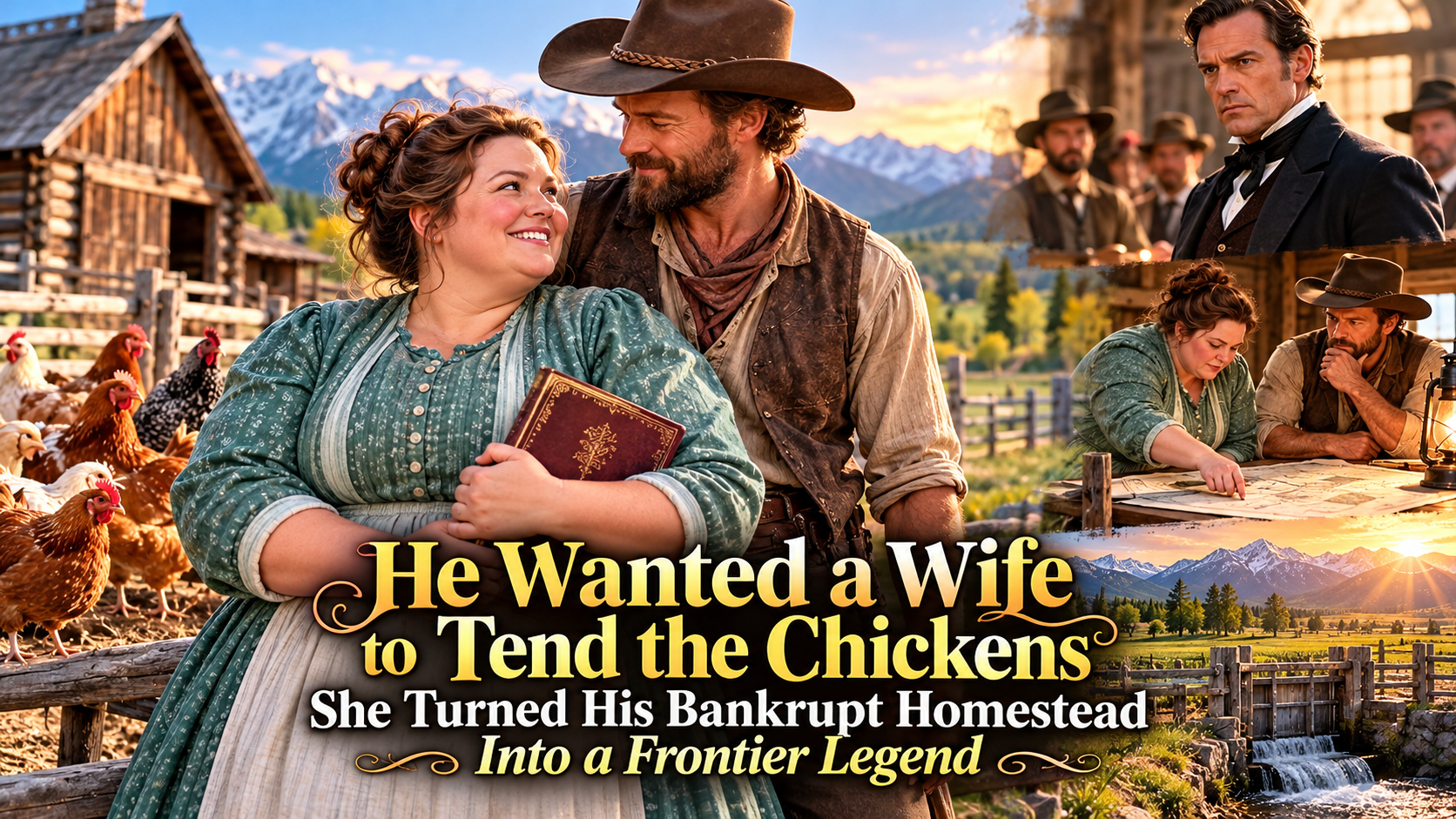
He Wanted a Wife to Tend the Chickens—She Turned His Bankrupt Homestead Into a Frontier Legend
Griffin Tucker had spent his entire life believing his father was an unlucky rancher.
By noon the following day, he would begin to suspect his father had been murdered.
The first clue came from the well.
Mattie insisted they inspect it before rebuilding the barn.
Griffin resisted.
“We need lumber. We need hay. We need money.”
“And you need to know why someone burned your barn to keep you away from a hole in the ground.”
He couldn’t argue with that.
They lowered a lantern into the shaft.
Twenty feet down, the stonework changed.
The upper section was rough and uneven.
Below it, the stones formed a precise circle, fitted together with extraordinary skill.
“Your father didn’t dig all of this,” Mattie said.
Griffin leaned over the opening.
“How can you tell?”
“Because this lower masonry predates the ranch.”
She removed a folded map from her ledger.
It showed the valley before Bitter Creek existed.
A narrow blue line ran directly beneath the Broken Spur.
An underground watercourse.
Griffin stared.
“There’s water beneath us?”
“More than water.”
Mattie pointed toward a handwritten notation.
“Your father discovered an old natural channel connecting the mountains to the valley. He believed it could supply irrigation to every farm for twenty miles.”
Griffin looked toward the dead creek bed.
“If that’s true, why didn’t he use it?”
“Because someone stopped him.”
The answer came sooner than either expected.
That afternoon, an elderly man appeared at the ranch gate.
He introduced himself as Amos Bell, a former railroad surveyor.
He was missing two fingers and walked with a cane.
“I heard Caldwell visited,” Amos said.
Mattie invited him inside.
The old man refused coffee.
Instead, he placed a rusted brass key on the table.
“Samuel Tucker gave me this the night before he died.”
Griffin’s throat tightened.
“My father died in a wagon accident.”
Amos looked away.
“That’s what Caldwell told everyone.”
Silence settled over the kitchen.
Then Amos explained.
Twenty-seven years earlier, Samuel Tucker and two surveyors had discovered that the valley’s water had been deliberately diverted into a concealed underground reservoir.
The diversion wasn’t natural.
Someone had constructed stone gates beneath the hills, redirecting the mountain runoff away from the small farms.
Why?
Because land without water became worthless.
And worthless land could be purchased for pennies.
Harrison Caldwell’s father had acquired thousands of acres that way.
When Samuel threatened to expose the scheme, his wagon overturned on a mountain road.
The horses survived.
Samuel did not.
“Why didn’t you tell anyone?” Griffin demanded.
Amos lowered his head.
“Because I was afraid.”
Mattie examined the key.
A seven-pointed star was engraved into its handle.
The same emblem as her ledger.
Griffin noticed.
“Mattie. How long have you known about this?”
She didn’t answer.
“How long?”
“Longer than you deserve.”
He stood abruptly.
“Did you marry me because of this ranch?”
Mattie’s expression changed.
“Griffin—”
“Answer me.”
She looked down.
“Yes.”
The word struck harder than any insult.
Griffin stepped away from her.
“So the advertisement. The train. The marriage. It was all a scheme?”
“No. The marriage is real.”
“But you came for the land.”
“I came because I believed something terrible had been done here.”
“And you couldn’t tell me?”
“I didn’t know whether I could trust you.”
Griffin laughed bitterly.
“You married a man you couldn’t trust.”
Mattie swallowed.
“People have done worse things for better reasons.”
He walked out.
For the first time since arriving, Mattie looked truly defeated.
But the valley gave them no time to settle their quarrel.
Three days later, Caldwell announced a public auction.
Not of the Broken Spur.
Of every small ranch along Bitter Creek.
The farmers were stunned.
Their mortgages had all been transferred to Caldwell’s private company.
Payments were suddenly due in full.
Families who had worked the land for generations faced eviction.
Mattie understood the pattern immediately.
Caldwell wasn’t trying to take one ranch.
He was trying to take the entire valley before anyone discovered the underground water.
She gathered the farmers at the church.
Some laughed when she entered.
Others whispered about the enormous mail-order bride who thought she could outsmart the richest man in Wyoming.
Mattie climbed onto the platform.
“How many of you have paid your debts and watched them grow anyway?”
Hands rose.
“How many have sold cattle at prices that never matched the market?”
More hands.
“How many have been told your land is worthless?”
Nearly everyone.
Mattie opened her ledger.
“Then listen carefully. Your land isn’t worthless. Someone has spent twenty-seven years making you believe it is.”
The room erupted.
By sunset, thirty-seven families had signed an agreement to challenge Caldwell’s claims.
Griffin watched from the doorway.
He still didn’t know whether he could forgive Mattie.
But he had never seen anyone make frightened people stand so tall.
That night, he approached her.
“If we find the reservoir, can we save the valley?”
“Possibly.”
“What do you need?”
“Men willing to dig. Women willing to organize. And someone brave enough to enter the old well.”
Griffin took the brass key.
“I’ll go.”
Mattie grabbed his wrist.
“No. There’s something you don’t know.”
He looked at her.
“What now?”
She opened the ledger to its final page.
There was a sketch of the underground chamber.
Beside it, written in Samuel Tucker’s handwriting, was a warning.
DO NOT OPEN THE EASTERN GATE.
BEHIND IT LIES WHAT CALDWELL FEARS MOST.
Griffin looked up.
“What does that mean?”
Mattie stared at the drawing.
“I don’t know.”
Then, from beneath the kitchen floor, came three slow knocks.
Both froze.
The knocks came again.
Someone was under the house.
And whoever it was knew they had found the map.