Beyond Appearance: The Extraordinary Story of Laxmi, the Indian Girl Once Called a “Divine Child”
When people first saw Laxmi, they did not always know what to make of her unusual appearance.
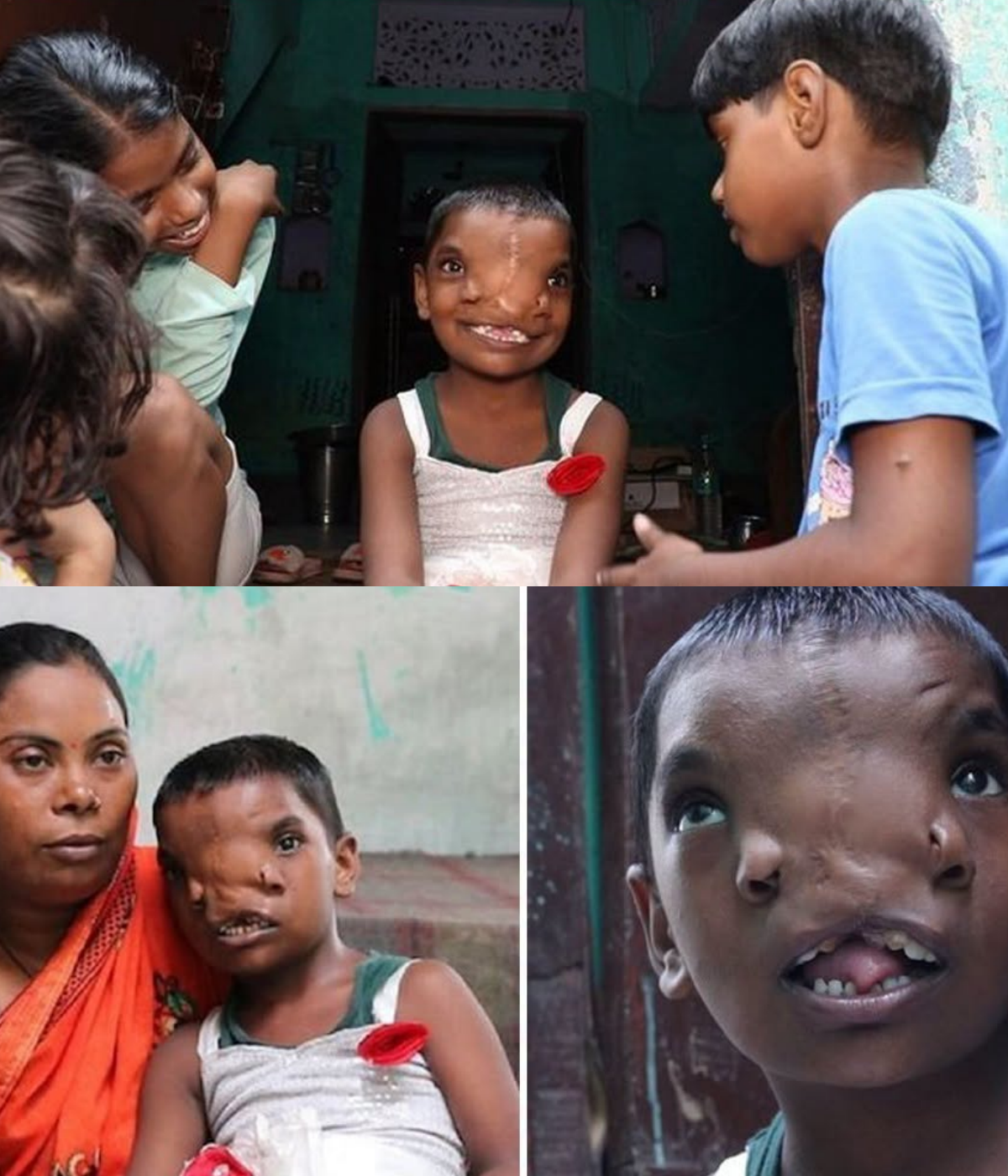
Born in Uttar Pradesh, India, Laxmi had an abnormal growth of tissue around the center of her face that dramatically altered the appearance of her nose. Some people compared the growth to an elephant’s trunk. Others saw something spiritual in her appearance.
But for her mother, Sarvesh, there was nothing mysterious about the child in front of her.
She was simply her daughter.
Laxmi’s story would eventually become one of medical treatment, family resilience and the complicated way society responds to children whose appearances are different from what people consider typical.
A Rare Facial Abnormality
Laxmi was born in Aligarh, Uttar Pradesh, with a prominent mass of tissue between her eyes and around her nose. Contemporary reports described the growth as resembling an elephant’s trunk, while photographs showed tissue that appeared to divide the nose into two parts.
The unusual appearance was not merely a cosmetic concern.
According to accounts from her family, the condition interfered with basic functions including eating and breathing. Her parents, Omprakash and Sarvesh, were a low-income family and initially faced significant difficulty obtaining specialized medical care for their daughter.
Doctors who examined the infant reportedly considered the abnormality a possible congenital or genetic developmental disorder and recommended further evaluation at the All India Institute of Medical Sciences in New Delhi.
The exact medical diagnosis has not been clearly established in the publicly available reports about Laxmi. It is therefore more accurate to describe her condition as a rare congenital facial/nasal abnormality rather than assigning a specific diagnosis without medical records.
Surgery at Just Eight Months Old
Laxmi eventually underwent surgery when she was approximately eight months old.
The procedure removed the excess tissue that had been affecting her face. However, the result did not immediately produce a conventionally shaped nose. Instead, her postoperative appearance gave the impression of having two separate noses. Her mother had reportedly been warned beforehand that doctors could not guarantee exactly how Laxmi’s face would look after the operation.
For the family, however, the most important issue was not whether Laxmi would look “normal.”
The priority was helping her breathe, eat and develop with fewer problems caused by the original abnormality.
The medical literature confirms that congenital abnormalities involving nasal development can be extremely rare. For example, a 2015 review of supernumerary nostrils identified only 33 reported cases in the literature at that time and explained that such abnormalities arise from disturbances during embryological development.
However, that scientific information should not be interpreted as proof that Laxmi specifically had a supernumerary nostril. Her publicly reported case was described more generally as an unusual facial growth, and the available reports do not provide enough clinical detail to establish a definitive diagnosis.
When Difference Became a Source of Fascination
As Laxmi grew older, something unexpected happened.
Instead of people simply being frightened or confused by her appearance, visitors began traveling from surrounding communities to see her.
Some believed that her face resembled the elephant-headed Hindu deity Ganesha, and they began regarding Laxmi as a special or blessed child. Reports said that visitors came to her home, brought money and gifts, and sometimes asked for her blessing.
For Laxmi’s family, this attention changed their circumstances.
Her mother reportedly described Laxmi as a blessing to the family and said that their lives had changed since her birth.
But the story also raises an important question about how children with visible differences are treated.
A child should not have to be regarded as supernatural in order to be treated with kindness.
From Medical Curiosity to a Child With a Life of Her Own
Laxmi’s appearance attracted attention because it was unusual. Yet behind the photographs and sensational descriptions was a young girl growing up like any other child.
By around seven years old, reports said that she was doing well and had relatively few problems related to her original condition. Doctors advised her family to wait until she was older before determining whether additional reconstructive or cosmetic surgery would be appropriate.
That approach is understandable in pediatric reconstructive medicine. A child’s face continues to grow and develop, and decisions about additional reconstruction can depend on anatomy, function, growth and the child’s own needs as they become older.
For Laxmi, the question was therefore not simply how to change her appearance.
It was how to give her the best opportunity to grow up healthy and confident.
A Mother Who Saw Her Daughter First
Perhaps the most moving part of Laxmi’s story is her mother’s perspective.
While strangers saw an extraordinary face, a medical curiosity or even a religious symbol, Sarvesh saw something much simpler:
her child.
That distinction matters.
Children born with visible differences can experience staring, unwanted attention, social isolation and assumptions about their abilities. When adults respond to difference with curiosity rather than judgment—and teach children to do the same—the social environment around a child can become much more accepting.
Laxmi’s story demonstrates how quickly society can attach meaning to physical appearance. Some people saw something frightening. Others saw something sacred. But neither reaction necessarily tells us who the child herself is.
The Difference Between Seeing and Understanding
Laxmi’s face became the reason people traveled to see her, but her identity was never limited to her appearance.
She was a daughter.
She was a child.
She was growing up within a family that had supported her through medical uncertainty and surgery.
And she was learning to live with a face that made her instantly recognizable to strangers.
Her story also highlights why responsible reporting matters. Terms such as “elephant girl” may attract attention, but they can reduce a real child to a physical characteristic. Describing the medical condition carefully and respectfully allows readers to understand the challenge without turning the child into an object of spectacle.
A Story About Compassion
Laxmi’s journey began with a rare congenital abnormality that affected essential functions such as eating and breathing. Surgery at an early age helped address the problematic tissue, while her family continued to navigate questions about her appearance and future treatment.
What happened afterward was less predictable.
Her unusual appearance attracted religious interpretations, visitors and gifts. But beneath all of that attention remained an ordinary human need: to be accepted, cared for and allowed to grow.
Laxmi’s story ultimately asks us to look beyond the first thing we notice.
A child’s face may be unusual. Their life is not.
And perhaps the greatest lesson is the one her mother seemed to understand from the beginning: before strangers saw a symbol, a curiosity or something “divine,” there was simply a little girl who deserved to be loved.
Sources
- Born Different — “The Girl With Two Noses”: contemporary account of Laxmi’s surgery at eight months, her condition and her family’s experience as she grew older.
- Wilderness Films India — “Baby Ganesh: Girl With an Elephant Trunk”: background on Laxmi’s birth in Aligarh, Uttar Pradesh, the facial growth, reported difficulties with breathing and eating, and the community’s religious interpretation of her appearance.
- SAGE / Plastic Surgery Case Studies — “Supernumerary Nostril: Report of a Rare Case and a Review of the Literature”: medical background on the rarity and embryological development of supernumerary nostrils.
Editorial note: Publicly available accounts of Laxmi’s case are limited and sometimes use sensational descriptions. The available evidence does not establish a definitive clinical diagnosis for her condition, so this article avoids presenting a specific diagnosis as fact.